
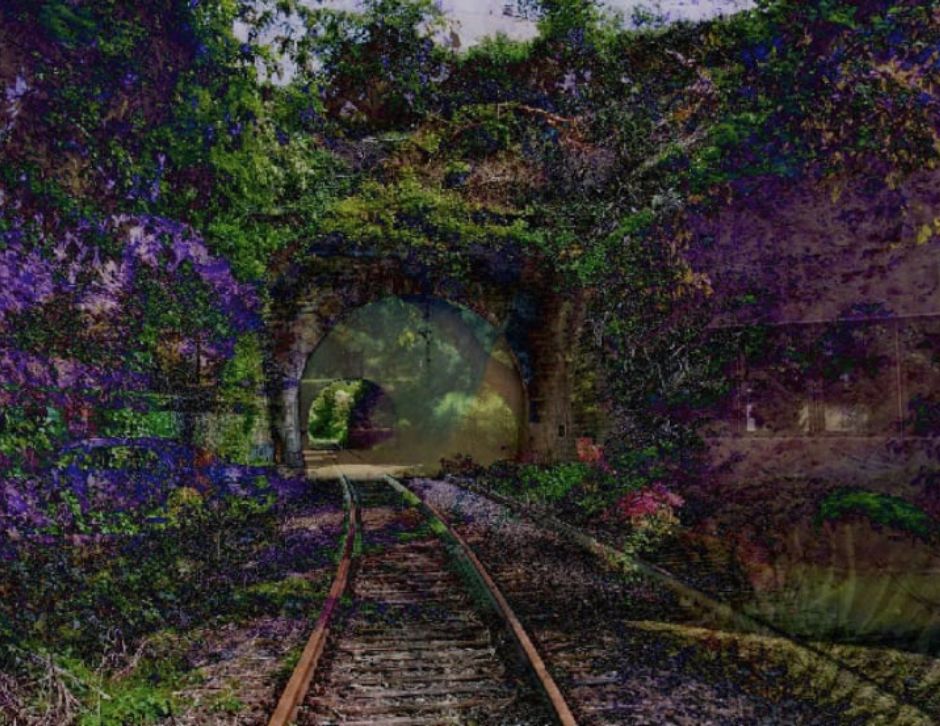
On March 18, 2025, the United States Court of Appeals for the District of Columbia denied Dr. Stephen Thaler’s application to register A Recent Entrance to Paradise, a work purportedly authored by a machine. This address was followed by the entire creative industry with interest.
When the court ruled that human authorship remains a ‘bedrock requirement’ of U.S. copyright law, it became the first U.S. court to address the copyrightability of AI-generated art. This judgment was a win for the entire creative industry, which sought to uphold the longstanding principle that works by non-human authors do not attract copyright protection. Further, this is a big disappointment to the people who hoped to do the bare minimum to sell art generated by a machine.
The case started when inventor Dr. Stephen Thaler filed a copyright application with the U.S. Copyright Office (USCO) in 2018 for a work entitled A Recent Entrance to Paradise (Paradise). He listed it as “autonomously created by a computer algorithm running on a machine.” Thaler named himself as the ‘Copyright Claimant‘ who was ‘seeking to register this computer-generated work [Paradise] as a work-for-hire to the owner of the Creativity Machine.’ But USCO rejected his application and then the Copyright Review Board rejected his two consideration requests.
However, Thaler was sure to get the copyright title for his synthetic art so he filed a suit against the USCO under the Administrative Procedure Act, 5 U.S.C. § 704, which provides for judicial review of agency actions like the USCO denial (see para. 6). Then, in August 2023, the lower court ruled against Thaler. Because Thaler represented in his registration application that he did not do anything to generate art except play a ‘controlling role in generating the work,’ the lower court held that the image doesn’t satisfy the human authorship requirement (see p. 13).
In October 2023, Thaler appealed the lower court decision, and followed an oral argument on September 19, 2024 before a D.C. Circuit panel. On March 18, 2025, the Appellate Court issued its 24-page Opinion.
The judgment was clear; human authorship is not just a tradition of copyright law—it is a legal necessity embedded in its very foundation. The court further detailed numerous sections of the Copyright Act that if ‘machine’ is substituted for ‘author,’ the Copyright Act would refer to a machine’s “children,” 17 U.S.C. § 203(a)(2), a machine’s “widow,” id., a machine’s “domicile,” id. § 104(a), a machine’s mens rea, id. § 101, and a machine’s “nationality,” id. Problematic questions would arise about a machine’s “life” and “death[.]” Id. §302(a). And “machine” would inconsistently mean both an author and a tool used by authors. Hence an author by all means must be a human being.
The court did not agree with Thaler’s assertion that he authored the image by using any creativity machine. On May 2, 2025, Thaler filed a petition again to cite his case as “an ideal vehicle for the Court to address whether the Copyright Office’s test is permissible under the Copyright Act” (see p. 22 of the Petition). The Petition states that “[r]efusing to register copyright in an AI-generated work is in direct contradiction of the plain language of the Copyright Act… It also frustrates the Act’s purpose, creates uncertainty, chills creativity, and it is already casting a shadow over the AI and creative industries.”
The AI-assisted works can be protected under current regulations if sufficient human creativity and authorship are demonstrated. The range goes from fully human-authored works, which are copyrightable, to entirely AI-generated works, such as “Paradise,” which are not. Some works may fall in between, like “A Single Piece of American Cheese.” As more applications are filed and litigated, case law will further clarify the limits of human authorship and copyright in the age of AI.
Featured Image: A Recent Entrance to Paradise by Dr. Stephen Thaler, Generated by AI; U.S. Copyright Office.
Related Reads.


