
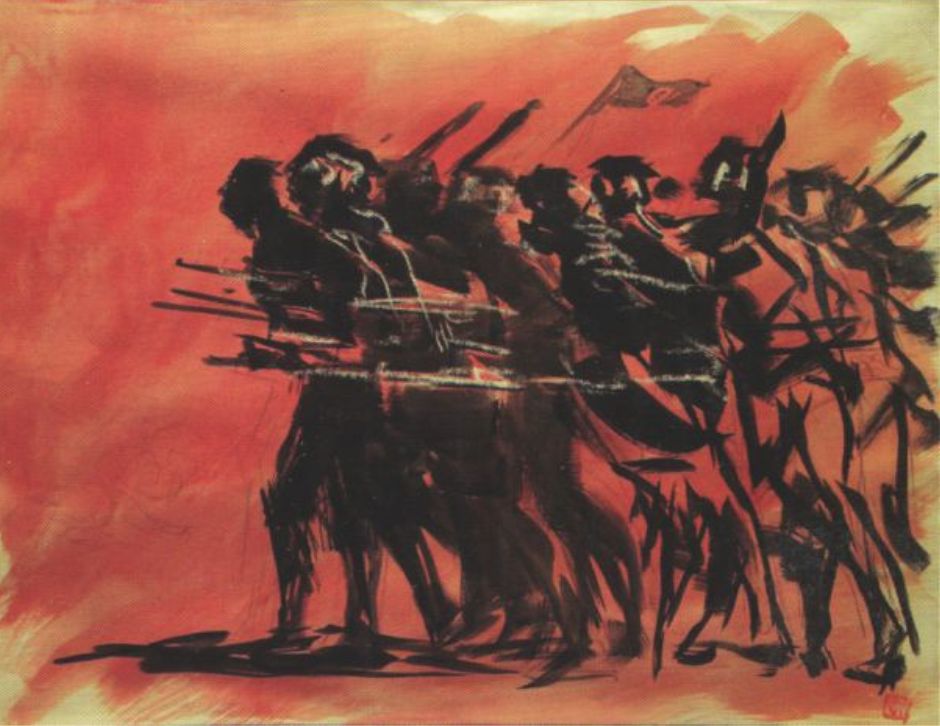
Months after the collapse of Sheikh Hasina’s government in Bangladesh, there have been ambiguous views on the country’s creative freedom. While some perceived it as an opportunity to dramatize the look of Dhaka streets to celebrate the downfall of then-Prime Minister Sheikh Hasina, a few canvases portray the pain of the aftermath.
When the Student protest occurred in Bangladesh last year, there were thousands of murals painted over the street walls to celebrate their creative freedom in response to the 15-year-old reign of Sheikh Hasina that was long criticized for its crackdown on press freedom and free speech. Art has consistently served as a powerful medium for advocating social justice, which is evident in the vibrant movements of Bengal and France. In contrast, Bangladesh faces significant challenges due to ongoing terrorism and economic instability, which pose serious threats to its minority citizens. Nevertheless, this turbulent environment also presents critical opportunities for artists to emerge and let their voices be heard in either way.
Bangladesh has always been an important artistic hub for its quality of art. It started through the remarkable step of the Modernist painter Zainul Abedin who founded an art school in Dhaka, further producing generations of fine artists. Recently, though August’s protest revealed that few artists found themselves restrained in terms of expression, there were several exhibitions and cultural programs that let several artists prosper during Hasina’s reign. For instance, the 19th Asian Art Biennale in Bangladesh showcased 893 artists in 2022. Another fair exhibition was ‘A Retrospective 1973-2023’ in 2023 which gave a tribute to famous and award-winning artist, Shahabuddin Ahmed. For a country that gained its independence from Pakistan a few decades ago, selling art with such promising opportunities is a privilege in itself.
Present Scenario.
The artist-curator Amirul Rajiv says that independent artists have suffered for the past 15 years. And it is only now that in the aftermath of the monsoon revolution, the Bangladeshi art scene got its creative freedom. One of the books that instituted wall art at this time was Paint the Sky, which shows murals referring to communal harmony and emotional growth. It is ironic that though the majority of the population doesn’t believe in these terms, how artistically street artists conveyed these emotions over the walls. Furthermore, the delusion begins at the moment when one sees that in a country where the majority of the population is Islamic and ready to oppose other religious movements, it is as if Hasina held a leash like various rules we have seen before but not to restrict the creativity instead to forbid its movement to its root country, Pakistan.
Though there is a celebration for the end of Hasina’s reign, which is well represented in cartoons and art of the present times, there are some deeply disturbing artworks that represent the oppression of minorities. The present artists impart that Hasina’s government managed to silence Bangladeshi cartoonists through the principle of persuading, purchasing, punishing, and exploiting the weakness. In 2020, one of the celebrated cartoonists Ahmed Kabir Kishore died during the ten-month detention after he was prosecuted under the Digital Security Act. As per the Digital Security Act, of 2018, one can’t publish “critical information infrastructure” which means any external or virtual information infrastructure declared by the Government that controls, processes, circulates, or preserves any information-data or electronic information and, if damaged or critically affected, may adversely affect (i) public safety or financial security or public health, (ii) national security or national integrity or sovereignty.
To sane minds, the Digital Security Act, though controversial, was the right decision if seen on the prospect of national integrity. If these cartoons or political fragility become widespread, they might behave as sweet treats of instability in Bangladesh for Afghanistan and Pakistan. Further, if press freedom brings the attention of discussing a country’s weakness, then it is absolutely right for politics to do its duties. But it does challenge the minds of artists.
Related Reads.


