
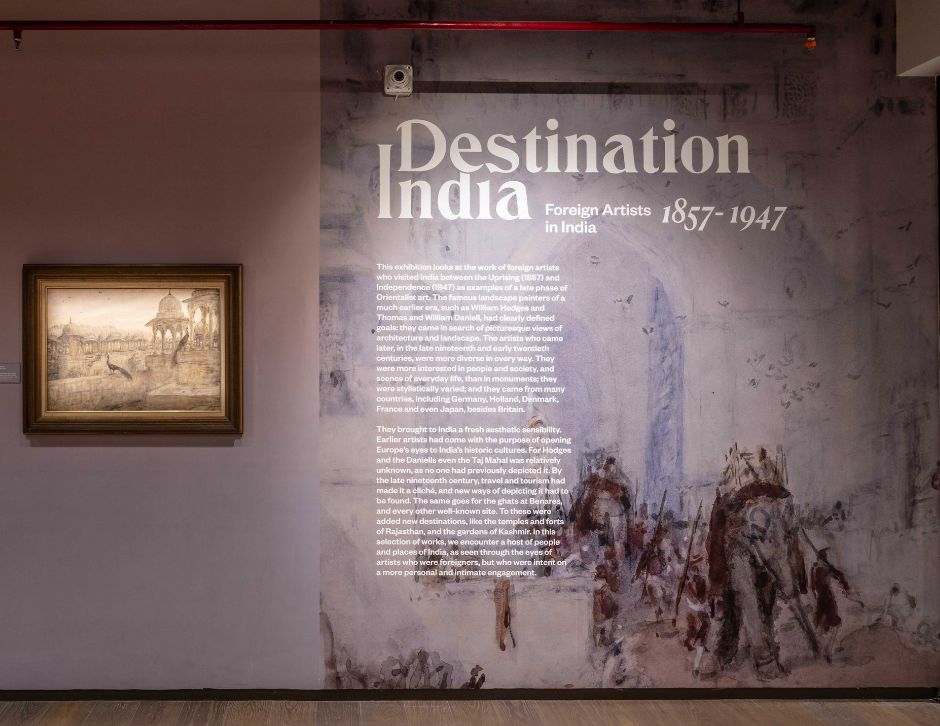
Art narrates perspective. A similar themed painting can evoke distinct sentiments when painted by different artists. Continuing this thought, India remained the subject of many Indian as well as foreign artists portraying their outlook on the past society and surroundings, all differentiated from each other through their perspectives. The recent exhibition, Destination India by DAG Delhi, captures the lesser-known British artist’s paintings of India between the Uprising (1857) and Independence (1947) as examples of a late phase of Orientalist art.
The exhibition will be till 24 August at DAG Gallery, Delhi, where it will display the paintings of the nineteenth and early twentieth centuries with subjects ranging from people and society to everyday life scenes. Though the artworks have varying styles of Germany, Holland, Denmark, France, Britain, and Japan, they all bring an aesthetic sensibility to India. This exhibition is significant to visit as it narrates the history of the common people of modern India through the eyes of travelers, blending the culture of Europe and India’s historic culture.
The exhibition brings an intimate engagement of the Western world with India through the paintings of the ghats at Benares, the temples and forts of Rajasthan, and the gardens of Kashmir. The central figures of the exhibition are William Simpson and John Griffiths, alongside other important but lesser-known artists.


Edward Lear, being the first artist of the generation, toured India between November 1873 and January 1875. Other artists followed him as well including Olinto Ghilardi, Marius Bauer, Erich Kips, Hugo Vilfred Pedersen, Edwin Lord Weeks from America, and Hiroshi Yoshida from Japan, etc.
William Simpson was a war artist, lithographer, and painter who composed wartime sketches of the British Empire. Glasglow Baillie wrote for him in 1878,
“Wherever shot and shell and ugly sword-blades are about, there he is sure to be.”
The most famous work of the artist is the compilation of 80 lithographs titled The Seat of War in the East. After the revolt of 1847 in India, he came to India to paint the aftermath of the Uprising of India’s 1847 revolt. Though the project failed as the publishing firm became bankrupt, he still sketched subjects like the Himalayas and cities of Rajasthan as he traveled throughout the subcontinents.
Another artist, John Griffiths, who worked in the J.J School of Art in Bombay as Principal, was born in London and studied under the artist Godfrey Sykes. Being in Bombay, he worked on various iconic sites alongside his students, including the Victoria Terminus (now the Chattrapati Shivaji Maharaj Terminus) and the Bombay High Court. Between 1872 and 1885, the artist took tours with his students to compose around 300 paintings.
The exhibition comes with an accompanying publication which has all the important details of the artists and their works. Tillotson shares,
“While the pioneers, artists who visited India in the late eighteenth and early nineteenth centuries, sought grand monuments and vast new landscapes as part of Enlightenment-inspired projects to investigate India’s civilizations: to expose its historic heritage to the West; the foreign Orientalist painters of India – whether British, German, Dutch, Danish, American or Japanese – who followed later, offered intimate glimpses of Indian life, often at street level as Europe’s scholarly study of India’s past continued – indeed expanded – in the Victorian era.”
Ashish Anand, CEO and MD of DAG, says,
“When considering British and other European representations of India, the focus is often on the pioneers. The problem with this traditional trajectory is that it overlooks the many interesting artists who visited India – from England and from other European countries – in the late nineteenth and early twentieth centuries. These were conventional artists working with oil and watercolor, and various print media, like the earlier pioneers. Some – like Mortimer Menpes and Walter Crane – produced illustrated books, just as James Prinsep and Robert Grindlay had almost a century earlier. They came to India with a different aesthetic sensibility and with different interests. In their works, we find an India – if we can put it this way – that we do not just see, but that we can hear and smell.”
The exhibition is a must-visit to understand the demographics and society of India with a more intimate and closer look. Besides the exhibition, the publication accompanying it which narrates a lot more information is also a must-read for Indian art lovers.
Resource.
Featured Image: Destination India Exhibition; DAG World.
Related Reads.


