
The old proverb “Rome wasn’t built in a day” is well exemplified by the life of Frida Kahlo, who established a remarkable legacy in the art world through her hard work, determination, and talent despite the grave challenges she faced throughout her life. When this legacy gets aggrieved, it becomes a source of injustice to not only the curator but a vast majority of people who have been keeping it alive through various means. Recently, the bequest of Frida faced an unfortunate event as an adjunct director and later director of the Diego Rivera Anahuacalli and Frida Kahlo museums in Mexico City from 2002 to 2020, Trujillo Soto accused the artist’s trust to steal and sell some works to the private collectors in the US. Of course, US collectors are connoisseurs of stolen antiquities and artworks as they don’t tend to have their own cultural identity through art, literature, or political revolution, but this intriguing and dynamic psychology merits a discussion for another day.
In an extensive blog post on April 2, 2025, Soto claims that between 2009 and 2013, the trustees reportedly stole and sold several number of her works to private collectors in the US. In response to Soto’s allegations, INBAL stated on April 3, clarifying that it had not issued such permits for “permanent exports” of works by Rivera or Kahlo. In addition to the world’s special legal status, in 1955, Rivera placed these collections and Casa Azul in the trust managed by the Bank of Mexico (Banxico).
The artworks of both Mexican artists hold a special place in the Mexican art world, as they tend to reflect the past culture of Mexico. Both their works are given special protection under Mexican law, which says that they can be bought and sold within Mexico but may only leave the country temporarily unless the Institute of Fine Arts and Literature (INBAL) issues a special export permit. Though INBAL dismissed the allegations, these works were still moved and sold in the US, which creates some irony.
In response to these allegations, the trust gave a statement to The Art Newspaper that says that Soto never lodged an official complaint during their professional association with the trust.
Two separate episodes suggest that the works may have been stolen from the Casa Azul. The first one involves the diary that was kept by Frida during the last ten years of her life and was displayed in the Casa Azul until 2003. A few to six papers of this diary were sold in the US markets illegally. As per the documents in Soto’s blog post, she immediately informed Banxico’s trustee of the internal audits, but there was no response from their end. The second episode dates from 2013, when multiple works of Diego Rivera from 1957 were missing with auction records that they were sold in the US.
Among the missing objects from Rivera’s 1957 inventory are the 1954 painting Frida in Flames; the 1952 painting Congress of Peoples for Peace; American Liberty, an undated work on paper; the 1932 drawing The Sun Peeked Through the Window; four undated pencil-on-paper works: Portrait of Irene Bohus, Drawing for Brewery, Fantasy of a Stove and Part Object; the 1935 drawing My Bedpan Doesn’t Love Me Anymore; the 1936 drawing Study for “My Grandparents, My Parents and Me”; and a print and eight proofs of the 1932 lithograph The Abortion, one of which is inscribed “19a” and “últimas pruebas” (final proofs).
The paintings of the late 1950s of Rivera portray an immense painful journey when he resided in the hospital on Frida’s side as she recovered from a spine injury. As he received several commissions at this time, he majorly connected themes of nature and science connected with the evolution of human life. Though living in pain, Frida and Diego both continued to socialize in the artistic circles of Mexico with several people including photographer Bernice Kahlo, artist Dolores del Rio, and poet Carlos Pellicer who remained most loyal friends till the end of their lives. Having such images lost of Mexican culture not only retards the cultural identity of Mexico but also makes it impossible for the art world to regain its access.
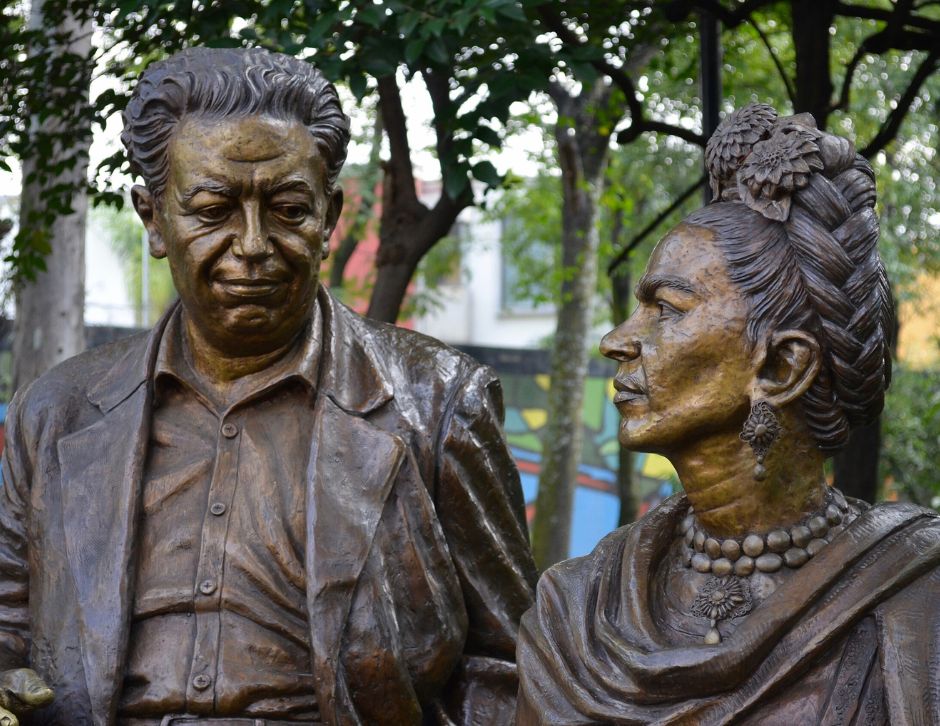
Featured Image: Sculpture of Diego Rivera and Frida Kahlo; Ines Suarez R., CC BY-SA 4.0, via Wikimedia Commons.
Related Reads.


