
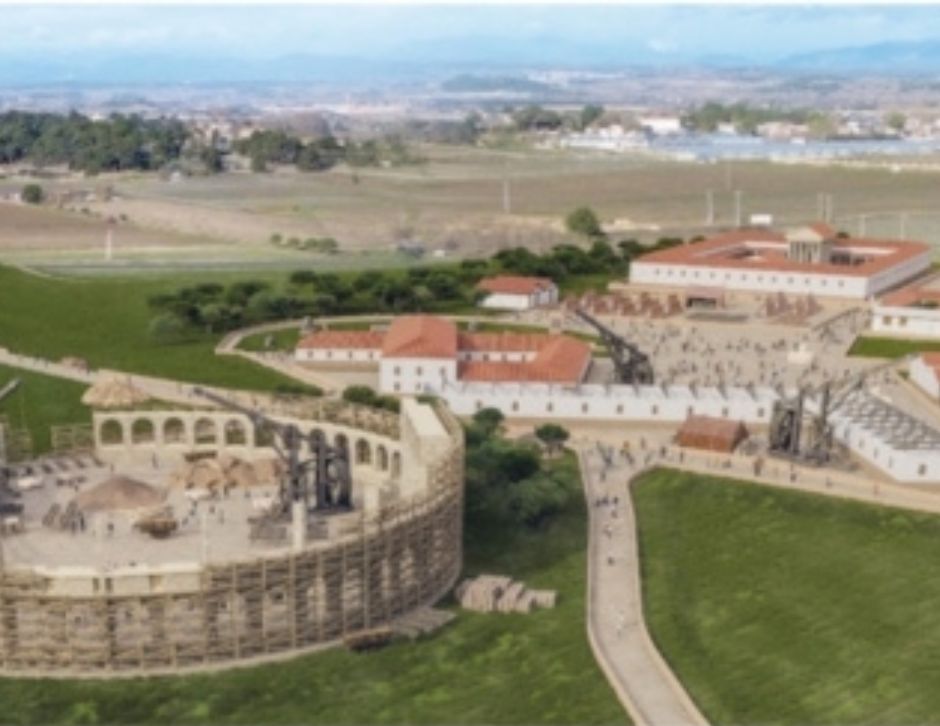
One of the most ambitious historical reconstruction projects in experimental archaeology will take place in the city of Beziers, a town of 80,000 inhabitants located near Montpellier. Being a living cultural site open to the public, the Beziers Antiques will be built on an area of nineteen hectares, where the significant elements of the Roman Beziers during the period of the so-called High Empire, between 27 B.C.C. and 235 A.D., will be used.
Following the public call for bids, the company Kléber Rossillon has won the bidding, which will allow the company to be in charge of its construction and management for at least 30 years from its opening, scheduled for April 2027. For this period, the visitors will be able to witness and participate in the birth of an ancient city. Unique in France, this project combines historical reconstruction with living crafts and a large-scale tourist ambition.
The Kléber Rossillon company has been active for nearly 30 years, working in the field of cultural heritage enhancement. Founded in 1995 with the opening of the Marqueyssac Gardens in Dordogne, it now manages twelve cultural and tourist sites in France and Belgium, including castles, museums, replicas of prehistoric caves, historic trains, and historic gardens. Welcoming around 2.5 million visitors each year through developing its projects on the basis of respect for the sites, the firm is consistent with providing the relevant economic and cultural benefits to the state.
The most significant aspect of the project is its configuration as an evolving construction site where it will witness the emergence of a reconstructed Roman city. However, this is not an absolute first city, as in Italy, a reconstruction of a small medieval town, much smaller in size, took place back in 1884, but it was one of the most ambitious projects of its kind.
The site plan will be accessed through the historic Via Domitia, the main road artery that connected Italy with the Iberian Peninsula. On the entry, the visitor will first pass through the agricultural area cultivated according to traditional practices. The fields will be devoted to crops, like cereals, vines, olives, and fruit trees. This agricultural strip will serve as a sensory introduction to the urban site, resulting in the landscape recomposition to evoke the morphology of the ancient land.
Once inside this site, the public will then be able to explore various urban environments reconstructed like the different spaces and buildings, some under construction, others completed; an amphitheater, a necropolis, an imperial forum, a tavern, town houses decorated with frescoes and mosaics, a domus, a ludus (gladiator school), craft workshops. The visitor will also discover the materials used and their manufacturing techniques, such as stone blocks, brick, cob, tiles, and Roman concrete.
The construction phases will be carried out with the tools and methods of antiquity. Some of the other ancient techniques, like Wooden scaffolding and craft techniques, will also be visible in this cultural site. Further, it will host a rich program of events, including performances and animations designed to make the visit dynamic and attractive to different audiences.
The president of the company, Geneviève Rossillon, states,
“We take visitors on a journey through time.”
One of the distinctive elements of this project is its scientific approach, which the project promoters made known. Headed by Éric Teyssier, the professor of Roman history at the University of Nimes, the activities on the site are conducted with a dedicated scientific board. Further, the board will be composed of the specialists at the local and national levels to work closely with the archaeological service of the city of Beziers.
For Beziers Antique, the outlook is ambitious as it aims to reach 250,00 annual visitors by 2032. Over the 30 years of public openings, the site will evolve historically while grasping scientific knowledge.
Featured Image: Kléber Rossillon.
Related Reads.


