
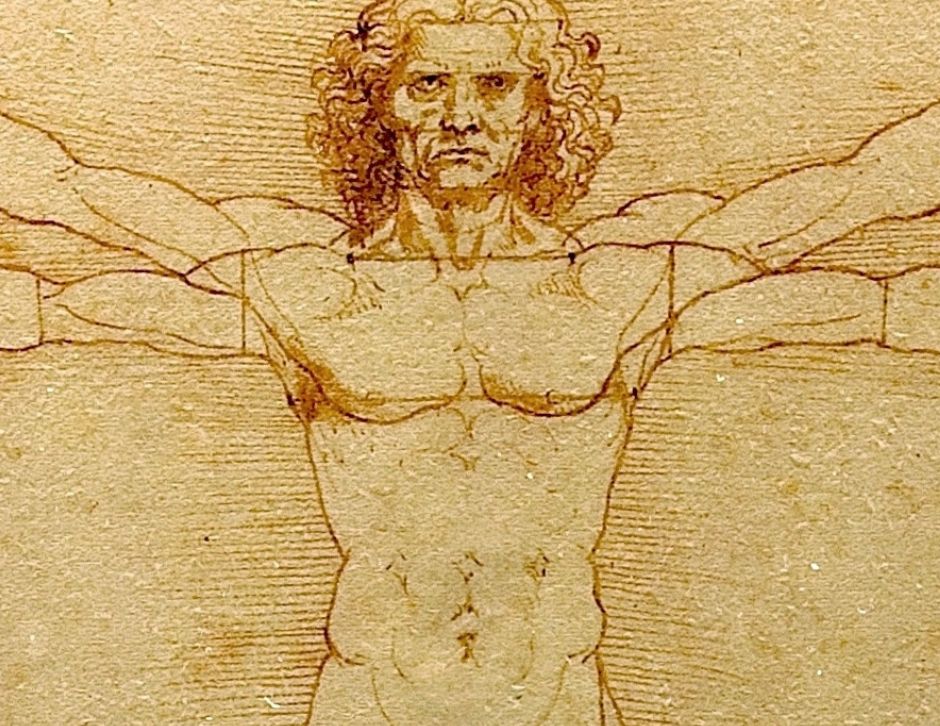
The Vitruvian Man is about the mesmerising unification of the cosmos with the earth through a human body. But it surely hides more mysteries that are yet to be uncovered. Last month, a London-based dentist gave a new insight into the work, which might reveal how Leonardo’s geniuses was centuries ahead of modern science.
The Vitruvian Man is a work inspired by the writings of the ancient Roman architect, Vitruvius, that Leonardo composed in his late 30s. It was the time when the artist was part of Ludovico’s Court of Milan in a collaboration circle of architects and engineers, which included Giacomo Andrea. After Leonardo and Francesco returned from their trip to Pavia, a dinner was held, where the manuscript of Vitruvius was discussed. This was the first time when the spark of the drawing of the Vitruvian Man was generated in Leonardo’s mind, which later resulted in one of the most iconic and intelligent sketches of the time.
The Vitruvian Man portrays human anatomy through a man in a square and a circle. The elegant sketch has the principles of art, mathematics, anatomy, philosophy, and architecture, further exemplifying the multidisciplinary approach that made him the ultimate Renaissance man.

A recent analysis of the picture by Dr Rory Mac Sweeney gave an entirely new perspective on the composition. He believed that the unique drawing “incorporates geometric principles that anticipate modern understanding of optimal biological architecture.” Published in the Journal of Mathematics and Arts, the paper focuses on a third shape in the drawings. It portrays an equilateral triangle that is hiding in plain sight between the man’s parted legs. This shape is referred to by the artist in the accompanying text.
According to Sweeney, this equilateral triangle is Bonwill’s triangle which is formed by the contact point of the mandibular central incisors and the right and left mandibular condyles. The principle of modern medicine that was established in 1864 by dentist William Bonwill explains how the human jaw functions optimally. In much the same way, Leonardo used this triangle to relate “the figure’s static positioning to its dynamic capability,” Sweeney explained in his paper.

He also explained,
“The square contains the figure in static cruciform pose—arms horizontal and legs together—while the circle encompasses the figure with arms raised and legs spread to form the equilateral triangle.”
He further added,
“This geometric relationship between static form and dynamic potential mirrors the structural-functional relationships that govern optimal craniofacial architecture.”
As such, Leonardo’s geometric insights showed the modern dental architecture studies, whose structural principle wasn’t formally recognized until the 20th century.
This finding clearly demonstrates a remarkable geometric relationship that Sweeney asserts Leonardo intuitively grasped ahead of his time. By replicating the equilateral triangle located between the figure’s legs in the *Vitruvian Man* six times around his navel, a hexagonal pattern emerges. This precise arrangement reflects a ratio of approximately 1.64—recognized as a tetrahedral ratio—between the side of the square and the radius of the circle.
The approximation of the tetrahedral ratio is essential. As Sweeney points out, this ratio is a mathematical relationship that determines the optimal spatial arrangements in both synthetic and biological systems.
“Leonardo’s geometric construction successfully encoded fundamental spatial relationships in human form, demonstrating the remarkable precision of his Renaissance vision of mathematical unity between the human figure and natural order,” concluded Sweeney.
“Vitruvian Man stands as a testament to Leonardo’s insight that human proportions reflect deeper mathematical principles governing optimal spatial organization.”
Featured Image: The Vitruvian Man by Leonardo da Vinci; Leonardo da Vinci, Public domain, via Wikimedia Commons.
Related Reads.


