
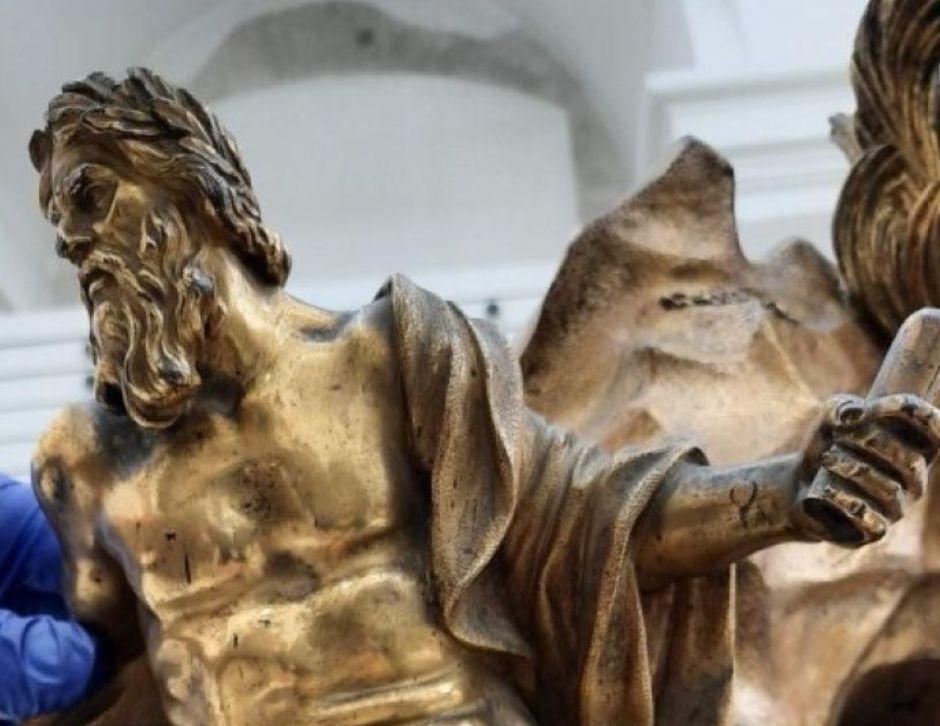
Having a long belief that any looted item from a particular country must be returned to its original owner, the museums still struggle to gain ownership of the artifacts that are significant to their history. Take the reference of the allegorical sculpture, the figure of personification of the Ganges, a part of the model ‘Fountain of the Four Rivers’ by the sculptor Gian Lorenzo Bernini, which has been long looted and kept by Royal Collections. It is the first time that any piece has been recovered by the Patrimonio Nacional.
The Patrimonio Nacional won the court ruling on the protection of the Spanish heritage through a technical report. The story started when the allegorical sculpture, located in November 2021 was going to be auctioned at the La Suite Subastas in Barcelona under the name of Vulcano. Being described as an independent piece made of mercury-gilded bronze and belonging to an Italian school, the auction house calculated its estimated value between 2000 and 2400 euros. Then on November 24, 2021, the Ministry of Culture and Sports declared the work as unexportable after the Spanish Historical Heritage Law, following which the piece was withdrawn from the auction.
At the same time, the Historical Heritage Brigade of the National Police started investigating the route of Bernini’s Ganges. Since the work was purchased from an individual by a company, and then went to an antique dealer, finally ending at the Barcelona auction house, no documentation supported its origin. Hence, it was requested to transfer to the Royal Palace of Madrid by the Barcelona Court to determine its origin.
There were two technical reports made; one by the Royal Palace of Madrid where they verified that the figure fit like a glove to the original model by Gian Lorenzo Bernini and that it carried a similar metal composition as the ‘Fountain of the Four Rivers’ and other by Patrimonio Nacional which compiled extensive documentation demonstrating the historical connection between both pieces- the auction house figure and the Fountain of the Four Rivers model.
The model shows a fountain with the obelisk in Piazza Navona in Rome with cast and gilded bronze sculpted by Bernini between 1651 and 1665. Depicting the four major rivers the Nile in Africa, the River Plate in America, the Danube in Europe, and the Ganges in Asia, this model also consists of allegorical figures that later disappeared without any records. Bernini made several models of the fountain and one of them was cast in silver for a relative of Pope Innocent X.
In 1668, Cosimo de Medici mentioned that the piece was a decorative piece in the office of Charles II. After being saved from the Alcazar fire in 1734, the sculpture was kept in the Royal Palace for its restoration as per the 1773 inventory preserved in the General Archive of the Palace.
Following the technical report, the Patrimonio Nacional filed a lawsuit to claim the belonging of the Bernini’s piece to the Royal Collection, arguing that “the inalienable, non-seizable and imprescriptible nature of these assets prevents their legal alienation”, as stated in Law 23/1982 regulating National Heritage. This led the Court to declare that the work was an indivisible part as a whole and that the company must deliver the figure to the institution. This way, the artifact and the entire model belong to Patrimonio Nacional Spain.
Resource.
Featured Image: Bronze Ganges Sculpture by Bernini; Patrimonio Nacional.
Related Reads.


