
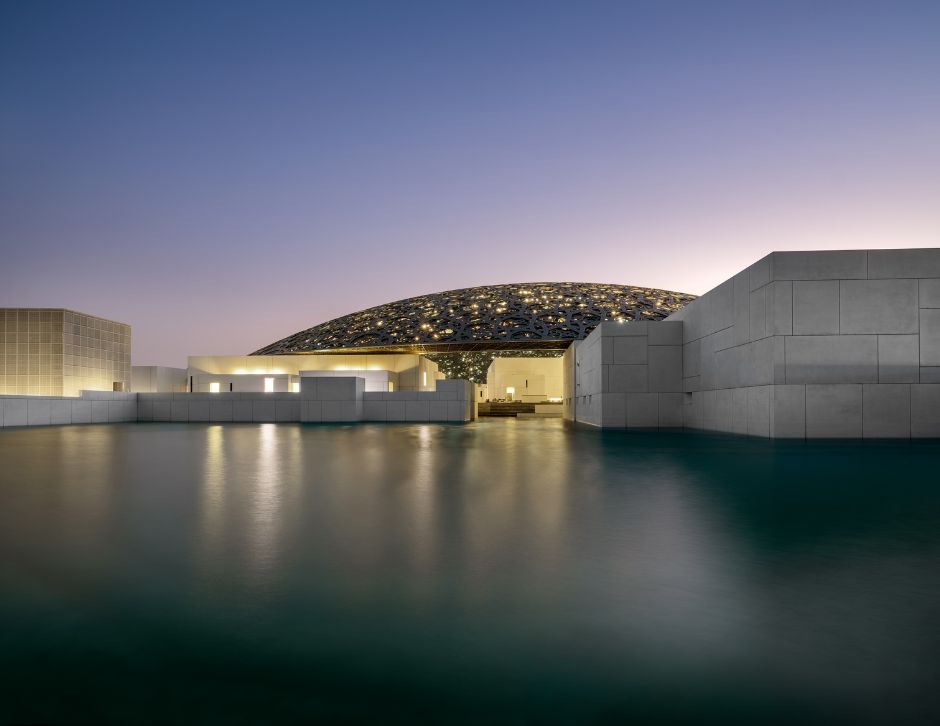
Summer prepares Louvre Abu Dhabi to undergo a subtle shift. This year, new loans and acquisitions expanded and enriched the universal narrative of the museum’s collection, but they did not disrupt the museum’s focus. While there are changes in the museum’s galleries year-round, this summer features a shuffling of the collection. Guilhem Andre, director of the scientific, curatorial, and collections management said,
“We refresh our new loans from partnering institutions and rotate our collections as well.”
This year, the museum focused on the additional range of objects, like a delicate Roman cameo, a Gabonese reliquary figure, several artworks by Russian painter Wassily Kandinsky, Swiss sculptor Alberto Giacometti, and Catalan artist Antoni Tapies. Among the most important collections, the Menhir statue stands apart. Dating back to 3000 BC, it stands small beside the towering image of Egyptian pharaoh Ramesses II, but is equally intriguing.
The Menhir statue has a triangular face with its arms etched flat across the body and legs marked by two straight lines. The features of the statue are minimal, but they suggest an outline of a person, which is important. This statue is on loan from the National Archaeological Museum in Saint-Germain-en-Laye.
Another significant item, which is a highlighted acquisition by the Museum is a decorative Roman cameo that is carved in layered stone no bigger than a palm displaying a young man. Regarded as Agrippa Postumus, the grandson and adopted heir of Emperor Augustus, founder of the Roman Empire, this cameo is a sign of imperial loyalty.
Nearby in this collection, the lustreware dish sits, which was produced in the works of Manises, near Valencia in the 15th century. Being a diplomatic gift to the French royal family, this piece is famous and striking for its shimmer which was achieved through the metallic oxides that were a technical marvel of the time.
Another notable addition is the Una Bulaquena by Juan Luna on loan from the National Museum of the Philippines.The painting is regarded as a Filipino national treasure and its arrival at Louvre Abu Dhabi marks the first time the work has left the country. Depicting a young Filipina woman poised, this work is composed in traditional attire with a handkerchief in one hand and an ivory fan in the other. Being an introspective work, this painting hangs between two other masterpieces from the same era- Auguste Renoir’s La Tasse de Chocolat (Cup of Chocolate) and Edouard Manet’s The Bohemian.
Several other additions to the collection include a limestone Head of an Ephede from the 5th Century BC and a Kota Reliquary Figure from the 19th century Gabon, which is displayed near artefacts tied to burial and remembrance.
One of the historically charged loans is the Sarcophagus of Livia Primitiva, circa 250 AD, considered one of the earliest-known examples of Christian funerary art. Other acquisitions include a trio of portraits and scenes that span styles and centuries. Some of them are The Rialto Bridge from the South (circa 1720) by Giovanni Antonio Canal, Charles Meynier’s The Farewell of Telemachus and Eucharis (1800), and Portrait of Kosa Pan (1686) by Antoine Benoist who depicted the first Siamese ambassador to the court of louis XIV.
Several other items that include this collection are Giacometti’s Femme de Venise V (1956), Germaine Richier’s L’Orage (1947–48), White Oval by Kandinsky, and Tapies’s Grand blanc horizontal (1962).
The entire collection presents a fascinating parallel in how the works demonstrate mark-making and a timeless desire to leave a lasting impact.
Featured Image: Louvre Abu Dhabi; © Louvre Abu Dhabi.
Related Reads.


