
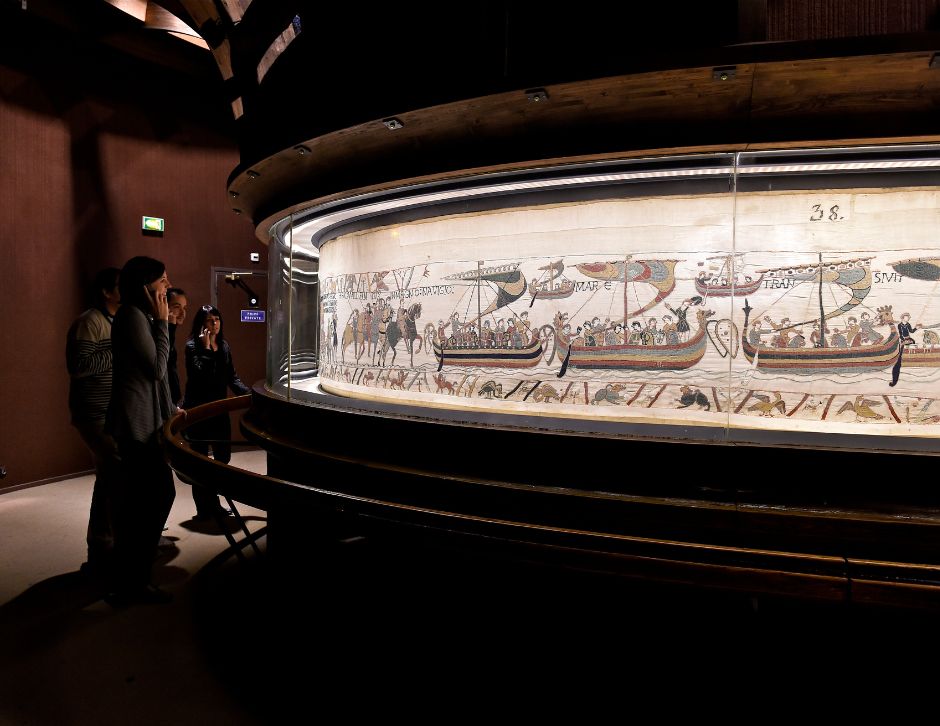
On July 8, 2025, British Prime Minister Sir Keir Starmer and French President Emmanuel Macron announced the historic deal which will be signed by Director of the British Museum Nicholas Cullinan, allowing the British Museum to display the Bayeux Tapestry. In exchange, the British Museum will give treasures that represent all four nations of the UK – including Sutton Hoo and the Lewis chess pieces to the museums in Normandy, France.
The Bayeux Tapestry is a 70-metre-long masterpiece, which narrates the story of the conquest of England in 1066 by William, Duke of Normandy. The piece is an embroidery in wool thread on the linen cloth that was created in the UK, dating back to the 11th century. Depicting 58 scenes, 626 characters, and 202 horses, the tapestry gives an account of the medieval period in Normandy and England like no other. Furthermore, it gives an enlarged vision of the civil and military architecture, armour, and seafaring in the Viking tradition, as well as precious details of everyday life.

On this spectacular occasion, Nicholas Cullinan, Director of the British Museum, said,
“The Bayeux Tapestry is one of the most important and unique cultural artefacts in the world, which illustrates the deep ties between Britain and France and has fascinated people across geographies and generations. It is hard to overstate the significance of this extraordinary opportunity of displaying it at the British Museum and we are profoundly grateful to everyone involved. This will be the first time the Bayeux Tapestry has been in the UK since it was made, almost 1,000 years ago. We are also delighted to send treasures from the British Museum representing all four nations of the UK – including Sutton Hoo treasures and the Lewis chess pieces – to France in return. This is exactly the kind of international partnership that I want us to champion and take part in: sharing the best of our collection as widely as possible – and in return displaying global treasures of the world never seen in London before to a global audience.”
The exhibition will attract several visitors as this is the first time the tapestry has been shown in the UK since it was composed. Since the British Museum attracted 6.5 million visitors in 2024 – which means it is well placed to ensure that the widest possible audience will have the opportunity to enjoy it.
George Osborne, Chair of the British Museum Trustees, said,
“Once in a generation there’s a British Museum exhibition that eclipses all others. Think in previous ages of Tutankhamun and the Terracotta Warriors. The Bayeux Tapestry will be THE blockbuster show of our generation. I know it will capture the imagination of an entire nation.
There is no other single item in British history that is so familiar, so studied in schools, so copied in art as the Bayeux Tapestry. Yet in almost a thousand years it has never returned to these shores. Next year it will and many, many thousands of visitors, especially schoolchildren, will see it with their own eyes.
And we’re thrilled too that the people of France will get to see some of the greatest treasures from all four nations of the United Kingdom.
We’ve worked hard at the Museum to make this extraordinary loan possible. I want to thank this government – the ministers, officials and diplomats – for all their help in getting it over the line. It is the most visible expression of a stronger relationship between Britain and France. Merci beaucoup!”
The Sutton Hoo ship burial, which will be displayed in the Normandy museum gives a remarkable insight into the early Anglo-Saxon England. Being a product from a place of exquisite craftsmanship and extensive international connections, spanning Europe and beyond, it shows that the world of great halls, glittering treasures, and formidable warriors described in Anglo-Saxon poetry was not a myth.

The Lewis chess pieces are significant chess pieces in the world that were made from walrus ivory in the 12th century. Buried in the sand dune on the Isle of Lewis in the Outer Hebrides, Scotland, the chess pieces testified to the strong cultural and political connections between the kingdoms of the British Isles and Scandinavia in the Middle Ages, as well as to the growing popularity of chess within Europe. These pieces are elaborately carved walrus ivory and whales’ teeth in the form of seated kings and queens with comical expressions, bishops, knights on their mounts, standing warders, and obelisk-shaped pawns.


The collaboration is one of the finest of the year which will contribute to the cultural knowledge of both countries.
Featured Image: Bayeux Tapestry Museum – exhibition gallery; © Bayeux Museum.
Related Reads.


