
Mural Paintings have always played a significant role in bringing art into the public sphere alongside expressing the historical and cultural identity of a particular period. It is interesting to note how every mural carries a story of its commission, formation, and conservation. One of the stories comes from the apse of Sant Climent de Taüll, which held a fragment of the mural painting of Santa Maria.
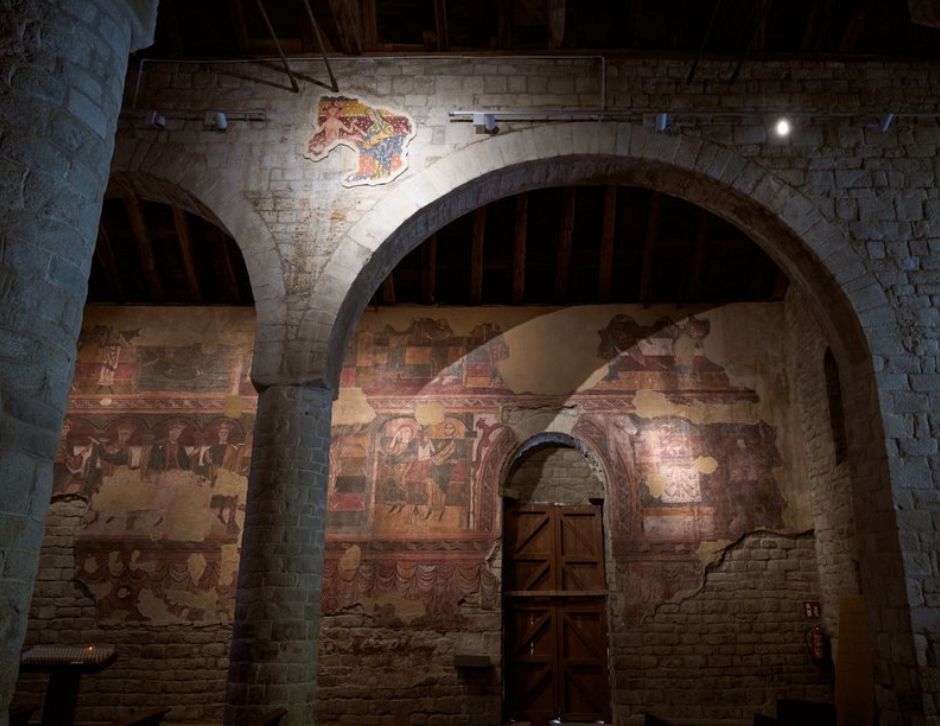
On July 20, 2024, the general director of Cultural Heritage, Sònia Hernández; the mayoress of Vall de Boí, Sònia Bruguera; the director of the Furniture Restoration Center, Mireia Mestre, and the curator of the Taüll Year, Eduard Riu, presented the intervention to return the original fragment of the mural painting to its location after being displayed in Sant Climent de Taüll for a long time. The fragment depicts the scene of Jesus’ bath.


The story starts more than a century ago when the wall paintings of the Romanesque churches of the Vall de Boi were torn up to move to Barcelona to protect them from the merchants who would roam the Pyrenees to find Catalan medieval treasures. These works have been long conserved and preserved in the National Art Museum of Catalonia (MNAC), where they got popularized with their discreet aroma of craftsmanship in the millennial cultural legacy. They received such praise that their copies were installed on the walls of the temples that were left bare. To move these frescoes and murals to their original place, where they would complete the story of their existence, was impossible a few years ago. However, with recent technologies and continuous efforts of the Culture Ministry of Spain, this has been made possible.
The fragment of this mural was not removed in the century’s beginning due to the same reason, but it was discovered during the architectural restoration work of the church in the 1960s. Located on a column of the arcades (the ones, which separate the central nave from the south side), in 1971, it was extracted after the architectural work was done. The mural was extracted using the strappo technique and transferred to the canvas to be exhibited in the Sant Climent for years. However, a few years back, it was moved to the Furniture Restoration Center for study and research so that the officials have a solution that would allow the mural to be returned to its original place, Santa Maria, without any fear of its conservation.
The purpose behind its return is that it would complete the narrative cycle of Jesus’s childhood, further adding the mural character to the place.
Resource.
Featured Image: View of the nau of the temple of Santa Maria de Taüll; DEPARTMENT OF CULTURE OF THE GENERALITAT, via El Punt Avui.
Related Reads.


