
The creative inspiration of South Asia and India was rooted in religion, an expression of spirituality, whereas trade and commerce, a sense of materialism, shaped Chinese and Japanese creativity. To proliferate this bliss and beauty of the harmonious balance between spirituality and materialism, one has to witness the beauty of various Asian art forms. The Toledo Museum of Art vouchsafed this knowledge through an Asian art exhibition, that started on April 20, 2024, and will end on June 29, 2025.
The art display tends to depict the sculptures of Buddhist and Hindu deities, which embody the ideas and philosophies of human existence, and white porcelain, celadon, and enamel ceramics from China, Korea, and Japan to highlight the trade of the seventeenth and eighteenth centuries between Asia, Latin America, and Europe. Besides, these artifacts also narrate the political and social conditions of the history.


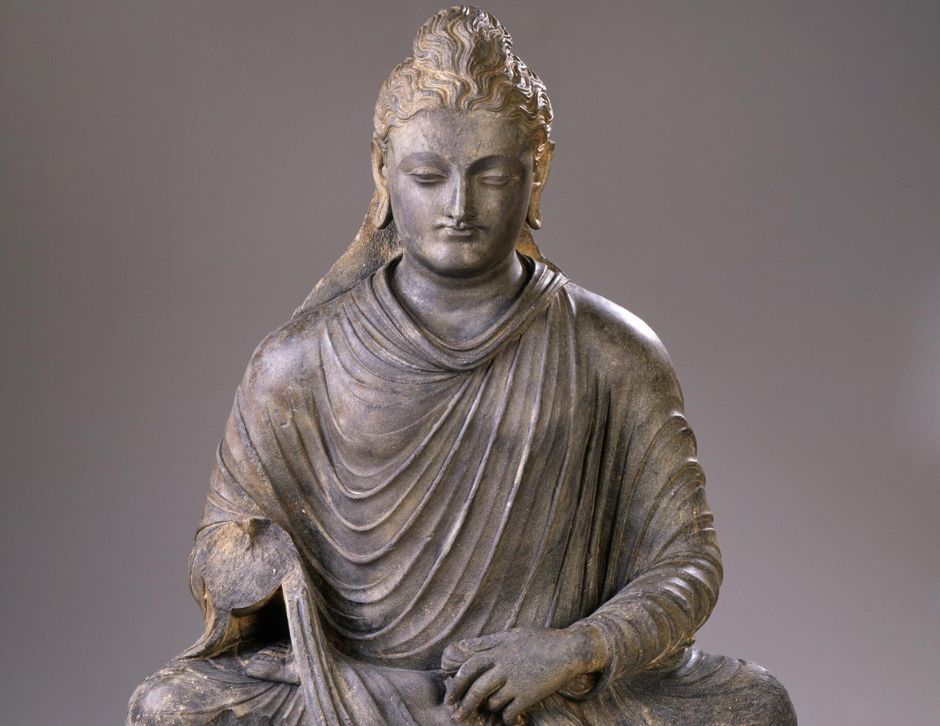
The three highlighted works of the exhibition include- a sculpture of Parvati from Tamil Nadu, India (Chola Dynasty, 860- 1279), which is made of bronze and has a height of 32 inches; A Vase of porcelain painted in polychrome enamels from China (Qing Dynasty, 1622-1912; Qialong period, 1736-1795); and a sculpture of Seated Buddha from Afghanistan carved with gray schist and has dimensions of 80 x 55.9 cm.
The sculpture of Parvati, The Great Goddess, and consort of Shiva. stands, while adorning herself with Karanda-makuta and Makara earrings with a bead necklace around her neck. An upavita passes between her breasts while she wears bracelets and arm clasps. Her lower garment, dhoti, is secured with an elaborate clasp with a festoon of pearls. She has a face with sharply carved eyes and a prominent nose with a smile and calming facial expression.
The Seated Buddha belongs to the Gandhara school of art. Having a sterner face with more familiarity, the sculpture looks as if it has been adapted from the Greco-Roman Prototypes. Seated in the Vajrasana, the right hand of Buddha is broken, whereas the left hand rests on his garment. Having a divine radiance and splendor of his face of Bliss, he has half-close eyes for deep meditation.
Having more of these artifacts and sculptures, this exhibition holds an integral part of knowledge for Asian art. To my opinion, it must not be missed at any cost and is a must-visit exhibition.
Resource.
Featured Image: Seated Buddha; Toledo Museum of Art.
Related Reads.


