
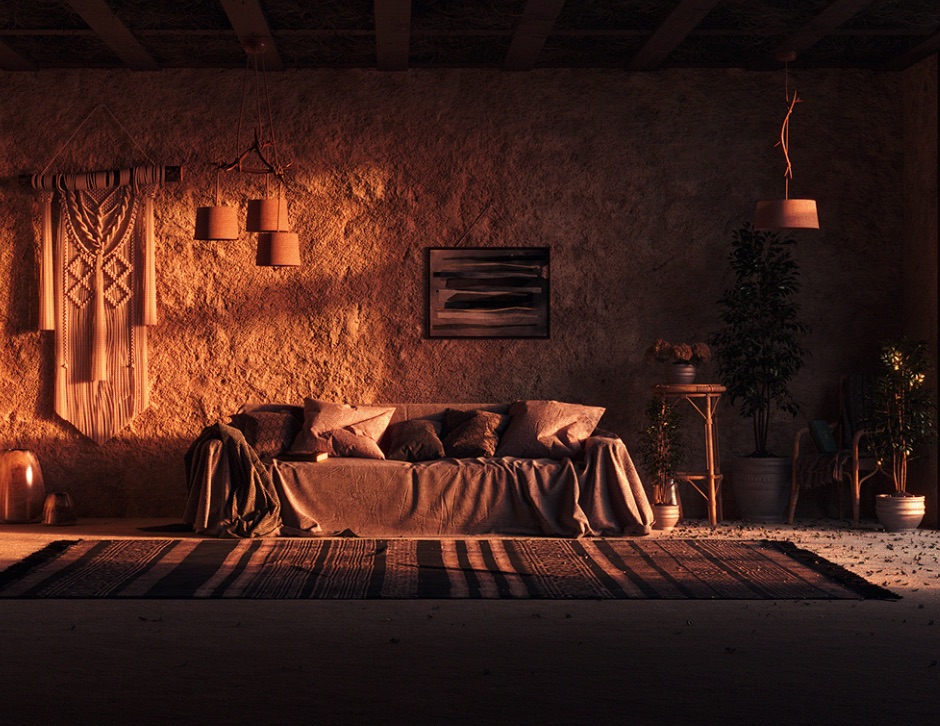
Rousing jolts are a recurrent practice for most of us in the world of insecurities and constant acceleration. Gone are the days when we actually felt love in even the finest imperfections. I still remember how my dad used to surprise my mom by waking her up with beautiful lilies, and those flowers were always part of my room for the rest of the day. In the moments of struggle, anger, and frustration, their efforts to be together provided them comfort and calmness. I don’t see this security of having someone by your side very often now. That sense of calmness and comfort with security in mind is rare to find, but over time, with our practice, we include things in our daily life in search of these feelings. It’s hard to find someone like that in today’s world, but to miss this comfort, calmness, and love with even the slightest imperfection is not fair. The easiest solution to this is to incorporate it into our surroundings through Wabi-Sabi interior design. In Zen philosophy, a wabi-sabi home teaches us a little patience amid the fast-changing world. The idea is not just about finding comfort but about slowing down the mind in times of dopamine rise and living life through the philosophy of impermanence and the passage, and letting your space reflect that. But before we walk through the essence of the wabi-sabi style, let’s first cover the basics, including what actually separates a modern wabi-sabi interior design from the past wabi-sabi home decor, which it is often confused with. But first things first, let’s hear from the sponsor of this article and move on to today’s book recommendation section.

Ignoring hardware while planning your interiors or renovation is the biggest mistake, since they can completely influence functionality as well as the accents of your home. At the same time, finding one that stands the test of time is tricky. To help you with that, I am excited to introduce you to the durable and handcrafted Rocky Mountain entry door hardware. Take my word, they are an absolute blessing for your interiors. Avoid the hassle and check their beautiful door sets today.
Today’s Book Recommendation

Proof of Heaven: A Neurosurgeon’s Journey into the Afterlife by Eben Alexander.
What if consciousness survives death? If this is one of the questions in your mind, then you can consider reading this book. A personal memoir of a Harvard-trained neurosurgeon, the book narrates the illusion the mind created when he spent a week in a coma with his brain’s higher centers shut down. What he described was a scene from heaven, but whether a believer or a doubter, this book raises the mind to ask and answer several scenarios and questions. Open the first page tonight.
What Is Wabi Sabi Interior Design?
When someone asks about the meaning of “wabi-sabi,” I can’t deny that both the words “wabi” and “sabi” evolved over time, taking on different senses.
Essentially, you can take “wabi” as a word applied to a life, which is simple, non-materialistic, humble, and appreciative. If I am referring to you as a Wabi person, it means I saw the qualities of happiness in you due to your self-definition instead of material wealth. Hence, the decor of Wabi will transcend the need for maximalism to go with a representation of your self-identity.

Now, can you guess what Sabi integrates? It is a simple yet complex imagery of the passage of a hard time and the appearance of something that shows age, imparting something through life. Sabi also invoked the patina, the wear, and the visible signs of age, which most new styles and designs try to hide. The old Japanese readers described Sabi as the muted and subtle beauty of the rural side.
When infused together, wabi-sabi interior design simply means a state of living that the passage of time leads to. You can also think of it as a departure from the state of materialism. The idea is to have a home that has imperfections because of the passage of time, but there is a deliberate stepping away from minimalism and materialism to adore the slower and more honest way of living.
Richard Powell described wabi sabi perfectly in his book, Wabi Sabi Simple: Create Beauty, Value Imperfection, and Live Deeply. He defines it as ego, gravity, and evolution; you may know it well but have never named it.
In earlier times, its only purpose was to create an ideal space for meditation. You might have heard about Zen philosophy. Wabi-sabi was for these Zen practitioners so that when they walk around the garden or enter a tea ceremony, in all the worldly activities, they don’t leave their introspection behind. The fusion of gardens, homes, and household objects to carry a calmer ambience is the Wabi Sabi style. Even today, the goal is the same—to never lose yourself or to connect with yourself through worldly activities and emotions.
A Brief History of Wabi-Sabi.
Before we learn and experiment with the wabi-sabi interior design, a quick look at its history is crucial. Every time, with my articles, I intend to tell you about the past, and the reason is the same; I do it purposely because of the in-depth information you will need to make the best out of it. I will not take much time in this section, so let me quickly start.

Wabi Sabi evolved slowly with the principles of Buddhism. After Gautam Buddha enlightened himself to differentiate between reality and the delusions of humans’ endless sufferings, Buddhism dominated. However, Wabi Sabi was not even a thought then. It was only after the Japanese tea ceremony, known as wabi cha, shaped by the tea masters like Murata Juko and later refined by Sen no Rikyu between the late 15th and 16th centuries, that this process had some aftermath. You need to understand that Wabi Sabi was never about an interior decor style, as it had no clear beginning and was just a part of the process of developing an environment for meditation. Maybe this is the reason why it has no stricter rules. In short, the wabi-sabi home decor is a philosophy to live life with utmost inner satisfaction, calmness, and serenity.
Why Switch to Wabi Sabi Design?
Learning through the section will teach you how you use less materialisation to form the best wabi sabi interiors. But, hey, don’t you think we are still missing something? We left a crucial questionnaire to help you know whether you have to change your home decor. Instead of boring conventional impositions of my thoughts on you, let’s find the purpose through quick questions and answers.
- Do you often get blown by gossip and trends or fashion, which makes you unsatisfied later on for not having all of them?
- Do you often deteriorate your mood from what is going on around you, and despite limitless efforts, you end up with unsatisfied happiness?
- Do you have a cluttered mind full of thoughts? Despite your best efforts, do you end up burdening yourself with harsh thoughts even after deciding to not think?
- Do you often bulldoze yourself with your ongoing situations? For example, in achieving a result, you forgot to be gentle with yourselves.
- Are your relationships badly affected by the stress and frustration you carry?
If you answered yes to more than one of the above questions, you’re in the right place.

As I told you earlier, wabi sabi interior design brings calmness and peace in your surroundings and teaches you a step forward to introspect yourself better, so hold yourself till I am here. And by the way, these questions are the answer to the section title.
The Wabi Sabi Color Palette, Explained
Colors in every single interior design change the aesthetics and the way of perceiving it. Now, I see color as light frequencies. For instance, red seems too alarming to me, but at the same time, yellows and oranges give a sense of variation. In the case of wabi sabi, there are absolutely no rules for choosing colors. What shades make you more modest, humble, happy, and calm? One way to find out is to just have an entire color brochure on your desk, look at every single color, and choose which one of them feels off or comforting to you.

Wabi sabi has no color rules, but it’s more appropriate to use natural textures and colors. Since it is picked from Japanese rural living, which has an autumnal and somber mood, conjuring up the wooden fences, fallow fields, and autumnal leaves, the colors are more grounded. Instead of whites, ivories, and showy hues, always try to use browns, yellows, slate, gray, moss green, and even black. Sahaj wrote an entire article on how to create an interior color palette, which you can use to create coordination and harmony between the colors. Now, using that article, I will be creating a few trending color palettes for wabi sabi interior design. Before that, there are a few points that you can take care of;
- Never use gloss finishes. Always opt for matte-finished colors, as they look more humble and less distracting.
- Use canvases, flowers, cushions, tablecloths, and pictures to fill the surroundings with color. However, keep them balanced and minimal.
- You can always use patterns, stripes, and strongly textured fabrics for a tactile and visually interesting wabi sabi style.
- Even if you use beige-colored curtains or drapery, you can always add colors through objects so that the wabi-sabi doesn’t look monotonous.
- Browns, sage greens, sandy beige, soft charcoal, and burgundy red are the trending colors of 2026. So you can always make nice color palettes with them. I will add a color palette of similar features to give you an example.
- Always lead with the raw material texture, including unpolished stone, cream of natural linen, coarsely textured handmade paper, and even mosaic for color addition.

Note that I have used #201E1D as the balancing color to neutralize the impact of the rest of the colors, in case it is in excess. This color, if used, should be added through objects such as a vase or the metal present in furniture essentials. If you are pursuing a darker palette overall, I’d advise using darker shades of brown through unlacquered wood brown finishes, or in general, a darker shade for one of the accent colors. This way, you will not grow over your interiors, as a lighter shade will make them feel airy and cozy. The latter can be achieved through lighting.
8 Steps to Getting a Wabi Sabi Style House.
1. Wabi Sabi Textures Are Down-To-Earth Representations.
Wabi sabi interior design accentuates simplicity by celebrating nature without reforming it. The wabi sabi concept focuses on giving your home and garden a makeover in a way that acknowledges nature’s purest forms. An underdone surface looks better than a finished, shiny, polished surface in the elementary wabi sabi language, as it narrates the effect on surroundings as time passes.
There are several ways that can help you to include texture in your decor. Do it yourself instead of spending hundreds of dollars on expensive woodworking items and shiny appearances.

A few tips for this section are: instead of Walmart furniture, use bare wood, or try to strip back the old furniture to its natural form. To illustrate, if you have an old cupboard, strip it back to raw wood, let it weather outdoors to give natural aging, and use linseed oil or natural wax over its surface to complete its look. In the case of dining tables and doors, you can use natural wax or oil so that you can clean them easily. The concept is simple: do the minimum to accept the pronounced gift!
You can use natural handmade paper, be it in the form of artwork, screens, or blocks of color pinned to a wall. Alternatively, you can use natural stone tiles to create a rough appearance. Try getting the porous and matte surface blemishes of the weathered and aged stones to get the best out of them. Furthermore, you can choose a mosaic, creating a varied texture on a floor or wall. When plumping for these, opt for muted colors to draw attention to these mosaics. Other options to create a finish are using bare wood frames for your pictures, wicker baskets, iron pots, and bamboo placemats.
2. Play With the Shapes From Your Previous Geometry Books.
It is the most creative section of the whole wabi sabi interior design, as you have to take inspiration from nature for beautiful shapes. The circular sun, needle-shaped ferns, and even the anatomical structure of the human body contain them! Try to recognize the best form from nature and recreate it in your home. For example, I love the tiny, beautiful butterfly wings! Curves, spirals, whorls, circles, and waves can all be recreated in the wabi sabi homes.
A few tips for this section: Soften the corners and round off the edges of furnishings, as they instantly relax your mind. Use oval or round windows to give more visual interest to the home, in case you are renovating through architectural elements. In either case, you can use oval tables or mirrors and angled picture frames.

3. Winning Fabrics Is Not Child’s Play.
Fabrics, when used wisely, can stage a mood for your room. Using them beyond the functional layer, like carpets, curtains, bedding, wall hangings, screens, and tapestries, further creates a statement.
For example, in the bedroom, you can use regular-weave, neutral-colored hangings and screens. Similarly, you can use shiny silks and satins in your living room to elevate the ambiance while adding softness to it. The best way to choose fabrics for your home is through learning the behavior of your favorites in your home’s atmosphere. This way you can understand how it interacts with existing things in your space and, of course, light. Order a few samples and you are good to go.
A few tips for this section: Try using a natural dye and soft-fibered textiles for the flooring. These coordinate too well with solid wood and stone floor. The second tip is to use window hangings and divergent drapery styles on curtains or natural blinds. Furthermore, you can use woven fabrics for your upholstery and chairs.

4. Remodel Your Furniture Into Wabi Sabi Style.
Picking the right furniture for your interiors is the trickiest part, given how you have to take care of comfort, style, accents, and space while maintaining the budget and quality of the finished article. The wabi sabi interior design has the most elementary furniture, which promotes necessity over materialism. Think of it like this: you can own a circular, aged coffee table with scratches and an easy look. You do not need to spend too much for buying vintage articles. Wabi-sabi implements living simply without reforming nature, which means the aged wood tells you the maturity. Do not get fooled by vintage, you just need to remember to own furniture pieces with a coarse-grainy surface finish. Try to find the original pieces from woodworkers or antique shops. Introduce the interesting asymmetrical shapes that reflect nature with the textured forms.

Wooden chairs and tables, which display knots and grain, stone tiles with flaws and fossils, or roughly cast metal accessories, are a few choices. Invest in large floor cushions, bean bags, low sofas, hassocks, and wooden chairs for a modern wabi sabi style house.

One quick tip is sealing bare wood with linseed oil, making it look adorable and perfect with a natural feel. Or if you like to paint the furniture, then you can use diluted natural dye or organic paint to retain the natural wood grain.

5. Stage the Photographs to Keep the Memories Alive.
Photographs are truly the frames of happiness that preserve the beautiful moments of our lives, and viewing them brings snuggly comfort, almost as if we are living those moments again. Further, the way you view things brings a sense of self-realization, allowing us to introspect how we have evolved and shaped our character amid the varying circumstances. Those pictures in your DSLR, memory cards, and mobile phones do not have to live there. Frame them and it is highly possible that you will see the brightest aspect, even in the harshest situations.
One quick tip is to create a timeline of yourself and your family, preserving the best part. Reinforce the hefty photos that you wish to display and see repeatedly. You can pin them to a large piece of wood or frame them. Think of it like this, you are creating an artwork that you have lived through.

6. Living Happily With Your Accessories and Plants.
Accessories are articles that reflect your life and personal inclinations in your interior space. In wabi-sabi interiors, your accessories must have a purpose or may retain an emotional state, instead of solely displaying an attraction to materialism.
For this, flaunt your home library, letting your books display your interest. Earthen pots and paintings are also a great point of attraction.

Furthermore, you can create a beautiful look through plants. In wabi sabi style, a trick for picking plants is by preferring symmetry and negative space over crowded bouquets. Some of the examples include cherry blossom branches, irises, chrysanthemums, and bonsai. You can choose your favorite one as well but trim them a little for a similar look.
7. Build Your Own Creative Corner.
In the creative process, expression cannot come alive overnight, but persistence and consistency will bring it to fruition. Supporting yourself requires bringing the language of expression into your home. And so there must be a place where you can find it easy to paint, sculpt, make things, arrange flowers, record sounds, and carve. With a focused mind and soulful atmosphere, you can easily follow your creative passion.
Don’t be afraid of criticism for your persistent efforts. Ask yourself, what do you need for your hobby?
Include all those things and arrange them systematically, and your creative corner is ready!


8. Illuminate Your Home With Purposeful Interior Lighting.
The best lighting your home receives is natural light; the best part about it is that it is free. However, you should maintain a balanced exposure of natural light in your space so that it doesn’t interfere with the HVAC in a way that it increases the energy consumption. One of the correct ways to ensure this is by maintaining the window-to-floor ratio: 15 to 20% is the right ratio to avoid any excessive glare or heat gain. In case you have bigger windows for airy interiors, use sheer curtains with blackout curtains for blocking any light trespass. I have written a separate article on window decoration, which you can refer to for proper guidance on dressing up your windows for a designer and comfortable look.
Getting to the interior light installation, use this formula for optimum results: Task Light + Ambient Light + Mood Light. For the task light, you can use the Japanese illuminated grid ceiling panel suitable for home interiors or pendant lamps and contemporary lighting of your choice, just keep them in coordination with the wabi sabi interior design. Speaking of ambient light and mood light, you can opt for warm lighting for the former, contrary to bright white light we need for the task light, and dim lights such as that of a candle for mood light. One of my favorite lighting setups is that of Longlegs Interiors, and you can take notes from the same for cozy interiors. Make sure the task lighting is set up correctly, though.


Final Words.
Wabi Sabi interior design is truly about choosing less for more comfort and an enriched look. I hope this article helps you understand better about this style and I will love to see how you recreate your spaces using this, so please share those loud but subtle pictures in the comments down below.
Frequently Asked Questions.
Based on the zen philosophy, wabi-sabi interior design uses minimalism and earthy elements for simple living. The objective is to depart from maximalism and live without stress and frustration.
Originally, wabi-sabi appeared in Taoism during China’s Song dynasty (960-1279), following which it passed to Zen Buddhism. However, wabi-sabi interiors evolved from Wabi-cha, a tea ceremony style established by tea masters Murata Juko and Sen no Rikyu from the late 15th to 16th century.
Although there are many similarities between wabi-sabi and Japanese interior design, the former uses emptiness and unfinished textures to influence curiosity.
There are no color rules for the wabi-sabi palette, and choosing matte-finished walls is the right pick. You can pick colors from the Japanese rural living for better coordination and planning for the style. Further, browns, sage greens, sandy beige, soft charcoal, and burgundy red are the trend colors of 2026.
Furniture that is not materialistic but useful serves the wabi-sabi interest best. In a nutshell, you can use raw textures with empty characteristics for the purpose. Further, you can develop a look from your old furniture instead of buying expensive antiques.
Related Reads.


