
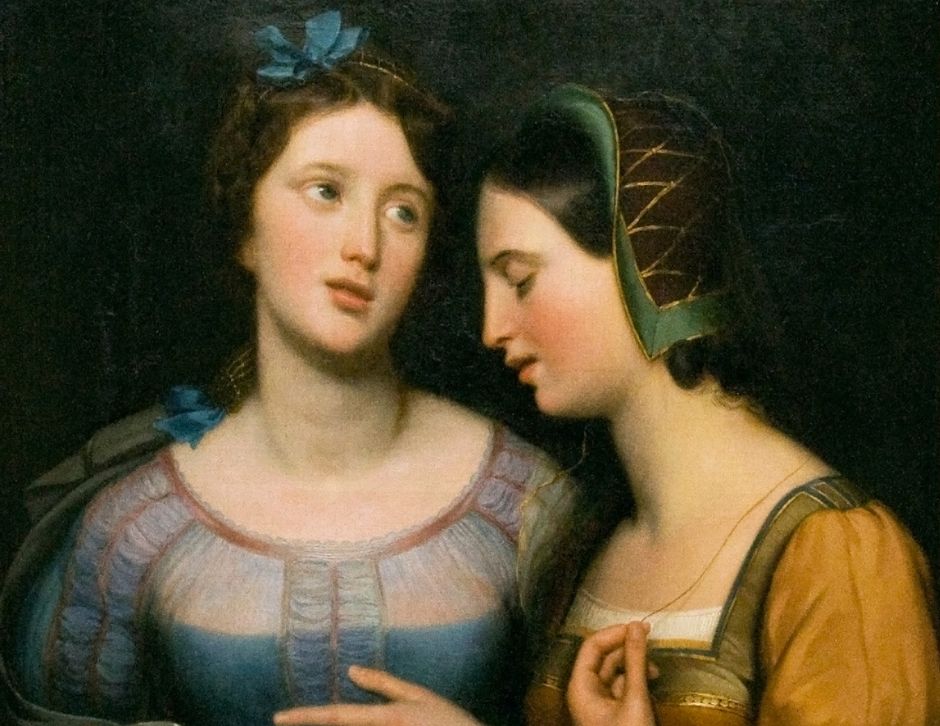
Belgium’s art history is filled with artists who challenged the norms of artistry but were neglected for their efforts. Among them, one of the artists challenged the viewer’s attention without inserting rationalism and democratic themes in his canvases. With a scant exception, this man was considered a mere freak and sometimes a madman who was not influenced by current conditions or whose work had little interest beyond that of an eccentricity. Certainly unbalanced, this man incontestably lacked from an artistic point of view, yet in his paintings, there was a display of death agonies of antiquity and the crude face of the modern world. In his entire existence, there was an unceasing struggle to attain self-adjustment, and he was torn again and again by his contemporaries and critics for his mischievous and absurd subjects. Maybe he was not as perfect as Michelangelo or Dürer, but whatever he showed through his canvases is witnessed by every single one of us in our lifetime but never explained or portrayed ever before. He seizes upon the viewers as if he casts a spell on them to have a fatal obsession with those canvases. And to them, these canvases are baffled beauty, maybe a sublimity but filled with the terrors of the subconscious mind. He who is Antoine Wiertz.
Antoine Wiertz | Fast Knowledge
Antoine Wiertz was a Belgian painter who painted many religious and social subjects in his lifetime of 59 years. Being a painter who cleverly portrayed human emotions, his paintings show all its force and development.
Artist Abstract: Antoine Wiertz.
Born on 22 February 1806 in Dinant, Belgium, Antoine Wiertz was one of the artists who painted religious, historical, and allegorical works in the picture quality equivalent to Rubens. Brought up in poverty, he saw the struggle and pain of losing his father at an early age, but he never stopped working hard. Painting some of the marvelous pieces, his life is equally inspiring like his works. His works had the plastic fervor of Michelangelo and the chromatic fulgor of Rubens.
| Artist | Antoine Wiertz |
| Birth | 22 February 1806 |
| Death | 18 June 1865 |
| Nationality | Belgian |
| Genre | Religious, Historical, Allegorical Works, and Portraiture |
| Famous Paintings | Patroclus, Revolt of Hell |

Life of the Artist.
Being the witness of the great revolution and valiant uprising in Belgium, Wiertz was born on 22 February 1806. The only son of Louis-Francois Wiertz, a soldier of the Grande Republique, and Catherine Disiere, a daughter of the people, Antoine’s earliest attempt to paint followed a troubled career.
“My brushes are my lances, a canvas is my battlefield,” exclaimed the artist as he lost most of his battles to attain success, but he still pursued art in all those bitter and agonizing years till he accepted his final defeat in Brussels. He had the talent to color his productions with the juice of berries at just four; by ten, he had mastered making portraits. He also knew the art of engraving, which was unusually uncommon at that age. Due to this, he was sent to school by M. Paul de Maibe, a patron of art and member of the States-General, in the hope that he would become the famous artist of the region. After his schooling, M. Paul de Maibe also ensured that Antoine received a small pension of one hundred florins a year from the king.
Pursued by his father, who wrote many letters to him; his protector and a strong desire to triumph, he first entered the Academy of Antwerp, where he began to devote himself to his artistic studies under de Herreyns and Van Bree. Working assiduously at the Academy under the last champions of Flemish art, Antoine Wiertz occupied a small attic room, and by fifteen, he began practicing with a jumble of books, papers, and anatomical studies, which were necessary to compose paintings, sculptures, and engravings. Antoine was so curious when it came to his practice that he would literally take his work to his bed, later falling asleep with a crayon in his hand and a scalpel in another. In fact, while being a student, he took the vows of chastity, invincibly telling himself that he would never affect his works because of any distraction or seduction. The early traces of the artist can be found as passing on to the school at Boussu-en-Fagne in 1816 and at Ciney in 1818.
At Antwerp, young Antoine faced obstacles – so as to surpass the infinity of art, he was encouraged by the letters of his father, who would write him as a friend. Once, he remarked in his letter,
“Your character makes me always believe you have thirty. So, it is that I consider you, not only as my son but as my friend.”
Indeed, he would work without any breaks, spending half of his nights drawing skeletons as he didn’t wish to interrupt his painting studies in the daytime. Another reason to do so was his poverty, as the skeleton was lent by someone, and he had to give it back in the daytime.
And then, in 1822, Wiertz loses his father, who was his best friend and a counselor and would uplift him from any struggle. Little later, his protector, M. de Maibe, died. But despite the two irretrievable losses, he would write letters to his alone and poor mother, who was in Dinant. His only motivation was to work harder! By his restless work, he achieved certain academic rewards, one was an extraordinary prize of 100 florins.
Being a phenomenally gifted musician, he played numerous instruments. Though he lived in utmost poverty, he never made any attempt to sell his artworks for the purpose of alteration and corrections. Once, a wealthy patron offered him a great sum of money for a certain sketch, but Wiertz never took it as he believed that this gold was “death to the artist.” However, his overmastering pride and resistant behavior to sell his artworks led him to live in poverty. When, in 1828, he competed unsuccessfully for the Prix de Rome, it was a cruel blow to his hopes, which led him to travel to Paris, where he was so poor that he often drew his belt tighter about the waist to lessen the inconvenient void of the utmost hunger. A mere three hundred florins pension could not let him live in Paris, at that time. Of course, he was not able to pay for his portraits. Hence, he would often paint himself or a young woman with bare parts of her body as “kinds of coquetry, whilst the artist, absent-minded, only thinks of his art and meditates on his work.”
These difficult days were soon changed when, four years later, he entered the academic lists, carrying off first honors. In a letter to his cousin and patron, Gilain Disiere, he announced that the path of glory had opened for him. Due to this, when he moved to Rome, the townsfolk of Dinant blessed him with good wishes by strewing the streets with flowers and firing complimentary salutes to him. One can realize how turning those pitiful events, which were filled with anguish and obscurity, into golden ones can relax the mind and bring more creativity to work.
In the summer of 1834, the artist entered Rome by the Porta del Popolo, where he witnessed crashing thunderstorms of the similar unrelaxing austerity, which he faced in his student days. He worked incessantly, succumbing too much. At the same time, he was planning a huge canvas to depict ‘Greeks and Trojans Contending for the Body of Patroclus.’ Antoine wrote to his cousin, Gilain Disiere,
“I am all impatience to begin; I would have my arms ready at hand. My brushstrokes will be furious and terrible, like the lance thrusts of the Greek heroes. I shall defy the greatest colorists; I shall measure myself against Rubens and Michelangelo!”

It must be noted that painting with such confidence was done because the artist had a momentous influence from the Vatican, the Sistine Chapel, and Notre Dame in Antwerp. These influences further helped him to make studies for his other painting, ‘Patroclus.’ Within six months, he completed this artwork and exhibited it at the Academy of Saint Luke in the presence of thousands of enthusiastic artists. There is one controversy with this artwork.
When this canvas reached the ports of Antwerp, consigned, of course, to the Academy, the institution declined to pay the five hundred francs for the carriage. Pending its formal exhibition at Antwerp, Antoine then placed this picture on private view in the ancient convent of the Recollets, and there he sat almost every day in wait for his hour of triumph. At that moment, he decided to exhibit the artwork in Louvre, France. France was like a mortal enemy to him as he recalled it with names like “hideous monster,” “cancer,” or “city of suicide.” Unfortunately, the big canvas arrived at the Louvre too late for the Salon of 1838. Antoine, in a fierce rage, then tried to get permission to erect a tent and publicly display his masterpieces in the place of Louvre, but he failed too. Hence, he waited a year longer and sent his ‘Patroclus’ and three other subjects, including an ‘Entombment’ to the Louvre for exhibition. But the story doesn’t end here. Though the jury accepted three of his contributions and hung them in the Salle d’honneur, they were ignored by the press and public. This left him with the pain of humiliation from which he never recovered.
Then Patroclus was finally exhibited in Antwerp and Brussels, where he got mixed reactions from critics. The painting didn’t receive that much praise because the era was changing, and the classic themes in painting were fast vanishing. Antoine, irrespective of his age, began a campaign of bitter and indignant rebellion to counter this issue, but sadly, it ended with his grave. During this time, his mother, for whom his devotion was unbounded, also died.
Residing at Liege because of her mother, he visited Paris again, after which a series of other subjects followed his succession. One of the most important artworks from this time is ‘Revolt of Hell,’ which he painted under the cupola of the church of Saint-Andre. With incredible energy, he composed this artwork within six weeks. He wrote,
“I know neither day, nor hour, nor date. I know but two things, the moment of labor and the moment of repose,”

After her mother’s death, he moved to Brussels, where he completed ‘Triumph of Christ.’ In this same period, he built a suitable studio for him, which would take the form of a museum, after his death. Throughout his career, he believed that
“It is time we threw off this foreign yoke (the artworks from foreign artists, like Rubens); it is time we had confidence in our native forces.”

Believing that Delacroix was greater than Rubens and M. Décamps was a worthy rival of Raphael, he painted his compositions for either bread or to lead, though somehow he earned only to provide himself with bread. In all this time, there was one thought that haunted him as his years of vividness slipped; the thought of death before glory knocks on his door. Hence, he painted other paintings like Hunger, Madness, Crime and The Premature Burial during this time, which witnessed human emotions at the extreme.


In these anxious and baffling months, he further learned chemistry, after which he perfected “peinture mate,” a combination of fresco and oil painting supposedly having more frequency to handle the irritating reflective quality of the paint in the compositions. His consistent labor in the hope of enlarging the museums with his paintings was not realized to be true as death claimed him at last.
Suffering from intolerable neuralgia, he died in fearful agony from gangrene at ten o’clock on the evening of 18 June 1865. In the cold weather, he screamed,
“I am burning! burning!”
In the moments before his death, he raised himself upon the pillow and cried,
“Oh, what glorious horizons! What beautiful, tender countenances! How sad they are; they weep because they love me sp. Quick! My Brushes! My palette! What a picture I shall paint! I shall vanquish Raphael!”
Then, speechless, he took his last breath.
The Art of Antoine Wiertz
The paintings of Antoine showed numerous emotions, all of them portrayed his sense of emotions towards the realities of life. Though they didn’t have an aesthetic value or significance, all of them had a flash of spiritual evocation with the luster of human emotions. The art of the artist is extensive rather than intensive. There were special feelings to each of his canvases. For instance, in ‘Happy Times,’ he portrayed the divinity of being blessed and the quietude of Poussin. Then, in Two Young Women or the Beautiful Rosine, the artist showed an eloquent and voluptuous fantasy of Delacroix. Similarly, in Patroclus, he challenged the Universe, and in The Revolt of Hell, he showed his own revolt against the existing power that he felt inside.


In the last phase of his career, he began to show a more sympathetic character of his race and time. For instance, in Orphans, Premature Burial, Hunger, Madness and Crime, and The Last Cannon, he showed powerful social subjects that had striking and deeper notes. In the ‘Scene in Hell,’ he doesn’t hesitate once to depict familiar figures with long cloaks or cloaked hats which were about him and a crowd of widows or orphans with slaughtered loved ones. There is restraint in his art, and some of them even had darkness lurking upon them.


Opinions and Conclusions.
I felt that Antoine Wiertz was an impeccable artist whose later artworks and sympathizing subjects are intriguing. However, there were times when he continued being hard on himself which somehow hindered his creative ability. Of course, there were several reasons for acting like that. But there were several reasons and situations that shaped his artistry including poverty, rejections, sarcastic critics, and personal losses. Among all his works, I found his later works including The Reader of Novels and The Premature Burial more connecting and mesmerizing. There is an urgency in the artist’s compositions which might be mirroring his state of mind. The only disappointing thing I found in his entire career was his slight arrogance which surely impacted him financially. There are hundreds of lessons of success and even failures which are equally significant and in the case of Antoine Wiertz, these failures served a conceivable purpose!
Resources.
- Featured Image: Singing Lesson by Antoine Wiertz; Antoine Wiertz, Public domain, via Wikimedia Commons.
- Modern Artists by Christian Brinton.
- Antony Wiertz by Julius Potvin.
Related Reads.


