
Imagine you have lost your car key on a long street and you have just crossed the street at the busy intersection. When you finally checked into your pocket, you realized that you had lost them, and when you searched for them in the busy street, there was something more important, which you lost- ‘your sense of proportion.’ It simply means that the value of keys or of anything else can be only known through comparison to a given situation, to some whole of which it is a part. This is what proportion is: ‘everything is relative.’ Hence, in general terms, proportion is the perception of the object as large or small, in relationship to others or generally ourselves. Hence, proportion impacts how we see the object, design, or even architecture. In my earlier article on balance in art, I pledged to explain the elements of design, which are really important to artists. Continuing the series, I am writing a descriptive article explaining proportion in art.
Proportion Definition in Art | Fast Knowledge
Proportion in art is the comparative relationship or ratio of things to one another.
What Is Proportion in Art?
Let’s start with a basic example. You have several types of rectangles, like the image below. Now, ask yourself, which one to you is perfect?

Now, it doesn’t matter which one you pick- the point is that in the very act of making up your mind, you exercise this visual “sense of proportion.” No one can prove your choice, whether it is right or wrong. Usually, we pick an object based on how pleasing it seems to us. When that happens, we don’t ask whether we picked the rectangle that is ‘right’ for us, but rather, is it ‘right’ for the job? Hence, for an artist, proportion in art means implication of the object in his canvas with respect to its surroundings for a desired effect. Or you could define it- ‘the parts are related in size to the whole and to each other, in a way, that is right for a particular purpose or situation.’
But now understand that proportion is not about the division of a particular object into a perfectly similar geometrical shape. For instance, you can’t call a giraffe completely wrong because its neck and legs are too long. However, you can judge them by comparison with other animals of the same kind. In any event, when we talk about proportion in nature, it usually measures them against the yardstick of our actual experience rather than in terms of personal judgment.
From what I said so far, for every artist, proportion is important with the problem of adjusting the parts of his design to the whole so that the relationship will be right for his particular purposes. For every artist, this purpose varies, and hence the proportion.
Proportion in Art.
Starting with the perfect proportion, the ancient Greeks used to tie their vision of ideal beauty as they considered the proper proportions of the human body. Polykleitos is credited with the derivation of the canon of proportions, which is a set of rules about the body parts and their dimensions relative to one another that became the standard for creating the ideal figure. Now, this physical manifestation of his canon was his Doryphoros. Every part of the body is either a specific fraction or multiple of every part. Ideally, for Polykleitos, the head is one-eighth of the total height of the body, and the width from shoulder to shoulder should not exceed one-fourth of the body’s height.
This set of perfection was however, more seen in the Greek sculptures and images. Contrary to many artists who violated the canon for expressive purposes. For instance, The Family by Alice Neel showed an unidealised form of figures. The enlarged heads, elongated figures, and calves show glaring obstacles to the realistic representation, but there is still somehow an overarching realism in it.

The Golden Mean: Proportion in Architecture.
Just as the Greeks developed a canon of proportions for representing the human figure in the ideal, they also developed a concept of the golden mean or golden section, which created ideal proportions in architecture. The golden mean requires that a small part of a work should relate to a larger part of the work as the larger part relates to the whole. For instance, look at the line, which is divided or sectioned at point B, so that the ratio of the shorter segment (AB) to the larger segment (BC), as the larger segment (BC) to the whole line (AC). Now, this segment BC is the golden mean.

In the following figure, the rectangle is based on the golden mean and is termed a golden rectangle. Now, its width is 1.618 times its height. This golden rectangle was thought by the Greeks to be the most pleasing rectangle, and it became the basis for several temple designs. Now, the question is, how would you measure this golden rectangle? So, the answer is that it can be made either by measuring the lengths of the lines or by rotating the diagonal of the half square. You can also rotate the diagonal of the square in both directions, sort of like a windshield wiper. If we add the second smaller rectangle, we obtain another rectangle that is made up of a central square and two smaller rectangles. The entire rectangle is called a root five rectangle, because its length is 2.236 times its width.


Now, this proportion of the root five rectangle has served as the frame for several works in art and architecture. For instance, if you superimpose a diagram of a root five rectangle over the picture of the east facade of the Parthenon, you will notice that it almost adheres to the geometric order that the Greeks visited in their places of worship. The facade is constructed of eight columns, and the four in the center fit within the central square of the root five rectangle.

One of the most significant things that most viewers neglect about the Parthenon’s design is this mathematical basis, but they do catch its overall impression of harmony and order.
If you examine the Notre Dame Cathedral and analyze its proportions, you will see that the regulating lines align with the golden section rectangle. The entire facade is in the golden rectangle proportion. The square of the golden rectangle encloses the lower portion of the facade, and the reciprocal golden section rectangle encloses the towers. Further, the lower portion of the facade can be divided into six units, each of which is a golden rectangle.

These conceptual things have even been seen in some of the most exemplary paintings. For instance, in Michelangelo’s The Fall of Man and the Expulsion from the Garden of Eden, from the Sistine Chapel ceiling, the artist used the concept of the root five rectangle. If you look at it closely, you will find that the central square contains the Tree of Knowledge from the book of Genesis- an important symbol of the temptation and fall of man. And this tree connects the imagery in the outer parts of the root five rectangle- the repetitive figures of Adam and Eve separated by time and the serpent.

A Little Exercise.
Now, it’s your time to find at least five images that use the concept of root five rectangle.
Proportion in Nature.
Gyorgy Doczi wrote in The Power of Limits,
“The power of the golden section to create harmony arises from its unique capacity to unite different parts of a whole so that each preserves its own identity, and yet blends into the greater pattern of a single whole.”
You have to understand that the golden section is not only limited to human aesthetics, but it also forms a part of the remarkable relationship between the proportion of patterns of growth in living organisms, including plants. For instance, if you look at the shells, the contour spiral shapes cumulate the pattern of growth in logarithmic spirals of golden section proportion. In the book, The Curves of Life, Theodore Andreas Cook describes these growth patterns as the essential processes of life. Though the biological growth pattern proportion doesn’t replicate the exactness of the concept, it shows an attempt at resemblance.
Facial Proportion.
The canon of Vitruvius includes facial and body proportions. Now, these placements of the facial features portray classic proportions used in Greek and Roman sculpture. Both Leonardo da Vinci and Albrecht Dürer used the canon of Vitruvius on the body proportion. However, when it came to facial proportion, Leonardo used a system for the face mirrors of Vitruvius and faint construction lines, which can even be seen in his original image of The Vitruvian Man.

What Is the Canon of Vitruvius?
Vitruvius advised that the architecture of the temples should be based on the likeness of the perfectly proportioned human body, where harmony exists among all the parts. This principle, in fact, I have explained it in my article, The Vitruvian Man, and is referred to as the Canon of Vitruvius.
In brief, the Canon of Vitruvius states,
“A square encloses the body while the hands and feet touch a circle with the navel as center. The figure is divided in half at the groin, and by the golden section at the navel.”
However, Dürer was different as he usually characterised the facial proportion with low-set facial features and a high forehead, which might be due to an aesthetic preference of the fashion of the time. In his studies, Four Books on Human Proportion, 1528, he experimented with facial proportion. For instance, in the drawing The Four Constructed Head, he introduced oblique lines into the construction grid to produce variations.
The use of the golden section proportion was an attempt to idealize and systemize a particular representation of the human body or even a structure.
Body Proportions.
The Vitruvius canon was used by several Renaissance artists, but Leonardo da Vinci and Albrecht Dürer were the scholars of the proportioning system of human form. Individually, both of them clearly conform to the proportioning system of Vitruvius. Though their body proportions principles are similar, the clear difference lies in their facial proportions.
Final Words.
Though I have explained proportion in art in an overview, I still think there is a lot of understanding and practice to apply this concept in real life. So, I am referring you to an excellent book that must be added to your knowledge base, Geometry of Design: Studies in Proportion and Composition by Kimberly Elam. Meanwhile, I will add more chapters in the form of new articles to explain the unity of design and elements of art.
Resources.
- Proportion in Art by Harry Bober.
- Geometry of Design: Studies in Proportion and Composition by Kimberly Elam.
- Understanding Art by Lois Fichner-Rathus.
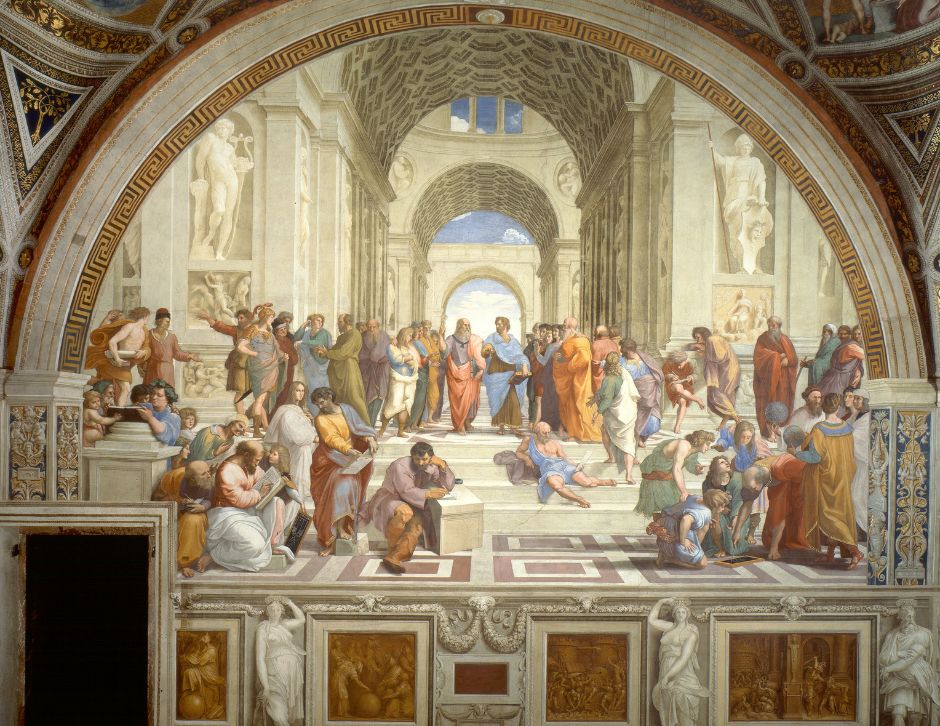
- Featured Image: The School of Athens by Raphael; Raphael, Public domain, via Wikimedia Commons.
Related Reads.


