
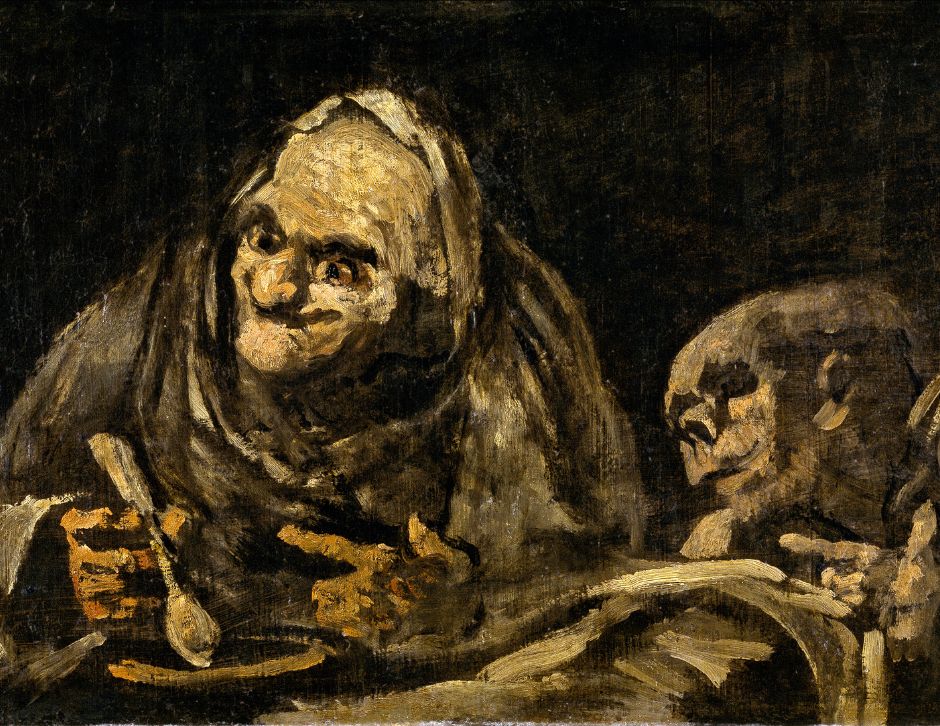
Somewhere I read that a man can ascend to the greatest heights of heavenly beauty while plumbing the ugly depths of depravity, and I truly believe it. I have experienced the two sides of a man myself: one that sounds like an angel, and the other, where demons reside, as if they are interlocked in the soul, forming a strangely captivating, symbiotic relationship. This thought has been even considered in the paintings over and over. From the Renaissance, a period of cultural rebirth and artistic beauty, when men and women were impossibly civilized, the achievement of capturing the heavenly god-like traits with the coexistence of the dark, dirty, and diabolical realities remained till modern art expanded to actually show the atrocities of the real world. Precisely, it was easy to just be attracted and seduced by the beauty while neglecting the uglier side of several art movements. This article is an effort to look at the uglier side of the canvases that have been overlooked for years, redressing the balance between beauty and ugliness. And by the end of this article, the paintings will not just appear to have been populated by angels or demons; they will simply not seem the same again.

This article is in collaboration with OMGFun.com, an Omegle alternative to connect with strangers through live video chats. No profiles, no small talk-small print, purely intentional and coincidental—tap in to see who’s online.
Caution: This platform involves an element of privacy risk, verify you meet the platform’s age requirements and stay cautious about sharing personal information.
Defining Ugly as a New Perspective.
In nearly every century, authors, philosophers, and artists have defined what beauty is, but they have never given a proper definition of what “ugly” actually is. Most of them have just defined it as the opposite of beauty, but I think there must be a treatise that can define it with the utmost length. Hence, while the beauty draws from a wide range of theoretical sources, the history of the ugliness seeks out its own documents in the visual or verbal portrayal of things.
However, there are a few common characteristics that ugliness and beauty have. For instance, the tastes of the ordinary people correspond to the tastes of the artists of their day. Like, some might find Venus by Titian too fascinating, but at the same time, we might not appreciate Picasso’s faces of women. The second characteristic common to both the history of ugliness and that of beauty is that we are restricted to learning the story of these canvases, as there are rarely theoretical texts to tell us if they were intended to cause aesthetic delight, holy fear, or hilarity. For instance, an African ritual mask might seem hair-raising to us, but the locals find it to be divine.

However, beauty and ugliness are not only based on how we perceive things. It further extends itself into the socio-political criteria. For instance, there is a passage in Marx where he points out how possession of money can compensate for ugliness. And this can help us understand certain portraits of monarchs who were devotedly immortalized by the fawning painters, though they did not have the intention of ever emphasizing these defects.
Then, when we read Frederic Brown’s Sentinel, one of the finest short stories, we see the relationship between normal and monstrous, acceptable and horrific. Hence, when these things are put into the landscape painting, some of them might look so soothing while others one can send chills to the spine.
Saying that beauty and ugliness are sometimes even relative to the different times and cultures, as they never meant that people haven’t tried to see them as more defined with respect to the stable model. Nietzsche’s argument is narcissistically anthropomorphous. However, it tells how beauty and ugliness are defined with reference to a specific model.
So can ugliness be seen as the symmetrical foil of a history of beauty? Maybe yes! In 1853, when Karl Rosenkranz wrote the first and complete Aesthetics of Ugliness, he showed how spirituality can link to the beauty and ugliness. In fact, he did a meticulous analysis of the ugliness in nature, spiritual ugliness, and the absence of form, asymmetry, disharmony, and deformation with the various forms of the repugnant, including horrendous, void, felonious, spectral, and even satanic. Hence, we begun to understand that beauty is harmony, proportional, and integrity, while the ugly remains just its opposite.
9 Ugly Paintings From the Beginning.
1. Portrait of the Dwarf Nano Morgante by Bronzino.
Bronzino is an artist whose portraits made the most indelible impression on the twentieth century because of their psychological complexity. Two of the most familiar works of the artist are his famous Allegory of Venus and Portrait of Lucrezia Panciatichi. The artist was Pontormo’s assistant; hence, several of his drawings shared the qualities of Pontormo’s art.


The Portrait of Dwarf Morgante is one of the most famous compositions from the court of Cosimo I de’ Medici. Portraying a dwarf with a bizarre and monstrous semblance from the front and back, this ugly art was made for Duke Cosimo. The subject is a fowler, a bird catcher, as he was not allowed to hunt larger animals. Subsequently, there are two moments in this canvas; the front one shows the dwarf before the hunt, holding an owl, which will be used as bait to capture a jay flying in the air. Here, two swallowtail butterflies cover his genitals, and from behind, the dwarf eagerly shows off his prey.

2. The Temptations of St. Anthony by Bernardino Parenzano.
Bernardino Parenzano was an Italian painter who was known for his works as a miniaturist, illuminator, and panel painter. Trained by Francesco Squarcione in Padua, he learnt fresco and the use of gold leaf in the canvases. One of the most famous works of the artist is the choir book for the Basilica of San Marco in Venice. Parenzano’s style was inspired by Mantegna and Giovanni Bellini, as his works show vivid colors, intricate details, and the use of gold leaf.
The Temptation of St. Anthony shows several devils trying to tempt St. Anthony by evoking the memories of his wealth, his affection for his sister, his love of money and glory, with several other pleasures and comforts of life. They even imitated the way he seduced his loved woman. In all this time, the devils heads turned into the animals like lion, bear, leopard, bull, and scorpio. And they wait persistently to attack St. Anthony, while making noises and apparitions to strike terror and fear. This painting is a representation of the fact that the demons will do anything to confuse a person, further pretending themselves to be innocent in order to fool simpletons, cause an uproar, and laugh madly. However, St Anthony found that this was an illusion, and he said to these devils,
“If you have been given power against me, I am ready to be devoured, but if you have been sent against me by demons, then leave at once, because I am Christ’s servant.”
This last line is shown in the composition through the background, where a cross and a few people praying cast light on these demons. The horrific faces of the demons, the monstrous setting, and the creepy setting all make this composition one of the remarkable ugly paintings.

3. Three Witches by Henry Fuseli.
Being a key figure in English art, Henry Fuseli’s art shows the influence of Neo Classicism, with the passion of the Romantic generation. His own work is a repertoire of his fantasies, bizarre, grotesque, sublime, and beautiful by turns. Though he was thoroughly intellectual, the ideas that his art shows are the emotional experiences that haunted him, the feelings of physical passion, dreams, fears, human frailty, and nameless desires. The art of Fuseli shows the illustrations to the literature of Shakespeare, Milton, Dante, and other legends, which revolve around the demoniacal and cosmic figures, but more importantly, his art has an obsession with the most unexplained regions of art.
The composition, Three Witches, was considered a success in the artist’s life along with the Lady Macbeth Sleepwalking. Based on Shakespeare’s literature, this painting is connected with another sort of emblem: the motif of overlapping profile heads, which was only found in Roman coinage and on bas-reliefs. In the Macbeth witches, Fuseli stresses the ancient and sibylline nature of these characteristics through the repetition of their pointing hands as if they have a prophecy imperative. And this was the first and last painting of the artist where he employed such a close-up view. With an ominous setting, the demonic trio in hooded attire points in one direction, highlighting the Gothic sublime and supernatural horror. It represents the pivotal Act 1, Scene 3 of Shakespeare’s Macbeth, where the three weird sisters give a prophecy that on the Scottish heath, Macbeth will becomes with Thane of Cawdor and King. And immediately after their prophecy, Ross and Angus confirm Macbeth’s title, validating the witches’ prophecy.


4. The Head of Medusa by Peter Paul Rubens.
Being the revolutionary seventeenth-century Flemish painter, Rubens art shows vivid and fundamental human values. His works occupied a notable place in the European as well as the Russian collection. In the first decades, Rubens approach to art didn’t fail, as his art served mirror for the most diverse social strata in several European countries, who were keen to assert their national identity. Hence, he sensually perceived the material world, which had value in itself, and his emphasis strictly layed on the sublime tension between man’s physical and imaginative powers. However, in the second half of the seventeenth century, the political situation in Europe was different, and there was an increasing disparity in society, which caused a contradictory attitude towards Rubens art.
The Head of Medusa is a Greek mythological painting that shows the cut head of A female character, Medusa, with a swarm of snakes over her head. According to Ovid’s Metamorphoses, Medusa was a beautiful woman, but Poseidon violated her dignity, causing Athena to turn her into a monster. Rubens painted Medusa with ominous expressions, with her skin turning grey in death, in a pool of blood.

5. Magdalena Ventura With Her Husband and Son by Jusepe de Ribera.
Of the great painters of the seventeenth century in Italy, Ribera is the greatest artist. His subjects were drawn from the Bible, the legends of the saints, classical mythology, or allegory, further gilled with the concrete reality and immediacy, rarely encountered. The male saints, ascetics, and apostles that the artist painted had grown old and leather-skinned in the harsh sun of Naples; his torturers in the martyrdom scenes learned from the trade in local butcher shops; his young virgins, though hardly plebeian, are dark-eyed and dark-haired beauties; all exemplify the artist’s paintings. Ribera admired the works of Raphael and Michelangelo, as well as Caravaggio.
The painting of Magdalena Ventura with her husband and son portrays a superb, realistic depiction of a man with his thick beard and infant son at his breast. Being an abnormal or almost repugnant clinical case into a superb work of art, this ugly painting has a beauty of pictorial treatment with the evident mysterious suggestion. It might be possible that the man’s breast is portrayed as the rich psychological content of the drama of the wife’s virilisation and the husband’s resigned bitterness in their marriage. Having the Carravaggism effect, the composition has a dense and dramatic darkness, making it an isolated kind.

6. Saturn Devouring His Son by Francisco Goya.
Being one of the most significant artists of the late eighteenth and early nineteenth century, Goya painted several paintings: lighthearted ones in his early career, and in later life, horrenduous and deeply emotional works. He was capable of producing some of the most biting satire ever created in the art world. His paintings are filled with the themes of treachery, corruption, and decadence. In the last years of his life, he painted grotesque works known as Black paintings.
Saturn Devouring His Son by Goya portrays a highly terrifying haunting of the mythological archetype Saturn, who kills his sons just after they were born to prevent one of them from defeating him. In this canvas, Saturn eats the body of an infant in a grossly ominous way, with the oozing blood flowing through his hands. The rough nakedness of the character with a disheveled appearance through hair and beard, and a wide-eyed stare, shows the hysterical insanity of the persona. Being the most bizarre canvas, the work represents the saddest state of the artist. The fierceness and savagery displayed in the work are shown through the half-eaten child with his head eaten and mutilated body dripping with blood.

7. The Arrest of Christ by Hieronymus Bosch.
Hieronymus Bosch was one of the artists who introduced a new vision to the history of art. Having his paintings based on Heaven and Hell, they are conjured out of the visions and myths that swirled and howled in the minds of many Christians. For Bosch, the tormented demons he portrayed prefigure the discovery of the unconscious with its demonic forces, but his portrayal of the evil power of machines proved a prophecy of our own dilemmas. Hence, Hieronymus Bosch was a painter who broke down the established boundaries of his art, as he gave emphasis on the originality of the expression. The most famous altarpieces of the artist are The Haywain Triptych, The Temptations of Saint Anthony, and the Garden of Delights in Madrid.


The arrest of Christ is an excellent painting that shows the radiant and indecisive brushwork, which is visible more than in any of his other paintings. It gives impulse to the dynamic action, an action that just begins in violence following the arrest of Christ. There is a visible mockery of the mob that follows him to the Golgotha strikes. However, the painting forecasts something new here; the furious throng of Bosch’s earlier depictions, which became a dense rabble surrounding Christ. It moves directly towards the viewer, thereby decreasing the hatred with gross crudeness towards Christ.

8. Woman by Willem de Kooning.
Willem de Kooning is one of the leading figures in the emergence of abstract expressionist painting. He painted beyond the radical departures of the cubism towards the viscernal physicality of the abstraction. He painted several women in aggression, lashing gestures, and other emotions, which stunned the art world. The fundamentals of Kooning’s work are abstraction and figuration.
The black and white abstractions of the painting show the unquiet and conflicted marks, which disrupt the legible space and cohesive form against the life-sized woman. Woman 1948 is a canvas where the subject is paired with the cartoon-like sign of an explosion. Like a rudimentary house, the figure has a comeback with the rethought and coalescing only to lose her edge in black wash at lower right with a mean cut to the face at left. Being the first major surviving painting from his second Woman series, this composition shows an aggressive distortion of the figure, which has swift, applied paint strokes further defining the subject. The figure has schematically rendered breasts, shoulders, and multiple arms with a star in the upper-left corner.
9. Christ Among the Doctors by Albrecht Dürer.
Albrecht Dürer was the leading representative of German Renaissance art. Born in 1471, he was first trained as a goldsmith and then as draughtsman. He was influenced by the Italian Renaissance movement. The artistic daring and curiosity of the artist made him study his environment more closely. The most renowned paintings of the artist are Adam and Eve and The Adoration of Trinity.


In this composition, he depicts six rabbis who form a circle, where the central figure is Christ. The hands of one of the rabbis and those of Christ make the central focus of the composition due to the volumetric nature. The subject depicts the part of the childhood of Christ from the New Testament and in the apocryphal Arabic Gospel of the infancy where his role as a teacher was emphasised. Christ uses several expressive gestures of counting the arguments on his fingers, which was common in the theological disputes. The picture achieves a nightmare effect by compressing so many expressions and gestures into a small area. The painting consists of just heads and hands, which was inspired by the sketches of Leonardo da Vinci.

Final Words.
By now, you might have understood the concept of ugliness in art. However, there are many more ugly paintings that I will continue to add in the future as I read more about them.
Resources.
- Featured Image: Two Old Ones Eating Soup by Francisco Goya; Francisco Goya, Public domain, via Wikimedia Commons.
- Pontormo, Bronzino, Allori: A Genealogy of Florentine Art by Elizabeth Pilliod.
- Life and Art of Henry Fuseli by Peter Tomory.
- Peter Paul Rubens: The Painter of Myth and Majesty by Maria Varshavskaya and Xenia Yegorova.
- Fundación Casa Ducal de Medinaceli.
- Jusepe de Ribera, 1591-1652 by Alfonso E. Pérez Sánchez and Nicola Spinoza.
- Goya by Elizabeth Elias Kaufman.
- Hieronymous Bosch by Carl Linfert.
- Hirshhorn.
- Willem de Kooning by Sally Yard.
- On Ugliness by Umberto Eco.
- Museo Thyssen.
- Dürer by Allan Braham.
- Dürer by RH Value Publishing.
Related Reads.


