
Art addresses our minds through vital organs neurologically, psychologically, and emotionally. I remember the different kinds of emptiness I felt seeing Van Gogh’s chair at various times in my life. I recall the illusions Dali’s Persistence of Memory gave me when I saw it clearly. There was always a disturbing silence I felt in Rubens’s Crucifixion. Whether discussing corporeal emotions affecting mind and body or the spiritual and intellectual side accompanied by bodily sensations, art always affects us. Though the reasons vary, the main elements give structure to a composition. In previous articles, I explained balance and proportion in art. Extending the series, I will discuss value in art in this article. However, before we move begin, here’s a word from the sponsor of this article.
RIN Register shares registration services and business resources at a tap. Whether you need compliance support or information related to online casino Ontario platforms, find secure, reliable, and easy-to-use solutions tailored to your needs in Canada. Visit today.
Caution: Gambling and Betting involves an element of financial risk and may be addictive. Please play responsibly and at your own risk.
Today’s Book Recommendation.

Hidden Harmony: The Connected Worlds of Physics and Art by Jack R. Leibowitz.
The Hidden Harmony is an interesting read for those who are curious about the involvement of physics in any artwork. It delves into the physics’ laws acting in every movement from Post-Impressionism to the modern times. Books make you smart, but if you want to stand out in a crowd full of art admirers, this book will equip you with the physics behind art, revealing how fundamental laws shape the world’s greatest works.
Value In Observation.
Value is simply the difference between light and darkness. It also defines the shape and solidity of an object, whether 2D or 3D. It further expresses the emotions behind and creates illusions of mass and space on the flat surface. In observation, when you turn a color wheel into a black-and-white canvas, you will see that it has different shades of black; that’s how they respond to light.


The best way to see value in any composition is through the grayscale. Grayscales are simply toned boxes arranged in a descending order for darkness. The lowest box is white in color, and as pigments are added, the highest box gets darkest in color. Now, if you want to see the value of any painting, just make it black and white and keep this grayscale nearby for comparison. Compare the areas of different shades of black in the composition.

A little more about the gray scale. It is a gradual progression of light to darker shades. When you half-close your eyes and look at this scale, you will find that there will be an optical illusion caused by these tonal differences. For instance, if you first look at the lighter side and then the darker, or vice versa, you will find that comparisons made the color more impactful. Hence, when someone applies a grayscale to their painting, the composition becomes more impactful.
Sometimes an artist wants a full range of value, which means blacks and whites in between. Whereas sometimes you want more contrast of white in the darker shades. The benefits of the interplay of the value in the art will be discussed later in the article.
What Is Value in Art?
Value in art is the variation of light and darkness through the choice of colors to alter the shapes and mood and even generate an illusion. For instance, if you look at the composition, Three Musicians by Picasso, you will witness that several shapes make the figures seem different due to tonal differences. Picasso used the darker and lighter tones simultaneously to compose this painting, which confuses the viewer with its shapes. Further, the contrasting whites and blacks create a darker and more intense emotion. I will share more examples of the paintings to make you clearly understand the value in art. Before that, let me define three words—tone, scale, and hue. Though these words are more commonly used in the context of color in art, they are often used for contrast and value, yet they remain undefined.

Starting with the word “tone,” it is exclusively employed to designate the modifications of a color, with its greatest intensity capable of being received from white. The word “scale,” on the other hand, is an assembly of tones of the same color. In general, the pure color is the normal tone of the scale.
Coming to the word “hue,” it is a modification of a color that is caused by the addition of a small quantity of another color. For instance, we speak of tones of the blue scale or tones of the red scale, but we say “hues of blue” to designate all the scales whose colors are still blue but different from the pure blue color.
Hence, the tones of a color are various modifications of that color at its maximum of intensity, capable of receiving from black and white.
Checking the Value in Painting.
Look at the painting Christ on the Cross Between the Two Criminals by Anthony Van Dyck. If you observe it closely, you will see that Rubens has modeled several solids with light and shadows. It means he focused attention on Christ through a flood of lighting with bold contrasts in value to create a dramatic effect in the overall composition. Similar to this, in the painting Ambassadors by Holbein, the artist used value to clarify details and space relations. However, if you look at Rembrandt’s Supper at Emmaus, he used value to remove the clarity of the picture to introduce a soft, glowy, brownish light in the painting. Further, the viewer will first put their eyes on the darker figure in the background and then travel to the lighting, which is like traveling through a gray scale.


Value Relations.
When arranging values, you find that light and dark exist in relation to each other. But for reading value in painting, you have to practice simultaneous contrast. To make you understand it thoroughly, imagine a painting that has lighter values and a medium grayscale. When you compare, you will find that the strokes of the gray scale look more intense beside the composition of lighter values. It’s like when a few obese people surround a fit person, they will look more obese than usual.
You have to study paintings to know how artists used value to give a particular effect to them. For instance, in the Abiquiu painting by Susan Shatter, there is the use of the total range of values from light to dark, and this placement is throughout the painting, which causes the composition to be more dramatic and full of movement. This drama and movement further causes an emission of a particular emotion from the painting.


On the other hand, if you look at the composition, The Water Lillies, The Clouds by Claude Monet, the value is almost constant and has a middle range of values. Having fewer contrasting values, the painting has a stillness, which makes it quieter and more peaceful.


Now, there is one exercise for you to see value in reality. Just pick a white background and place a few objects that are white. You can take white cups, saucers, or even eggs. Arrange them in any way and shine a spotlight on them to know the highlights and shadows. As you do that, just mark these shadows and lights with charcoal on the sketch. You will understand the same.
Value Contrast and Space.
Value contrast is the use of value to create an illusion of space by means of mass, either by softening the edges or making the planes or edges separate. For instance, in the painting Pastoral Concert by Giorgione, there is the use of aerial perspective. Similarly, you can see the use of aerial perspective in The Tribute’s Money by Masaccio, but when you look at The Persistence of Memory by Dalí, you will not find the use of aerial perspective. In fact, he managed to create an illusion of deep space through the values. He used value contrasts to create a deep space behind the foreground object.


Salvador Dalí. (Spanish, 1904-1989). The Persistence of Memory. 1931. Oil on canvas, 9 1/2 x 13″ (24.1 x 33 cm). © Salvador Dalí, Gala-Salvador Dalí Foundation/Artists Rights Society (ARS), New York. Photograph taken in 2004
Value and Light.
By now, you might know that value is an expression of light. It simply means that when there is extensive light, all we have is a white hue on the gray scale, whereas when there is little light, it means values are dark.
In any composition, light is the most significantpart,t as it affects art in several ways. The contrast between light and dark further gives emphasiston the painting, and the gradation of light helps to establish the distance in space. In any painting, light can work as a subject and a source.
For instance, in the Morning Coffee by Jody dePew McLeane, the artist used intense lighting from the windows, making the figure standing near the window darker. There are lighter and darker areas in the abstract patterns. Here, the light acted as a source. When light acts as a source, it will make the area on which it falls directly the brightest and darken the farthest object.
If your light source is the sun, then the upper right area of the composition will be the brightest, and shadows will be on the left side, which means there will be the lightest values on the bright side and the darkest values in the shadows. If there are reflective sources in the painting, then the value nearby will be a little lighter.
If the light is subject, it means light falls on every object, and it portrays a pattern of dark and light. Lastly, if light is turned dramatic, the values are usually darker, which is shown in the paintings of Caravaggio.

Conclusion.
Value in art is an important element that can transform the entire mood of a painting. It is much more than just dramatizing your artwork; it is significant to alter the atmosphere, mood, light, and even color in a painting. The only task after this article for you is to practice and read the recommended book, which will help you learn the light and energy pockets from physics, which can be implemented in your art.
Resources.
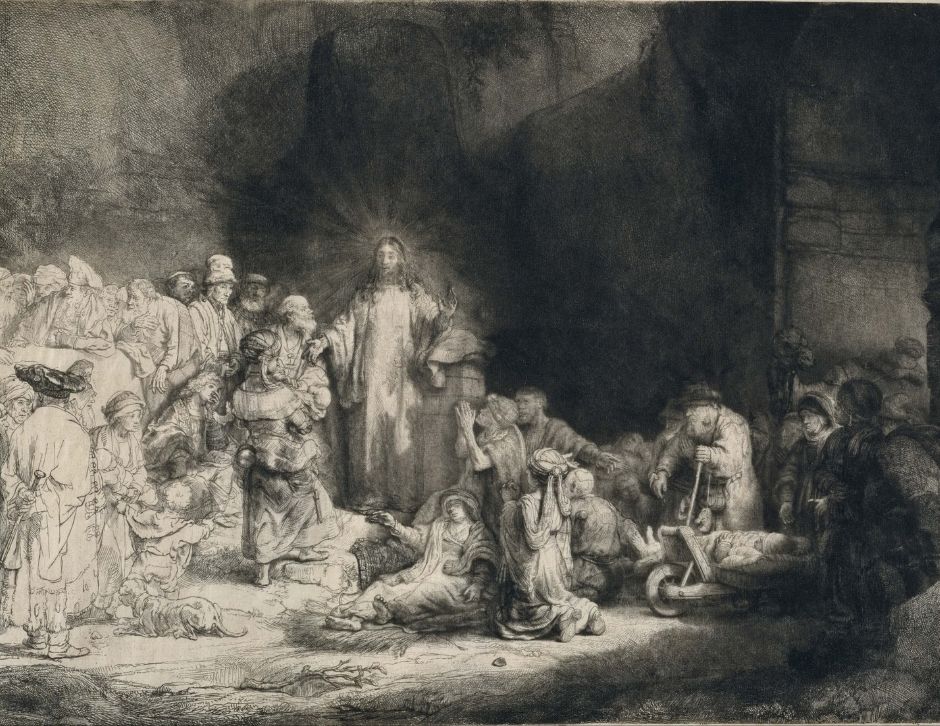
- Featured Image: The Hundred Guilder Print by Rembrandt; Source: Rembrandt, Public domain, via Wikimedia Commons.
- Art: An Introduction by Dale G. Cleaver.
- Dramatize Your Paintings With Tonal Value (Elements of Painting) by Carole Katchen.
Related Reads.


