
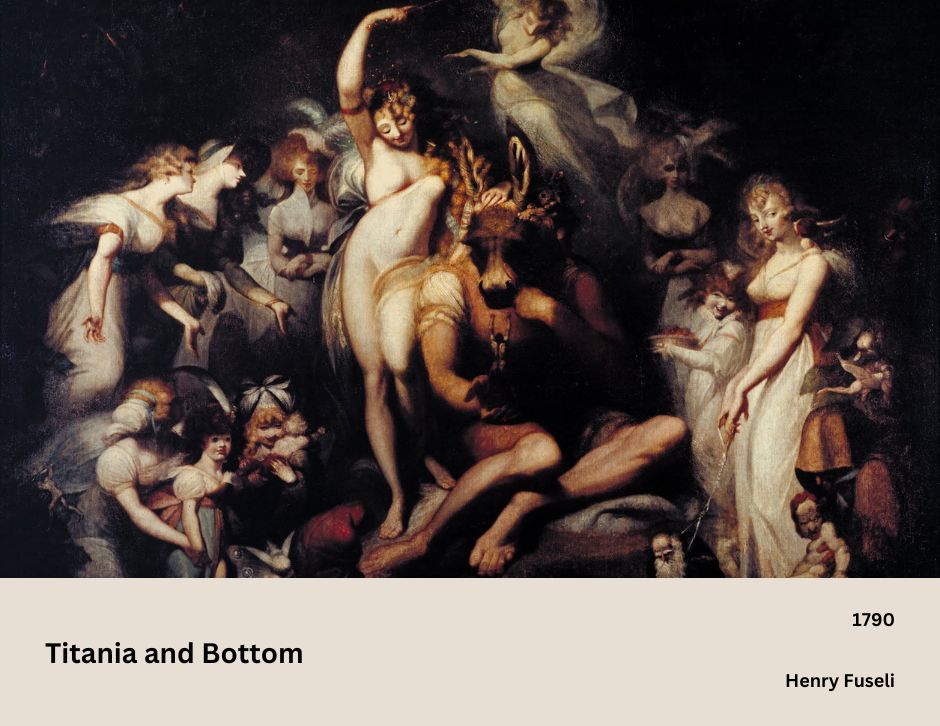
The art of Henry Fuseli has always been undermined, as it has never received as much appreciation as it deserves. The dark-frenzied figures, the supernatural drama, the skin-scrawling smiles, the eerie surroundings, and the loose setting of several of his masterpieces painted a picture of our worst nightmares. Not only that, but all of them also have a complex psychological setting, as if the worst thoughts took the shape of Fuseli’s figures. Fiercely intellectual, his work explores fantasies and bizarre, grotesque situations, but with a beautiful twist and turn. For Fuseli, the external forces always pressurized the destiny of a man, and those forces are too strong by nature. Hence, his artworks showed consistently similar obsessive symbols, defining his oeuvre. For instance, in his painting Titania and Bottom, he celebrates Shakespeare’s play A Midsummer Night’s Dream with eroticism and a well-structured compositional scheme. But it is not just an erotic composition; instead, it is filled with symbolism and history, which I am going to discuss in this article. However, before I dive into the article, here’s a book recommendation.
Today’s Book Recommendation.

The Catcher in the Rye by J.D. Salinger.
The Catcher in the Rye is an epic book for those who wish to see the dark reality of life, which occurs somewhere in the world but remains silent. The protagonist of the book, Holden, a sixteen-year-old, gets expelled from school and sees the cruel reality of the adult world, eventually collapsing mentally. But in all of it, he sees the innocence of his little sister, giving him a flashback of how his innocence was lost forever.
Titania and Bottom: An Introduction.
Titania and Bottom is a historical painting that uses late-erotic mannerism in an airy atmosphere, with several diagonals creating an ornamental connection with the viewer. Surrounded by fairies, Titania, who is at the center of the composition, dances in an unusual pose. The fairies vary in size, with a fancier approach in late Mannerist style. Some of them stand, fly, and even dance on the perimeter of the composition. Titania is nestled up to the Bottom in an erotic mannerist style, which resembles the style of Saint Catherine fondling baby christ in Correggio’s Madonna With St. Jerome. On the left, two female figures stand, pretending to be court attendants. The Bottom has an ass head, and he sits with his unusually long feet.


The many-figured composition is rich in characters of fairies and gnomes, with some classical and others in a fantastical manner. Several of them stay on the ground while others swirl in the air, thereby darting in all directions. But it is in a rhythm rather than a random motion. There is less command in the situation by Bottom, as he is a prisoner of the cosmic powers.
Based on Shakespeare’s play, A Midsummer Night’s Dream, this painting has a gothic and supernatural genre. Before I tell you more about the painting, let me introduce you to the play it is based on. The play is a famous work by the writer comprising love, jealousy, desire, and magic. Based on five acts, the story begins with the escape of Hermia to the woods with her lover, Lysander. She escapes as her father wanted her to marry the chosen candidate, Demetrius, and Theseus says that if Hermia disobeys, she will either be executed or become a nun. However, Hermia’s friend, Helena, who is deeply in love with Demetrius, tells the whereabouts of Hermia and Lysander. In Act II, the Fairy King and Queen, Oberon and Titania, argue over a young servant boy. To punish Titania, the Fairy King orders his servant Puck to put some of the magical flower potion on her eyelids as she sleeps. This potion would make her fall in love with the first living creature she sees upon waking. At this point, Oberon notices Demetrius rejecting Helena, so he decides to fix it. He orders his servant, Puck, to use this magic potion on Demetrius, but he actually puts it on the sleeping Lysander instead. In the midst of all this chaos, Puck turns the lead actor, Nick Bottom, into a donkey-headed human whom Titania falls in love with. When Oberon catches Puck’s mistake, Puck and Oberon use this love potion on the right ones, thereby solving the problem in the end. I would recommend you read the play for a good, humorous read.
This painting is a part of a scene where Titania falls in love with the donkey-headed Nick Bottom. In 1789, Fuseli wrote about this painting in Analytical Review IV, 1789:
“This is the creation of a poetic painter… The soft and insinuating beauty, the playful graces here displayed would, without reflection, scarcely be expected from the daring pencil that appears ever on the stretch to reach the utmost boundary of nature.”
| Title | Titania and Bottom |
| Artist | Henry Fuseli |
| Medium | Oil on canvas |
| Created | 1790 |
| Period | Romanticism and Neo-Classicism |
| Dimensions | 2172 x 2756 mm |
| Museum | Tate, Britain |
Subject Matter Analysis of Titania and Bottom.
Moving to the subject matter analysis, Titania stands nude, with her long blonde hair in Leonardo’s Leda pose. She attends Bottom, who has a donkey head, with her fairies, who wear contemporary-style dresses. Several scary and grotesque figures also join her. The peach blossom scratches the head of Bottom while a small girl in a white dress brings a meal of dried peas in a basket. Nearby, a young lady in a white dress with a red cloth wrapped around her waist leads an old dwarf by a string, symbolizing the triumph of youth over old age, of senses over mind, and of woman over man. Coming to the rightmost corner, there is a hooded old woman who holds a white demonic effigy of a man and is made of wax. A totem and a face coming out of the dark on the right of this composition show the dark magic, which exists alongside fairies. On the left side of the composition, the kids are artificial beings that are created by witches. The girl with a butterfly head who holds a male effigy is a type of variation of Reynold’s portrait where the girl resembles the face of a cat or a mouse.


In the painting, some of the fairies are shown as demeaning and evil, while others are depicted as young and beautiful. It is because of the fact that the world of fairies in Shakespeare’s and Milton’s literature includes incorporeal spirits who could wreak havoc and pleasure. Further, the giant man, Bottom, is shown helpless with all the women around because of the fact that in the literature, the fairy forces, Oberon and Titania, fought against each other, embroiling a helpless man between them. If you look at the center of the composition carefully, you will notice that it resembles the Farnese Bull group, as it has similar compositional diagonals, verticals, and horizontals through bodies and limbs. Even Titania’s wand is similar to the rope by the antique group. Secondly, there is another relevance here. In the Farnese Bull group, Pasiphae falls in love with the bull. Similar to this, Titania falls in love with the donkey head here.
Final Words.
The painting, Titania and Bottom, has a blend of reality, as there is a venomous malice in several characters. From what I see, the painting is a lustful and sinful appearance where the light covers the beauty of the female youthfulness while other elements appear in the darkness quietly. The blackness, flying malevolent spirits, evil-faced artificial children, ass-faced man, and the magical fairy at the center of the composition all portray a darkness and high sexual energy. Leda, who is in the canvas of Leonardo da Vinci, was a victim of rape by a god turned animal, and in a similar way, Titania also was a victim of magic that made her fall in love with an animal-faced human. It is interesting to note that Fuseli took the reference of Leda for his Titania. Thereby, there is a similarity, but the painting Titania and Bottom has a comically absurd mapping. If you look at the face of Titania, she seems unaware of the happenings around her, as if the love potion really made her blind.
Resources.
- Featured Image: Titania and Bottom by Henry Fuseli; Henry Fuseli, Public Domain, via Wikimedia Commons.
- Fuseli Studies by Frederick Antal.
- Henry Fuseli, 1741-1825: [essay, catalogue entries and biographical outline] by Girt Schiff.
- The Life and Art of Henry Fuseli by Peter Tomory.
- The Mind of Henry Fuseli by Eudo C. Mason.
Related Reads.


