
There is a very significant term used by Jay Bryan Wolf in his book Vermeer and the Invention of Seeing that can describe every single artwork, artist, or movement. This simple term is none other than “generational anxiety” among the artists. We see perfection or less-revealing sexuality in some of the artists’ works from the Renaissance, including Botticelli’s, and then characteristics like androgynous beauty in several others, or the use of restricted space and elements of art in the works of Fra Angelico. In a similar way, if we move to Rembrandt’s paintings, we see and feel that the artist painted through an emptiness or nothingness. In his painting An Artist in His Studio, he showed a certain kind of blankness that needs to be filled. However, there is less generational anxiety among Rembrandt’s artworks. For instance, in An Artist in his Studio, he lessens the generational anxiety but turns the composition into high drama and dilemma, whether to fill the blank canvas or unfill it. Similarly, if we look at the painting Sunlight in a Cafeteria by Edward Hopper, there is gendered drama: the drama of the man’s hungry stare and the woman’s uninterested isolation. One of the similarities in both the above-mentioned paintings is the artist’s keenness for isolation and sense of emptiness in their canvases. However, before Rembrandt or any other artists, it was Vermeer who made terrific images and captured our attention, similar to the Baroque images. In his famous Girl Reading a Letter at an Open Window, he portrayed a lady engaged in reading the letter, but he connected an emptiness with the silent home. The painting has no loudness anywhere, as if Vermeer intentionally disconnected the viewers from any noises, only to give them the silence of home. In this article, we are looking at the painting through various angles to know the excellent artistry of Vermeer.

This article is sponsored by Casinos Analyzer. Tired of casino bonuses with fine print you can’t decipher? Casinos Analyzer’s bonus overview breaks down Pure Casino’s 400% match up to $6,000—clear terms, real value. See the full bonus now.
Caution: This game involves an element of financial risk and may be addictive. Please play responsibly and at your own risk.
Today’s Book Recommendation

The Bride of Lammermore by Walter Scott.
The book is an excellent read for those who love to explore Gothic romance. Set in the Scottish hills in 1707, it is a tragic love story of Lucy Aston and Edgar Ravenswood, whose families are bitter enemies. Loosely based on the historical events, the story is a slow burn with an exceptional narration of events. As the young lovers engage in a romantic relationship, Lucy’s mother schemes to destroy their relationship while forcing Lucy into a politically advantageous marriage, which further depicts the social conditions of the time. But wait, there’s a twist in the end, and for that, you have to read the book!
Girl Reading a Letter at an Open Window: A Little Provenance.
The central motif of the painting is a female subject holding a letter. I am emphasizing the usage of the letter here because the letter is a remarkable object of privacy and inner life while also portraying a social activity. The paintings of Vermeer are not mere reflections of social and cultural politics or environment; rather, they are blessings of Dutch history, which portrays the intimacy of domestic scenes while keeping the social role of the artist in the modern nation-state. There were several artists, like Metsu and Steen, who composed letters on their canvases. Usually, they documented the social activity through these letters. However, they also express the prestige of education and worldly business that they grant to the readers or bearers. The usage of letters indicates two important historical incidents: the literacy of the Dutch period and the postal services, which only improved in the mid-seventeenth century. Hence, the letter, specifically in compositions, endows a rich inner life while depicting the greater social conditions. Lastly, letter writing was considered a fashionable activity among the Dutch upper class and came under Dutch fijnschilders, which portrayed psychological depth that was required in leisure-class existence.
| Artist | Johannes Vermeer |
| Year | 1657-59 |
| Genre | Trompe-l’œil |
| Period | Dutch Golden Age, Baroque |
| Museum | Gemäldegalerie Alte Meister, Dresden, Germany |
Glossary: What is Fijnschilders?
Dutch Fijnschilders is a genre that portrays everyday life and activities, including the candle-lit paintings and even trompe-l’œil “niche” paintings. The term “Fijnschilders” simply meant “fine painters,” and it was commonly used in the middle of the sixteenth century for the artists who were meticulous in their art.
I will discuss the subject matter of the painting in later sections of this article. For now, let’s go back to the 1660s, when Vermeer composed six compositions, all depicting the theme of writing. If we look at the painting, Gabriel Metsu’s Lady Reading a Letter With Her Maidservant, which is often linked to Vermeer’s paintings, then it is visible that the artist made no effort to complicate the relationship between the maid and the woman reading a letter. Metsu portrays a letter as leisure, which is served by a maid. In contrast, Vermeer focused on the drama of consciousness. There are two major contrasting zones in his paintings: the objects in his foreground and the private space, which is commonly occupied by the women.


About the Subject.
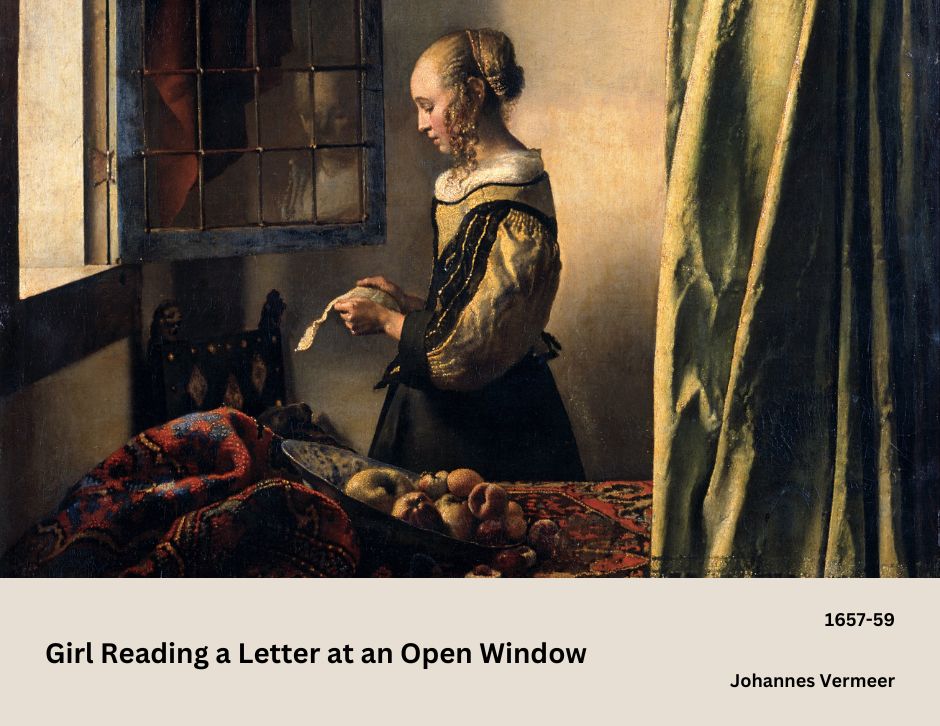
A young lady reads a letter against a blank wall (the new restoration shows a painting of Cupid on this wall). Detached from the worldly spaces, she is at peace and at equilibrium. This is one of the specialties of Vermeer’s works, which is achieved in this painting. The hanging red curtain over the leaded casement window, the intricately detailed carpet with a fruit bowl, and the chair further fill the painting as supporting characters. However, these silent objects must not be confused with secondary players of this painting, as there was never a hierarchy in Vermeer’s painting. Earlier, I explained how Vermeer always divided his paintings into two contrasting spaces and then combined them, leaving it to the viewer to interpret them. In this composition, the window doesn’t show the outside world as if there were stillness and quietness in the atmosphere; the lady has already read half of the letter and is deeply engaged in it; the domestic setting awaits her finishing the letter.
One of the significant things to note here is the type of window, which was typically used in 17th-century Dutch domestic architecture. The small diamond lozenge panes of glass, which were held together with the cames, were standard in the Dutch Golden Age houses. With the colorful panels of windows, the reflection of light was greater. Furthermore, these similar windows were a recurring architectural motif in several of his works, including The Milkmaid.

The use of the singular woman is prominently portrayed in several other works of the artist, including A Young Woman With a Jug, A Woman Weighing Pearls, and The Woman in Blue. This repeated singularity of the woman in his paintings was to emphasise the introspective and passive nature of the female. Furthermore, this composition is the first complete work of Vermeer, where he actually used the play of light from the window upon an entire figure. In addition to this, there is a fine still life in this composition itself: the fruit bowl over the carpet. The lion-carved chair, the motionless girl, and the quiet shimmers of light over the pale blonde hair of the lady; all just fill the space with a quiet drama in tranquility.


The effect that Vermeer created in this composition shows as if the viewer is at a distance from the letter reader, which can be accurately spotted by the foreground curtain, as it has a full view. This curtain further unifies the space, making the scene fictitious in nature. Further, this is contrasted with the crimson red curtain falling over the window as it is looped back to enable the light to fall on the letter reader. It was Dirck van Baburen who inspired this work of Vermeer.
Who is the Girl in Girl Reading a Letter at an Open Window by Vermeer?
Malraux has repeatedly emphasized that the lady in this composition is likely Vermeer’s wife at the age of 27. However, there are several disputes on this claim, as Goldscheider notes that this girl resembles the Officer and Laughing Girl painting. The reflection in the window suggests that Goldscheider’s claims carry more weight.
Did you know?
The painting, Girl Reading a Letter at an Open Window, was reattributed repeatedly to Rembrandt, the school of Rembrandt, and Pieter de Hooch. It was only in 1858 that it was rightly attributed to Vermeer.
The Painting Technique of Girl Reading a Letter at an Open Window.

1. Space and Pattern.
There is a deliberate use of space and pattern in this composition, as seen in several other works of Vermeer. However, the colors and painting style of the artist rely heavily on the retina as its guide; the kind which further contrasts to the conceptual representation known as Impressionism. Vermeer uses localized colors and tones, like Manet and Velázquez, and this is especially seen in the Girl Reading a Letter at an Open Window.
2. Shadows.
One of the spectacular features of this painting is the addition of the hemispheric shadow of the lady against the wall, as if Vermeer knew what the darkened forms were. Furthermore, initially, the wall had a Cupid painting, which is now visible after the restoration. There was a possibility that Vermeer might have wanted to associate the letter with the young god of love, but he then made it blank.
3. Horizon, Vanishing Point.
The horizon in the early sketch of Girl Reading a Letter at an Open Window is placed in such a way that it divides the painting into two equal parts while keeping the vanishing point between the neck of the girl and the green curtain. However, it seemed irrational, as it didn’t appeal to the eyes of the spectator. But Vermeer removed the Cupid painting from the wall, leaving the girls’ reflection on the window’s glass. This horizon, with the viewpoint of the spectator, showed the vantage point of the artist to be low. This was done to keep the viewer at a distance.

Did you know?
The humanity inside the painting, the veiled curtains hanging in the air, leaves a lot of space for the subject. Vermeer, through the use of curtains and the design of this artwork, wanted to show that the substance of life can be half-uncovered.
Final Words
The Girl Reading a Letter at an Open Window is an exemplary painting by Johannes Vermeer, which not only shows his outstanding handling of technical values in his art but also gives a psychological view. Stationed at the narrowest space in this much larger space, she is so wrapped in herself that she displays no outwardness towards the world. It feels as if she is so mesmerized in her own world that neither the gleaming light from the windows nor the falling of fruit from the fruit bowl affects her. She seems uninterested. Though she reads the letter, which several critics think is a love letter, she is expressionless and silent. But there is a possibility that this undue engrossment might unsheath the inner power or some native personality of hers. I hardly think this letter is a love letter; in fact, it is a tough letter whose message was already known to her somehow. The painting seems a deception because the lady offers us nothing but just a glimpse of her own world, which is not like the outside world. There is no world of touch or any magnetic appeal in her, as if the whole purpose of this painting were to show the inner world of the subject.
Resources.
- Vermeer and the Invention of Seeing by Bryan Jay Wolf.
- Vermeer The Complete Works by Wheelock, Arthur K. (Curator of Northern Baroque Painting, National Gallery of Art) (Author) on Jan-01-1998.
- The Complete Paintings of Vermeer by Piero, Bianconi.
- Johannes Vermeer by the National Gallery of Art, Washington.
- Vermeer by John Malcolm Nash.
- Jan Vermeer by Gowing, Lawrence.
- Featured Image: Girl Reading a Letter at an Open Window by Johannes Vermeer; Johannes Vermeer, Public domain, via Wikimedia Commons.
Related Reads.


