
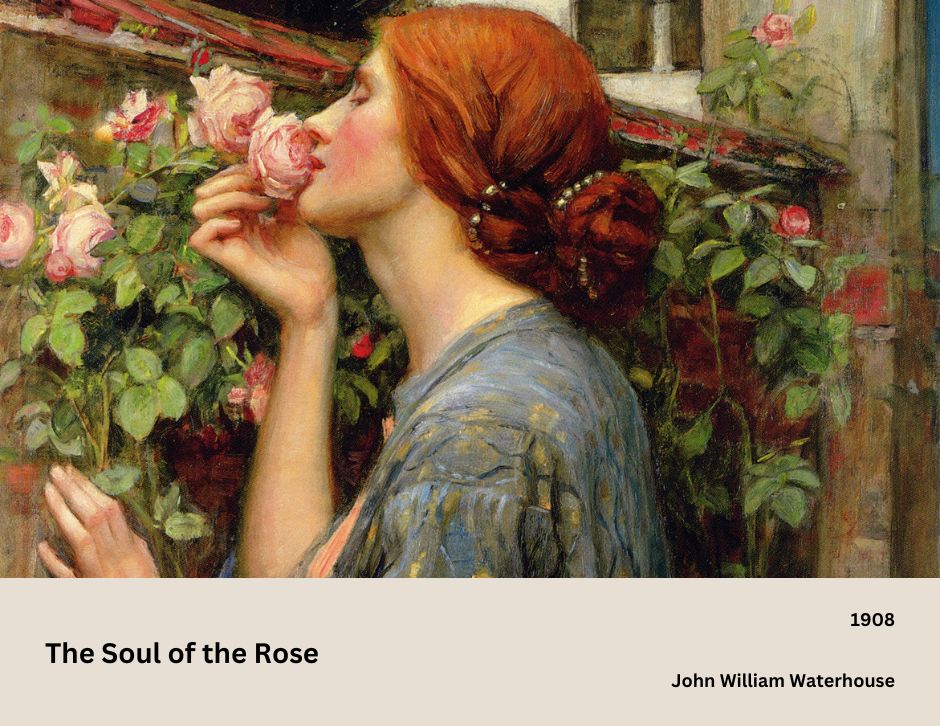
In almost all of Waterhouse’s paintings, there are perennially attractive figures whose beauty is timeless. Being incorrectly called a Pre-Raphaelite artist, he was more of a romantic classicist whose paintings portray romance and mystery. Although his subjects initially showed the influence of several ongoing movements of the time, he later demonstrated a personal and creative approach to his works, making him an admirable example of Victorian academicism. Indeed, his paintings had a central theme of flowers throughout his life. One of the most significant paintings from his mature period, The Soul of the Rose, is governed by lively brushstrokes and exceptional beauty, which has flowers as its central theme. In this article, I am going to tell you everything about the composition, but before that, here’s a word from the sponsor of this article.

Fragrances, whether of a space or a person, leave a memory, either to comfort us, attract us, or form an opinion. A good fragrance is always a product of experience, understanding, and dedication. The House of Amouage does the very thing through rare ingredients, masterful blending, and heritage craftsmanship rooted in Omani tradition. Pick your scent—use Amouage, and carry your identity with such grace.
Who Was John William Waterhouse?
Born in Rome in 1849, John William Waterhouse had continuously nourished his mind because of the ancient history books he read. While working in his father’s art studio, his interest in painting emerged, which later led him to join the Royal Academy. In his entire career, he was known for his masterful storytelling with a striking narrative in his compositions. Though several paintings of his were historical, mythical, and had literary episodes, they all had an original storyline with his artistic imagination. The prestige of the artist grew when he painted an enormous canvas of the Hebrew martyr Mariamne, which made him win several medals and a vast recognition. Coursing throughout, he then composed The Lady of Shalott, whose extreme passion and haunted expression made it the first painting of Pre-Raphaelitism, as it was influenced by John Everett Millais’s Ophelia.


The artist first studied the original works and drawings of several masters while having theoretical inquiries into the methods of the masters. This helped him to always have a pictorial idea of the composition in his mind. Coming to the subject matter of the artist, he had different establishments in distinct periods of his career. For instance, in the first period of his career, the subjects are miscellaneous as they commence with the Eastern themes. These pictures fetched a good price, which made the artist financially independent. When he reached 30, he was ranked higher than any of the Royal Academicians, formulating his style and further experimenting with it.

Briefing The Soul of the Rose.
Waterhouse succeeded throughout his life, but the paintings that were from his mature years created a pattern of prestige, like The Crystal Ball, The Missal, and The Soul of the Rose. In all three of these compositions, there is the use of familiar elements carried through a fresh touch. Pictured in the interior setting with a classical use of vertical columns and circular arches, this painting shows some inspiration from Renaissance architecture. The landscape has a rugged nature, but at the same time, it emphasizes the fragility of his psyche-figure. Archetypally romantic, this composition has been executed with fluidity and verve.


The artist took inspiration from the composition of Chaucer’s dream poem, The Romaunt of the Rose, adapted from the 13th-century French romance Roman de la Rose by Guillaume de Lorris. In the poem, the message delivered is that there is an embarkation of pilgrimage with the God of Love, with perfect love symbolized by the rose. The poem became an inspiration for Waterhouse’s early mentor, Sir Edward Burne-Jones, who composed The Heart of the Rose, 1889. Embodying the beauty of the sentiment, the subject here becomes a love object for the young poet. In the painting of Waterhouse, The Soul of the Rose, he links the lovely protagonist with psychology (which I will tell you later).

The Soul of the Rose by John William Waterhouse portrays a female protagonist inclined towards a pink rose to inhale its scent. With closed eyes and reddish maroon hair tied in a bun, she is depicted in a side profile. She is depicted with an expressive mood and character, set in a more impressionistically painted landscape setting with a telling atmosphere. Elegantly dressed in a loose, brocade robe, her red hair contrasts with the beads and pearls in her bun. The background shows the walled Tuscan garden, which appeared in the paintings of Fra Angelico. This paradox of the garden is something abundant, reflecting an experience that is implied by the story, whereas the rose scent is an emblem of intense love.
As the protagonist leans to smell the rose, her closed eyes show a degree of power, as if she were hoping to find the desired secret through the flower scent. Though she is someone’s muse as she is an object of someone’s desire, the viewers are invited to imagine her psychology to find the hidden narrative of the aspiring love. Though she is a passive symbol of love here, she acts more like a participant. Speaking of the subject matter, the model of this composition might be Miss Muriel Foster, who was the protagonist for several other paintings of the artist, including Ophelia (1894) and Mariana in the South (1894).


In The Soul of the Rose painting, Waterhouse shows a balancing detail with soft brushstrokes. In the background, there is a tonal depth with a subsidiary to the foreground figure. The artist emphasized the sensuousness of the romantic heroine, which is a specialty of his art. The association of women with flowers in all of the artist’s compositions is because of the depiction of the concept of regeneration. In the 1909 piece of Art Annual by Rose Sketchley, she writes about the redemptive interpretation of Waterhouse’s imagery, which is the ‘analogy of the unfolding of the rose through earth, as the soul through suffering.’
Final Words.
The paintings of John William Waterhouse have a combined expressive mood with impeccable characterization. In The Soul of the Rose, the artist took romantic elements while adding classical revival elements. Being a romantic painting, this composition has every single element—harmonious setting, warm pastel colors, and a beautiful and sensuous model. But somewhere, I feel that the protagonist has a longing for love in which she can find comfort. Unlike in Millais’s Ophelia, from which this image is partly inspired, this composition is dreadfully beautiful as it holds the thought of perfect love. The model’s hand resting on the wall and leaning towards the flower can also symbolize the invisible man she wants for herself. Though to the viewer, she is a sense of beauty, there is no erotic awakening through her pose or expressions.
Resources.
- Featured Image: The Soul of the Rose by John William Waterhouse; John William Waterhouse, Public domain, via Wikimedia Commons.
- The Art and Life of J.W. Waterhouse, 1849-1917 by Anthony Hobson.
- Pre-Raphaelite and other masters: the Andrew Lloyd Webber Collection by Robyn Asleson.
- J.W. Waterhouse by Anthony Hobson.
- Myth and Romance: The Art of J.W. Waterhouse by Editors of Phaidon Press.
- Christie’s.
Frequently Asked Questions.
The Soul of the Rose by John William Waterhouse depicts a female protagonist inclining towards a pink rose to inhale its scent. Taking inspiration from Chaucer’s poem The Romaunt of the Rose, the painting invites viewers to imagine the psychology of the woman who is looking to be loved.
The Soul of the Rose is currently exhibited privately, after an anonymous buyer bought it for GBP 1,140,000 at a Christie’s auction in 2007. However, the painting was last seen at a public exhibition at the Montreal Museum of Fine Arts in 2010.
Given the lack of documentation and any written notes by John William Waterhouse, it is unclear where The Soul of the Rose was created.
Related Reads.


