
The wild ride, sabbat, child sacrifice, impossible diseases, ruins, and torture are the first things that come to our minds when we think about witchcraft. But there is one of the most significant aspects behind it, which is neglected most of the time—the psychology. When I watched the TV series Hannibal, somehow my brain garnered a few scenes, like the totem pole of the bodies on a coast; the blood eagle scene; the death of Abigail, and even the name Abigail Hobbs, carefully chosen from the actual Salem witch trials; or the honey boney scenes, which come from the Biblical scene where Samson finds a lion’s corpse that has a beehive inside. There are several other scenes that even have cultural objects, including Will’s hallucinations. But they were all connected through psychology to make it more impactful to the viewer. In a similar way, the witch paintings were connected with psychology and even spirituality in some way. This article is an introduction to witchcraft in art that will help readers understand art history across different genres, with a twist of psychology, magical realism, and society. Before we start though, here’s a word from the sponsor of this article.

Who hasn’t wondered about psychics and how they can answer your reasonable questions? But haven’t we also thought about connecting with a real psychic and not a person who relies on guesswork and says what we want to hear? Well, your search ends here; Nebula is a leading platform with a team of real psychics. How can you trust them? More than 90 million users are already doing that as we speak; escape the wait.
Today’s Book Recommendation.

The Witch as Muse: Art, Gender and Power in Early Modern Europe by Linda C Hults.
Whether witches existed literally or it was another mask, this book gives strong opinions while analyzing the existence of witchcraft in art from the beginning. It further explains how it came into Europe and why artists chose this genre while giving a vast comparison. Lastly, it reasonably argues the preference for gender in the genre.
Witchcraft Since the Beginning.
If I were to explain the beginning of witchcraft, then according to history, it came when paganism first gave place to Christianity. Certainly, it was also before any social or political revolts, religious schisms, or societal changes. Every book tells a different history about it—some say that it started in the 4th century, and others indicate that witchcraft was prevalent in the 16th century. Of course, the Salem witch trials are a famous witch-hunting event in history. However, it is believed that Europe witnessed an inclination towards witchcraft from the fifth century, and it peaked in the 16th to 18th centuries. What started as folk magic turned to demon worshiping and rituals of Satanism.
Before I delve into the origins of witchcraft in detail, I am telling you that there are two sides to it. One of them is that there was folk magic, which existed, but to force Christianity, the Church found a way to draw common people, and the other one is that the magic spells from witches have always been in existence.
In Western literature, writings about witches and witchcraft go back to 800 B.C.E., tracing their way to modern literature. However, one of the major obstacles to finding its origins is that there was no actual documentation of witches and witchcraft, except for the witchcraft trials or a few commentaries. One of the books that became the bible of witch hunting is from the sixteenth century—the Compendium Maleficarum by Francesco Maria Guazzo.
If I were to discuss the condition of England, then witchcraft seems to be a way of drawing Christianity into the reign. When St. Augustine reached England, he knew he had to work harder to spread the religion, as paganism was already there. However, he converted the pagan temples into a church by putting holy water over them.
In Europe, it was believed that the Roman Empire brought deities like Jupiter, Diana, and others who surrendered to the Devil. Hence, Paganism included magic, which was done with the help of the Devil. And that the religion just had one thing—illusions. Christianity was the answer to these hindrances, which is how it spread to Europe. There are other theories and discussions on this topic as well, which can be overwhelming for this article. So I recommend you read the book from today’s recommendation.
In Europe itself, between the 1400s and 1700s, around 100,000 people were booked for practicing witchcraft, and 50% of them were executed. Then came the most popular text, Malleus Maleficarum by Heinrich Kramer and Jacob Sprenger, which roughly showed the characteristics of witches and how to identify and prosecute them. In the 13th century, St. Bonaventure, for instance, warned us, saying,
“In proportion to their subtlety or spirituality, demons can introduce themselves into a man’s body and torment him, unless prevented from doing so by a superior power.”
The 16th-century Salem Witch Trials confessions were somewhat conflicted about whether witches really existed or if it was just an accusation to depict the societal perception of femininity associated with treachery and evil. And not to forget, there was a famous book, Malleus Maleficarum, which taught how to spot a witch and torment her to such an extent that she would confess her pact with the devil.
Now, as per my opinion, there is a slight possibility that witchcraft might exist as black magic or worse than that, but it has never been researched enough. Whether the innocents executed in the Salem witch trials were mentally retarded or they really were witches, I am not aware of. But there is a possibility of intruding on people’s lives through forced religious extremism, which is a modern society’s problem too. Well, I am keeping this debate for another day; for now, let us just go back to our article and discuss witchcraft in art.
Since witchcraft remained an essential subject from the Renaissance to modern times, the artists saw it as a genre and a means to portray the society of that time through their art. So, without wasting our time, let’s move on to some of the famous witch paintings.
10 Famous Witch Paintings: Understanding Witchcraft in Art in Detail.
1. Witches at Their Incantations by Salvator Rosa.
Witches at Their Incantations shows a dark sky with bizarre and monstrous figures arranged in such a way that they stand in the pool of light. Evoking a witches’ sabbath, they gathered around to worship the devil. In the center of this composition, a witch smokes the criminal corpse, which hangs from a tree, and a hooded figure cuts its toenails. Another witch holds a mirror and toys with a small wax effigy. On the left side of the canvas, two figures exhume a skeleton and further force it to sign something as if they are communicating with the dead. A veiled figure in white wears a garland to perform a mysterious ceremony behind them. On the right side, a man bends over a burning circle, accompanied by two other men: one holding a broom and the other with a sword. On the extreme right, a demonic creature emerges through the shadows, an amphibious-like beast with jaws and bones. An infant is held over him by a witch with an orange cloth over her.
The artist painted this composition, taking inspiration from his own satirical poem, La Strega, which tells of a spurned lover seeking revenge through sorcery. Further, the 17th-century literature portrays witches as grotesque figures who live in a naked condition and tempt the devil by even kissing his posterior. Rosa’s neighbor, Lorenzo Lippi, also showed incantation in his epic II Malmantile Racquistato. It was then that Rosa wrote the poem and further composed this masterpiece.

2. The Witches’ Sabbath by Frans Francken II.
This famous witch painting shows the central subject engaged in the cult through the skeletal faces arranged with a knife and some stones around. She takes something from a glass vessel to complete her ritual. Just near her, a small, grotesque figure reads a book with a candle, and a female figure looks at us. In the background, a tormented man is seen crying for help from the devil as he looks above. A few figures, including naked ones, gather around a pot while murmuring the spells as if they were cooking something to impress the devil. In the rightmost corner, a naked lady sits with an abnormal figure engaged in lustful activity. This painting shows the beauty of lust and evil powers throughout, oscillating between beauty and horror.
Francken was an imaginative artist who specialized in religious and mythological scenes, but he is famous for his depictions of collectors’ cabinets, introduced in a genre of painting that influenced several famous artists, including Jan Brueghel the Elder.

3. The Three Fates by Francesco Salviati.
The Three Fates is an exceptional composition that portrays three emotional states through the figures: evil, manipulation, and fear. A work filled with ancient symbolism from Florence, this composition shows Lachesis with her spindle, Clotho ready to spin the life, and Atropos holding shears to cut it. These figures spin a story determining human destiny, which is rendered with a stark realism. The spinning, measuring, and cutting of life’s thread, which appears in Norse mythology, show symbolism behind. The spindles and shears are a part of the collective memory, which transcends geographical boundaries. They further exaggerate the underlying fear and fascination with human life, which proves that no matter how civilizations rise and fall, some symbols never fade. Other theories that are connected with this composition are that the three figures represent birth, marriage, and death.

4. The Lesson Before Sabbath by Louis-Maurice Boutet de Montvel.
The Lesson Before Sabbath, one of the famous witch paintings, shows an old witch teaching the new. Though the old witch wears typical old and worn-out clothes, the new witch remains naked with her hair tied up in a bun. She holds a witch’s broom between her thighs. A few books with skeletal face upon them are spread on the floor. In the entire composition, where the action of studying occurs, a mysterious figure with sparkling eyes intrudes. The room, or the foreground, is domestic and shabby, as if it were confined to a small space. Louis-Maurice Boutet de Montvel was a French painter who depicted several mythological and fantasy themes, particularly from witchcraft and the supernatural, by blending Romanticism and Symbolism. The thematic and atmospherically enclosed setting captures beauty and darkness in the work. Capturing tension through the surroundings and motifs, this painting is another masterpiece after Witches Sabbath by the artist.

5. Macbeth and the Three Witches by Theodore Chassériau.
Macbeth and the Three Witches is a composition by the French Romantic artist Theodore Chassériau, which portrays the tragedy of Macbeth from Shakespeare’s literature. The Tragedy of Macbeth is the darkest play by Shakespeare, which is based on witchcraft, prophecy, and murder. Following a bloody battle, Macbeth and his comrade Banquo met three weird sisters, or witches, who gave him a prophecy of their future that Macbeth will be king one day. Unable to remove this thought from his mind, he tells his wife and finally executes a plan to murder King Duncan at their castle, making Macbeth the king. This painting shows the exact moment when he, with his comrade, meets three witches. Being in a dishevelled appearance, with white hair, ugly faces, and expressive body language, the three witches stop the horses. The faces of the figures riding horses are suspicious.
Chassériau combines Romanticism with Mannerism through a focus on emotional depth and dramatic narrative. In this composition, the subject is dramatic, and it is treated through classical techniques with an emotional expression.

6. An Allegory of Witchcraft by Moonlight by Dominicus van Wijnen.
The painting An Allegory of Witchcraft by Dominicus van Wijnen is a work of witchcraft art that takes its inspiration from Salvator Rosa, whose witch engravings were widely admired. With the real and supernatural figures, this composition has a background of domestic interiors with subtle lamplight. On the left of the composition, a man kneels down in front of the woman and the devil on the right. But this kneeling down is also in a broken heart, as if something is lost. The composition shows evil and vicious male figures with thorns on their heads on the two sides of the old lady, who holds a lamp and is naked above her breasts. Further, the composition holds the traces of sorcery.
Utilizing a rich dark color palette while focusing on vivid details reflects a naturalistic style that was popular in Dutch art.

7. The Four Witches by Albrecht Dürer.
The painting, The Four Witches, portrays three witches initiating another woman in a circle with their identities unknown. Being naked, their bodies are painted in an unusually ugly way. It is the first engraving that the artist ever dated. The skull and bone are scattered at their feet, indicating magic and invocation. The poses of the women are inspired by The Three Graces, and their beauty isn’t as grotesque as artists usually paint witches. Combining the classical and heathen with the Renaissance ideals of thought, the background has a confined space. Interestingly, if you look at the floor of this composition, where the nudes stand, it has steps at different levels. On the left of this composition, a devil-shaped monster is peering out. It is highly possible that the girl wearing the wreath is initiated by the three witches, given that the devil is lurking in the background and a skull and bones lie on the floor.
A contradictory opinion of this composition is whether Dürer showed women of different ages, but the skull and devil make it inclined towards a witch painting. The letter O.G.H. at the bottom might mean Obsidium generis humani, which might be the witches’ rites. The engraving is inspired by the 1487 published book, Malleus Maleficarum.

8. Titania and Bottom by Henry Fuseli.
Titania and Bottom is a deeply disturbing image of witchcraft in art, which consists of a nude young figure, Titania, with a donkey-headed prince, Bottom, along with several grotesque and haunted creatures. When we look at the triangular section of the composition, there is the use of several diagonal and straight lines through limbs, making this composition more closed and attentive. To the left side of the painting, there are several kids with dolls who look toward the viewer in a haunting way. These artificial kids were created by the witches. And a few fairies wear contemporary dresses, attending Bottom. The work further has a compilation of scenes like Pease Blossom scratching his ass’s head; Cobweb killing a bee and bringing him a honeybag; and even a young woman cutting a dwarf creature with a sharp object to symbolize the triumph of youth over old age. The hooded old woman on the right is formed out of wax with a totem above it, and a screaming face appears from the dark.
Though the painting is based on the famous scene in Shakespeare’s A Midsummer Night’s Dream, where Queen Titania, under a love potion, falls in love with a donkey-headed individual, Henry Fuseli turned this into a hauntingly perfect witchcraft artwork.

9. The Conjuring by Francisco Goya.
The painting depicts a ritual of witchcraft where several grotesque witches, wearing black and yellow robes, surround a man in white clothing. If you look at the witches, one of them pins a wax effigy, another holds a basket of babies for sacrifice, one torments an infant, one gestures hideously, and an owl perches on one of the witches’ heads. Bats and devilish creatures fly in the dark and chaotic sky. With an expressionistic approach, Goya arranged the witches in a half-circle. The composition has extended lighting and contrasts, which makes it more attentive. The background has a mountainous terrain, and it’s almost twilight. In the work, a central subject casts a spell on the man, almost making the man scared to his heart.
The Spell or Conjuring is one of the six series paintings of The Incantation. Goya composed it when he suffered from a grave illness in 1793. Acquired by the Duke of Osuma in 1798, this composition was a series anticipated on the walls of the Quinta del Sordo, Goya’s countryhouse.

10. Saul and the Witch of Endor by Benjamin West.
In the composition, Saul and the Witch of Endor, Benjamin West depicts a scene from the First Book of Samuel, which narrates that a witch, at the request of Samuel, appears and summons the spirit of Samuel. The witch in white then says that Saul will be killed the next day and his army will be defeated in the battle with the Philistines. The artist painted this scene with clarity, where the witch is appearing from a white fog, a man is kneeling down, and a soldier and a man appear frightened, escaping to the right. In remembrance of the ancient funerary rites, this composition evokes a sense of mystery. There is use of cloaks and veils, which were usually found in Roman art; the witch’s raised hand mirrors the gestures of invocation. Saul bows in supplication as if he were reenacting the ancestral worship. This image shows the primary level of the occult with mortality, prophecy, and supernatural visuality.
One of the finest American painters who filled the romantic spirit in a composition, West started this painting in 1777.

Final Words.
Witchcraft in art has existed since the beginning, whether evident through Roman art or more precisely and famously in the Renaissance. Starting from Baldung’s experiments to Dürer’s obsession with witchcraft, it became an artistic identity. Another reason for this genre was the political, social, and religious implications of witchcraft, which made the artists choose it. Though symbolically, witches were always female, which also became a feminist debate on whether witches really existed or it was just another way of controlling women in the patriarchal society of the time. It must be noted males in witchcraft existed as well.
Resources.
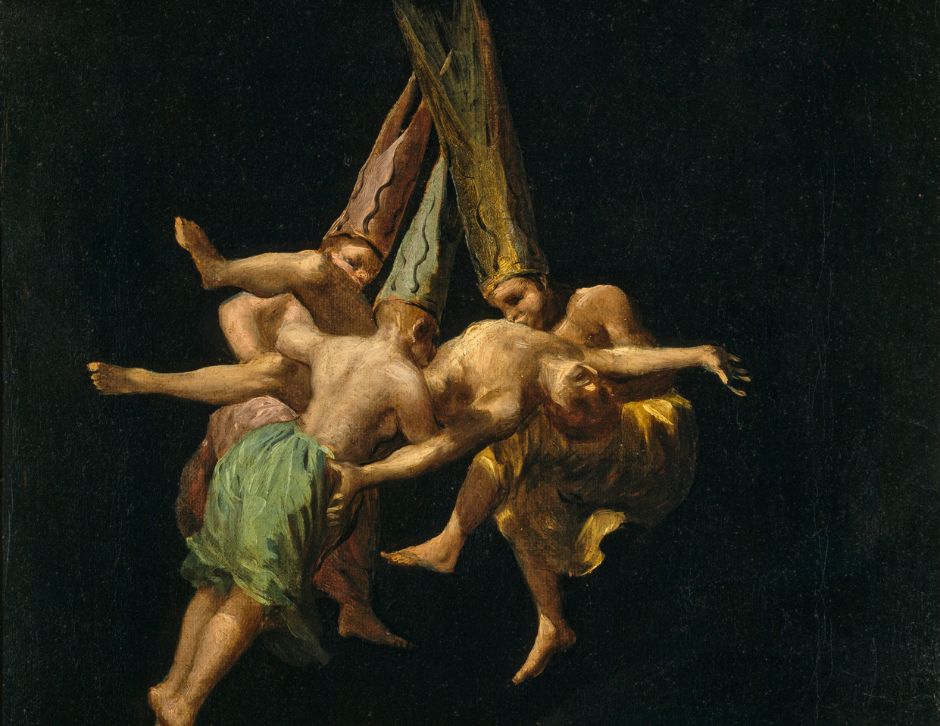
- Featured Image: Vuelo de brujas by Francisco Goya; Francisco Goya, Public domain, via Wikimedia Commons.
- Witchcraft and Paganism Today by Anthony Kemp.
- Witchcraft and the Black Art – A Book Dealing with the Psychology and Folklore of the Witches by J.W. Wickwar.
- Witchcraft at Salem by Chadwick Hansen.
- On Ugliness by Umberto Eco, Alastair McEwen (translator).
- Salvator Rosa: His Life and Times by Scott, Jonathan.
- The World of Realism by Henri Haymans.
- Albert Dürer: His Life and Works by Moritz 1838-1884 Thausing (Author), Fred A (Frederick Alexis) Eaton (Creator).
- The Life and Art of Henry Fuseli by P.A. Tomory.
- Goya by Goya, Francisco.
- The life of Benjamin West (1816-1820) by John Galt.
Related Reads.


