

As scrolling is dragging this generation to have a Goldfish Memory, an exception that keeps most readers belted to their seats are ancient mythology, demonology, and cults. There might have been a moment in your time when you found an object to be of great value despite its shady appearance, and unsurprisingly the stories these objects associate themselves with can be a cave to our minds who have been requiring the needed break. Taking a page out of this philosophy, in the last week of my month, I keep myself light on work and practice to refresh my brain through Thriller or Crime Novels or Flanagan’s twisted stories, not that they are the same anymore. But taking this to a higher floor is my friend who is a mole on the web searching for convincingly terrible stories, particularly evolving around Horror or Witchcraft. Last day, as we were coffee-tasting around our city and talking of a dream she saw, we met a locus, the story of Saturn who ate his sons and left the daughters, a topic I was working on and making notes. Was that just a coincidence? Well, I certainly don’t know about it. But, I have been reading about an artist, Francisco Goya, who was obsessed with dark paintings at one stage of his life. Hence, he painted the famous Saturn Devouring His Son. Today, we are here to read about the artwork.
Saturn Devouring His Son | Fast Knowledge
Francisco Goya painted Saturn Devouring His Son between 1820-23, depicting the Greek Mythology of Saturn eating his son. The painting is part of the Black Paintings series by Goya and is on public view in the Prado Museum.
General Information About Kronos Eating His Son.
1. Artist’s Statement.
“Always lines never form! But where do they find these lines in Nature? For my part, I see only forms that are lit up and forms that are not. There is only light and shadow.”
2. Subject Matter.
The painting, also referred to as Saturn, shows a highly terrific haunting of the mythological archetype Saturn. The subject matter of the composition shows Saturn, who is eating the body of an infant. The rough nakedness of the character, disheveled appearance through hair and beard, and wide-eyed stare show the hysterical madness of the persona. There is no head or right arm on the infant body he holds in his hands, and he is about to bite his left arm. As he devours his body, oozes of blood flow from his hand.

3. Artist.
Francisco José de Goya y Lucientes, one of the most significant Spanish artists of the late eighteenth and early nineteenth century, painted Saturn Devouring His Son. In his long career, the artist made two kinds of paintings; earlier in his life, he made jolly and lighthearted ones, and in later life, he usually painted deeply pessimistic and emotional drawings, etchings, and frescoes. Born in Fuendetodos, Francisco began his painting career by studying under the painter José Luzán Martínez at fourteen. The year 1746, which is the year of the artist’s birth, is historically crucial as Spanish was under the rule of Ferdinand VI. As a result, the Bourbon king Charles III (r. 1759–88) ruled the country as an enlightened monarch sympathetic to change and employed ministers who advocated radical changes in the economy, industry, and agriculture. The Enlightenment period marked Goya’s artistic maturity.

4. Date.
Francisco Goya painted the composition Saturn Devouring His Son during 1820-23.
5. Provenance.
In 1819-20, when Francisco recovered from an illness, he used his time to decorate his house, Quinta del Sordo (Deaf Man’s House), and constituted a series of Black Paintings. Out of all of them, the Saturn Devouring One of His Sons remained spine-chilling and most terrific work.
Francisco bought this house in 1819 on the banks of the Manzanares River opposite Madrid. Leaving the city and moving into the house, Quinta del Sordo was his way of getting away from Ferdianand’s oppressive climate, as well as to avoid being under close supervision by the Inquisition, which he had reason to fear due to his personal relationship with Leocadia Zorilla de Weiss, a relative by marriage to Javier. In 1812, Leocadia’s husband abandoned her because of her infidelity, while in 1814, she gave birth to a daughter, Rosario, who almost unquestionably belonged to Goya. The date of the move to Quinta del Sordo is unknown, but Leocadia was indeed there since a portrait of her stood by a tomb, decorating the wall of the house with fourteen black paintings by Francisco.
I will tell you the entire history and provenance of the circumstances and the paintings in the later sections.
6. Location.
Currently, Saturn Eating His Son painting resides in Museo Del Prado.
7. Technique and Medium.
Saturn Devouring His Son is a mural painting, which Francisco painted on one of the house walls, La Quinta del Sordo. With the massive use of dark pigments and black in the mural, the artist used a sombre subject matter with heightened tension. The privacy and intimacy of the home allowed the artist to build the characters with great expressiveness. He painted directly on the walls with a mixed technique, as a chemical analysis revealed the use of oils. In 1873, Baron Émile d Erlanger acquired “la Quinta” and had the paintings reproduced on canvas. There was an enormous amount of paint lost in the process, making the works look drab. However, the canvas is now safe in the Prado Museum.
| Artist | Francisco José de Goya y Lucientes |
| Year Painted | 1820-23 |
| Medium | Mural Painting |
| Period | Romanticism |
| Genre | Mythological Painting |
| Series | Pinturas de la Quinta del Sordo (Pinturas Negras), Planta baja |
| Dimensions | 143.5 x 81.4 cm |
| Value | Not on sale |
| Where is it housed? | Prado Museum |
Detailed Description of Francisco Goya’s Saturn Devouring His Son.
About the Artist: Francisco Goya.
Francisco Jose de Goya y Lucientes (the artist’s full name) was born on 30th March 1746 in the province of Saragossa. He went to the school at Saragossa and took an apprenticeship under José Luzán. I have already discussed this in the previous section. In 1763 and 66, Francisco went to Madrid to participate in competitions at the Royal Academy of San Fernando but he was unsuccessful twice. When he left Saragossa, he took commissions of extensive religious decorations, and the work that brought him to attention was the fresco in the vault over the Coreto at the east end of the Cathedral of El Pilar. His series of wall paintings in the Charterhouse of Aula Dei was also quite a success. Other than this, we do not know much about the artist from those days.

Francisco Jose de Goya y Lucientes (the artist’s full name) was born on 30th March 1746 in the province of Saragossa. He went to the school at Saragossa and took an apprenticeship under José Luzán. I have already discussed this in the previous section. In 1763 and 66, Francisco went to Madrid to participate in competitions at the Royal Academy of San Fernando but he was unsuccessful twice. When he left Saragossa, he took commissions of extensive religious decorations, and the work that brought him to attention was the fresco in the vault over the Coreto at the east end of the Cathedral of El Pilar. His series of wall paintings in the Charterhouse of Aula Dei was also quite a success. Other than this, we do not know much about the artist from those days.
In 1771, Francisco married Josefa and began to work in close associations with his two brothers-in-law, Francisco Bayeu and Ramon Bayeu, in Madrid. Francisco Bayeu was already in favor of the Court and was a famous and influential painter during the reign of Charles III. So he managed to get a series of commissions for tapestry cartoons of scenes from admired life for his brother Ramon and his brother-in-law Goya. In the timespan between 1775 and 1791, Francisco executed sixty-three cartoons with attractive bright colors. In 1780, after his election to the Royal Academy of San Fernando, the artist got a commission to create a fresco for a dome and its pendentives over a section of El Pilar, Sargoassa. In this way, Francisco had a significant career from the beginning. However, it was only in 1783 that his fame widened as a portrait painter after he painted Charles III’s chief minister, the Conde de Floridablanca, with himself in the foreground. With a series of commissions for portraits, Francisco received a stream of success, and he occupied the position of court painter of Charles III.
Now that you briefly know about the life of the artist, let me take you to the next section, which will tell you more about the artwork Saturn Devouring One of His Sons.
History and Background of the Artwork.
After the restoration of Ferdinand VII, Francisco gave up his residence in Madrid and bought a property on the other side of the river Manzanares, close to the Puente de Segovia. The house was a small and unpretentious building of two stories with windows to give a commanding view of Madrid. The rural home where he loved to entertain his small group of friends became known as the House of Deaf Man, whose domestic arrangements were controlled by his second cousin, Leocardio. She lived with Rosario Weiss, born in 1814, under the same roof as Francisco. In 1819, Francisco suffered from a severe illness, but it didn’t stop his productivity during the last years of his life in Spain. His work during this period included engravings of thirty-three plates for a series, Tauromaquia, of which 18 were titled Proverbios, and a few scattered plates that included The Colossus. He was also busy creating the most fantastic inventions ever devised by an artist for the walls of his Quinta.
During the last years, he decorated the house with frescoes, now housed in the Prado Museum. When these artworks were in an exhibition in the Trocadero during the Paris Exhibition of 1878, they produced varied feelings among the viewers. Hamerton describes them as
“Goya’s mind grovelled in a hideous Inderno of its own- a disgusting region, horrible without sublimity, shapeless as chaos, foul in colour and forlorn of light, people by the vilest abortions that ever came from the brain of a sinner.”
He further, stated,
“Francisco surrounded himself of these abominations of devilish satisfaction and rejoicing in a manner altogether incomprehensible to us, in the audacities of an art in perfect keeping with its revolting subjects.”
Among all these paintings and artworks we are talking about, Saturn’s painting was the most horrible. I would like to show you the Rubens version of the artwork before we continue discussing the famous “Black Paintings” series, which included the famous Saturn Devouring His Son.
Rubens’ Version of Saturn.
We are not discussing the entire history of Rubens’ Saturn but you must know the basics. In 1636, Rubens painted Saturn. The artist used a traditional iconographic representation of Saturn by clasping a scythe in the right hand and setting it upon the clouds in a cosmic landscape. The depiction of clear muscles as the man boults down that little boy is terrific. You see, it is probably Rubens who gave the idea of a mythological scene with a conglomeration of expressions.
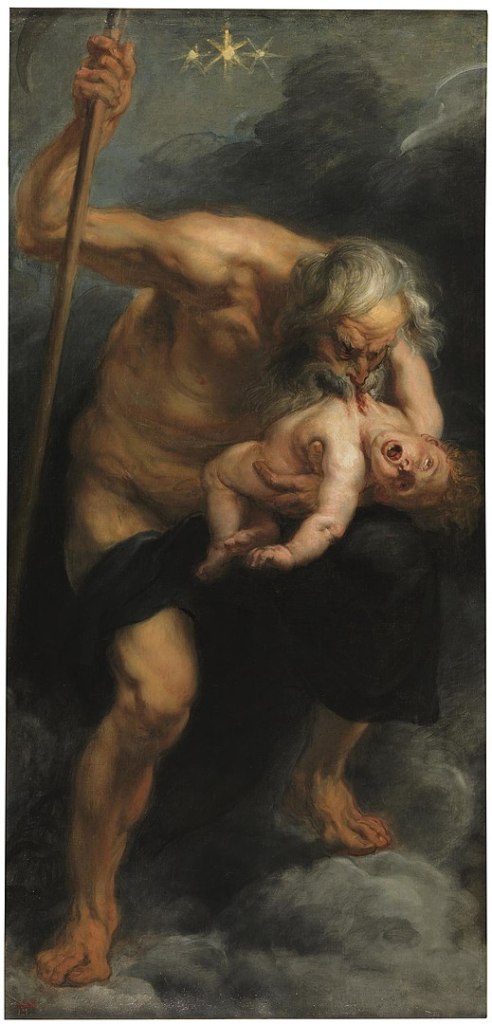
There is smoothness in the painting with realism, still intact with no blood flowing, like by Francisco.
Now, let me show you the famous Black Paintings of Francisco in detail.
Black Paintings by Francisco Goya.
The Black Paintings were a series of oil compositions that Francisco painted directly onto the walls of two of the rooms of the country house, La Quinta del Sordo, between 1820 and 1823. All these paintings have a subject matter blackened and overpowered by the sparkling visual punch and power of expressivity. These were not commissioned by anyone to Goya but defined his own taste as he put up with his influence upon contemporary Expressionism and Surrealism and delineated things that have absurd, violent, and irrational models. The personal considerations that made the artist create such paintings might be his age, poor health, and affair with Leocadia Zorrilla. It is not his depression that is shown in these Black Paintings, but his scorn for the Inquisition that was abolished in March 1820 amid a moment of hope among liberals who had made Ferdinand VII swear to follow the Constitution of 1812.
The Black Paintings is a series of fourteen paintings in rooms measuring 9.02 x 4.51 meters. The Ground Floor room includes Saturn Devouring one of His Children, Judith and Holofernes, Una manola: doña Leocadia Zorrilla, Two Friars, Two Old Ones Eating Soup, Witches’ Sabbath, Saint Isidro’s Pilgrimage.


The upper Floor Room includes Man Mocked by Two Women, The Reading, Fight with Cudgels, The Pilgrimage to Saint Isidro’s Spring, The Fates, The Drowning Dog.


Understanding the Meaning of Saturn Devouring His Son.
Saturn Devouring His Son narrates an Ancient Greek mythological story from the past. According to the mythology, it says,
“But afterwards Earth lay with Heaven and bare deep-swirling Oceanus, Coeus and Crius and Hyperion and Iapetus, Theia and Rhea, Themis and Mnemosyne and gold-crowned Phoebe and lovely Tethys.
After they were born Chronos, of her children the wily, youngest and most terrible, and he hated his sire father.”
Now, before we understand the scenario, let me give you an understanding of the character; Saturn. Also known by the name Cronus (also Kronos), Saturn is the son of Gaia, who is Mother Earth and Uranus. According to mythology, Saturn reigns over death, old age, melancholy, drought, and war, and he is the genius behind dearth and catastrophes.
Now, it is said that through the flint sickle given to him by his mother, he castrated Uranus. Due to this, the blood flowing from his wound fertilizes the world and creates Erinnyes, Titans, and Nymphs. As per a prophecy, Saturn will be overthrown by one of the sons. Hence, when he got married to Rhea, Saturn used to eat his offspring, only his sons, as soon as they were born. The painting, Saturn Eating His Son, shows this story.
However, their mother cunningly saves the youngest, Zeus. Once he reaches manhood, he compels his father to regurgitate his brood and then leads a successful war against the blood-sprung Giants.
Now that you understand the painting’s meaning, let us finally move to the subject matter analysis of Saturn Devouring One of His Sons.
Subject Matter Analysis of the Artwork.
Francisco showed the cruelty of mythological trapping. The Saturn he showed here has bulging eyes, maw drools, hands mangled at a corpse, and devours an offspring underscoring the terrible humanness of the scene. There is nothing here except Melancholy and Death, where the lonesome cruel old man eats the kid with blood flowing through his hands. Francisco deforms his body to create a movement through muscles and limbs, which gives an impression of latent bestiality. The uncompromising visual stamp, gruesome postures, rank gloominess of the anecdote, and the ashamed pictorial fact of the figures make this scene a modern expression.

In this painting, Saturn devours one of his sons with the voracity of a famished wolf. Every detailed overview on the canvas, from largemouth to blood spills and wide eyes, makes it more disgusting. Hamerton says,
“Enough has been said to show that Goya has made himself a den of foulness and abomination, and dwelt therein, with satisfaction to his mind, like a hyena amidst carcases.”
Now, let me take you to the final part to understand the remaining part of Saturn Devouring His Son painting.
Learning Saturn Devouring His Son Analysis.
1. Line.
The painting shows several lines. For instance, it has a presence of diagonal lines to showcase instability. You can notice them through the hand of the infant, which lies to its body diagonally, showcasing a resilient dilemma and melancholy. Further, the man’s posture is also in the diagonal line, showing catastrophic gloominess and violent instability. Next, if you look at the knees of the man and the buttocks of the infant, they seem in sharp circular curves, expressing violence and turmoil.
The only vertical line here is the infant, which is a new beginning. But the diagonal lines together break this vertical line, forming an agitation.

2. Shape.
There are sharp circles through the man’s open void mouth, infant buttocks, and angular joints of the man. There is an absence of geometrical and natural shapes. However, if the gruesome eyes and two feet join through a line, it forms a triangle.

3. Light and Value.
Saturn Devouring His Son is a dark painting and lacks brightness in it. Even with the soft contours of the body, there is an absence of value. But the infant’s body becomes a spotlight through a soft lightening. The intensity of the painting remains darker, and there are no bright colors. These dull colors with black create a serious and sedate mood. Further, this artwork carries vigor and torment due to the sharp contrast of red blood.

4. Color.
The color of the painting remains majorly black with few shades of grey and a whole red through the blood spill. Outside the figures to make a gruesome and lone nature, the artist filled black color. In Saturn Devouring His Son, dark-themed colors contribute to a melancholy atmosphere.
Opinions and Conclusions.
The painting, Saturn Devouring His Son, is truly a masterpiece. Though many contemporaries and critics have called it a gruesome and lonesome piece of art, it remains a melancholy and interesting subject for hundreds of art lovers. The painting enriches the mythological narration through its dark-themed colors, texture, presence of strong vertical lines, and sharp contours.
Resources.
- Francisco Goya: A Study of the Work and Personality of the Eighteenth Century Spanish Painter and Satirist by Hugh Stokes.
- Goya: Black Paintings by Bozal Fernandez, Valeriano, Museo Del Prado.
- Francisco Goya by Eric Young.
Frequently Asked Questions.
In Greek mythology, it was prophesied that Cronos or Saturn would be overthrown by one of his sons one day. In response to this, he devoured all of his male offsprings just after birth. Nevertheless, his wife, Rhea, cleverly saved one of their sons, Zeus, who overtook his father after he reached manhood.
The Greek myth, Saturn Devouring His Son, painted by Francisco Goya, depicts the scene when Saturn or Cronos ate his son, after their birth. The power-hungry and notorious man shown with the wide-eyed, open black mouth showcases a terrible and violent representation of the fear that he would be overthrown by one of his male offsprings.
Quinta del Sordo means the house of the deaf. It was named after Francisco Goya, who lost his hearing after a fever. As a result, he named the country house, where he lived and painted Black Paintings, Quinta del Sordo.
According to Greek Mythology, Saturn or Kronos or Cronos is the son of Gaia. He reigns over death, old age, melancholy, drought, and war, and he is the genius behind dearth and catastrophes.
Some of the elements that make Saturn Devouring His Son by Francisco Goya scary are the bulging eyes, hands that exert pressure on the corpse of a child, the contrasting color of blood, and the use of black for creating melancholy in the painting.
According to the mythology, Saturn married Rhea, who cunningly saved their youngest son, Zeus.
Francisco Goya’s Saturn Devouring His Son is a mural painting belonging to the Romanticism Age.
Related Reads.


