
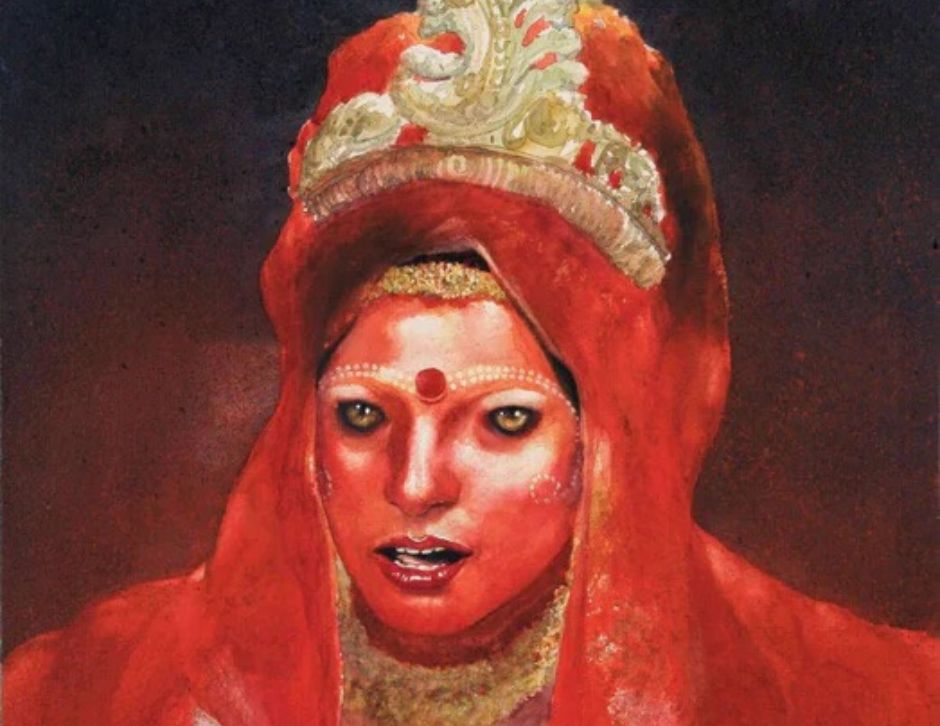
Bikash Bhattacharjee, an artist who thematically used a wide range of imagery to leave a mark on the course of history, comes from a time when Bengal witnessed some of the most horrific and haunting events. In that era itself, several artists shared the intention to display the scenarios of the time, some with spiritual consent, others with realist or surrealist, but all of them had one similarity: to carefully stage the image for maximum dramatic effect. However, before I talk about any of the artworks of these artists, specifically Bikash, let’s first shine a flashlight on the Bengal Renaissance, from where it all started. The term Bengal Renaissance has long been debated by scholars for the question, did Bengal actually experience a Renaissance. If I were to take a stance on this, I’d really call it so, as it was an era of new social, political, and cultural orders that India experienced through various means. Having roots in British Orientalism, Bengal of the nineteenth century had some of the most immaculate scholars, writers, reformers, scientists, mystics, and artists. Between the 19th and 20th century, Bengal witnessed the unveiling of the cognitive nature of creativity through Indology, theology, literature, science, and practise of religion, giving a cognitive revolution to Indian artistry. This, in general, is such a lengthy and inspiring revolution that nobody could sum up in even a few books. Furthermore, several other countless forces shaped Bengal’s intellectual renaissance—from devastating socio-economic crises and the grim toll of famines and diseases, to the seismic shock of India’s partition eventually, which irrevocably transformed Bengal and changed it forever. In all of these, there was one thing that expressed all the pain, suffering, intelligence, reforms, and politics of Bengal: the painting of the time. In this article, I will discuss the life and art of the surrealist Indian artist, Bikash Bhattacharjee, which further overviews the Bengal of the time.
Artist Abstract: Bikash Bhattacharjee.
Bikash Bhattacharjee launched his creative career in the late 50s, but he stood apart from his contemporaries by using hard-edged chiseled realism, strong light, and deep shadows like an art photograph. In his works, he portrays an exceptional technical mastery with his power to charge the appearance of the subjects with a deceptive reality of the depth beneath. Being an artist who evokes near-illusionism of the realistic details, his imagery has an obvious distortion and multi-layered meanings. Having spent his early life in an old North Calcutta locality with an urban social ambience, his images explore the themes of dark social and moral tones.
| Artist | Bikash Bhattacharjee |
| Birth | June 21, 1940 |
| Death | December 18, 2006 |
| Nationality | Indian |
| Movement | Surrealist Art |
| Famous Paintings | Doll series and Durga Series |
Life of the Artist.
Three words that actually describe the outlook of the artist’s life and works are conservative, realist, and traditional. However, these words carry a special implication when describing the artist. For instance, the conservatism that Bikash had in himself was an eagerness for a change and progress, instead of keeping up with the old norms and self-indulgent cultural practise. Similarly, when it came to tradition, he counterchecked its core instead of having blind faith in whatever was called a tradition. This was because he saw the sufferings of women so closely because of the harsh regimes of the so-called old values on them, whether they were married, unmarried, or widowed. Hence, most of his paintings carry the pain and suffering of women. Furthermore, he saw his mother’s life, which was filled with challenges after his father’s death.
Born in Calcutta in 1940, Bikash Bhattacharjee studied Fine Arts from the Indian College of Arts and Draftsmanship. Having a fatherless childhood, these days of the artist’s life were completely bleak. As he grew up, he had two reminiscences of his father- one where his father is buying clothes for him, and the other when he was dead on a bedstead while his mother mourns him. Those days were tough for him because all he faced was loneliness, poverty, and pain. There were days when he felt the constant humiliation by his uncles as they provided them a good meal, and had they never been there, they would have starved to death. One of the incidents that he remembered throughout his life was when his father died, one of the hands from the crowd gave him a coin as to distract him from the current scenario. He used this incident in his paintings as an irony.

For most of his adolescent days, he roamed like a loner in several of the streets, where he saw the city, slum dwellers, and the lives of the people living on the back streets. Hence, his paintings portray the street views of 20th-century Calcutta, including people, rooftops, alleyways, and crumbling building walls of where he lived. As a profession, he first taught at his alma mater in 1968, and then at the Indian Colleges of Art and Draughtsmanship from 1968 to 1972. After 1972, he taught at the Government College of Art and Craft till 1982. He was an active member of Lalit Kala Akademi, New Delhi, and the Society of Contemporary Artists, Calcutta.
In his entire twenties, he saw the cityscapes filled with asphalt streets, brick and morter buildings that looked absolutely desolate. He portrayed the dark and damp alleys, desolated environment in his paintings in an un-seeming arrangement of scales, space, and chromatic values. Furthermore, he depicted political leaders in his paintings, as he was sympathetic to the principles and objectives of the Communist Party. However, his works embody the elements of surrealism and hyper-realism with an imprint of well-etched subjectivity in technical precision.

Bikash Bhattacharjee was awarded by the Academy of Fine Arts, Calcutta in 1962, the Lalit Kala Akademi’s National Award in 1971, the Bangla Ratna from the State Government in 1987, and the Padma Shri by the Government of India in 1988.
Looking at the Art Style of Bikash Bhattacharjee.
Bikash brought back realism to Indian art when artists leaned towards distorting figures and abstraction. The artist included a familiar crowded jungle of asphalt streets in his paintings in his early twenties, but this changed in his forties when he applied the techniques of Post-Renaissance European oil paintings to create an illusion of reality of the actual world. But Bikash didn’t choose to display the simple drama of human nature; instead, he chose something completely different. Painting after painting, he just composed a haunting and terrifying drama with an irony in which humans are engaged. In all of his pictures, he twanged a generalised concept of the human condition in an alienating worldly order. At first, his pictures had more human condition, but after a while, his mature artworks had a more focused and unprecedented attention to the loneliness in an enigmatic and volatile environments. The entire doll series is about the vulnerability of an individual in different situations in a dreadful manner. Furthermore, the women’s series he painted is about the defiled women who enigmatically took their condition of oppression as terms of glorification, suffering the consequences of self-deception. These women were mainly the lives of Bengali lower-middle-class women in a deceptively academic manner. There is a relation between these artworks with dream psychology of Sigmund Freud that the Surrealists used.
In all the Bikash Bhattacharjee paintings, there is a use of strong light and deep shadows, which looks like an art photograph against the tide of Indian fashion. Bikash, in a conversation with his fellow artists, stated,
“Whether I’m realist, naturalist, or surreal, I do not know. It may be a combination of attitudes and techniques.”
He further explained his influence from the cinema on his compositions, stating,
“I’m influenced by the cinema. I used to see up to thirty-five films a year. I’m inspired by film shots, their compositions within a frame…”
Influences On Bikash Bhattacharjee.
1. Rembrandt and Goya Influences.
Bikash studied a lot of artists back then, but Rembrandt and Goya inspired him most, which is why the artist’s painting technique resembles them. Rembrandt had an impact on his paintings from the theatre, and Bikash too was greatly interested in regional movies of the late 1900s, which is also a similarity between them. Hence, the early Bikash Bhattacharjee paintings, which include the Durga and Doll series, has theatrical lighting, like Rembrandt did in his works. In addition, there is the use of expressiveness, which theatre and films use, in the figures to make a greater emphasis.

However, his late works have an eerie sense like the dark paintings of Goya. Works like Morning, 1990, has an eeriness, like the Yard with Lunatics, where the figures sees you with an awkwardness and in a bizarre manner.


2. Hans Bellmer Influences.
The entire Bikash Bhattacharjee Doll series was inspired by Hans Bellmer, when the doll actually took the place of a human emotion in a sinister way. Hans Bellmer used the sinister Victorian dolls and clowns, who are dismembered and mutilated in the interior domestic setting. Though Bikash didn’t use life-sized dolls in such a manner, he used children’s dolls in alienated valleys and domestic settings with an uncanny emotion.
However, it is evident from Bellmer’s compositions that he depicted the erotic photographs and drawings of dolls and mannequins as metaphors of sexuality. Bikash instead explored the alienation and self-destructive isolation in his compositions in a sinister way. The 1934 issue of the Surrealist publication, Le Minotaure, describes the compositions as variations on the assemblage of an articulated minor.

3. An Influence of Surrealists, Freud, and More.
Surrealism has long served as a means to display the tendency towards subversion and the subconscious mind of the artist. Bikash showed characters in an environment, rendering a sinister theme. A little history of Surrealism is essential to understanding the art of Bikash Bhattacharjee, which is why I am brushing up on a few important things.
Surrealism was developed on Freudian studies and was initially conceptualised in Paris when a poet and critic, Andre Breton, wrote about it in the publication of the Manifesto of Surrealism. Hence, the artworks have the undulating contours of the mind and human psychology that Freud explained in his works. In his 1924 Surrealist Manifesto, Breton defined Surrealism as
“Psychic automatism in its pure state, by which one proposes to express…the actual functioning of thought…in the absence of any control exercised by reason, exempt from any aesthetic or moral concern.” (Breton, 1969)
Before I discuss more about Surrealism, I would like to tell you a bit about the dream psychology of Freud. In simple words, the interpretation of dreams is done because it is capable of giving hints for the structure of our psychic apparatus. It can uncover the original problem behind any thought through dream-disfigurement. However, the question is how to analyse the disagreeable content to fulfill the wishes. One must know that a dream has a secret meaning that which turns out to be the fulfillment of a wish. Now there are several dreams, which have painful content, and their examination can lead one to remove the particular problem. To read and completely understand the dream psychology, you have to refer to the works of Sigmund Freud.
Coming on Surrealism, it’s about to capture the visual imagery from the subconscious mind to create an art without any intention to sort through logical comprehensibility. These works are bizarre as they have an element of surprise and they have depictive expressions while a fascination to the Freudian analysis of the subconscious. If you look at the works of surrealists like Dalí, Magritte, and Miró, you will find that they achieved a distinction of being called masterpieces, as they had an abstract realm while staging a psychological retreat from reality, either past or present. Now, Bikash used to study Dalí for his works and the Surrealist movement closely, so his artworks are influenced by them.
If you look at René Magritte’s artwork, The Lovers, he added a striking veil to enshroud the lover’s face. The painting is striking and quite realistic, while depicting two lovers engaged in the intimate act of kissing. However, if we critically analyse this painting in terms of Freudian postulates, this appears not to be the case. Probing deeper into Magritte’s past, we see that his childhood was marked by the disturbing memory of his mother having committed suicide by drowning herself in a river. Magritte’s vision of his mother’s body floating on the river with her dress obscuring her face was a memory that was pushed into his unconscious, given its deeply troubling and tension-inducing nature. Although Magritte always denied that this incident had affected any of his works, enshrouded faces were a common motif in his art.

Coming to the artworks of Bikash Bhattacharjee, he painted witchy eyes of women, which might be because he wanted to portray women as deceptive. Though he respected and adored women because of their ability to remain happy with their small group even in the worst times, he always pointed out that they keep themself in deception for most situations, making them suffer more. Further, as he grew up, he saw his widowed mother in pain and suffering due to social stigmas, sympathising with women and further portraying them in agony. In the entire Durga series, he portrayed the women he saw in his life who lived miserably, but they have this eye, the eye of strength, which they fail to recognise. Bikash saw the sufferings of women, and that might have stepped into his subconscious mind, but the dreams he had might be petrifying. This might be the reason he painted the woman’s eyes to be witchy. Furthermore, the psychoanalysis of Freud also connects witchcraft or magic to an escape from the affliction, which Remedios Varo did in her paintings. Hence, it might be possible that Bikash gave an escape way to the women through magic who suffered in their lives.


4. Comparison with Nalini Malini’s Art.
Nalini Malini is known for her thematically wide-ranging imagery, whereas Bikash’s work sought to define a portrait space for the characters who are in the process of mutation. The interiors that sought to surround the characters are haunting in both of their paintings. For instance, in Nalini’s composition, Bloodlines, she depicts a dark landscape, which is based on the political event of the partition of India. Similar to this, Bikash’s painting She (1968) shows a woman twisted flying over an alienating landscape, which is based on the younger memories of the artist. Though both of them depict landscapes from regular life, they have a poignant sense with respect to the subject of the paintings. However, there are fundamental differences between their art.


Nalini painted a lot more introverted, alienated, and possibly psychotic personalities in dim and sealed spaces. One has a feeling of guilt as they watch her painting, but Bikash’s characters are normal, and the interior space is rational, too. He paints with technical skill in a painstaking manner, but his figures have illusory eyes, more probably eyes of a witch, and the body of a bronze deity. The room changes character when it shows these elements, as they are secret alchemies.
Nalini gives a psychological metamorphosis in her compositions, but Bikash shows magic metamorphosis with a reference in Surrealism. I already told you the artist’s perception of Dalí’s works.
Indian Tantra Yoga.
The most significant part of the artworks of Bikash Bhattacharjee is the symbolism of Indian tantra, which was quite popular in Bengal in the 1900s. Though a contradictory issue, the paintings depict the influences.
If you examine a few paintings, such as Morning 1990, you will notice that it features the Shaktipeet of Sati, which is evidently used to channel magical powers for a specific purpose. Since the tantras include chakras, circles, visualisations of elements and elementals, forms of God and Goddesses to represent the energies of natural principle, ritual postures, gestures, curations, and worship, it was not everyone who could perform these acts. According to Nig Douglas’s book, Bengal remained a stronghold of the Tantric tradition, though in a modified form strongly influenced by Shaivite, Shakta, Vaishnav, and Baul cults.

Now, if you compare the painting with the Holy Tree, you will find that the holy tree and the yoni are represented again and again in his compositions, which are the important parts of Indian Tantra. Furthermore, though not a part of Indian tantra, his paintings consisted of totems and a devil’s face.

Final Words.
In my opinion, the paintings of Bikash Bhattacharjee are characterised by a pervasive sense of darkness, with many works evoking unease or even fear. Some figures appear empty or hollow, while others are rendered with striking expressiveness. Across his body of work, the theme of lust is as prominent as the madness present in Goya’s most disturbing pieces. A closer examination of his body of work reveals numerous studies of women that demonstrate Bhattacharjee’s expertise in anatomy, lighting, and other technical aspects of painting.
Resources.
- Featured Image: Bride by Bikash Bhattacharjee; Tallenge Store.
- BENGAL RENAISSANCE,THE(HB): Identity and Creativity from Rammohan Roy to Rabindranath Tagore by Subrata Dasgupta.
- Close to Events: Works of Bikash Bhattacharjee by Manasija Majumder.
- Indian Art (Oxford History of Art) by Partha Mitter.
- Pictorial Space by Lalit Kala Akademi.
- Psychology in Art: The Influence of Freudian Theories on Surrealist Art by Nitansha Nema.
- Dream Psychology by Sigmund Freud.
Related Reads.


