
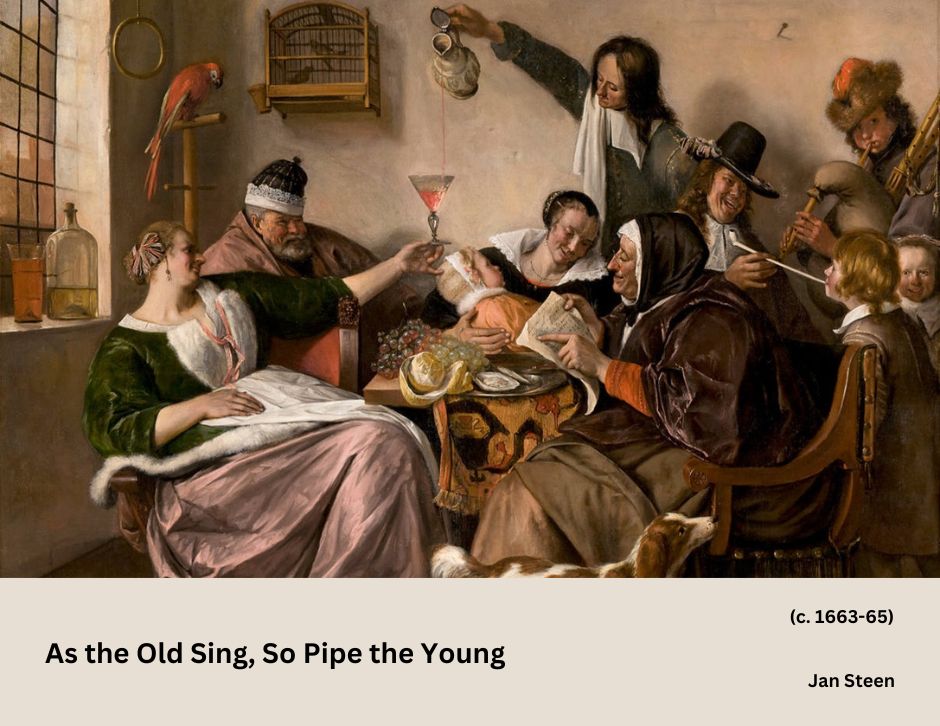
The seventeenth-century Dutch painters changed the landscape of craftsmanship and art. Whether there are striking motion-picking portraits of Frans Hals, the sunny and luminous interiors of Pieter de Hooch, the exceptional psychological setting of Rembrandt, or the humorous pictorial setting of Jan Steen, the more I mention the names of the Dutch painters, the more I find it strenuous to conjure up the glorious era of the history of the seventeenth-century paintings. I do not intend to give a detailed overview of all these artists’ lives and compositions through this article; practically, it is impossible to summarise anyone’s works and lives. Thereby, I have started to introduce the rare paintings of the artists, which narrate the brief parts of the artist’s life while explaining the story behind those artworks. But before I begin to describe today’s marvelous pieces, I shall abide by the rules of the introduction- which is warming up your knowledge of the particular era. Talking about the subjects of the Dutch artists, though they were modest; a street, room, glass of wine, lady or gentlemen or sea, they had the minutest detail through the meticulous attention of the artist. In addition, their scenes were simple, including the kitchen chores, well-dressed women reading, playing music, or riotous scenes of inns or bedrooms. The most unusual themes were picked by Jan Steen, infusing much of the wryly comic personality. The Dutch proverb “a Jan Steen household” refers to a home in disarray, which has rowdy children, fools playing around, and his own imitation through humorous portraits. To connect the viewers with his paintings, he usually fostered the competitive cultural traits of wit, exchange, and challenge by including himself or his wives through comic rule as a fool’s guise. Amongst his many paintings, I am introducing one of his most beautiful and entertaining works, As the Old Sing, So Pipe the Young.
Jan Steen always believed that every painter paints himself, and he was not entirely wrong here as we have seen especially, in the Dutch Golden Age artworks, how artists portrayed themselves in their exquisite masterpieces. Similar to many artists, Jan Steen also portrayed himself in many of his compositions, but there was a twist. To spot him in his artworks is the most compelling part, as he would often paint himself in comic roles of fool, profligate, or rogue. For instance, in As the Old Sing, So Pipe the Young, he portrays himself in a role to teach the child to smoke a pipe from a straw, thereby serving to create a pun embodiment of the painting’s proverb. Now, you might ask why he would do so anyway. So, the reason lies in the fact that Steen would often fashion himself as a fool to folly a comic strategy, further serving a complex pictorial device, which is destined to baffle the viewer. But this doesn’t end here as he used to alternate his facial features repeatedly in his paintings to make himself seem eternal as if he is putting on a mask, which the generation of viewers and critics will see to construct his never-ending questionable personality. Of course, we don’t know what “real” Steen looked like.
Steen’s first biographer, Arnold Houbraken, characterized the humorous Steen as a
“jocular sot, a hapless ne’er-do-well, constantly in financial straits, who nevertheless was unsurpassed as a master of a lower, comic mode of painting.”
According to him, the artist excelled at adding humor to everyday life scenes, but at the same time, he painted some marvelous history paintings. Indeed, Steen had financial troubles. He was Brewer’s son, who in the 1650s, was mentioned as the brewer in Delft and in 1672 was granted permission to open an inn in Leiden, though no documents confirmed that he set up this business. However, being a brewer and innkeeper was central in his early biographies, which also became a central aspect of his life and artworks.
A fundamental aspect of seventeenth-century art was the relation of the painting and the theatre. Steen also imparted this sense of theatricality to his countless works, but there was one difference between him and Rembrandt or his other contemporaries. This difference is that while other Dutch painters specialized in portraiture, genre, landscape, or still life art, Steen painted a broad range of subjects. Though his paintings were comic and often showed low or vulgar subjects, they displayed a witty erudition.
Coming to the painting As the Old Sing, So Pipe the Young draws its subject from Jacob Jordaens, who himself once tried to revive the older Flemish tradition through this similar comic approach. Jacob painted As the Old Sing, So Pipe the Young in 1640. Steen used real models in scenes from daily life for his paintings to achieve a convincing landscape. This similar approach was also practiced by Pieter Brueghel the Elder when he portrayed country fairs and weddings to exemplify the truthful faces of the ignoble subjects. These inspirations clearly helped the artist to compose Twelfth Night and As the Old Sing, So Pipe the Young.


The impulse to translate and convert the genre paintings into comic descriptions was not unique to the artist. But he yielded an unusually rich narrative description in his compositions, particularly in the eighteenth-nineteenth century sale catalogs where he frequently discerned himself in his comic scenarios. One of the classic examples is Steen’s As the Old Sing, So Pipe the Young, which is an autobiographical scene.
The painting is a punning play on the children who imitate their elders through smoking and blowing on pipes. It shows three generations of the family, who are gathered around a table, which is draped with a carpet and has a pewter plate of oysters, an oversized lemon, and a bunch of grapes. In this domestic setting, Steen paints an old woman as his mother, who is reading a newspaper to his second wife. The inscriptions of this sheet follow,
“Song/ As it is sung, thus it is piped, that’s been known a long time, as I sing, so (everyone) do the same from one to a hundred years old.”
His second wife is carrying an infant lovingly in her arms and she glances in the newspaper while having a good time. On either side, a grandfatherly man smiles benevolently as he sees his happy family. A servant pours wine for his first wife while the painter himself teaches his son to smoke by a straw. The artist casts himself in the fatherly role as he undermines his paternal authority, further enlisting the other family members as transgressors. The little boy is his son, Cornelis, whereas the other boy who is playing bagpipes is most likely his old son, Thadeus, and the little girl who looks towards the viewer to engage our attention is his daughter, Eva.

In this entire composition, the most savage character is the artist’s first wife, Margriet van Goyen, who is slouched across her chair with her foot set on a foot warmer. She is an image of indulgence. Wearing a fur-trimmed green velvet jacket, she shows her intemperance with the raised glass to have wine. The parrot above her is the symbol of her learning and imitation, reiterating the role of her negative exemplar. It is worth noticing that the artist cast himself and his entire family to address the themes of learning and imitation in several ways. And it must not be neglected that the painting title itself which is a Dutch proverb refers to the “eternal regeneration of humankind’s innate foolishness.” Hence even the animals in this painting are the imitation of human nature.
Certainly, the images of the children who are drinking and smoking show that their parents served as their proper models. The painting is a slippery proverbial truth that whatever parents do, children imitate. In this painting, the grandfather’s kraamherenmuts, a traditional hat worn by new fathers draws attention to the sleeping baby. Look how this baby is strategically located between the glass of wine and the proverb in the song shit, which further underlines the father’s abdication of his paternal duties.
Talking about the technique of the artwork, there is a monumentality and fluid brushwork in the composition which suggests that Steen knew one of the paintings of Jacob Jordaen. In this warmly engaging picture, there is spontaneity in each of the characters which is enriched with the warmer palette. There are convincing facial expressions, remarkably true-to-event quality, and engaging figures, which many viewers find relatable.
Opinions and Conclusions.
Though a lot of theories can literally start an endless debate on the topic of whether children really follow their parents, I still think that a lot of things from our parents are reflected in our behaviors and even habits. Thereby, I see this painting as a reflection of a family, which can have all vulnerabilities but it still stands together. Steen had given a lot of thought in choosing his figures for the artwork while maintaining humorous but extremely relatable expressions and drama in subtle colors and landscapes with a hell lot of symbolism. I see this painting as a mockery of the perfect families who would cover up for themselves but hide in the veil of vulnerabilities passed to the next generation. What do you think about this artwork? Let me know in the comments.
Composed between 1665-67, As the Old Sing, So Pipe the Young by Steen now hangs in Mauritshuis, The Hague.
Resources.
- Featured Image: As the Old Sing, So Pipe the Young by Jan Steen; Jan Steen, Public domain, via Wikimedia Commons.
- Jan Steen, Painter and Storyteller by H. Perry Chapman, W. th Kloek, Arthur K. Wheelock, Guido Jansen, National Gallery of Art (U. S.), Rijksmuseum (Netherlands).
Related Reads.


