
Many of us think that the artist’s spontaneity is the key to his excellent craftsmanship, but spontaneity can never come without the unconscious coordination of form, space, and balance. Hence, though art is imagination and skill, it can’t be left to its chance but must be learned through its own laws of imagination. For instance, who would neglect the fact that Leonardo was a genius in art, but when you look at his painting, Annunciation, you will find that there are errors due to mismanagement of perspective and vision? Hence, art is a gift, but it can’t be applied unless it is taught again and again. To commemorate this fact as well as my determination to explain every single element of art through a series of articles, I am here to explain balance in art today.
Balance In Observation.
Before we learn balance in technical terms, let us first see what it means in our general observation. We constantly describe things like “My right hand is larger than the left, The flagpole is not straight, The piano is out of tune, or The coffee is richer than we had before.” These statements are a clear sense of us realizing that we do measure things on a certain scale.
To understand it precisely, note that any object or thing is seen through its size, taste, and brightness scale, and the slightest difference like a grain of salt can make you feel “It’s different.” This difference we see is in the balance scale. To summarize more, let us talk about the location for now.
Spot anything in your room. Let’s say you have spotted a book. It might be located on the perfect center of the table or a little off-side to it and even other positions. Hence, the book is at a certain spot, having a location, which is defined with respect to the room and the objects near it. This location is the balance of the object concerning the surroundings elements, and space. To put it in a few more words, let me tell you that no object is perceived as unique or isolated as it is always connected to a place in the whole, and we combine this sense to check balance.
Another point to keep in mind is that when you see, it is always a visual judgment. These judgments are immediate and indispensable ingredients of the act of seeing itself. Hence, when you see, these observations from the eye are geographical. For instance, as you are reading this article, if my editor had made a mischievous arrangement with the words and ad placement, the probability is you might have left the entire article no matter how useful it was gonna be. Or imagine if I have adjoined all these paragraphs in a large comprehensive one, your eyes would judge and then respond to your mind, neglecting or avoiding this article. This perception of size, location, or blackness contributes to the tension, called psychological force.
Hence, the balance or arrangement of objects related to the space contributes to even emotional consequences. For instance, some people might feel that keeping a book at the edge of the table in proper posture is a pleasure otherwise the clutter can possibly disrupt them. So, what started with a location or expression led to the connection with your mind. All these things happen in a particular artwork too. To understand the balance in art, let us move on to the next section.
What is Balance in Art?
Balance in art is exactly the same as what we learned previously. The only thing to keep in mind is that here the book is the object to judge balance in art concerning the other elements like line, shape, color, etc. Or, in technical language, balance in paintings is simply the distribution of the weight- the actual or apparent weight of the elements of a composition. Further, it is used to control the distribution or emphasis of other elements like line, shape, and color of the composition.
Let me delve into a little history of how exactly balance came into notice in artistry. The Classical Greek Polykleitos was the first artist to observe the body’s shifting of weight to achieve balance and develop a set of rules to apply this observation to representations of the figure. In his Doryphoros or Spear Bearer, he featured his weight-shift principle. What he observed was that when the body is at rest, one leg bears the weight of the body while the other is relaxed. Additionally, the upper torso shifts as if following an S curve, allowing the arm opposite the tensed leg to be tensed, and the one opposite the relaxed leg to be relaxed as the body tries to balance itself. As a result, tension and relaxation across the body can be read diagonally with weight-shift principles. Hence, an overall balance is achieved.

To check this balance in painting, let us move forward to the next section.
Checking the Balance in Painting.
Let us learn this entire section through observation. Take the painting, Giovanni Arnolfini and His Wife by Jan van Eyck and subject it to the following test- First, sketch a vertical and horizontal line from the center point of the artwork. A central point in this canvas forms the pivot around which the different components group themselves, pulling and competing for attention. The satisfactory picture displays balance on one side as well as the other, and the completely balanced picture displays it above and below the horizontal line. As of this painting, there is a balance from the vertical line and not the horizontal line. This is called complete balance, situated around the middle. The joined hands further act as a pivot point for the whole composition.

In another painting, Madonna di San Sisto by Raphael, when you do a similar thing, you will notice that there is a use of classical balance. To achieve classical balance, an object or figure must have equal proportions on each side, and it should also show balancing elements from top to bottom. The visual effect is similar to the scales above. And for each part, there must be the presence of a corresponding part to keep the scales from teetering.

In the painting, Robert Andrew and Wife by Thomas Gainsborough, take this test- Draw a line where the dress of the lady ends in an attempt to place the main subject on the complete left. Draw one more line from the center point and notice how the subject is close to the pivot point, demanding more balance to the center. Since the main subject is at complete left, closer to the pivot point, it shows the balance of the steelyard. Understand that not every single composition can show complete balance in art. Testing for overweighted parts can be conducted in order to ensure balancing weight does not become a matter of divided interest. Don’t worry, I am going to explain divided interest in the following sections, so you can revisit this painting and understand it clearly.

Like in the painting, The Dutch Courtyard by Pieter de Hooch, the main group is just to the left of the middle, balanced by a small figure and the heights and the mass of the building. You can place your hand over the right-hand side of the picture and notice that the effect is like a seesaw when one person leaves it suddenly, causing the other to go crashing down, as the weight of the left side is more than the right part.

Understanding the Types of Balance in Art.
1. Actual Balance and Pictorial Balance.
To start, remember that actual weight and actual balance are never a problem in a two-dimensional work such as drawings, paintings, and prints. Pictorial balance is the distribution of the visual weight of the elements that are basically two-dimensional, and there are different ways to achieve it. I have pretty much explained the terminology of actual balance from previous sections.
2. Symmetrical and Asymmetrical Balance.
Symmetry, by name, refers to the similarity of form or arrangement on either side of a dividing line or place. The best example of symmetry in artwork is the Vitruvian Man, which is pure or formal symmetry. Though nature does not portray our body this symmetrical, Leonardo’s sketch depicts an exact correspondence between the left and right sides.

Some of the examples of pure or formal symmetry appear more in art rather than nature. By using approximate symmetry, a symmetrical balance can be achieved in which the whole piece has a symmetrical feel, but slight variations provide more visual interest than a mirror image would. It is said to be asymmetrical balance when there are differences between the right and left sides of a composition, but there is still an overall sense of balance in art.
To be more precise, the asymmetrical balance would have a weighted arrangement of components, but there are differences in shapes, colors, and textures on the left and right sides of the composition. For example, in River Dwellers by Wu Jide, there are patches of white and well-placed touches of color, which gives an overall visual balance in an asymmetrical and essentially monochromatic composition. The figures are in balance but the use of colors in even random touches to other parts of the composition makes it balanced asymmetrically.

3. Bilateral Symmetry.
An actual or imaginary line, either on the right or left, can be used to describe pure or formal symmetry. Thus, the regularity and predictability of the symmetry evoke feelings of peace, calm, comfort, and order. Repetition can have a mesmerizing effect. As seen in the United States Capitol Building, the repetition and asymmetry imply rationality and decorum, tying the structure of the building to a certain symbolic ideal. This kind of balance is bilateral symmetry.

In many works of art, the symmetry is approximate rather than exact. Like, there is an overall impression of symmetry in William Wegman’s Ethiopia due to the echoing shapes of the Weimaraners’ heads and the firm vertical line bisecting the composition. Yet few elements, like the juxtaposition of red and green colors and, the detailed face of the dog on the right do break the monotony of the symmetry.

4. Horizontal, Vertical, Diagonal, and Radical Balance.
Horizontal balance in art means that there is an equal visual emphasis on composition through the elements on the left and right sides. As I stated earlier, the US. The Capitol Building has a horizontal balance.
Artists usually use vertical balance through the elements at the top and bottom of the composition. For example, in Kay Sage’s I Saw Three Cities, a firm horizon line separates a landscape from the sky, and most of the visual weight in this composition occurs in the lower half. It is an example of vertical balance.

Another balance in paintings is diagonal balance, which is established through equal visual weight on either side of the pictorial space.
In the case of radical balance, the design elements always radiate from a center point. From the petals of a daisy to the spider’s web, everything revolves around this balance. One of the classic examples of this kind of balance is a decorative tabletop from nineteenth-century Iran- Ali Muhammad Kashigar Isfahani Iranian tabletop. At the center of the piece is a large and round painted tile, which is surrounded by a circular garland of flowers, birds, and a cluster of grapes.

5. Imbalance.
While balance in art affords a certain level of comfort, the imbalance aims to shock the viewer or to play into a viewer’s discomfort in an artwork. One of the classic examples of imbalance in art is Black Venus by Niki De Saint-Phalle, who used an unbalanced position of the female’s lower body, giving the figure a contradictory sense of weightlessness.

Scales of Attraction.
Before we move on to learning the effect of balance through line, light and shadow, shape, etc, let me give you a few significant rules of balance from Henry Rankin’s book, Composition in Art,
- “Every picture is a collection of units or items.
- Every unit has a given value.
- The value of a unit depends on its attraction, and its attraction varies according to placement.
- A unit near the edge has more attraction than the same unit in the middle.
- Every part of the picture space has some attraction.
- Space without detail may possess attraction by gradation and by suggestion.
- A unit of attraction in an otherwise empty space has more weight through isolation than when placed with other units.
- A black unit on white or a white unit on black has more attraction than the same unit on grey.
- The value of a black or a white unit is proportionate also the size of the space that contrasts with it.
- A unit in the foreground has less weight than the same one in the distance.
- Two or more associated units may be reckoned as one.
Their united central point is the point on which they balance with others.”
A scale of attraction measures how much each factor, like line, mass, light, and dark and measure, exhibits balance in a combination.
In each composition, the eye crosses the central division at least once, creating an equipoise or balance of parts. When you look through a composition, the eye naturally shifts its interest to the focus of interest, but there must be something to balance this interest on the other side of the canvas. If it finds nothing, the artist must create something.
For instance, in a landscape, the eye must be attracted by trees to houses, or anything else, as the other half of the painting moves the painting. This is commonly called divided interest in a picture and is nothing more than the doubt created by a false arrangement. Let me explain it through examples of paintings.
The Marriage of Bacchus and Ariadne by Tintoretto shows an excellent balance of lines. The focal point of the painting is where the hands join, further representing the center of a wheel. Furthermore, the linear movement from each quadrant is directed towards this focal point. The painting shows a balance of lines through inventiveness.

In the painting, Landscape with the Rest on the Flight to Egypt by Claude Lorraine, the balance of mass is achieved through the distribution of light and dark areas. To the left of the painting, there is a greater weight with an offset by the area of interest, and on the right, with a small white mass of the group, portraying the application of a steelyard.

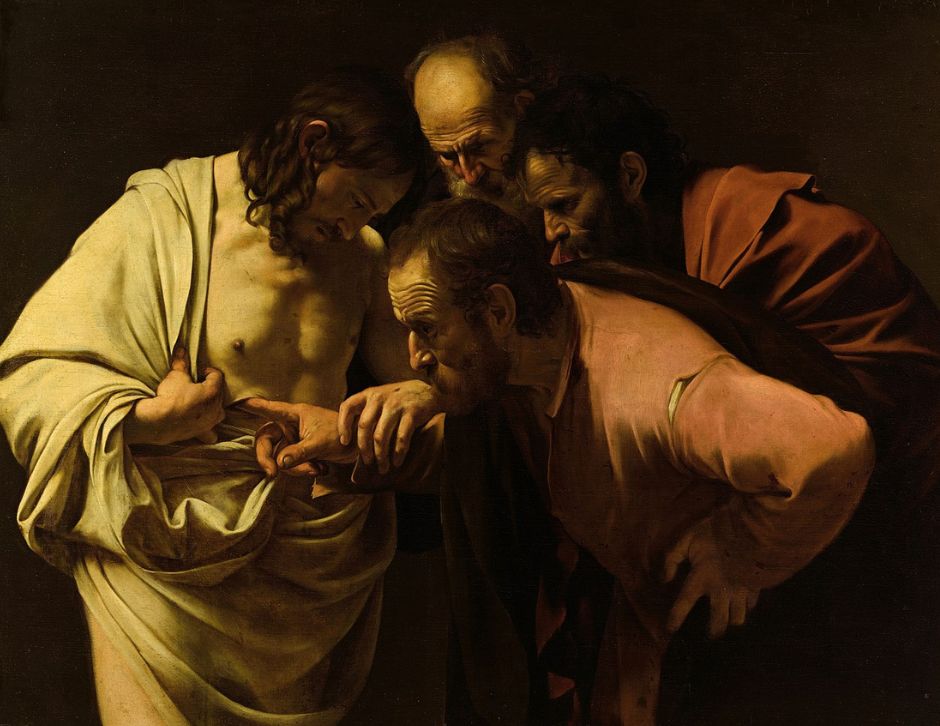
In all of the paintings of Caravaggio, there is a balance of light and darkness. Hence, balance is achieved through a series of elements like color, massing, and even accents.
Conclusion
Balance is an element that can perfect any composition, making it more delightful. There are different ways to achieve balance, which the book, Composition in Art explains in detail. You can refer to the book for more information. I hope I have given a satisfactory brief on balance in art.
Resources.
- Understanding Art by Lois-Fichner-Rathus.
- Pictorial Composition (Composition in Art) by Henry Rankin Poore.
- Art and Visual Perception by Rudolf Arnheim.
- Featured Image: The Incredulity of Saint Thomas by Caravaggio, Caravaggio, Public domain, via Wikimedia Commons.
Frequently Asked Questions.
By integrating different elements, the principle of balance creates harmony within a composition. An important principle is to avoid creating divided interest in a painting by making the composition a whole through different elements like line, shape, mass, and color.
There are a few types of balance in art- symmetrical and asymmetrical balance, bilateral, and Horizontal, Vertical, Diagonal, and Radical Balance. All of them are achieved through varied use of color, space, and line and make sure that there is no imbalance in a painting to invoke a psychological drama of the beholder’s mind.
To achieve a harmonious peace in the artwork, balance in art is necessary. While balance affords a certain level of comfort, the imbalance aims to shock the viewer or to play into a viewer’s discomfort in an artwork.
Related Reads.


