
Of the most outstanding artists of the Renaissance, one of the masters whose paintings created momentum across later artists and influenced their works is Raphael. Having his fame rested mainly on his art of painting, he worked in several fields, including designing tapestries, engravings, and architecture. With chief patrons like Pope Julius II and Pope Leo X, Raphael was a legend, but beyond that, he was a genius who was accepted as an equal by scholars and courtiers. When I read about him first through Vasari’s account and then the monograph of Leopold and Helen Ettlinger, I found that there is far less information about his strength and splendor, which impressed his contemporaries. As Vasari stated, ‘In truth, we have from his art, coloring, and invention harmonized and brought to such a pitch of perfection as could scarcely be hoped for.’ It is worth distinguishing here that Vasari hinted at the goals of perfection and idealization in Raphael’s art, which we can see through his Madonnas. Indeed, Raphael was capable of portraying both eroticism and heroism, but he never felt the need to seek obscene or horrible versions in his art, which is one of the interesting points to note. Being a Renaissance master, Raphael idealized the human figure as he strove towards the definition of beauty as given by Aristotle in his Poetics: ‘In everything that is beautiful, whether it be a living creature or any organism composed of parts, these parts must not only be arranged in a certain order but must also have a certain size.’ To capture this beauty was the artist’s ultimate goal in his life, which we all can see through his paintings. Though he enjoyed an ambitious and mesmerizing career, the end of the artist’s life leaves a controversy about his death, which I am going to discuss in this article while answering the question; How did Raphael die?
When we talk about the lives of Renaissance masters, Raphael’s life wasn’t as eventful as Leonardo’s and Michelangelo’s, as he was never forced to flee suddenly from a French invasion, nor did he design weapons or traipse around Italy with Cesare Borgia. There was a certain lack of drama in his life, which let historians and people create one of the most enduring myths of any artist – Raphael’s mistress Fornarina. Why am I saying myths? It’s because there is no single indication of Raphael’s mistress in contemporary documents, salacious poems, or any gossipy letters. But enough of these stories, even the end life of the artist was unpredictable, and very few people know the actual story behind his last days, which is why this article. Vasari claimed that the artist died due to a fever contracted after an intense night of excess love-making, but the claim has no basis and served as a mere interesting variation on the same theme. However, in this article, I have used a number of resources to let you know about the last days of the artist and his death at a very young age.
In Raphael’s last years, he composed an altarpiece for the Olivetan monks of S. Maria dello Spasimo in Palermo, where he displayed Christ collapsing on the way to Golgotha. The picture further adds Simon of Cyrene lifting the Cross from his shoulders as Christ turns and sees his mother, who kneels by the path. Commonly noted as Lo Spasimo, this painting’s modello must have been completed by 1517. It had many similarities with the previous altarpieces that the artist made. For instance, the pose of the soldier who leads Christ by a rope is similar to that of the executioner in the Judgement of Solomon. Among his last works, he portrayed desperate physical conditions and extreme emotions. But this painting was special as Raphael had an additional motive to devote special attention to the artwork. Though Vasari states that Raphael completed the painting, it is often suggested that it was finished by Giulio and Penni (Raphael’s heirs) as its payment was made after the artist’s death. Further, there is some evidence that Raphael might have first intended to paint the Transfiguration of Christ on Mount Tabor, but he extended his subject to include the episode, which occupies the foreground of the painting.


A letter dated April 15, 1520, which Sebastiano wrote to Michelangelo after the artist’s death, expresses Raphael’s intelligence and devotion towards his paintings. It says,
“That poor fellow Raphael [quel povero de Rafaello] is dead.”
He further added,
“I am sure this has much saddened you, may God have mercy on him. Rivalry with Raphael was, however, by no means over. Today, I have carried my painting (The Raising of Lazarus) once again to the Palace in order to exhibit it beside the Transfiguration. I don’t regret it.”

If I discuss the last days of Raphael, they were insanely productive artistically, but they were destitute of striking events. In 1515, he moved to Florence and assisted Leo X here while participating in a competition. Then, he returned to Rome only to never leave it again. During these years, he had a lot to do as the Pope and his companions demanded a civilized Europe, which let him have no peace. He was obliged to take inspiration from theatrical scenes and make cartoons for frescoes, tapestries, mosaics, and easel pictures and altarpieces. At the same time, he had to guard the antiquities of Rome, and supply designs to silversmiths, sculptors, and engravers while handling and performing his duties as a courtier. For several years, the young artist succumbed to such a burden. Of course, anyone except Raphael would not be able to handle it but the young artist was able to perform his duties pretty well. Together, these responsibilities that were carried on by Raphael led to another theory that he died due to overwork and burden.
After the accession of Leo X, Raphael’s work was increased and he was supposed to satisfy all his caprices. But that is not all. He had to prostitute his brush to political intrigue as he worked for Francis I of Charlemagne. Bibbiena also commissioned him the portrait which was to be hung in her bathroom and ordered another picture, the likeness of Joanna of Aragon. Francis I was delighted to see these two pictures which led him to give another commission to the artist, St. Margaret.
From 1518, Alphonso also began to press his time on Raphael. He writes,
“Rafaello da Urbino still seeks excuses. He will not have finished your Excellency’s picture until Easter. He cannot keep at it owing to the portraits and designs, which the Pope and His Highness the Duke (Lorenzo de’ Medici) give him to do. A Saint Michael, life-size, has been ordered by His Holiness, as a present to His Most Christian Majesty, and that picture absorbs nearly all his attention. It must be finished as soon as possible. But still, I am most pressing in my entreaties to him.”
As a sop to this impatience, Raphael presented him with the cartoon of Saint Michael to which the envoy replied through letter.
Dated November 20th, 1518, the letter says,
“I thanked him for his cartoon and assured him that your Excellency had been delighted to receive it. I then offered him the twenty-five crowns that your Excellency charged me to give him. With the great delicacy, he objected to taking them, declaring that he had sent the cartoon out of devotion and respect for your person. He is full of courtesy and assured me several times that he was more disposed to satisfy Your Excellency than to please the whole court here. He took the money at last, with many thanks to your Excellency.”
Though the Duke was encouraged by these gifts, he did not forget his picture and continued to torment the artist as he thought that Raphael was giving excuses. But the truth was the artist already had so many commissions to fulfill that it was nearly impossible to even complete the older ones on time.
So for three years, it was put off successfully but in the end, the Duke’s patience got away. On September 10, 1519, he wrote to his ambassador,
“Go to Raphael, and tell him that three years have passed since he gave his promise and that this is not the way in which those of my rank should be treated. If he does not carry out his engagement, we will teach him that it is not advisable to deceive us. You can add, as coming from yourself, that it would be well not to change the affection we bear him into ill will. If he keeps his promise, he can count on us; if not he may be sure that one day he will regret his failure.”
Later after this letter, when the envoy had a long discussion with the artist on March 20, 1520, he told the Duke that he would send the alterations as soon as possible. Sixteen days later, Raphael died.
Final Words.
Raphael lived a mysterious life as there are records of at least two houses purchased by Raphael in Rome but we cannot be certain that he ever married. Though Vasari’s The Lives of the Painters, Sculptors & Architects is strikingly correct, it has its loose ends, one of which can be observed in Raphael’s chapter. Alongside many theories, Vasari also fails to confirm his life and death. It is interesting to note that among these rumors, one is about his lover Margherita Luti, also known as Fornarina. I have talked about her previously in the analysis of Sistine Madonna but it should be known that we are not completely known about the two as well. To end this read, I am concluding this article with one of the artist’s declarations that can tell us about his character,
“the task of the painter is not to do things as nature has done them, but as she ought to do them.”
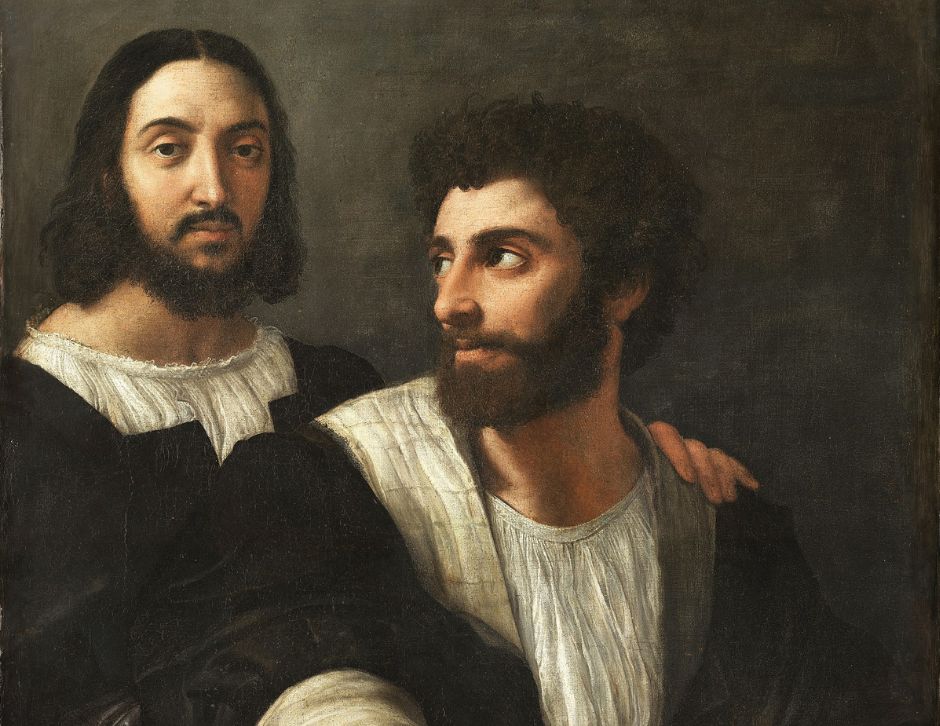
Featured Image: Self-Portrait with a Friend by Raphael; Raphael, Public domain, via Wikimedia Commons.
Related Reads.


