
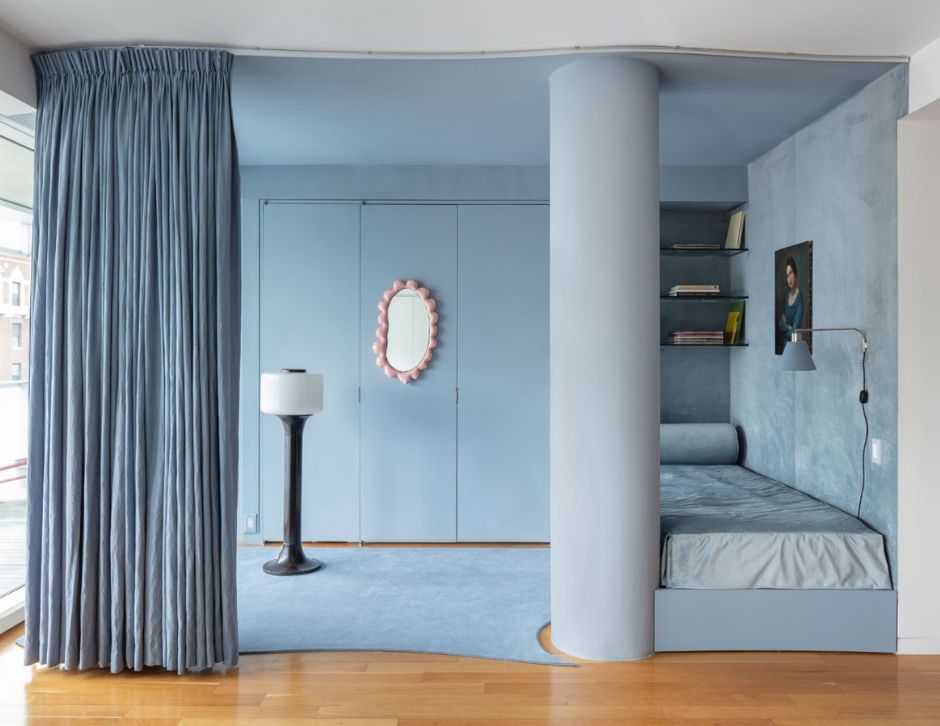
The perplexity of decorating a small room is not something new to come by. Be it making it look bigger or arranging it in a sophisticated manner, or leaving enough room to avoid interruptions, the questions are reasonable and tricky to answer. These spaces require maximum planning so that it doesn’t feel like a compromise over a regular home, and we have the freedom of giving less effort to maintain it. While arranging these rooms is another topic to discuss, I am here to extend my previous article about interior color palette and share steps to answer the most asked question on the web – how to make a small room look bigger with paint? By the end of this article, you will know the exact answer to that, alongside the common mistakes and myths. So let’s get on to this topic without wasting a split second.
Note: The article has lesser images than usual but easy to understand information.
6 Steps to Turn Your Small Room Into a Living Heaven.
1. Determine the Present Scenario of Your Small Room.
I have said this before, and every decor article on SimplyKalaa mentions this – a color scheme is the foundation of any decor. You can’t find successful interiors without a color scheme, and this stands true for small spaces, mainly because we require unity of the area. However, before we work on the color scheme, I need you to observe the present state of the room and note down the colors and the lighting situation.
Let’s say you may want to leave the floor untouched, and while doing so, it becomes a color element that is going to be part of the scheme and needs careful pairing with other colors, ones that will decorate the walls or complement the fabrics and furniture. At the same time, it is necessary to note down the natural lighting conditions and light fixtures, so you do not make wrong choices with colors, as each color reacts differently with lighting, some might be beautiful while others may look ugly – we want the former. Once you complete this step, we can move forward to start finding the right colors and experiment with the chapters from the playbook of designing a color scheme that can make a small room look bigger.
2. Understand the Basics of Small Room Coloring.
Let’s clear the air, there is no shortcut to making your small room look bigger with paint, as it is more about ideas and inspiration, and a decisive choice to use only the colors and design components that have characteristics to trick your brain and make the elements, in this case your walls, appear less enclosed. At the same time, it is a choice whether you want a cozy interior or an open feeling.
To ease up this process of cozy or open interiors, I will explain through breaking down a color scale. You can witness how colors that are on the warmer edge of this scale limit you in a way that can be both exciting (such as red) and cozier (such as brown). Moving towards the middle, we have green that creates a restful feeling for the interiors, while the colors on the cooler side, such as violet and blue, are great for creating a feeling of distance and a soothing effect, thus making them great for making a small room look bigger with paint.

3. Use Colors That Make a Room Look Bigger.
You might have a little clarity on how different colors on a color scale react to the surroundings. It must have given you an idea that the presence of white in paint can lead to a distancing effect. A quick answer to which colors are most suitable for making a space look bigger is white and shades of blue. However, attention to small details must not be ignored. Let me explain this for two different scenarios.
Remember how I advised you to note down the lighting condition of your small room? It’s time we finally use it. Let’s suppose you have a brightly lit room, you might need to drop pure white and pick a cooler shade of white that looks fresh. Now, this exact rule will fail terribly in case you have a room with less natural light. In this scenario, you need a slightly yellowed white.
Now let’s take the example of blue. You must not use darker shades of blue when you are going for a space-enhancing feeling for your small room, and light blues only work great when they complement a room with enough natural light. If you have a small room with dull exposure, go with the creamier shades of white and not blue.
4. Pick the Right Finish.
While not necessarily an element to create a space-enhancing feeling, knowing which finish may create a good-looking visual composition with the present elements of the room might come in handy. Refer to the table for clarity on this.
| Wood | Matt Finish Paint |
| Fabrics | Mid-sheen Finish Paint |
| Glass | Glossy or Lacquered Finish Paint |
5. Add Contrast to Your Small Room.
Plain white or blue can be boring, no matter how beautiful the shade is. To change that, you have to complete what you started, that is, design the palette and choose your favorite combinations of accent colors. After you have your primary color (white or blue) and accent colors, it is time to balance these colors, that’s when a balancing color comes into play.
Accent colors can be anything that influences your outcomes. For instance, if you want warmth in your interiors, go for a combination of warmer shades for your fabrics and accent wall. At the same time, if you want more soothing tones, go for cooler shades, such as lavender, violet, and purple. On the other hand, a balancing color is to stabilize – you can use a simple plant or a shiny vase to take excessive attention away from the walls and other accessories. I am adding a color palette as an example to ease up.

Now, one of the pro-tips to plan your interiors is to plan your floorings, reflective surfaces, and upholstery really well.Through these elements, you will be bringing texture to the interiors and creating a sense of comfort as well as adding depth, which can speak a lot about your planning. If I were to share my preferences, I recommend the WML Approach – wood for flooring, mirror for reflective surfaces, and linen for upholstery. Not only do these look good, but they also demand less maintenance.
Tip for small home owners.
If you have a hallway or staircase connecting your small room to other rooms of the home, I suggest you consider high-wavelength colors such as red, orange, and yellow to increase the presence of colors in your small home. This way, you will have a white interior for your small home, but through spaces where you spend the least time, such as a hallway or a bathroom, you will have the freedom of adding colors without causing interruptions with the color scheme. You can also use dividers or colored glass doors for this purpose.
6. Fix the Lighting.
Let’s answer, how important is lighting in small spaces? So much that you cannot skip it in your good conscience. Light and shadow are both part of our strategy to make a small room look bigger with paint. To achieve the best interior lighting and avoid making a mess in your newly painted interiors, planning should take place beforehand, in case of newly constructed homes, where electric fittings are to be done. Only after careful planning and fitting of these switches should you plan the color palette, focal point (something Mahima explained too well in her article about couch decor), and furnishings.
If you are redecorating and there is no change to the light fittings, just note down their locations and plan the lighting beforehand that suits your colors. Make sure to check the sample paints under these lighting conditions, so that you do not regret it later.
Coming to the lighting part, you can follow the following steps to achieve the desired outcome for your small room:
- Taking the cue from the first step of this article, you need to design a layout of your lighting, both natural and artificial. For this, take a blank paper and sketch to log natural light during the morning, afternoon, and evening. This way, you will be able to determine the spots where the light is maximum and where it isn’t, or the spot that is underlit.
- Once this is done, check the flexibility of dimmers that can enhance the practicality of your lights. At the same time, see if these components are not too old – a recommended rule is to change them after 15 years of use.
- Starting with the natural light and work on enhancing it through elements such as a mirror, curtains, or shades that can be pulled to fully expose the light source, diffusion glass, and reflective surfaces that can enhance your decor. For more ideas, refer to this article about brightening a dark room.
- Last but definitely not least, setting up artificial lights for complete exposure to light and to create a mood that you require from your small room. Note that you must simply install a harsh light source that is going to ruin the complete look. Instead, divide it into three components – Ambient Light, Task Light, and Mood Light. The first one can be a source of light that has a dimmer attached to it so that you can control its illumination as per the requirement, and can also control the ambiance of the room. The most accessible source of these types of lights is a table lamp. Moving on, a task light is more directional and, as the name suggests, helps in tasks such as reading, work, or anything that requires high exposure light. Lastly, mood lights are more decorative in nature and have less exposure. Most accessible mood lights are candlelights – inexpensive and ones that never grow old.
Final Words.
I hope this answers your questions about how to make a small room look bigger with paint, and with that, I would like to conclude this article. On a lasting note, though, do not forget to read all the linked articles I have mentioned in the read, as they will contribute to your small room decoration to a great extent. I will see you with the other article, and if there’s still any doubt that you have regarding this, use the comment section like it’s X!
Featured Image: Charlap Hyman & Herrero
Related Reads.


