
There has always been an art activity in India from its start, and it is due to this activity that generates enough energy to keep the artists alive, further providing sufficient cross-fertilization for individual talent to flourish. But, somehow, it is so unfortunate that despite such craftsmanship and energy, fewer artists felt the need to migrate abroad to prove themselves. However, none of the Indian artists ever made a breakthrough in the international scene in the sense that they regrouped with each other to create an avant-garde movement of this century to challenge the hitherto-established forces. In brief, in the last twenty years, the artists who used to make a bold forward step without shedding their tasks and creativity as artists: the task to seek new or deeper values in the creative act- have been diminishing. In contrast, the West continued to produce some of the eminent artists who created an avante-garde movement alongside sustaining the depths of generating a new energy. It is the need of the hour for Indian artists to create a newer generation of art, which gives a new energy and story to this century. Talking about the last avante-garde movement, where the century enjoyed Indian artists who had a purpose and gripped their feelings over the rapidly running avant-garde art, there are few names that lesser people know about. It is unfortunate for us that there is almost no systematic documentation available that explains contemporary Indian art. Most of the artists didn’t complete visual libraries of their own work. Though it is easier to find an artist through intelligent initiatives by the Government today, their visibility remains less than what they deserve. One of them from Indian Modern Art was Jagdish Swaminathan, who emphatically repudiated the assumptions of modernity and saw to cut clean from its trap to traverse the greatest void of the consciousness to find its bearings. In this article, I will solely discuss his life and famous artworks.
About the Artist: Jagdish Swaminathan.
“Art is neither conformity to reality nor a flight from it. It is a whole new world of experience, the threshold for the passage into the state of freedom.”
These words are from Swaminathan from the 1963 manifesto of the Group 1890. Painting major landscapes, measured by the mountains and concentrated to a point of exquisite focus by the glittering image of an object with a great void, he explores verbal and visual metaphors through his paintings with a magnificent spatial illusion. He was a political correspondent and art critic for Link for several years and a founder-editor of the art magazine Contra, where he wrote numerous polemical articles on politics, art, and artists’ philosophy with a larger context of contemporary Indian culture.

Discussing the Life of Jagdish Swaminathan.
Born in Shimla in 1928, Swaminanathan’s father, N.V. Jagdish Iyer, joined the government service in North India after his initial attempt to practice law in Madras. His father served as a P.A. to the Minister in the Commerce Department, living a middle-class life in the cities of Delhi and Shimla. Swaminathan’s mother came from a wealthy family of zamindars. Variedly contrasting in behavior, the artist’s father was a gentle, generous, and somewhat detached person, as he would spend his spare time reading and translating the Sanskrit classics, whereas his mother had a powerful and extrovert personality whose relatives would show off their privileges of class and wealth.
Jagdish Swaminathan was the fourth child among his eight brothers and sisters and was the most mischievous, impetuous, and self-willed, among them. Studying at the Harcourt Butler School, he was a difficult child but reserved his all mischiefs for after-school hours. Refusing to use his brain to merely win merits, he read at random but developed a lifelong aversion to learning knowledge. Geeta Kapur explains his childhood personality in her book Contemporary Indian Artists,
“Touched from the very start with an emotional vivacity, there was nothing arid about his intellect. During his restive adolescence, he believes, he had already experienced the entire gamut of emotions he was to feel as an adult: from fabulous delight to bewilderment and rage. Yet he was not an oversensitive child and not easily wounded. Fighting his big and little battles, he kept up his flamboyant vanity along with his morale. And for the most part, he made sure to win the battles in which he engaged himself, he had no use for any sort of vindictiveness. His bullying went along with a good deal of kindness and generosity, making him both a star performer and a natural leader.”
Swaminathan’s Journey to Painting.
Swaminathan started to paint when he was very young. At first, he would just pick landscapes that he appropriated during his wild expeditions and compose them with steady and loving patience. Hardly composing the artworks on what he saw, young Swaminathan painted his connection with nature. He captured the natural phenomenon, as much as possible, like the sunlight shifting inch by inch over the landscapes, which remained intact in his adult work. In his later life, he would refine his intimacy with the elements of nature to give prolonged innocence and purity to them with a cultivated state of spiritual elevation.

The Political Career of the Artist.
Though keenly interested in painting, he joined Delhi University as a pre-medical student, but he soon realized that he had no interest in academic pursuits. Rather than devoted to his studies, he continued to do roughish activities at the University, and his aimless rebellion started to take a form. While studying at the Hindu College, he developed a vague political outlook, but his political acts were impulsed, like looting the shops of foreign goods during the Quit India Movement. Hence, in 1943, he failed his pre-medical exam, so he left home and ran away to Calcutta. Arriving penniless in Calcutta, he was put up at a Dharmasala and made a clerk friend who took him to his house and helped him earn a little money. Jagdish Swaminathan then began to sell cinema tickets in the black markets and squatted on the pavement selling underwear. With the help of his friend, who was a member of the Revolutionary Socialist Party, he initiated his full-fledged political milieu. Beginning to read avidly this time, Swaminathan read a lot of political tracts by various leftist parties in India and went on to learn the political works of Marx, Engels, and Lenin.
After one and half years in Calcutta, Swaminathan returned to Delhi and joined the Congress Socialist Party (CSP) and soon became the executive of the Delhi wing. Editing the Trade Union Journal, Mazdoor Awaz, he worked as a trade unionist among the workers. Being a good speaker and writer, his initial attraction for the CSP arose from the simple fact that
“it was the left wing of the Congress Party which, with all its faults and compromises, was leading the national struggle.”
With his growing awareness, he knew that the dependence of this rich country on the Congress is critical and that it hinders the growth of the country.
After the independence of India in 1947, he wrote a pamphlet entitled “What is History?” where he presented the working class struggle on the basis of the central Marxian thesis, which was distributed in thousands. Swaminathan threw himself into the lives of the people. Geeta Kapur writes,
“Whether it was fixing a tap in building in worker’s colony at Jhandewala or saving the whole shanty colony from the demolition squad of the municipality, he was able to muster enthusiasm and organize collective activity. During the partition, he worked in the riot-torn localities of Delhi in harrowing circumstances, removing corpses from houses and streets.”
She adds,
“The British were preparing to leave. The Congress leadership, it seemed, was making a mistake in the transitional situation. Rather than wrestling power from the imperialist clutches they were negotiating on the basis of weak-willed compromises, the consequences of which would be grave and almost irreparable for free India: the power would “peacefully” pass into the hands of the bourgeoisie by virtue of the fact that it had supported the national struggle.”
In 1953, Swaminathan made his exit from the party, due to some reasons. This break from the party coincided with the decision to get married, but he faced problems in earning a living. However, in 1955, he got married, but the couple was virtually homeless and penniless. Hence, for the next ten years, he, his wife, and two boys lived as a joint family with his parents in the small house in Karol Bagh. To earn a living, he designed book jackets, freelanced as an author, and even wrote stories for Dainik Hindustan and Sarita.
In 1958, he, with Aruna Asaf Ali and Narayanan, decided to start the weekly magazine Link and then worked at a regular job until 1962. Though not politically engaged, he was aware of international politics and wrote a column on Southeast Asian Affairs. He also became an art critic and then expressed ideas on art.
Art and Swaminathan.
Throughout Jagdish Swaminathan’s life, he painted off and on as painting was the first vocation he chose for himself in his adolescence. Having never been trained in an art school, in 1958, he got a scholarship to study graphics at the Academy of Fine Arts in Warsaw. Though the course was three years, he returned after six months due to family problems and homesickness. He then worked as an unofficial apprentice under Sailoz Mookherjea. At the end of fifties, he became a more sober art critic.
It was only in the artist’s sixties that he became one of the most important artists in India. To find a public platform for his paintings, he founded a little magazine, Contra. In 1963, Jagdish Swaminathan launched Group 1890, which had like-minded colleagues and presented an exhibition whose forward was written by a Mexican poet, Octavio Paz,
“With a rag and a knife
Against the idee fixe
The bull of fear
Against the canvas and the void
The uprushing spring
Blue flame of cobalt
Burnt amber
Greens fresh from the sea
Minds’ indigo
With a rag and a knife
No Brushes”
In 1968, the artist won the honor of mention in the first Indian Triennale, and the next year, he was invited to Brazil to be part of the international jury at the Sao Paulo Biennale. In the same year, he was awarded a Nehru Fellowship by which he could travel the country to write his “thesis.” He chose the subject, “The Relevance of the Traditional Numen to Contemporary Art.” As this fellowship freed him from his financial worries, he later got a string of collectors, a majority of whom were foreigners.
Why Did the Artist Paint?
In one of the essays by the artist, he answered this question. He wrote,
“A child of a chance who could have been nipped by the bud by abortion or be still-born or be in the arms of the tired woman who calls me son be killed by bombs raining from heavens as it is now happening in Vietnam or simply by Malaria, Typhoid or smallpox or even just plain hunger for there are so many, oh, so many, many mouths to feed… So I paint while I can though I do not know why I paint, but I know that I do not paint to make you happy or for the glory of man or the motherland or even as the propitiation of death though I would like to be happy with the thought if my work give you joy or introspection or relief from the prison house of knowledge which is surely better than the bomb. I paint because I cannot keep away from it, and it takes me from myself.”
Now that you know a little life of the artist, let us finally look at his paintings.
The Art of Jagdish Swaminathan.
The paintings of Jagdish Swaminathan have different stages, and they portray an attempt to reverse, deny, and overcome history so that they rise from its vortex into the spirit region, which is tranquil and timeless. Briefly, the artworks of the artist can be divided into four phases. In the first phase, around 1959, the artist showed an
“imagery akin to that of prehistoric art and to the totemic sign language of the primitive.”
In this phase, the artist was more or less denoting his preferences, and he wanted magical impulse in his art rather than the common rationalism.
In the second phase, Swaminathan turned his focus on Indian folk and tribal culture, especially the images and motifs that define the magical implications of India. He used folk motifs, and he brought himself closer to history so that he could use the folk and tribal art symbols in his contemporary paintings. From the sixties, he repeatedly used symbols, which were derived from Indian mythology, like the signs of Om and svastika, the lotus or lingham, and even snakes. These signs had a specific purpose in the art. For instance, snake motifs are placed at the roots of the pipal tree; the magnificent lingham is placed within the temples, which all serve as a symbol of fertility. However, one must understand the purpose behind these symbolic paintings of Swaminathan. The obvious reason might be traditional symbology, providing a ready-made pictorial language to the artist, but if this is the reason, then he is not different from Jamini Roy, or for that matter, he is not different from several artists since the sixties who have exploited the tradition for the mere convenience of finding a foothold in the realm of the possible images. The only difference between them is that Jagdish Swaminathan made no attempt to stylize the indigenous language of the images, and this is the most important aspect.

In the next phase of his paintings, he painted the translucent screen of the imagination upon which the geometric forms took shape in a faint subliminal manner, also called “Color Geometry of Space.” Swaminathan wrote in an exhibition,
“The triangle and the rectangle and the circle as color, I find, are windows on the Avyaktam, the unmanifested.”
This phase was more about an attempt to make geometric abstraction serve a metaphysical purpose of his composition, which also put him in line with the Russian Supramatists. He further used a diagrammatic form with color and delineation similar to the Tantrik yantras.
Lastly, the artist had an abstract phase of life where his painterly techniques evolved. Geeta Kapur explains,
“The palette was lightened to iridescent hues like pink, mauve, pale green, and lemon yellow, and the painting was conceived entirely in terms of colors. There was no tonal contrast and also neither thickness nor depth; the geometric shapes were arranged very simply and in a flat pattern on the picture surface.”
The painting The Last Step perfectly fits in this style.

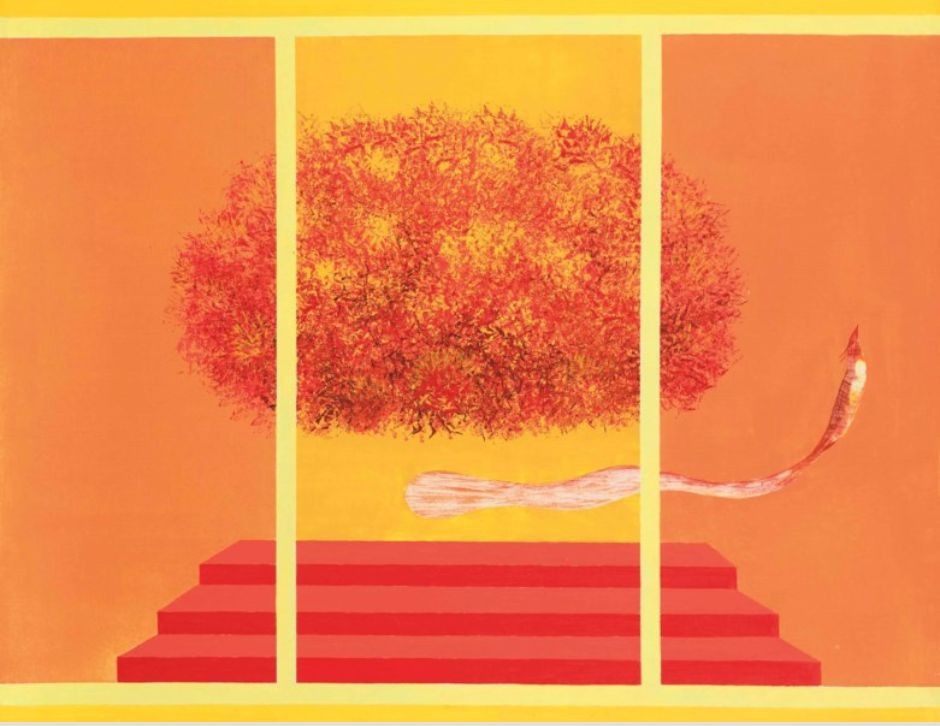
Jagdish Swaminathan moved to the last phase in 1968. These paintings constitute an uninterrupted sequence where he selects the images from nature but dematerializes them through metaphors while expressing a spiritual sentiment while meditating on the mirror of nature. These give some sense of landscape pictures like the zigzags of the mountains, a free-floating rock hung against the sky, or even aerial rock. There is always an exquisite bird or tree or a flowering bush in these compositions. The space of this picture radiates light. There are crescents of pure light across the face of these mountains, as in Ardhachandra.

There is a lot more to learn about the artist’s paintings, which you can read from Contemporary Indian Artists by Geeta Kapur.
Opinions and Conclusions.
To me, the paintings of Jagdish Swaminathan radiate peace and a moment of introspection. They have a blankness in them, but that doesn’t look bad because, to me, the blankness and emptiness make my mind wander and give an individual outlook of the painting. The echoes of this emptiness touch the far point, but it return to us again with a more convenient thought and interest. There is a shadow of intimacy in his works with effulgent depths, which gives a spiritual form but gives a quality to assimilate the cosmos into your own self as if you vanished in those depths. The colors are pure as if they are taken from the Pahadi palette. For a painter who literally quotes Upanishads frequently, his paintings consist of a fundamental space, which is the occasion for cosmic manifestation. The works are transcendental, but they show the beliefs in metaphysics, the cosmos, and eternity, which fascinates the viewer but gives him a longer impression to think.
Resources.
- CONTRA’66 (Number 2).
- Featured Image: Untitled by Jagdish Swaminathan; Christie’s.
- Contemporary Indian Artists by Geeta Kapur.
Related Reads.


