
Lately, I am pouring my life with the joy of a sabbatical to encourage my inclination to shop and review products on their pain points. In my last post on decorative knives, I explained how my present surroundings influenced me to take charge and plan everything with utmost functionality and precision. However, as I continue this journey of redecoration, I come across many products, reviews, false claims, and useless review posts by honorary magazines like The New York Times. And yes, I understand you might think that I am only partial about my reviews (like half of the other reviewers) and trash others for personal benefits, but you cannot argue with hundreds of people who feel the same about Wirecutter when they do not sugarcoat their sayings on Reddit. I hope somewhere there is a lie that Wirecutter has spoiled with time, and we can together continue our feat against false information or state if there is anything in an article that is promoted for financial gains. Leaving this behind, I am here to continue explaining how to select the love of every chef- kitchen knives. In doing so, I will define this shiny-sharp instrument in a more explanatory yet simple way so that you never scar your kitchen or yourself with a blunt one. So let’s start this article without wasting any more time on my gossip.
Note: The images that I have used in different sections are for reference to learn about the subject and unless stated “I recommend” or under the “Best Kitchen Knives” heading, I do not encourage you to buy the product without further research.
Why Should You Trust This Article?
Understanding a knife without being a culinary expert is almost as if you know better than Van Gogh about Brushstrokes. Surely, I don’t want to be one of those fellows, and to have the nonpareil knowledge of knives, I did comprehensive research (resources are mentioned at the end of this read), read from the best of the culinary books, worked on my knife handling skills (which are pretty dicey at the moment), and learned the material as well as compared how their construction vary their usage. Unlike most magazines on the web, this did not take me a couple hundred hours or months, but the last couple of days were edgy, and I think I am ready to write this article and help you out.
Continuing my habit of uncovering the secrets of most publications and review posts, I am going to concern you regarding one of the most repeated gimmicks they plan for you. In today’s case, let’s say you really like Japanese knives and how convincingly sharp they are. You might even have seen many magazines promoting this, but while doing so, did someone check with your demands to confirm if you need to make a $1000 or above purchase? This is an area where buyers should pay extra attention as budget is one of the key corners you want to hold your spot at.
For example, let me ask you a few questions– How good are your knife skills? Are you someone who cooks more than often or entertains large gatherings? Do you know how careful you need to be around sharper knives? Do you have any kids who may enter the kitchen and harm themselves while playing around? Do you understand how you need to maintain the sharpness of these knives? If you think your answer is satisfactory to all these questions, you are ready to own something nice. If not, you should stick to learning more and operating a normal, less dangerous knife.
You Have My Word.
Now, you will learn more about kitchen knives, their material, their types, their use, their anatomy, their maintenance, the sharpener, and even the best kitchen knives you must check. In the meantime, you should know that I never intend to spoil my review posts for any amount of money. Yes, you may find relevant links that are affiliates and help me a little, but none of these products are present for my financial gain. I want to be relevant to you, your time, and your purchase. Treat these articles as a zone where I am only honest and am talking to you as a friend. Let’s continue with the next section.
Lastly, this will be a long read but stick to the end and I am sure it will be helpful with your next knife purchase.
Understanding the Materials of Kitchen Knives.
When we speak of kitchen knives and their material, the major component that changes the behavior of the blades and how well they will hold up are the components that are added to steel, or I may say stainless steel. You should know that steel can be stain-Less not stain-NEVER. The use of components like chromium makes it behave this way. However, prolonged exposure to salt, acids, and water can make them rust after they corrode the layer of chromium oxide on the metal. Further, the use of other elements makes them hard and heat resistant. These qualities may change per the type of element used, and it is always advised to see the packaging to get an idea about the behavior of your kitchen knife’s blade. It is never possible to fully determine a blade unless you work in this industry, but knowing these elements will keep you away from mediocre kitchen knives.
| Elements | Properties or Use |
| Iron | One of the primary materials to form steel. (Steel = Iron + Carbon) |
| Carbon | Increases hardness and brittleness. Helps in sharpening a blade and retaining it. |
| Manganese | Intensify the benefits of carbon and increases hardness, strength, and water resistance. |
| Chromium | Makes steel stainless and improves the blade’s durability. |
| Tungsten | Makes the blade harder and resistant to heat, water, and shock. |
| Molybdenum | Reduces brittleness while increasing hardness and rust resistance. |
| Vanadium | Makes them sharper, tougher, and more water resistant. |
| Nickel | Adds toughness. |
| Cobalt | Increases hardness and ease to be sharpened. |
Types of Kitchen Knives.
To understand which kitchen knife is best it is first crucial to understand the different types of kitchen knives and how they differentiate from each other in making and role.
Types of Kitchen Knives by Making.
As I said before, determining your knife by only materials is a tough task, and it has made many knife manufacturing capitals change the way they do their work, fleeing from the bubble of traditional techniques that will have at least one demerit. There had to be no perfect kitchen knives until Japan became the capital of knife intelligence and designed some of the best kitchen knives for your use.
1. San Mai Kitchen Knives.
Sandwiched kitchen knives, also called San Mai, are manufactured with a very sharp but brittle carbon stainless steel blade and this blade is sandwiched between two softer (low HRC) steel blades. To make a unique composition, these blades are then manufactured in a way that the middle layer acts as the cutting edge while the other two cover the blades.

2. Damascus Kitchen Knives.
One of the most popular types of kitchen knives, Damascus is adopted from a historic technique, originated in the Middle East, of creating “watered” appearance blades for battles that were extremely sharp, tough, and flexible.
The new Damascus uses a patterned technique where different qualities of steel are folded and twisted to achieve the perfect steel blade. This procedure not only made these kitchen knives sharper but introduced a new pattern, wavy and rippled, to not only the surface but even beneath the layers. It should be noted that you cannot find pure Damascus kitchen knives at local departmental stores as they require handcrafting and much attention and are a lot more expensive than other types of kitchen knives. Also, do not get fooled by knives that have a pattern similar to theirs but are not purely Damascus.

3. Ceramic Kitchen Knives.
The innovation in the industry of kitchen knives, Ceramic knives have been around for more than two decades, but knowing how even I have never used one and only found their presence a little too charming makes me believe this is what you should consider next. These kitchen knives are 50% harder than their steel counterparts and admirably, according to Kyocera, the first and largest maker of Ceramic knives, they are going to retain the sharpness 10 times longer than a stainless steel knife. However, with all the impressive claims and features, they are brittle, and as with any ceramic, they are going to shatter at some point. Also, these are not made for carving or boning, as they are just better than anything at only chopping vegetables.
In summary, ceramic knives are great for household, need care, and are not made for carving or boning a chicken.

Types of Kitchen Knives by Usage.
Based on usage, there are many types of kitchen knives, and although you might have seen most of them, this section will help you understand which is better and which one should you pick for your knife storage, which, by the way, you should have for better placement.
1. Chef’s Knife.
A chef’s knife or cook’s knife is essentially an all-purpose tool that will help in chopping, slicing, and mincing and has a sufficient knuckle clearance to avoid any difficulties while working on the cutting board. It is also sufficient to cut large and small items precisely.

Further, these kitchen knives come in different lengths, ranging from 4 to 14 inches. While I prefer using a 6-inches, you can opt for 8 or 10 inches and even go for a longer blade if you are trying to experiment with them. Lastly, do not ignore the 4-inch blade as it is perfect for chopping leaves, essentially Basil.
Should You Use a Western Or Japanese Chef Knife?
Chef’s knives come in a number of categories, but the two important or rather main ones are Western and Japanese kitchen knives. While a better understanding of both is possible only in real life, I will try to brief them in a table so that you know their functioning and be able to select the most suitable one.
| Western Chef’s Knife | Japanese Chef’s Knife |
| Thicker and Heavier | Thinner and Lightweight |
| Traditionally has a big bolster, but half or no bolsters knives are also available | Doesn’t have a bolster |
| Thicker Spine | Thinner Spine |
| Requires more energy to operate, given the weight | Requires less energy, given sharper blade and lightweight |


2. Paring Knife.
A companion to your half-useful chef’s knife, a paring knife is a tool that is useful in peeling fruits and vegetables, coring tomatoes, scoring strawberries, helpful in boning chicken at tight spots, trimming fat, segmenting citrus fruits, and more tasks that you need to undertake in your kitchen.
They have a 2 to 4.5-inch blade and come in different shapes– fluting knife, granny knife, serrated parer, tournet knife, classic spear point parer, and sheep’s foot parer. You should take a look at these different types of paring knives and then decide by your handling and usage.

3. Cleavers.
Cleavers are some of the most important kitchen knives for meat and vegetables. While both knives differ in their build, through a distance they look similar.
In terms of vegetable cleavers, they are broad, thin, and light blades that can split vegetables too easily. Once you get used to them, there is no going back. They can also be used for slicing, dicing, mincing, and preparing juliennes.
Further, meat cleavers are heavy, broad, and thicker blades that create a downward force to cut through the meat and even bones.

4. Slicers and Carvers.
These types of kitchen knives should be identified by their shape:
1. Pointed Tip Carvers.
These are longer, lighter, and slimmer blades that play an important role in slicing through Turkey roasts, leg of lamb, pork loin, or any roasted or grilled meat and poultry.
You should always pick a suitable size for your purpose and for this note, the size of your food and the knife should be 2 inches longer for suitable slicing.
Note: Never get a serrated version as they are not meant to pierce into meat.

2. Rounded Tip Slicers.
These types of knives have two subcategories- ham slicers and salmon slicers.
Ham slicers have long, wide, and rigid blade to cut through meat.
While, Salmon slicers are thin and flexible blade, about a foot long, helping to slice easily.
Note: Both these kitchen knives have a rounded edge to protect you from hurting yourself when the blade changes its direction.

3. Boning Knives.
Boning knives are used to separate meat from bone without making unnecessary cuts in the flesh.
These knives come in two varieties, flexible and stiff blades, allowing the cook to either use it to bone a chicken breast or use it for the lamb. A distinctive feature of this blade is that it has a tapered tip and a blade size of 5 to 8 inches.

4. Fillet Knives.
Fillet knives are thin, sharp, and flexible blades that give more freedom to fillet a whole fish.

5. Utility Knives.
Utility knives are some of the most traditional tools that come in handy for daily reasons. However, to some cooks, they are of no use, as they are too short for slicing meat and too long for trimming vegetables and have no knuckle clearance that they can operate on a cutting board.

5. Tomato Knife.
If you are someone like me who loves Italian cuisine and preparing sandwiches, I recommend you always have a tomato knife by your other knives. It is only a serrated knife at a smaller blade length that is useful for everyday use.

6. Butter Knife.
A butter knife is a blunt and rounded tip knife that is more of a spreader in function than a knife. These are built to not tear into bread and have thick and blunt edges. While you may prefer using a spatula instead of this tool, you can always keep your kitchen sorted for better presentation, as butter is almost daily eatable.

7. Bread Knife.
If you don’t love artisanal bread, I don’t know what you do but talking about bread knives, these serrated tools are picked for their specialty of piercing into anything that has a harder surface than the core. It can be anything, a loaf of bread, a pineapple, or even a crispy breaded chicken breast.
Tip: Look for a rigid blade (not flexible otherwise you will end up hurting yourself) that is about 9 or 10 inches and has wavy serrations for a clean cut.

8. Cheese Knives.
Just when we have our precisely cut bread slices, it is essential to have the right amount of cheese. Cheese knives are not the most essential tools, as I used to rely on my tomato knife, knowing I never enjoyed large gatherings. However, once you develop a taste for them, they become an experience, as if you are in the Luncheon of the Boating Party.
While a lot of us have a specific preference for our cheese, the types of tools for them differ a lot.
You can use a chef’s knife for hard cheese, a wire for soft cheese, and a butter knife for spreadable cheese. Use the comment section to ask about the type of knives that will suit your favorite cheeses, and I will try my best to answer them there.

9. Shears.
A pair of vegetables and poultry (if you consume meat) is always preferable for your kitchen. While the former is used to cut through parchment paper, cut vegetables for a naive cook, and help with trimming the pie dough, the latter is a tough version that can take the toughest jobs including cutting through the bones of any meat.
Tip: Pick the ones where the screw comes off, and you can wash the blades individually, and by now, you must know what material blades should be there? Stainless Steel.

10. Mincing Knife or Pizza Cutter.
Distinguishable by their appearance, these knives have a less sharp blade compared to a chef’s knife and are used to cut plenty of herbs or your pizza.

11. Decorative Knives.
In the past couple of decades, the imagery of food has changed extensively throughout the world, and as a result, its presentation has become a deciding factor. To contribute to this stylistic tradition, decorative knives are a way. With a designer edge, these knives are not extensively known for the sharpness of their blades but are suitable for cutting potatoes or any other hard vegetable in wedges.
The blade size of these knives is similar to a utility or a tomato knife and is widely available in stainless steel unibody.

How to Maintain Kitchen Knives?
After you have successfully understood the types of kitchen knives, it is essential to learn how to maintain kitchen knives by honing them, as it is as crucial as keeping your work desk tidy for optimum productivity.
Before starting, you must know that maintaining a knife is different from sharpening it. I will add a table to explain that better in the later section. For now, let’s start with the initial information.
To maintain kitchen knives, you should always hone them while the edge is sharp because as soon as it gets less sharp or blunt, it will do no good.
Tip: You will require a honing rod and storing the knife in the right place, avoiding moisture, for maintaining your kitchen knives.
Honing Steels.
Honing steels are metal rods that come in oval, flat, or round shapes and have a textured surface. Always make sure these are made of steel and not other metals as that will not strip away the material and also will not degrade the life of your knives’ blades.

How to Pick: the correct honing steel for your kitchen knives, take a measure of your longest kitchen knife and pick a honing rod that is at least 2 inches longer than it.
How to Use a Honing Steel?
- Take a measure of your longest kitchen knife and pick a honing rod that is at least 2 inches longer than it.
- Hold the honing rod perpendicularly to the surface and align the anchor on a board or towel. Make sure it is steady.
- Pull out the knife, place it on the top of the rod, and set it at the heel (the nearest part of the blade to the handle, or before the bolster.)
- Make sure the angle is 20° (16.5° for Japanese kitchen knives) at which the knife rests. To achieve this, first, align the blade at 90°, then half it to attain 45°, and half it again to attain 22.5°. You can also check if the handle of your honing steel allows you to achieve an angle of 20°, which is the case in most products.
- Pull down the blade towards you. Make sure that you concentrate on the angle and not speed, and keep the pressure of the edge to rod light.
- Repeat the movement about eight times on each side.

Quick Tip: If you can’t give time every often to maintain your kitchen knives, take diamond and ceramic steel rods. Due to their harder surface, they are not only helpful in maintaining but also sharpening them.
When to Sharpen Kitchen Knives?
Before we move forward to learn how to sharpen a kitchen knife, it is essential to determine when to do so. These are the points you need to take note of that will tell you if your kitchen knives really require sharpening.
- Paper Test: Hold a piece of paper in the air and move the knife from its top corner to the bottom. If your knife is sharp, it will be able to create a clean cut and even make curved patterns if it is very sharp.
- Tomato Slice: Take a tomato and slice through it. A sharp knife will be able to pierce through its skin and flesh as if it’s too easy and might not even require you to hold the tomato if the knife is super sharp.
How to Sharpen a Kitchen Knife?
There are many ways to sharpen a kitchen knife and they include visiting a professional knife sharpener, using manual or electric knife sharpeners or even sharpening stones.
1. Professional Knife Sharpener.
Contacting a professional for sharpening can be an easy option to get your kitchen knives as good as new. However, if you have no backup knife, this can be a time-consuming process that can make you lacking a kitchen knife for probably days, depending on the business activity of the individual. Still, if you want to pick a professional knife sharpener for the purpose, make sure he has good reviews, as good word of mouth is earned with time, and it hardly goes wrong. Next, it comes to your own checks, and for this, you need to ask specific questions and note a few things when you visit him/her. You can blindly trust them as these are advised by the authors of Knives Cooks Love, Sur La Table and Sarah Jay.
- See if the blades he has sharpened before are even and not oversharpened but sufficient. Make sure if it is a western knife, there are no notches at the heel, and the sides don’t have scratches as if the work is not his/her best.
- Ask him, Can you sharpen my knife at 21°, giving him an odd number and asking him if he can sharpen your Japanese knives at 16°. If the person is right, he will be able to accommodate you and ask if it is 20° or 21° and advise for the former.
- Ask him, what he/she does to finish the edge. If he/she takes time for a finer finish (mirror polish for instance), it says that he/she is careful about the work.
- Check if his sharpening equipment makes a spark as that can make your knife slide to a lesser life.
- Lastly, if it’s a dull knife, ask if he works on the edge before setting the final angle. This gives better results and strength to the blade.
2. Knife Sharpeners.
In case you prefer DIY and want to sharpen your knife by yourself, you can use a manual or electric knife sharpener.
Manual sharpeners are considerably cheaper but is effective only for kitchen knives that are not too dull. Two of the manual knife sharpeners that you must consider are Pull Through Sharpeners and V-Style Stick Sharpeners.
1. Pull Through Manual Knife Sharpener.
For handling pull-through sharpeners, you are required to hold the knife steady and pull it through the V-slot multiple times.

2. V-Style Stick Knife Sharpener.
Similar to the honing steel, V-style stick sharpeners have rods stuck to a base, and to sharpen your kitchen knives you give a stroke at a constant angle (20° for Western kitchen knives and 16° for Japanese kitchen knives. until it attains the desired sharpness.

3. Electric Knife Sharpener.
You can use a more expensive sharpener that is operated on electricity and is more versatile to handle any type of blunt kitchen knife. All you need to do is plug the device and put the knife through the slots. Some of the most popular and reliable electric knife sharpeners that are also suitable for serrated kitchen knives are manufactured by Chef’s Choice.

Quick Tip: Always pick a manual sharpener that has options to customize the sharpening angle. At the same time, when you pick an electric knife sharpener, get either one from Chef’s Choice or look for models that mention the sharpening angle. 20° or near is the most preferred angle, especially for Western kitchen knives. Lastly, if you have Japanese knives, note that the manufacturer should mention “Asian Knives.”
3. Sharpening Stones.
Sharpening stones are abrasive stones that require no elaborate process and are completely reliable on you and your kitchen knives. However, to make sure that this satisfactory practice pays off, you have to always make sure that the angle you are rubbing your knife at is right and doesn’t leave a non-uniform edge.
For this purpose, you can use either Arkansas stones, water stones, diamond stones, or ceramic stones.

How to Sharpen a Kitchen Knife With a Stone?
Following these steps will help you sharpen a kitchen knife with a stone:
- Take an abrasive stone and place it on a wet towel so that it doesn’t shift its position during the process.
- Put some water or oil on the stone, and similar to the honing steel, place the heel of your knife’s edge at a desired angle (20° for Western kitchen knives and 16° for Japanese kitchen knives).
- Pull the knife away from you and in an arc fashion reach toward the tip of the knife. Apply pressure with your hands and keep your other hand’s fingers on the blade while doing this.
- Now, on the other side, pull the knife towards you from heel to arc.
- Flip the knife again and continue working on the alternative sides until you feel the burr on the surface.
After you feel the burr when moving the finger downwards the blade from the spine to the edge, move on to a finer grit stone and achieve a uniform look.
The burr will disappear if your stone is too fine and if it doesn’t move on to the honing still for a few rubs. And this is how to sharpen a kitchen knife with a stone.
Honing VS Sharpening a Knife.
To elaborate on the previous sections and clear your remaining confusion about Honing and Sharpening the following table will guide you through the basic differences between honing and sharpening a knife.
| Honing | Sharpening |
| Keeps a knife sharp but doesn’t sharpen a blunt knife. | Turns a blunt knife into a sharp one. |
| Scrapes no metal away from the blade. | Shaves metal off of the edge. |
| Is a frequent practice to maintain the edge of the knife. | Should be done only when a knife goes dull. |
Kitchen Knives Buying Guide: Be a Curious Shopper.
By now you know a lot more about kitchen knives, their types, and how to maintain them like a pro. To keep your knowledge on the highest scale I am going to share the most useful kitchen knives buying guide and by the end of it you will know how good a knife is and if it is useful for your purpose.
1. Understand the Anatomy of the Kitchen Knife.
Before getting kitchen knives, you should learn about their anatomy and how they should be examined to rate the whole knife and understand its quality and handling. The following image labels the different parts of a kitchen knife.

Now that you have looked at the terms, let us understand them in a little detail.
1. Butt.
The Butt of the kitchen knife is the lowermost region that can either be flat or rounded, impacting the way you hold or operate your knife. For some, a flat butt, together with the knives’s handle, does not provide proper handling, and they might have difficulty working with it for longer times. At the same time, this might be relevant for people who do not like curved butt and might prefer the former.
2. Handle.
The handle is the most useful area of kitchen knives as this is where most of us understand if the knife is perfect for us or not. When determining the handle, you need to check if they are wood, plastic, or metal. While both metal and plastic may get slippery, manufacturers introduce texture to the plastic handles and make them have a nice grip. Next, wooden handles require special care and they must not be left in moisture for too long.
Always take a kitchen knife in your hand before buying and see if it’s slippery or develops sweat. Check if you have it gives you sufficient knuckle clearance, and also together with the butt of the knife, determine the handling.
3. Bolster.
A bolster is the metal region that connects the blade to the handle of a knife. As previously mentioned in the article, it dominates Western knives and while some people may like it, as it gives them a suitable area to squeeze their knife’s handle and work accordingly, some people will love Japanese kitchen knives for the lack of bolster. Lastly, the presence of bolster can add weight to the knife, which is why you should check if they are appropriate for you. You can also use this region to measure if the knife is rightly balanced- just place the bolster and heel across your index and middle finger. Do this on a board so that if the knife is supposed to fall it doesn’t hurt you, and if the knife is perfectly horizontal, it is highly balanced.
If you like lighter kitchen knives and want to spend less energy on the knife, it is better to prefer buying a Japanese one instead.
4. Tang.
Tang is the sandwiched strip that runs from the handle to the handle (where it is attached to the rivets) and acts as a support mechanism for the blade. I have come across a few kitchen knives that have a rough edge tang that can be difficult to hold, so look for that, in addition to looking for the balance of your knife. It is also possible that the tang is hidden and not exposed. Therefore, it is necessary to rely on the balance slightly more to understand the handling of your kitchen knife.
5. Heel.
This is the lowermost area of the blade, and it is just near the bolster (if it is present). See if you like it to be round or sharp, given your commitment to safety.
6. Spine.
The spine is the top blunt area of the blade that needs to be smooth and polished, otherwise it can hurt you.
7. Edge.
Notice the curvature of the sharp edge of the blade- this will give you an idea if the kitchen knife is made for your purpose. For instance, it should have a little curvature that enhances its cuts and chopping skills.
8. Tip.
The tip of the knife is really important to note as it gives the idea of the function of the knife. Note the tip of your kitchen knives before buying and from the following points, take an understanding if it suits you:
- Rounded Tip: A rounded tip is made for kitchen knives that are not supposed to pierce into food.
- Pronged Tip: These types of kitchen knives are designed for cheese and tomatoes.
- Trailing Point: These can help in separating meat from bones without causing damage to the flesh.
- Spear Point: These kitchen knives are the most common and can be used for a variety of purposes including piercing and scoring. Due to their construction, they can create a rocking movement on the cutting board.
- Snub-Nose: These have an almost straight edge and are very sharp and suitable for a chef’s knife.
2. Never Pick a Kitchen knife Out of Its Usage.
Understanding the types of kitchen knives is important and if you have directly hopped to the section of Kitchen Knives Buying Guide, you should look at the previous section where I have explained the types. However, I am taking this section to specify further details that you can note about the knife and then understand its functions and usage.
1. Take a Look at the Blade Length.
Measure the length of your kitchen knives by your eyes and handling. If it is large, it is designed for meat and cutting. In contrast to that, shorter blades are designed for peeling vegetables or cutting herbs.
2. Take Account of the Flexibility.
Kitchen knives that are made for the chef’s purpose are extremely rigid. You might have understood the flexibility from the previous sections. But it should be noted that while some of the meat-purpose kitchen knives are flexible it is also possible that the quality of the blade is not reliable and thus it is flexible.
3. Blade Edge.
Note if the knife is serrated or not, and accordingly, align it with your purpose.
4. Blade Thickness.
The thickness of the blade of a kitchen knife is the direct coefficient of determining how sharp it is.
Thickness also adds weight to the overall structure, making it easy to chop, it is useful to know that the thickness is indirectly proportional to the sharpness. The more the thickness the less sharp a knife is.
Important Tip: Learn the types of kitchen knives for better results in this area.
3. Determine the Material of the Blade.
What type of blade do you prefer for your kitchen knives? Would you like it to be carbon steel (highly brittle) or sandwiched and Damascus-style blades (both made of steel)? You can also find ceramic blades that last longer. After you have selected the material you want to pick for your usage, determine other factors, and you are off to the next step.
Note: While ceramic blades have a better life, I do not recommend them to everyone as they require special care, unlike stainless steel.
4. Read Reviews and Look for Good Word of Mouth.
I always say this, and I will say it again- take your time on the internet and look for options and reviews, even online discussion groups, and spot which comment or review is genuine and which is sponsored by a company-linked marketing person. This will not only help you learn better but also find better kitchen knives and in general good products. Good honest reviews are hard-earned trophies, and they are highly preferable.
5. Experiment and Handle Them in Real Life.
While we love the idea of online shopping and placing an order on a tap, given the easy returns by manufacturers, I advise you to make a little effort and visit an offline store where you can find good kitchen knives. Not only will that help you take some time out for yourself, but this way, you will be looking at what you are planning to buy beforehand.
Take a couple of minutes, use this kitchen knives buying guide, and then when you reach this step, you now have to handle it and try to understand how it will work on the cutting board.
Everyone has their preferences, and even if the reviews are great, there is a high probability that you will not end up liking that kitchen knife. Therefore, take your time and learn about a knife and its handling in real life.
6. Stick to Your Budget.
There are great options at every price range unless the types of kitchen knives you like are Damascus. So, stick to an appropriate budget, give the internet a chance (but not AI), and then proceed with learning more about it and making a purchase. Lastly, look around for sales, and I am sure you will find better knives at even cheaper prices.
7. Never Get Kitchen Knives in Sets.
Just as loud as the heading sounds, never get kitchen knives in sets as it is better to form your knives collection on the basis of your requirements. It is also possible that some manufacturers are better at creating one type of knife but not the other. So, even if the price is attractive, do not get kitchen knives in sets.
You finally have enough knowledge about buying kitchen knives as a curious and smart buyer, so let’s now take a look at the best kitchen knives I have picked from the internet.
Best Kitchen Knives That Enjoy Luxury of Their Chopping.
Finally, the exciting part! I have used the complete information you just read, and I am classifying some of the best kitchen knives in some of the most often bought categories.
1. Best Ceramic Kitchen Knives.
To start with the most stylish knife probably after the Damascus, as they are no less than a Renaissance sculpture, ceramic kitchen knives are manufactured today by many companies, and though I have no objections to giving them a try, we are talking about the best kitchen knives in this category, and without a doubt, Kyocera Innovation Black wins this spot.
Kyocera is known to be the first manufacturer of ceramic knives, at least on a wide scale, and after assessing many reviews by genuine customers and how often they face the problems of chipping off the blade of ceramic kitchen knives, I picked this knife.
Not only do they behave like a chef’s knife, but are also Santoku type, making them lighter.
Lastly, Kyocera claims that these knives remain sharp 2X longer than regular white blade ceramic knives. The company even owns a patent for them, making them one of a kind.
Note that you should read the guidelines of these kitchen knives before making a purchase, and only when they align with your usage make the decision in their favor.

Pros.
- Sharpness lasts longer than most stainless steel knives.
- The company claims no gimmicks.
- Attractive design.
- Leading Manufacturers of Ceramic Knives.
Cons.
- Chips after a few falls.
- Is not preferable for hard items, especially non-vegetarian ones.
- Pricing may be slightly expensive for some buyers.
Verdict.
Get this knife along with a stainless steel kitchen knife that can be useful for hard items and is not susceptible to breaking at all.
2. Best Chef’s Knife.
Chef’s knives are the most important, if not only, tools in the kitchen, and after examining options in every range and of every behavior, I knew that this part was going to get exciting. Firstly, if you are a professional or need a knife for optimum usage and according to your working conditions, I will repeat this again, Get a knife that suits you and go check them in real life. However, I am providing you with options that you can trust and take a test drive of.
1. French Kitchen Knives.
Starting with French manufacturing, I recommend Thiers-Issard Sabatier knives that use the original but one of the most widely used range of kitchen knives since the early 1800s.
You can find many Sabatier kitchen knives, given their popularity, but as far as I gather, Thiers-Issard is the most reliable firm that follows a similar process for their blade construction.
The others are only Made in China, given that there was no copyright for the name Sabatier. Keep in mind these knives are heavy when speaking of their blades and have a French blade profile that is slightly straighter. While you will enjoy working with them in case you have bulky hands, I do not think they will be suitable if you are looking for a lighter knife. Other information from the reviews of this knife says that the blade is rich, and with your maintenance schedule, it can last for years without a scrap of disappointment. Make sure you buy them from only their official retailer, which is Sabatier Knife Shop.

Pros.
- Highly reliable French blade.
- The body has a better balance.
- Has a curved blade which creates better cuts.
Cons.
- Hard to find real knives in offline markets, other than their official stores.
- Are not available in lengths longer than 10 inches.
- Lighter than their German counterparts, which can be daunting for many cooks.
2. German Kitchen Knives.
Coming to German kitchen knives, one of the most reliable makers of these types of blades is F. Dick who are in business since 1778, and the construction of the blades is so good that you can give months to it, and it will not decline in sharpness. Further, they claim that their stainless steel is of grade 56 HRC, which is reliable and does not cause any type of brittleness. It should be noted that these knives are not made for home cooks and might have a certain weight to them, weighing at around 194.8 Grams for 7 inches. Lastly, I love how the bolster (which is replaced by the collar-like ring) is polished so that it prevents the formation of a callus on your index finger.

Pros.
- High-quality German-style knives with lasting blades.
- Better control for cooks who prefer heavyweight.
- Has a comfortable handle overall with high clearance.
Cons.
- Most users feel the knife to be too bulky, making them spend extra energy to operate it on the cutting board.
3. Santoku Kitchen Knives.
A santoku is undoubtedly the most suitable kitchen knife for homemakers, especially because it serves all the purposes, from cutting vegetables to fish and to meat. Coming to the point, the best kitchen knives of the Santoku type are by Mac. Do not hesitate to take time to find more from different companies, especially ones that originated in Japan, as they are as good as Santokus can get.
The reason I picked the Mac Santoku knife is for their good word of mouth, construction, reliability, and the length for which they sustain the sharpness of their blades.

Pros.
- Lightweight and useful for home cooks.
- The blade is well-designed with less maintenance demand.
- For the price, it competes even with some high-end knife’s performance.
No Cons.
Verdict.
Get yourself a santoku knife if you are just starting to experiment with sharper chef’s knives and cannot handle much maintenance or weight. You should always pick a chef knife after testing them in real life, and it is possible that even for the first time, you like German blades better than any Japanese ones. All of these kitchen knives can handle professional work and require no second thoughts if you already know how they might feel in hand.
3. Best Affordable Kitchen Knives.
It is not necessary to spend above your budget as I previously mentioned. The key is not to fall for marketing and look out for only kitchen knives that work for you at a certain budget. You can later add a honing steel rod and maintain it in a professional way to retain its sharpness.
The best affordable kitchen knives that you can get in the market right now are manufactured by Victorinox. Not only do they have the most trusted customer base, but with better care, their knives can handle any torture you throw at them on the cutting board; obviously, I am speaking for home cooks and the type of items it is purposed for.
Now you must note that you can’t get a blade or build similar to some of the high-end chef’s knives you just read about, but it is the perfect knife for beginners and daily usage. You will learn more about it in the pros and cons.

Pros.
- Highly affordable.
- High-quality blade at the price point.
- Lightweight and suitable for daily use.
- Nice grip.
No Cons.
- Some of the longer blade models of this knife are expensive and not the best at their price points.
Verdict.
There must be no second thoughts when buying Victorinox knives and you are strict on budget.
4. Best Damascus Kitchen Knives.
Many sellers on the web claim to provide a high-quality Damascus, but I am going to recommend almost nothing in this case. Why? To identify these types of knives, you need to visit the shop of a sought-after artisan. The pricing that you will invest in these knives is supernumerary, so do yourself a favor and get rid of the web to search for these knives. Plus, when you refer to an artisan, you can ask him/her to make one that suits you and is better in your hands, and not just a sculpture for your knife wardrobe. You can’t risk a single point when buying these kitchen knives and need to be careful about handling, blade, maintenance, and every little thing.
Lastly, when you visit the shop of your artisan, first check his previous works, ask him about the blades he had manufactured before, and ask if he can show them to you.
Verdict.
Do your research before you get a Damascus and always refer an artisan who can make it for you instead of online websites.
5. Best Utility Kitchen Knives.
Let’s just say the best utility kitchen knives, the best-serrated kitchen knives, or the best overall chef knife (that requires no further inspection) are manufactured by Wüsthof. Not only do they have a reliable blade, expertise in stainless steel, and great handling, but they have a strong word of mouth, better than any other knife brand you will find on the web.
Utility Kitchen knives need to be affordable but at the same time reliable and not blunt. Therefore, I recommend you to check Wüsthof and most likely stop your search for them.

Pros.
- Great word of mouth and really positive reviews.
- Highly reliable and use of quality materials.
- Great handling and making at this price point.
No Cons.
- The pricing for blades longer than 4.5″ is a tad expensive.
Verdict.
There is no other opinion required, other than how you like Wüsthof in your hands as they really are the best kitchen knives you can get for the price.
What’s Next?
By now, you must have a solid idea of which kitchen knives you need to buy, and importantly, how to buy a kitchen knife and in which types they are categorized. Now, you should know that the most crucial part is to learn knife skills, as they not only ensure your safety and work standards but let’s admit it, they are impressive.
I hope this guide helped you and that you gathered valuable information. Let me know if there are any questions you have or if I missed anything. I will see you in the next article, most likely related to one of your kitchen accessories. Lastly, in the meantime, do not forget to check out our Kitchen Essentials List.
Resources.
- Knives Cooks Love: How to Buy, Sharpen, and Use Your Most Important Kitchen Tool by Sur La Table and Sarah Jay.
- Science Direct.
- Research Gate.
- Mastering Knife Skills: The Essential Guide to the Most Important Tools in Your Kitchen by Norman Weinstein, Photography by Mark Thomas.
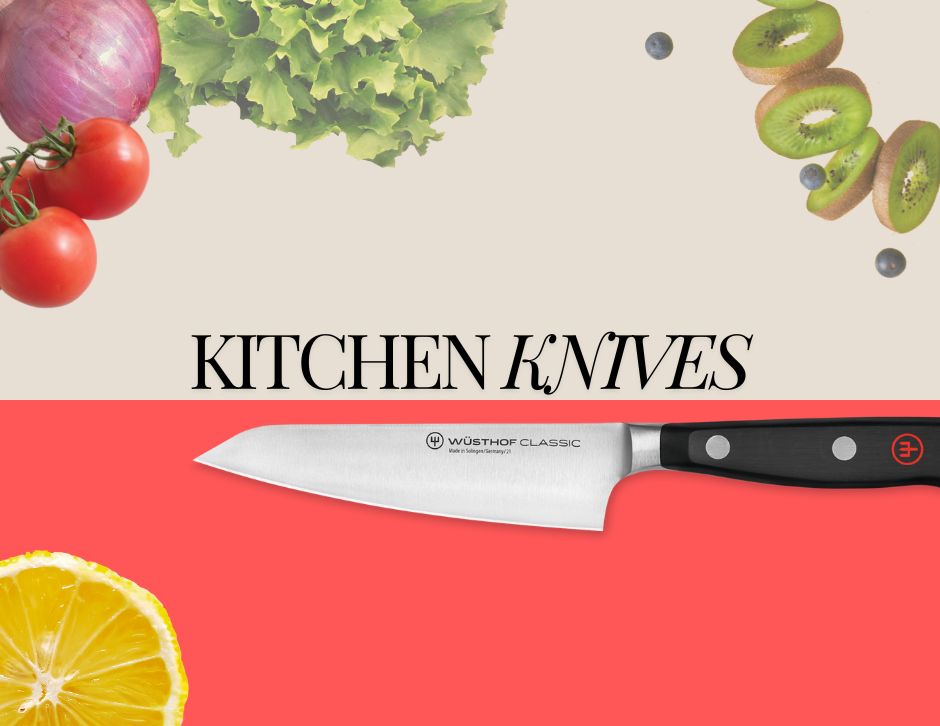
- Featured Image: Knife in the image is by Wüsthof.
Frequently Asked Questions.
Some of the best kitchen knives that you can rely on are Wüsthof, Thiers-Issard Sabatier, F. Dick, Victorinox, and Mac knives.
To sharpen kitchen knives, you can use either a manual sharpener, an electric sharpener, or refer to a professional knife sharpener for the purpose.
The most suitable angle to sharpen Western kitchen knives is 20°, while that for Japanese kitchen knives is 16.5°.
Some of the most basic things that one should look at before buying a kitchen knife are the balance of the knife, how sharp is the blade, and if it has the right composition for a better life, pricing, reviews, and other factors listed in this kitchen knives buying guide.
If you are a home cook, I recommend Santoku Chef’s Knives as they are light, sharp, and all-purpose kitchen knives suitable for cutting vegetables, meat, and fish.
The three basic types of kitchen knives that everyone should have are a Chef’s knife, a paring knife, and a serrated or tomato knife.
The best type of steel for kitchen knives is a composition of stainless steel with the right amount of carbon, molybdenum, vanadium, and other compounds. The carbon grade can be between 55 to 58 HRC and a better example of the best type of steel for kitchen knives is Damascus because they have different types of steel beaten to form a single blade of the best characteristics.
Chef’s knives, paring knives, cleavers, carving knives, slicing knives, fillets, boning knives, utility knives, tomato knives, bread knives, and cheese knives are some of the most prevalent types of kitchen knives.
I have included a short table to differentiate between sharpening and honing, however, the most basic difference between both is that while sharpening can turn a dull knife sharp, honing cannot and is only made for maintaining the sharpness of a sharp knife.
Japan, France, Germany, and the United States of America are known to manufacture some of the finest kitchen knives in the world.
Related Reads.


