
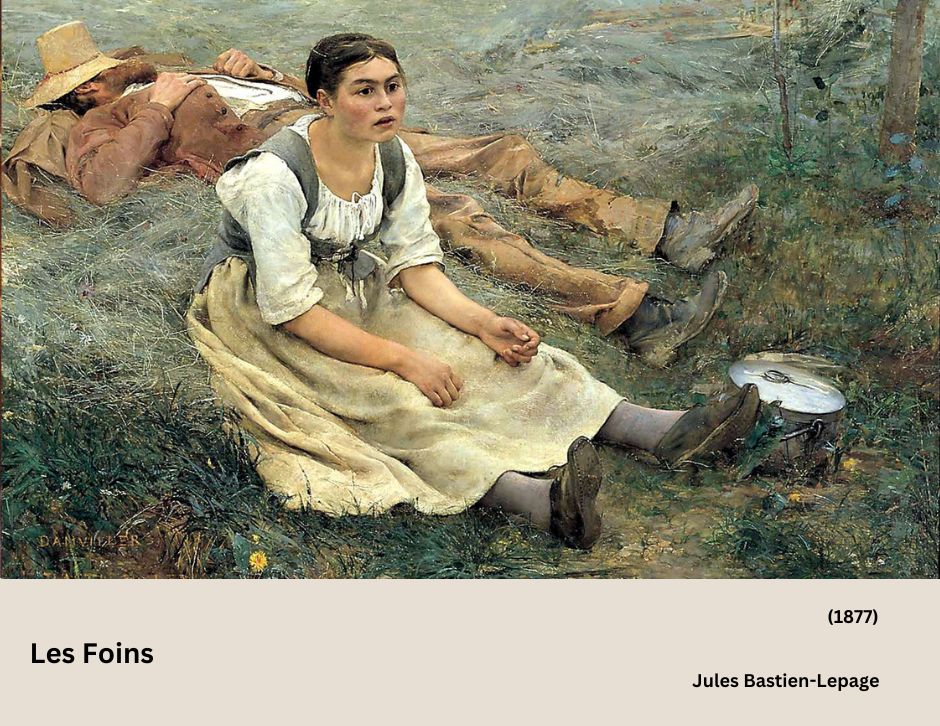
Though not a believer in fate, I sometimes have a contrasting thought that the ways of fate are strange and might work in a few cases. For instance, look at a painter who attains greatness almost without an effort as if he was meant to have a prosperous life, but on a similar end, there’s another artist who is gifted and unquestionably talented but struggled his entire life with poverty and despair, but his death took a turn as what he painted for his daily bread was sold for thousands of pounds. No, I am not talking about the renowned artist Vincent van Gogh but the French artist Jules Bastien-Lepage, who was almost well-known in England and France but found it difficult to survive in the artistic world even though he composed masterpieces his entire life. But while the other artists leave behind a luminous trail, which vanishes after some time, Bastien-Lepage was a rare artist who traced his passage in a furrow of dazzling splendor, the radiance of which has not faded till now. Today, in this article, I am introducing one of his most powerful yet rare paintings- Les Foins (English: Haymaking).
Starting from introduction of the artist, Jules Bastien-Lepage was born under the gray northern skies in an obscure village in eastern France on the first of November 1848. Having been brought up in a poor family; his life was hard, and he knew that he had to make his own way in the world. He spent his boyhood among the peasants and bourgeois who knew nothing about art, his native village never had good artists or masters, nor did it include any popes and cardinals who would set him to work on the Vatican walls of the Faresina ceilings. Hence, he came to Paris as a clerk in the post office, further serving as a franc-tireur in the war of 1870. It was only in later years that he began painting, and his artistic career lasted for about twelve years. In his later years, he was attacked by a cruel disease that made his brain and hands lose power, bringing his life to an end at the mere age of thirty-six. It’s like when people knew that greater things were yet to come for the artist, death stepped in and erased the hopes and dreams of Bastein-Lepage. Describing this,
“But the fair guerdon when we hope to find,
And think to burst out into sudden blaze,
Comes the blind Fury with the abhorred shears,
And slits the thin-spun life.”
Coming on the backstory of the painting, Les Foins was first exhibited in 1878, a magisterial painting which is a pride of the Musée d’Orsay with its engraving scattered to the extent of a million copies. Being the finest peasant picture, Les Foins or Haymaking is a representation of natural fact, indicating the thoughtfulness and gentleness of the subject’s character. It was in the summer of 1877 that Bastien-Lepage thoughts became occupied with this painting, making several studies of haymakers either at work or resting from their tough labor day. One of the significant points of these studies was that often the same woman appeared with half a dozen different attitudes, sometimes lying in the grass, leaning upon her rake or turning her back on us.

In one of the letters, the artist sufficiently described his painting,
“I shall not say much about my work; the subject is not yet sufficiently sketched in. What I can tell you is that I am going to give myself up to a debauch in pearly tones: half-dry hay and flowering grasses; and this in the sunshine, looking like a pale yellow tissue with silver threads running through it.” Then, a month later, he writes again saying, “Your verses are just the picture I would like to paint. They smell of the hay and the head of the meadow… If my hay smells as well as yours, I shall be content… My young peasant is sitting with her arms apart, her face hot and red; her fixed eyes seeing nothing; her attitude altogether broken and weary. I think she will give the true idea of a peasant woman. Behind her, flat on his back, her companion is asleep, with his hands closed; and beyond, in the meadow, in the full sun, the haymakers are beginning to work again. I have had hard work to set up my first ideas, being determined to keep simply to the true aspect of a bit of nature… My people stand out against the half-dry hay. There is a little tree in one corner of the picture to show that other trees are near, where the men are gone to rest in the shade. The whole tone of the picture will be a light grey-green.”
Coming to the subject matter of the painting, a vast sun-bathed meadow with new-mown hay, punctuated here and there by the rounded cones against a blue background of green hill-tops, the painting shows a foreground of a robust and cony-armed country woman seated on the grass with her leg stretched out before her. Having her eyes fixed, her limbs relaxed, her mouth open and wonderfully real, she has an attitude and expression of utter exhaustion due to her work. There is a little unusualness in her dull face, which is extremely tired and in deep thought. It looks like every inch of her exhausted body is veritably resting. The lip parting might suggest that there is hurried breathing due to tiredness. In addition to all of these, her hands look as if she was accustomed to outdoor work from her childhood.
Just beside her, there is a man who sleeps with his body stretched at full length on the thick couch of the grass as if he is too worn out with the work in a similar manner to the woman. With his hat over his face to shelter from the sun, he sleeps in his own calming world. There is absolute perfection in the canvas because every single detail is as perfect as if the artist literally saw their reactions, habits, and behaviors after work alongside their expressions. It looks as if Bastien-Lepage affirms his predilection for the open country, but he connects this landscape with these two homely-turned beings who set amid this splendor of the meadow turned golden by the sun.
The painting is an everyday scene, but it still succeeds in providing the most indisputable form of beauty in an impression emanating from the most humble scenes. Though the artist used a picturesque majesty of nature, it surely adds all the grandeur of the life of the fields. The reason behind this composition was the love of Bastien-Lepage with the rural aspects of Lorrain; the fertile and undulating plains, which he visited eagerly year after year.
Resources.
- Featured Image: Les Foins by Jules Bastien-Lepage; Jules Bastien-Lepage, Public domain, via Wikimedia Commons.
- Jules Bastien-Lepage And His Art: A Memoir by Andre Theuriet and George Clausen.
- Jules Bastien-Lepage by Julia Mary Cartwright D 1924 Ady and Jules 1848-1884 Bastien-Lepage.
- Bastien Lepage (1848-1884) by Fr. Crastre.
Related Reads.


