
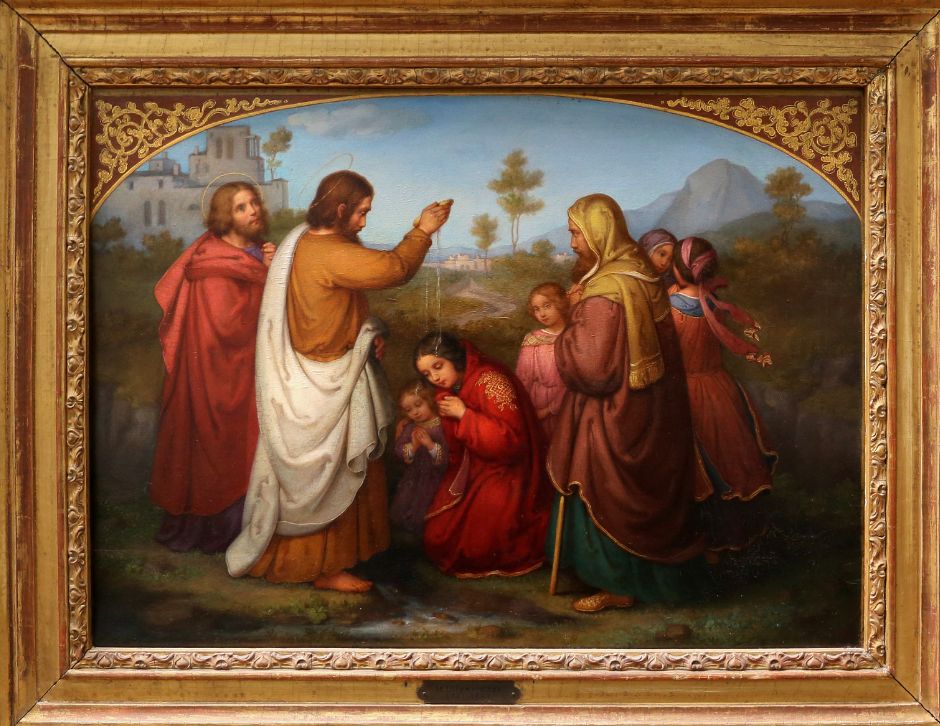
Talking about the patronage of the artists, you might have heard how some of the powerful protectors or patrons at the courts had closer links to the court society, and how these court artists were provided with great privileges. Of course, there were no differences between men and women artists, when it came to enjoying positions in court. For instance, after Sofonisba Anguissola was recommended by the Duke of Alba and painted his portrait in 1558, she was invited to the court of Philip II of Spain, where she enjoyed courtly life and privileges. Similar to this, Louis Seidler’s favor at Weimar was gained as a result of his friendship and close personal relationship with Goethe, whereas Marie Ellenrieder’s early career was stimulated by the powerful and influential protection and advice of Ignaz Heinrich von Wessenberg. Hence, there is no second thought on the fact that the court artists usually enjoyed a great number of privileges and support from their influential patrons, but there was a slight difference between men and women artists. Little did we know that any appointment as the court artist usually involves travel to and residence at the court in question. But one must note that this opportunity to travel was not necessarily a mark of independence and freedom of action. It is because sometimes women were chosen to hold a position in the courts as artists on account of a noted virtue, chastity, and obedience. This was the case for even Sofonisba Anguissola in the 16th century, Anne Killigrew in the 17th century, and then Marie Ellenrieder in the 19th century, all of whom were unmarried when they were first appointed to the court. Coming to the salaries and rewards of these court artists, the permanent positions of the salaried court artists might bring really good awards, although this was not always the case. Sometimes, there were even petitions for greater financial remuneration, knowing that this increased salary could also bring certain demands and obligations. For instance, Marie Ellenrieder, when petitioned about increased pension in 1830, had to supply a major Pflichbild every other year. This way there were different obligations expressed to court artists, but they differed in women artists greatly. Today, we are looking at the life of one such court painter, Marie Ellenrieder.
Marie Ellenrieder | Fast Knowledge
Marie Ellenrieder, one of the most important German female artists of modern times, was the first woman artist to be trained at a German Academy. Having proficiency in the Nazarene style, she painted many portraits and religious artworks.
Artist Abstract: Marie Ellenrieder.
Having a career of greater interest, Marie Ellenrieder is one of the foremost female painters of Germany in the early nineteenth century. Born in Constance, Ellenrieder was first admitted to the Munich Academy through the help of a sympathetic bishop, where she studied under Peter von Langer from 1813 to 1816. In her student life, she became interested in Old German, further becoming a source of inspiration for most of her progressive contemporaries. Between 1822 and 24, Ellenrieder worked in Rome where she closely worked with Overbeck and the Nazarene, Germanic forerunners of the Pre-Raphaelite movements, engaged to further recapture the formal beauty and moral innocence characteristic of Italian art before the High Renaissance. As she completed her artwork, Stoning of St. Stephen for the high altar of the Church of St. Stephen in Karlsruhe, she then became the Bavarian court painter in 1829. Further, her patron, Grand Duchess Sophie of Baden gave her many commissions for portraits and religious works. The religious paintings by the artist are more charming whereas her drawings are fresh, direct, literal, and idealized.

The case of Marie Ellenrieder is an interesting issue associated with women artists as she was not discovered by contemporary art historians despite her excellence in her artworks and good reputation. Hence, though she was known to the art lovers of Karlsruhe and Constance, she was virtually unknown to other places.
| Artist | Marie Ellenrieder |
| Birth | 20 March 1791 |
| Death | 5 June 1863 |
| Nationality | German |
| Genre | Portraiture and Religious Paintings |
| Period | Nazarene Movement, Classicism |
| Famous Paintings | Virgin Mary With the Christ Child, Grand Duchess Sophie von Baden With Her Five Children |
Looking at the Artist’s Life.
On the death of Marie Ellenrieder, one of the painters and art writers, Friedrich Pecht, wrote,
“All things considered, Marie Ellenrieder must be one of the most important German female artists of modern time.”
From being the first woman to be trained as an artist at a German Academy to getting a gold medal of art and science by the Baden artists and appointing as the court painter in 1829 by Grand Duke Ludwig von Baden, Ellenrieder is one of the most significant artists of the Nazarene style. But there is still a distinguishing character of the artworks from the movement.
For those who don’t know the Nazarene style, let me tell you that it is based on Renaissance and medieval German art. The works of the artist have an individuality in the character, which is because of her deep religiosity and sensitive perception. Her excellent painting technique distinguishes her works from those of other Nazarenes. Marie Ellenrieder also left extensive diary notes that reveal a sensitive artist who reacted strongly to contemporary religious morality and its inherent contradictions.
Early Training of Marie Ellenrieder.
For three years, Ellenrieder studied under the Konstanz miniature painter Joseph Einsle before she began her studies at the Munich Academy. In 1813, she was accepted into the Munich Academy through her patron and Mentor, Ignaz Heinrich Freiherr von Wessenberg, a Konstanz church official, where she learned under the classicist painter Johann Peter von Langer. Now, Johann Peter von Langer was recognized for his exceptional talent for portrait painting, which is why in the earlier works of Ellenrieder, we see his influence.
Early Works.
Marie Ellenrieder’s early works show a preference for the deliberate use of light emerging from the darker background, showing the influence of the Baroque period. There are even studies of male heads available, which were executed with a broad brush and strong, lively colors, revealing an impressive vividness and force. Further, during this same period of 1815-16, she also made use of varied cross-hatching (a method, which was used in Baroque copper engravings), which she employed in the later pastel works; a genre in which the artist specialized.
Period of 1817-22.
The period 1817-22 of Ellenrieder was the most productive time of her career. At this time, she displayed enthusiasm and sensitivity in her artworks that further added particular qualities and emotions of the people she painted. It was only in the second half of the 19th century that she would master the genre of realistic portraiture through the deepening of spiritual expressions. Talking about the early portraits of the artist, they were mostly half-lengthed with partly in profile and were created by the artist in the middle-class milieu of her family and Lake Konstanz’s home. Among these portraits, the best ones were of her parents, which also shows psychological characterization.
The Portraiture of Marie Ellenrieder.
As I told you earlier, the portraits from the artist showed a psychological stir in them. Besides, the Ellenrieder added a great degree of liveliness through the use of pastels. She enjoyed portraits of children as her subjects. For instance, the Portrait of Prince Carl von Hohenzollern-Sigmaringen, Heir to the Throne, and Portrait of the Artist’s Nephews and the Daughters Thurn-Valsassina, all were the most beautiful portraits of the children which showed them in refreshingly unself-conscious. One must understand that these paintings were from her early life as it was only in her later life, that she would portray them as ideals of angelic goodness.
In her later life, she painted her self-portraits too. From 1818, she received princely commissions for the portraits of Princess Jablonowski, and Carl Aegon II, and Princess Amelie of Fürstenberg. During this time, she began to portray her sitters in half and full length.
In 1820, she was then called to Baden court at Karlsruhe to paint the portraits of Margrave Leopold and Margravine Sophie von Baden.
Coming Across to Religious Paintings.
The first religious canvas of the artist was St Cecilia and St Jerome, which shows a stronger reliance on Baroque art in content, form, and manner of representation. The paintings further depict an excellent result of her academic studies and the flowering of her talent for color and composition with great sensitivity and liveliness.
Leaving Konstanz for Italy.
Ellenrieder left Konstanx in 1822 to travel to Italy, where she stayed for many years. She stayed with the Weimar artist, Louise Seidler in Rome, who then introduced her to the colony of German artists around Friedrich Overbeck. It was at this time that her art changed as she got influenced by Nazarenes. Hence, during this time, her art had influences of Nazarenes with the impressions of the art of Raphael and Perugino. Also, at this time, she perfected her technical skills.
Her art became more subtle as the application of paint had a smoothness, the colors became lighter, the plasticity of figures and depths was gone, and the faces were idealized. The figures moved to the foreground of the picture plane with a divine light surpassing the figures. And this was when her paintings became more mature.
Paintings from Marie Ellenrieder’s Gallery.
1. Self-Portrait, 1819.
The artist painted Self-Portrait previously in 1818 and then in 1819. Portraying herself as a vivacious, self-confident, and merry young woman, she filled soft brushstrokes to the portrait. Wearing a black dress with a little contrasting white floral strap over the neck, she shows herself wearing a gold chain with a cross symbol. The most attractive part of the artwork is the braided hair and realistic curls, which the artist portrayed herself with, showcasing beauty.

2. Saint Cecilia.
Being the first religious artwork by the artist, this painting had the relics of the Baroque period when it comes to form and manner. The artist showed excellent results in this painting through contrasting colors with a great deal of sensitivity and liveliness. She used quick and firm brushstrokes and light to the figures while giving depth to the surroundings. The artist painted the subject while depicting her innocence and beauty at the same time as she read the book. In the rightmost corner, there are three faces of babies with divine light coming from the foreground.

3. Virgin Mary With the Christ Child.
The artwork is a life-sized painting, with a resemblance to Raphael’s structure, forms, and coloring. The contemporaries’ critics highly praised this painting, and the artwork was closer to the artist. There is a harmony of mystical power and human closeness in this artwork, which makes it one of a kind. Further, there is a sentimentality in the artwork, which makes it more beautiful. When Marie Ellenrieder stayed in Italy, she learned the clarity of the drawing, balance in art, and delicate harmony of the colors, which is pretty visible in this painting.

4. Martyrdom of St Stephen.
In the later life of the artist, she was prominently known for her religious paintings in southwest Germany, which is why she received the honorable commission of painting the Martyrdom of St Stephen on the high altar of the Stadtkirche St Stephan in Karlsruhe. Being the first and only woman to paint such an artwork, she showed a reminiscence of the Italian Renaissance. Avoiding the common and brutal depiction of the stoning of the saint, her artwork contributes to the “ennobling and edification of the beholder.” Since the image is not available, I recommend you visiting the Parish next time you are in the city.
Final Words.
Marie Ellenrieder had no artistic successor as she did not have many students due to the fact that there was a different direction in the second half of the nineteenth century. The artist had such terrific artwork with human sensibility and harmony, but she disappeared into increasing obscurity after her death. Not only this, but the three significant exhibition catalogs of the art of 1977, 1981, and 1989 do not even mention her name despite her technically excellent compositions. Being the central figure of the Nazarene tradition, she must be counted as one of the best artists of Southwest Germany.
Resources.
- Dictionary of Women Artist, Volume 1 by Delia Gaze.
- Women Artists: 1550-1950 by Ann Sutherland and Linda Nochlin Harris.
- Featured Image: Il battesimo della Lidia Marie Ellenrieder; Sailko, CC BY 3.0, via Wikimedia Commons.
Related Reads.


