
The twentieth century saw an incredible fascination with poetry as it turned to speak through culture by rhyming words. For instance, many Russian poets were fascinated by America and have written vividly about the country. Jacques Prévert’s bold and sardonic provocations flung in the face of the defeatist and reactionary France of World War II were taken up by the Beats in America in the Fifties and by the Liverpool poets in the Sixties in England. Furthermore, the poets of Northern Ireland felt inspired by the East European poets of the communist era. This way, despite cultural differences between countries, poetry brought them together; or should I say that literature has always brought people closer, and it has been re-energized by vigorous speech? In this sense, much of the anonymous work of everyday life by people’s words also contributes to the literature even when they don’t know about it. Mildly, this happened when Wordsworth and Coleridge broke with the stilted diction of eighteenth-century poetry. It happened so powerfully in the American fiction of the twentieth century when this melting pot brought together the idioms of Jewish, Italian, and African idioms into the English language. While all these events took place in this same century, the end of this century introduced a few exceptional women poets who were better than men. But as in most countries of the first half-century, the female poets were virtually invisible, there was a great exception in Russia, which brought the shining names of two Silver-Age poets of the twentieth century- Marina Tsvetaeva and Anna Akhmatova. We all know that great poetry defies socially deterministic explanations, which were especially seen in the works of these two legendary poets. Today, in this article, I am introducing a few selected Marina Tsvetaeva poems, which are filled with extreme feminine opinions!
About the Poet: Marina Tsvetaeva.
Born in Moscow in 1892, Marina Ivanovna Tsvetaeva was the daughter of a university professor and a pianist mother. Having her life tormented in the extreme, Marina Tsvetaeva poems fill the reader with passion and scorn at the same time through their tumultuous rhythmic movement. She followed her husband into exile in Paris in 1922. Enduring extreme poverty to such an extent that she hardly accommodated herself to the émigré world, she returned to Russia in 1937 in the Stalin’s Terror. After she returned, however, she faced some of the most terrible circumstances as her husband was executed, and her sister and daughter were imprisoned, spending nineteen years of their lives in labor camps. Evacuated in World War II to Yelabuga, near Kazan, the poet, troubled by her life, ultimately hanged herself to death.

Disclaimer: Note that these poems are translated from the Russian language, so the words might differ from translator to translator, but I have taken the easiest of the translations, which will connect you more to the poet!
10 of the Marina Tsvetaeva Poems Speaking Her Life and Thoughts.
1. An Attempt at Jealousy.
When Marina Tsvetaeva was in Prague in 1923, she began an affair with Konstantin Rodzevich, which ended badly after some time. Some critics and commentators suggest that it was at this time that she wrote the poem, ‘Popytka revnosti’ or ‘An Attempt at Jealousy,’ which captured her disappointments from a failed relationship or affair.
The poem starts with a question to the poet’s former lover, whether his life is simple without her and if he is having a journey with his partner in a far ocean with the poet’s memory. Though the title and lines of the poem indicate jealousy as an emotion, but the speaker tries to indicate that she is just appearing to be jealous, as if she doesn’t care about her rival, and she makes it seem that her rival is not worth being jealous over. Throughout the poem, the speaker uses lines like, “Is the breakfast delicious? How’s your life with a tourist on Earth? or How do you live with cheap goods: is the market rising?” to let her ex-lover see that he is depriving himself with the actual love; the speaker herself.
How is your life with that other one?
– Marina Tsvetaeva, Translated by Ilya Kaminsky
Simpler, is it? A stroke of the oars
and a long coastline—
and the memory of me
is soon a drifting island
(not in the ocean—in the sky!)
Souls—you will be sisters—
sisters, not lovers.
How is your life with an ordinary
woman? without the god inside her?
The queen supplanted—
How do you breathe now?
Flinch, waking up?
What do you do, poor man?
“Hysterics and interruptions—
enough! I’ll rent my own house!”
How is your life with that other,
you, my own.
Is the breakfast delicious?
(If you get sick, don’t blame me!)
How is it, living with a postcard?
You who stood on Sinai.
How’s your life with a tourist
on Earth? Her rib (do you love her?)
is it to your liking?
How’s life? Do you cough?
Do you hum to drown out the mice in your mind?
How do you live with cheap goods: is the market rising?
How’s kissing plaster-dust?
Are you bored with her new body?
How’s it going, with an earthly woman,
with no sixth sense?
Are you happy?
No? In a shallow pit—how is your life,
my beloved? Hard as mine
with another man?
2. Readers of Newspapers.
The poet conveys that the newspapers tick people in some way. The readers of newspapers are faceless and featureless, buried alive, and there is no way to categorize them. She raises a basic question, whether the readers of newspapers even know what time it is through this poetic line, ‘What do such men care if it is dusk or dawn?’
There is a constant dialogue between its conventional syntactical and grammatical function in the poem to define the newspaper’s readers. Further, she compares the editors of these newspapers with the train that carries them down the line and with their gradual withdrawal into the netherworld akin to the editing process or censorship. In the final stanza, she uses the Biblical void, ‘There is no emptier void’ to compare the faceless appearance of the newspaper readers.
The underground snake crawls,
– Marina Tsvetaeva, Translated by Ilya Shambat
Crawls, carries people.
And each — with his own
Newspaper (with his own
Eczema!) Newspaper
Bone eater, chewing tick.
Readers of newspapers,
Chewers of mastics.
Who’s the reader? Old man? Athlete?
Soldier? Not features, not years,
Not faces. Skeleton — since no
Face: sheet of newspaper!
Which — entire Paris
From navel to forehead wears!
Enough, girl! You’ll give birth to —
Reader of newspaper.
Rock — “lives with sister” —
ing — “his father he killed!” —
Rocking – of vanity
Pumped themselves full.
What do such men care
If it is dusk or dawn?
Swallowers of voids,
Newspaper-reading ones!
Read newspapers: slander,
Read newspapers: waste.
A column — calumny,
A paragraph — disgust…
With what on Terrible court
In the light you’ll appear!
Seizers of minutes, you
Readers of newspapers!
He went! Vanished! Got lost!
Old is the mother’s fear.
Mom! Guttenberg’s press than
Schwartz’s dust is scarier.
Better on churchyard
Than in hospital of pus
To cast scratchers of scabs,
Readers of newspapers!
Who is it that rots our sons
In their prime of years?
Mixers of blood, they are,
Writers of newspapers!
Here, friends, — and where
Stronger than in these lines!
What do I think, where
With writing in my palms
I stand before the face —
There is no emptier space!
That means — not with face
Of editor of news —
Paper filth.
3. You Who Loved Me With the Falseness.
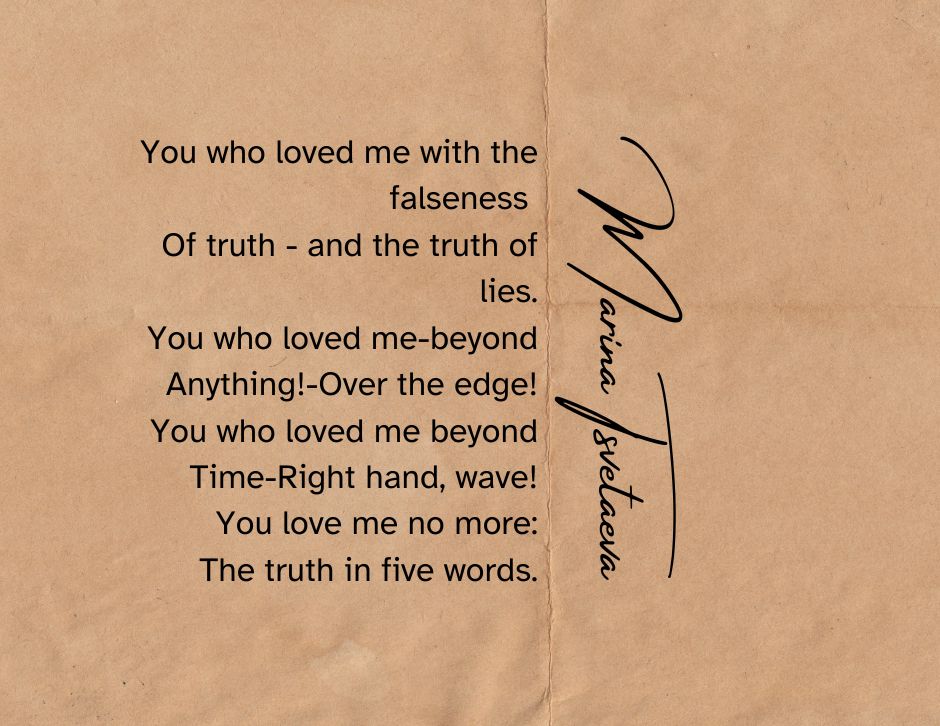
Through the poem, Marina Tsvetaeva explains that her lover loved her with both sincerity and deceit before abruptly ending the relationship. Beginning from the second and extending to the fourth line, it explains how the ex-lover of the speaker used to love without any boundaries, edges, or waves, but at the end, she speaks, ‘You love me no more,’ as if she is past it and accepted the reality.
You who loved me with the falseness
– Marina Tsvetaeva
Of truth – and the truth of lies.
You who loved me-beyond
Anything!-Over the edge!
You who loved me beyond
Time-Right hand, wave!
You love me no more:
The truth in five words.
4. Before a Little Coffin.
The poem narrates the pain of a mother who has lost her five-year-old daughter. The speaker compares the bright coffin and Sunday attire contrast with the lack of failing hair and the absence of the comb over her pretty child. During the five years of her life, she was never disturbed by anyone and lived her life to the fullest through mid-lilies and fantasies, but as she died, the flowers near her in the coffin knew about her golden heart.
There is a pain infused with the loss and fragility of life in the poem with a more restrained tone.
Mother has painted the coffin brightly.
– Marina Tsvetaeva, Translated by Ilya Shambat
The tiny one sleeps in Sunday attire.
Onto the forehead no longer is falling
The light-brown hair;
A round comb no longer is pressing,
Having seen so little, of the child’s head;
Only of joy knew
The heart of the kid.
For five years so happily lived she
Much played the deft arms!
Fantasies, fantasies mid lilies,
Nobody disturbed them.
The flowers seek a place nearer to her,
(She seems tight in her new bed).
The flowers know: Little Katya
A golden heart had.
5. Bound for Hell.
The Bound For Hell is a classic feminist poem by the poet in response to society’s expectations of an ideal woman, demanding to be involved in household chores all the time. To the women of the time who miss spinning at night and are ‘careless seamstresses,’ they are bound to go to hell, where all of them will wear fine Chinese silks and would-be queens each. The speaker exaggerates the experience of hell through these lines,
‘And we’d strike up the songs of paradise; Around the campfire of a robbers’ lair.’
Throughout the poem, the speaker challenges society by maintaining a stand of living a great life even in hell. She speaks about lost benefits and rewards of heaven as they have been in jail.
Hell, my ardent sisters, be assured,
– Marina Tsvetaeva, Translated by Stephen Edgar
Is where we’re bound; we’ll drink the pitch of hell—
We, who have sung the praises of the lord
With every fiber in us, every cell.
We, who did not manage to devote
Our nights to spinning, did not bend and sway
Above a cradle—in a flimsy boat,
Wrapped in a mantle, we’re now borne away.
Every morning, every day, we’d rise
And have the finest Chinese silks to wear;
And we’d strike up the songs of paradise
Around the campfire of a robbers’ lair,
We, careless seamstresses (our seams all ran,
Whether we sewed or not)—yet we have been
Such dancers, we have played the pipes of Pan:
The world was ours, each one of us a queen.
First, scarcely draped in tatters, and disheveled,
Then plaited with a starry diadem;
We’ve been in jails, at banquets we have reveled:
But the rewards of heaven, we’re lost to them,
Lost in nights of starlight, in the garden
Where apple trees from paradise are found.
No, be assured, my gentle girls, my ardent
And lovely sisters, hell is where we’re bound.
6. A Kiss on the Forehead.
The poem unfolds the importance of an intimate kiss, which can erase all the misery and problems. The speaker emphasizes the importance of having a loved one who can kiss you to put you out of your discomfort and anxiety.
A kiss on the forehead—erases misery.
– Marina Tsvetaeva, Translated by Ilya Kaminsky
I kiss your forehead.
A kiss on the eyes—lifts sleeplessness.
I kiss your eyes.
A kiss on the lips—is a drink of water.
I kiss your lips.
A kiss on the forehead—erases memory.
7. Grey Hairs.
Marina Tsvetaeva explores the transformative nature of time with pain and loss through the metaphor of grey hairs. She remarks them as a sign of the wisdom accumulated throughout her life due to her painful experiences. Comparing these experiences or grey hairs as treasures, doves, and Solomon’s ashes, she uses classical literature to strengthen the resilience of the human spirit as it passes through all kinds of ups and downs. The speaker also conveys a sense of time passing and that ‘God knocks at the door — Once the house has burned down’ to reflect the complexities of the aging process and an enduring presence of soul within all the hardships.
These are ashes of treasures:
– Marina Tsvetaeva
Of hurt and loss.
These are ashes in face of which
Granite is dross.
Dove, naked and brilliant,
It has no mate.
Solomon’s ashes
Over vanity that’s great.
Time’s menacing chalkmark,
Not to be overthrown.
Means God knocks at the door
— Once the house has burned down!
Not choked yet by refuse,
Days’ and dreams’ conqueror.
Like a thunderbolt — Spirit
Of early grey hair.
It’s not you who’ve betrayed me
On the home front, years.
This grey is the triumph
Of immortal powers.
8. Conversation With a Genius.
The poem explores the theme of the inner struggle of a creative individual when they run out of ideas, motivation, and inspiration. With sharp, clear, and concise language, the poet intensifies the unconventional nature of the creative process. Remarkably comparing with the genius of the domain, for instance, sound to compare singing, the poet explores the contrasting themes as if she is focussing on the direct confrontational dialogue with them. The poem is an inspiration that focuses on ‘doing’ instead of getting lost in the shadows of lethargy and demotivation though one might find it extremely difficult at the moment. Further, it also reflects the challenging nature of creativity especially when the women of the 20th century were marginalized in Russia.
Like mountains – on this brow
– Marina Tsvetaeva
Laurels of praise.
“I can’t sing!”
– “You will!” – “Sound
(Put me on a diet
of flour!)
Like milk –
Is gone from my breast.
Empty. Dry.
In full-blown spring?
I feel like a twig.”
– “That’s an old song!
Drop it, don’t blabber!”
“From now on I’d better –
Pound gravel!”
– “All the more reason to sing!”
“Am I a bullfinch,
To sing
Day in and day out?”
– “Even if you can’t,
My bird, sing!
Out of spite!”
“What if I can’t
put two lines together?”
-“When could – anyone?!” –
“It’s torture!” – “Bear it!”
“A mown meadow –
My throat!” “Then wheeze:
That’s a sound, too!”
“It’s lions’ business
Not women’s.” – “Children’s:
Though disembowelled –
Orpheus still sang!”
“So, even in the grave?”
– “Under a headstone, too.”
“I can’t sing!”
– “Sing about that!
9. Prayer.
The Prayer is a poem that yearns for the poet’s experience of extraordinary experiences with a life filled with passion and adventure. As the speaker has a conversation with God about a life that transcends ordinary experiences, she asks for a ‘marvel,’ expressing a thirst for the life that has to offer. She questions God on patience through the lines, “Now be patient, Your time’s not ripe you will not say” and asks for the extraordinary experiences for her life. She wants to live like a gypsy with the Romantic era’s emphasis on emotion and individualism to experience every aspect of life to the fullest. However, there is an intense emotion in the poem as the speaker creates an urgency as if she is impatient and restless. The last lines of the poem, “You gave me childhood – better than fiction; Now let me die at seventeen!” create drama in the poem as the speaker asks for death instead of living a normal and monotonous life.
Christ and the Lord! I thirst for marvel
– Marina Tsvetaeva, Translated by Ilya Shambat
Now, here, as the day would start!
The life is like a book to me,
So let me die. Let me depart.
You’re wise, and sternly “Now be patient,
Your time’s not ripe” you will not say.
Yourself you gave me – too much now!
I thirst at once – for every way!
I want it all: with soul of gypsy
To run to plunder with a song,
To suffer for all near an organ,
To run to war, an Amazon;
To divine stars in a black tower
The kids through shadows to lead…
That yesterday would be a legend,
That each and every day be mad!
I love the cross, the silk, the helmet,
The minute’s trace of soul of mine..
You gave me childhood – better than fiction
Now let me die at seventeen!
10. Dialogue Between Hamlet and His Conscience.
The poem explores the theme of love and the aftermath of the loss of Hamlet’s beloved, Ophelia. Written in free verse style, the poem puts the reader into immediate urgency as if Hamlet is speaking to the reader with exceptionally raw and honest emotions. As the poem begins with “She’s in the riverbed, in algae,” it creates a sense of obsession and grief as if Hamlet is unable to escape the image of his beloved’s body. As the speaker uses the line where she says that Hamlet loved her like “forty thousand brothers,” it begins to intensify the emotion and grief of Hamlet as if he is so overwhelmed right now that he is unable to even think rationally.
– She’s- She’s in the riverbed, in algae
– Marina Tsvetaeva
And weeds…She went to them
To sleep, – but there’s no sleep there, either!
– But she’s the one I loved
Like forty thousand brothers
Couldn’t love!
– Hamlet!
She’s in the riverbed, in algae:
Algae! . . And her last garland
Has surfaced in the logs by the bank…
– But she’s the one I loved
Like forty thousand…
– Less,
Even so, than a single lover.
She’s in the riverbed, in algae.
– But she’s the one –
I loved??
Final Words.
I personally found Marina Tsvetaeva poems to be expressive, sentimental, and thought-provoking. Though these poems are translated into English, the actual Russian work is even more connecting and beautiful. Never before I had read such exceptional and strong feminist poems exploring the themes of loss, determination, love, and pain. If you love these poems of hers, then I definitely suggest you to her complete poems through the Selected Poems book.
Resources.
- Poetry Foundation.
- All Poetry.
- Selected Poems (Penguin Twentieth-Century Classics) by Marina Tsvetaeva; Translated by Elaine Feinstein.
- Featured Image: You Who Loved Me With the Falseness by Marina Tsvetaeva; Poetry Foundation.
Related Reads.


