
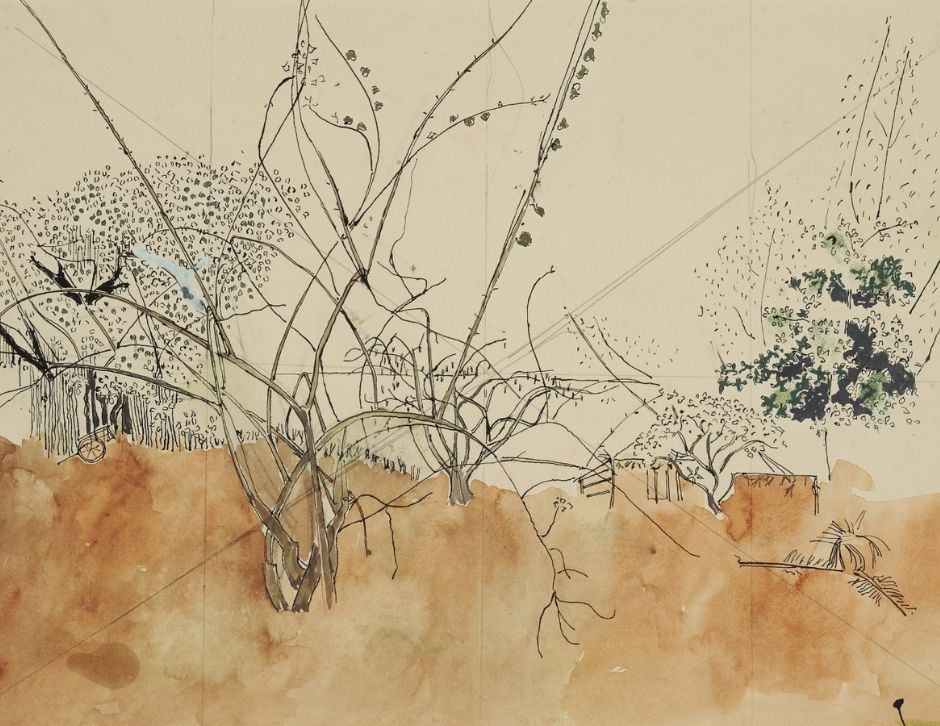
Every time I write an article on a female artist, I ask myself one question- is this a feature special to the woman artists, or am I turning more feminist? But then I rethink the quote of Geeta Kapur on feminism ideology, “Questioning the essentialist aspect of the feminist argument, I would like to propose that if something like an ‘authentic’ female experience is sought to differentiate the feminist rendering of reality and truth, the criteria have to be taken away from the existentialist frame. Rather than duplicate and ‘correct’ the hegemonic overtones of humanist notions such as male sovereignty, feminism may propose a more didactic and tendentious aesthetic within a historicized context of cultural production.” Of course, it’s right because somewhere I feel that firstly, there are very few people who consider writing about the rare women artists and then who finally acknowledge their work and presence, they add their feminist agenda instead of actually telling you their essential works. More recently, women artists have been studied more by people and even historians because of the fact that they tell you more about how their worlds have been shaped, their societies, and the cultural differences they faced during the journey. With this acknowledgment, I am making a proposition on the lesser-known Indian woman artist, Nasreen Mohamedi, an artist who has a great lineage of metaphysical abstraction in a way that no other Indian artist ever had.
Nasreen Mohamedi | Fast Knowledge
Nasreen Mohamedi was an Indian artist who used metaphysics and spirituality to form geometrical compositions. Having been influenced by Russian Suprematism, Biblical Verses, and French scholar love letters, she wanted to romanticize Indian art while giving attribution to forms and shapes.
Artist Abstract: Nasreen Mohamedi.
Being the most significant artist of Post-Independence India, Nasreen created numerous artworks that demonstrated a singular and sustained engagement with abstraction art. Having frail limbs, an ascetic face, and an ungendered artist persona, she is one of the most beloved artists of India who painted till the end of her life.
Sometimes, the mind is manifest in the aspects of mindlessness, but Nasreen wanted to live in a blithe madness, laughing and sobbing, crossing over, but without the help of objects.

Born in Karachi (British India) in 1937, she moved to Bombay with her family in 1944, where she spent her childhood. When Nasreen was four, her mother died while giving birth to her youngest son. The family consisted of five sisters and four brothers, two of whom died of a debilitating neuromuscular illness.
Moving to Central Saint Martin’s in London, Nasreen spent a significant time in Bahrain, but she returned to Bombay in 1958, where she had her first solo exhibition at the Bhulabhai Memorial Institute in 1961. In the 1960s, she traveled extensively through India, Iran, and Turkey. Then, in 1972, she moved to Baroda to teach at the Faculty of Fine Arts at M.S. University in Baroda. Throughout the 1970s and 80s, she participated in several exhibitions and participations, including The Third Triennale in New Delhi (1975) and Contemporary Indian Art as part of the Festival of India in Britain (1982).
| Artist | Nasreen Mohamedi |
| Birth | 1937 (Karachi, British India) |
| Death | 1990 (Mumbai) |
| Nationality | Indian |
| Genre | Abstract Art |
| Period | Indian Modern Art |
About the Artist’s Life and Art.
Starting from the daily rituals of washing and cleaning to commence her day, Nasreen writes,
“The empty mind
Receives
Drain it
Squeeze the dirt
So that it receives the sun
With a flash.”
One of the books, that Nasreen Mohamedi loved was the translated love letters of Peter Abelard and Heloise, the French medieval scholar and his beloved committed to nunnery who both lived through the pain beyond belief, but there was an unwillingness to surrender before God in the shape of Christ. Heloise writes to Abelard,
“Like a white magnolia flower
cupped in ivory prayer,
my tranquility rests in the evening
And floats, still in the quiet air.
I can now remember our misfortunes
without regret;
I can now be alone,
Without loneliness;
And can sleep without dreams,
and even think of you
without the pain of not being with you…
…
I used to call you beloved;
I do so now,
But observe the word is an imperative;
beloved, be loved; be free.
I have found another.
I no longer need you.
It is true: you are free.”
Nasreen identified with the words of the beloved evacuating it of every symbolic truth, but she neglected the deeply embedded narcissism in it. She painted an echo to the Narcissus with her drawing which reflected the visage in the sky as if it catches the echo on the ground below. There is another echo in the painting (reflected from the ground), which is freedom of longing, negated/recovered. Further, the artwork shows as if a body is hovering with a possessed view from nowhere to a view from everywhere which is a kind of phenomenological wonder.

From the 1980s, Nasreen’s body was losing motor functions and becoming gradually dysfunctional as her limbs didn’t have movement as if they were flying like puppets, but she didn’t take this destinal sign of her failed limbs. Though it seemed, like destiny was against her mortality, Nasreen did not leave her paintings. Barthes says,
“In order to suggest, delicately, that I am suffering, in order to hide without lying, I shall make use of a cunning preterition: I shall divide the economy of my signs.
…. The power of language: with my language, I can do everything: even and especially say nothing.
I can do everything with my language, but not with my body. What I hide by my language, my body utters… By my voice, whatever it says, the other will recognize ‘that something is wrong with me.’ My body is a stubborn child, my language is a very civilized adult.”
To portray this, Nasreen Mohamedi painted another composition, Untitled 1981, where she portrayed a body as an invisible presence in a map of a few lines. The drawn lines are remote with an idealized trajectory of the stricken body but they still evoke a compensatory grace and precision. Kapur explains this artwork as,
“A precise specularity, the flight of an angel shearing space. Then, in the night of the soul, where the ejected body persists, Nasreen was content to work with a poverty of means. To counter the spectacle of love and of spiritual ambition, she was willing to break apart. She would simply survive and let the calligraph, the graphic sign, speak.”
Nasreen did have antecedents in contemporary Indian art like V.S. Gaitonde who acted as her mentor in the early 1960s. Further, she had her longtime friend and colleague Jeram Pate who brought a new direction in the Indian abstraction beginning with the Group 1890 exhibition in 1963. Nasreen’s intention towards Indian art was to overween its romanticism. Her art practices systematically denuded the metaphysical paradoxes with the abundance of romantic modernity, western and Indian alike. She further disengages representational ethics derived from the artist’s gaze as if she deliberately cancels or defies the gaze regime, sensing the appropriative and exploitative aspects of it. Her works further have a shadow of Christ’s imprint or the shadow of the Hiroshima victim of the wall.
Historical Lineages of Nasreen Mohamedi’s Art.
One of the important parts of Nasreen Mohamedi’s art is that she is aligned with two historical lineages. It is that her vocabulary comes from a lyrical, expressive, and spiritual source in the high modernism of India, but it also comes from the Utopian dimension in twentieth-century art which provides the metaphysics and ideology of her modernist inclinations.
Talking about the lineage of the utopian abstraction, it emerged from revolutionary socialism (from the Soviet Union in the 1920s) and is suprematism. Among this suprematism, there was Kazimir Malevich whom Nasreen adored, which is why she uses flat picture place, a Cubist injunction to form into the diagonal as a preferred form in her artworks. Then, she uses a chevron, a triangle, and a cross to dominate the visual vocabulary to make a geometric abstraction for a symbolic language. Further, she adds an interest by using light and dark contrasts while giving a privilege to the clash of elements. In 1921, Malevich explains the suprematism as,
“In the future, not a single grounded structure will remain on Earth. Nothing will be fastened or tied down. This is the true nature of the universe. But while each unit is a singular part of nature, it will soon merge with the whole.
This is what Suprematism means to me- the dawn of an era in which the nucleus will move as a single force of atomized energy and will expand within new, orbiting, spatial systems… Today we have advanced into a few fourth dimensions of motion. We have pulled up our consciousness by its roots from the Earth. It is free now to revolve in the infinity of space.”
Hence, geometry was used in the Soviet Union to celebrate a futurist plan of the world along with the victory of the autonomous mental realm. In addition to this, the energies of the mind, seen as geometrical forms can stand for the human praxis energies, which makes these forms strictly a dynamic order. But the act of balancing these with spirituality needs a lot of courage which Nasreen Mohamedi did in her artworks.
The Untitled 1980 is one of the important paintings of Nasreen’s career that shows the floor of the artist’s house which was just a polished stone with no prints of the barefoot or illusions. The artwork shows an airy matrix as if there is a weaving pattern. The parallel lines and grids were undulating, following a pencil along a string or measuring tape. Another painting, Untitled 1976 shows the artist’s acceptance of impotence, humility, empty rectangles, silence, and blankness. Nasreen explains the paintings in the 1960s as,
“The new image of pure rationalism. Pure intellect that has to be separated from emotion… A state beyond pain and pleasure… Again a difficult task begins.”


The drawings and paintings of Nasreen raise a question of perspective in several different ways. Geeta Kapur explains,
“Perspective as a ubiquitous premise of thought; perspective throwing up a vanishing point and providing the flip-face of imagist art that is mostly anthropomorphic, blocking the horizon by foreground bodies.”

Furthermore, she had optics in her artworks as if she saw things through a telescope into stellar space. Lastly, her artworks had influences of Turkish and Mughal architecture and Arabic calligraphy.
Final Words.
“Break
Rest
Break the cycle of seeing
Magic and awareness arrives.”
Nasreen Mohamedi was an excellent artist but most importantly a pure bliss of knowledge with numerous inspirations. She embraced humility, exposed her needs, and accepted the poverty of means while folding up the memory of love. The only thing I saw in her artworks was her self-image which longed to gather attention.
Resources.
- Featured Image: Untitled, ca. 1960 Ink, graphite, and watercolor on paper 13 3/5” x 19 3/10” by Nasreen Mohamedi; Talwar Gallery.
- When Was Modernism: Essays on Contemporary Cultural Practice in India by Geeta Kapur.
Related Reads.


