
Nudity has always been an integral part of art history. The nude art of the ancient Greeks epitomized the perfect physical beauty that can never be destroyed over time, further signifying the imposition of order upon the caprices of nature. Hence, when you see the Greek gods, they have been portrayed in nude forms, while the portraits of actual people were generally clothed, symbolizing the nobility of the human spirit. However, in contrast, during the Medieval era, the naked body portrayed temptation and sin. It was because of the belief in Christian theology that emphasized on the inevitability of the body’s decay and shame in nakedness that came after eating the fruit of knowledge. Hence, in medieval art, the nude paintings were restricted to fewer themes, including the Temptation, the Last Judgement, and the Torments of Hell. Later on, the classical ideals were rediscovered during the Renaissance when the nude became an embodiment of the perfect beauty and an emblem of abstract concepts including beauty, genius, friendship, and love. Hence, naked paintings have always been an artist’s muse to depict a wellspring of creativity. In this article, I will apprise you of several famous nude paintings, and the list will continue till I explain a satisfactory number of these works.
11 Nude Paintings to Understand Nudism in Art.
1. Adam and Eve by Hugo van der Goes.
Hugo van der Goes was a genius of the Early Renaissance, as he showed little interest in composition. He usually distributed the figures in his paintings with care, while giving them an appropriate proportion. However, he depicted a curious inequality in the conception of male and female form. As he depicted the female saints of slender build with a superabundant realism in their expressions while portraying a disappointed male.
In the painting, Adam and Eve, the artist depicted Eve slim, high-breasted, and full-stomached. However, there is a lack of physical beauty, particularly female beauty, in the expressive role of Eve. Rather than shown as a sinful temptress, she is condemned for her disobedience here. Adam and Eve are depicted here at the moment of temptation, but before the point of no return. Having plucked an apple for herself, Eve reached for another apple for Adam, with a strange female serpent standing behind. There is a premonition of a sense of shame to come after this event, which is already seen through the strategic placing of Adam’s hand and the iris in front of Eve.

2. The Birth of Venus by Sandro Botticelli.
Sandro Botticelli was one of the Medici’s favored artists and the greatest master of the Italian Renaissance. He created masterpieces that, in their time, reflected some of the philosophical concerns of the Florentine nobility. Painting some of the numerous portraits of Florentine society, he often included images of the Medicis themselves in such major religious and allegorical works as The Adoration of the Magi and Pallas and the Centaur.
Botticelli painted The Birth of Venus between 1485 and 1488. Venus is reminiscent of the Primavera, but she is more mature and allegorical here. The subject is derived from the classical myth, which I have explained in detail in my previous article. The Birth of Venus is not just a tapestry of symbolic mystery, but a personification of perfect beauty with the context of the Renaissance’s new interest in classical ideas. The pose and the sculptural treatment are derived from the Medici’s Venus, but there is not a classic borrowing here, as it shows the graceful elongation of the International Gothic style.

3. Venus With Cupid the Honey Thief by Lucas Cranach.
Born in 1472, Lucas took his name from his birthplace, the Franconian town of Kronach, a part of the Bishopric of Bamberg. He was first taught by his father, Hans Maler, who was also an artist. Lucas’s paintings are mainly influenced by the graphic art of Albrecht Dürer, further giving his paintings an extraordinary quality.
One of the famous nude paintings of all time, this composition has its roots in the 3rd-century BC poem by Theocritus, “The Honey Stealer.” It indicates the painful consequences of seeking sexual pleasure and is one of the several treatments of the same subject by the artist. Venus, the goddess of love, is shown here accompanying her son, Cupid. The honeycomb that the cupid holds here is the symbol of the joyful consequences of the sexual act, while also pointing to the dangers inherent in that pursuit. The stinging bees here symbolise the pain of requited love or a possible illness. Despite the fact that the subject is classical, the northern European Venus owes nothing to classical.

4. Gabrielle D’Estrees and Her Sister, the Duchess of Villars.
The nude painting, Gabrielle d’Estrees and her sister, the Duchess of Villars, is a rare composition, which does not seem to hark back either to the classical or the Biblical sources. Representing the French King’s mistress, Gabrielle d’Estrees, accompanied by his sister, this composition shows the unusual half-length pose. The Duchess of Villars touches the breast of Gabrielle d’Estress in allusion to the impending birth of the Duc de Vendome, the king’s son. In the background, the servant prepares the baby’s linen. Gabrielle was the most famous and well-known mistress of the French King, Henry, due to her youthful beauty. The portrait shows nude sisters sitting in a tub lined with a silk cloth. Their skin is as white as porcelain, with their gaze directed towards the viewer. Though at first glance, this scene suggests a homoerotic connotation, during the Renaissance, the pinching of the mamilla was an allegory of fertility.

5. Expulsion of Adam and Eve by Michelangelo Buonarroti.
Michelangelo Buonarroti was the supreme artist of the Renaissance who remained the victim of his own genius throughout his life. Though the greater part of his long life was occupied by serving the Papacy, he was essentially a man of honour who was kind, generous, courteous, and considerate. His professional career began with his arrival in Rome on June 25th, 1496. During the four years of his stay, he executed two notable works, Bacchus and the great Pieta, as well as the Madonna della Febbre in St. Peter’s. In 1501, when Michelangelo returned to Florence, he was regarded as a sculptor of repute and an acknowledged master.
The Expulsion of Adam and Eve was commissioned by Pope Julius II on the Sistine Chapel ceiling despite his protestation that he was a sculptor. The whole cycle contrasts the Old and New Testaments, emphasizing two of the main Judaeo-Christian beliefs- the One God and the hopelessness of humankind. In the composition, Adam is much stronger than Eve, swatting away the point of the angel’s sword while Eve crouches beside him.

6. The Venus of Urbino by Titian.
Tiziano Vecellio or Titian, was born in 1490 and went to Venice at the age of ten to study with Giovanni Bellini. Titian was recognized as the master of the High Renaissance. Being commissioned to paint several portraits of Popes and emperors with numerous frescoes and altarpieces in Venice and Rome, Titian’s reputation spread far beyond the borders of Italy.
The Venus of Urbino is one of the most famous works of the artist. Depicting an emblematic figure of a young bride about to be dressed to take part in “il toccamano,” the artist paints a girl lying naked on a bed with the crumpled sheets. She gazes out at the onlookers in a flirtatious and allusive manner while hiding her pubis with her left hand. The background of the composition shows an elegant room distinctive to a rich patrician home in 16th-century Venice. There are two maids, one searches the painted chest while the other one is seen to have the sumptuous gold and light blue wedding dress on her shoulder. On the windowsill, there is a pot of myrtle, which is traditionally linked to Venus, a reference to the constancy in love. Adjacent to the feet of Venus, a dog sits. Though the composition has an ostensible depiction of the ideal beauty, with her status being intimated by the flowers she holds, the figure appears quite aware of her charms with her gaze at the spectator.

7. The Toilet of Venus or Rokeby Venus by Diego Velázquez.
Being acclaimed as “the greatest painter of all,” Velázquez impresses and intrigues so many of the modern artists. Apprenticed under the painter Francisco Pacheco, Diego Velázquez, which was his full name, was admitted to the painter’s guild after five years, signing his name as Velázquez de Silva. Even the church registries where his marriage and the baptisms of his two daughters occured consistently recorded his name as Diego Velázquez de Silva. Pacheco tells that the artist, during his first Italian journey in 1629-30, made many drawings from Michelangelo’s Last Judgment and Raphael’s frescoes at the Vatican and from antique sculptures at Villa Medici in Rome.
Rokeby Venus was painted by Velázquez in the course of his second Italian journey. The masterpiece harmonizes the red and blue colors with the curtain and Cupid’s sash, further infusing the lavender-pink hues through the ribbon looped over the mirror frame. With a series of long curves, over the nude lady, the artist contrasts draperies. The lady’s face in the mirror is a successful attempt at illusion. While not portraying the exact features of the lady, the artist leaves a mystery in the painting. In front of her, her son, Cupid, holds a mirror while intertwining pink ribbons with a knot at the top. The subject shows the influence of the Venetian nudes, as this composition shows Venus in a reclining pose, absorbed by her study of the mirror held by a male cherub or Cupid.

8. The Three Graces by Peter Paul Rubens.
Peter Paul Rubens was one of the most exciting and influential painters of the Baroque Era. He was commissioned with most works during this time in comparison to any other painters of his time. Considering the whole world his native land, he traveled from Flanders as an emissary to the courts of France, Spain, and England. In fact, by transplanting the Italian Baroque to Flanders, Rubens broke the last of the artistic barriers between Northern and Southern Europe. Being a man of action, his energy was directed towards a life of prolific painting and engraving. Transplanting the Renaissance ideals of beauty into a classical form, Rubens firmly transplanted the Baroque into northern Europe.
The Three Graces are the most beautiful of the Rubens’ nudes and hence among the most famous nude paintings. Unfortunately, years after they were done, they were painted over with light gowns in defence to the Christian modesty, damaging them badly. Being concerned with ideal female beauty, specifying that it included a long neck and hair, broad breasts, a straight back, ample but firm buttocks, and full thighs. In the composition, he combined the ideal type with a personal type of beauty. The left figure of the composition has the features of Helena Fourment, the painter’s second wife, and the right figure has the features of Isabella Brandt, his first wife. Hence, Rubens created an ideal link between his two spouses, one charged with personal emotion.

9. The Odalisque by Francois Boucher.
Boucher was no libertine but rather a humble Parisian who rose by his talent to become the Premier Peintre du Roi and the director of the Academie. Being industrious till the end of his life, he painted over a thousand paintings and executed ten times as many drawings. Boucher is known for his many mythological paintings, such as Diana at the Bath of 1742, and pastoral subjects, such as Pensent-ils au Raisin of 1749. Generally, he produced several religious paintings, such as La Lumière du monde of 1750.
The painting, Odalisque, shows the influence of Rococo art, appealing to the sophisticated tastes of the French Royal court, further celebrating the atmosphere of gallantry and coquetry in which this social elite lived. The subject and style both emphasised sensuality while glorifying the erotic subject. It portrays a Turkish female slave in the disguise of a mythological subject. The subject is thought to be the Victoire O’Murphy, a member of the court around the King’s mistress, Madame de Pompadour. Though beautifully painted, his nude is little more than a pretext of erotic titillation as the disarray of the model’s robe and draperies is designed to remind the male spectator of past sexual delight while offering a promise of more to come.

10. Les Baigneuses by Jean-Honoré Fragonard.
A famous name, Fragonard, was born at Grasse near Cannes on April 5. Being born in Grasse, southern France, on April 4, 1732, during the reign of Louis XV. His life was marked out by events and upheavals that included the Seven Years’ War of Prussia at Jena. Lasting until the dawn of the 19th century, the seventy-four years of his age embraced his long career. His grandson put it,
“Fragonard’s fall from favor came when he was not yet fifty. One could say he outlives his public by twenty-five years.”
The theme of Les Baigneuses had many precedents, though earlier examples generally contained more explicit mythological references. The keynote is rather coquettish eroticism, which distinguishes Rococo art. These nudes disport themselves with the gay abandon, particularly the central nude who provocatively leaps with her arms outstretched while her other two companions playfully wrestle on the bank. The theme of the painting has an earthiness as the artist used fleshy pinks and warm greens.

11. Leonidas at Thermopylae by Jacques-Louis David.
Jacques-Louis David was a supremely gifted artist who was also a passionately political man. Though his first paintings were acclaimed during the aristocratic era of the Ancient Régime, he became one of the most crucial artists during the French Revolution. Never ceasing to draw and paint, he was imprisoned briefly in 1794. Emerging from the confinement to record some of the most exalted movements in Napoleon’s reign, he continued producing superb history paintings and several insightful portraits while living in exile in Brussels.
The composition had Neoclassical influence, but it did not pay too much attention to nature or detail. Instead, it expresses the highest emotion and virtues. For Winckelmann, the art must have a double aim: to delight and instruct. So David, who was a strong supporter of the French revolution took up the idea of an ethical purpose for his art at the same time as he determined to work in the pure Greek style. The subject of this treatment is the Spartan heroes who prepare for battle and death, their idealised male beauty, being a symbol for manly and more particularly Republican virtues.

Resources.
- Fragonard by Marie-Anne Dupuy Vachey.
- The Early Flemish Painters: Notices of their Lives and Works by J.A. Crowe.
- Botticelli (Gramercy Great Masters Series) by Rh Value Publishing.
- Michelangelo by E.H. Ramsen.
- Velázquez: Painters of Painters Volume I by José López Rey.
- Rubens by Claudia Lyn Cahan.
- Boucher by Georges Brunel.
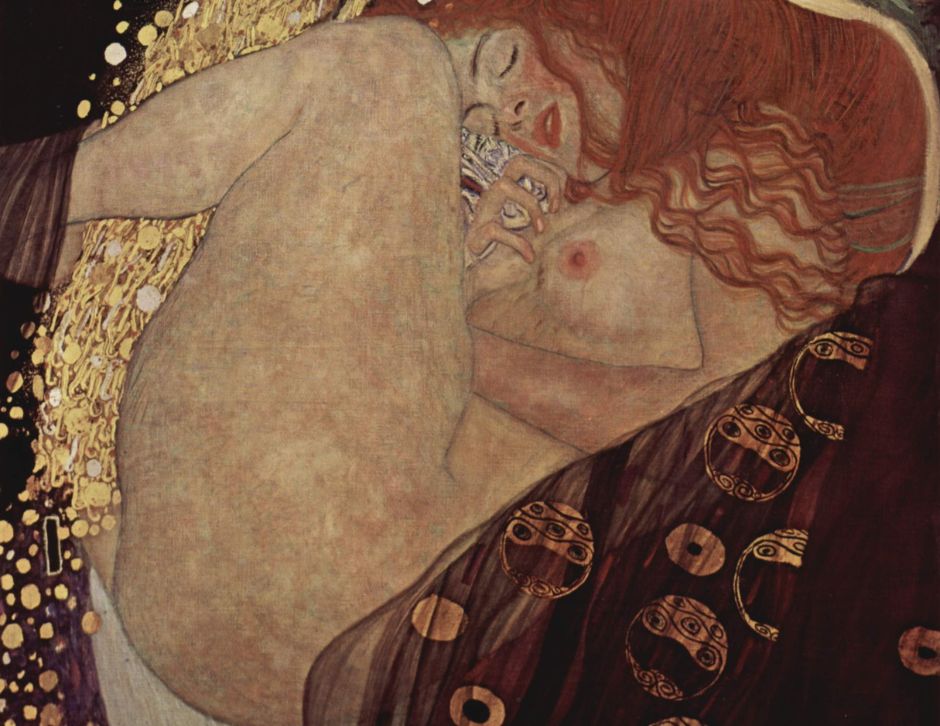
- Featured Image: Danaë by Gustav Klimt; Gustav Klimt, Public domain, via Wikimedia Commons.
Related Reads.


