
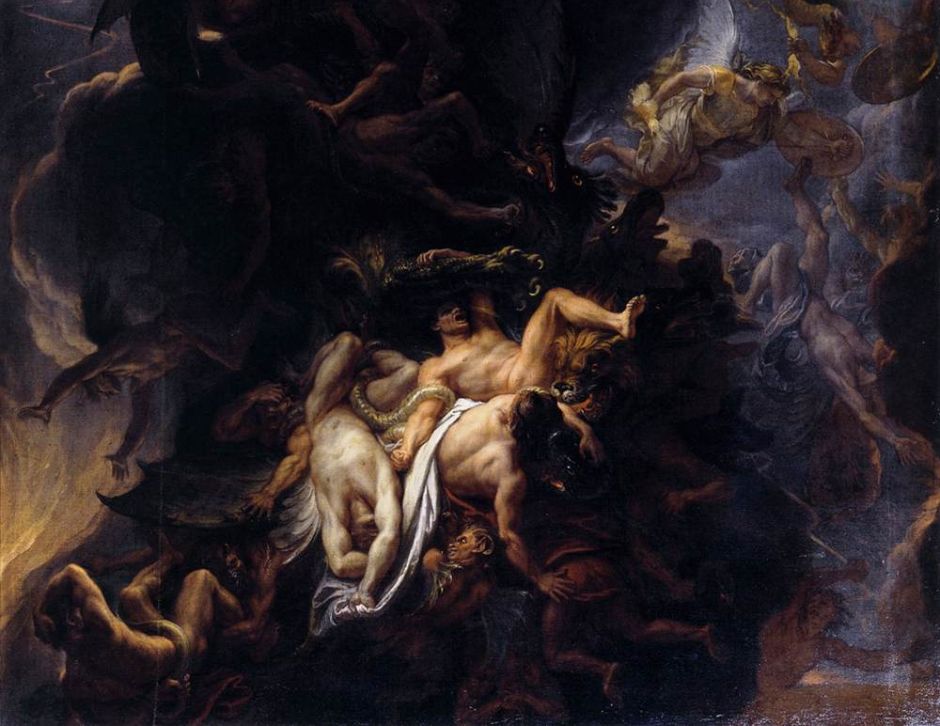
“On a starred night, Prince Lucifer uprose.
Tired of his dark dominion, he swung the fiend
Above the rolling ball in cloud part screened,
Where sinners hugged their spectre of repose.
Poor prey to his hot fit of pride were those.
And now upon his western wing, he leaned,
Now his huge bulk o’er Afric’s sands careened,
Now, the black planet shadowed Arctic snows.”
These few lines from the poem Lucifer in Starlight by George Meredith might rightly describe Lucifer’s aura. A prominent topic of discussion among the generations with contrasting views, Lucifer has been imagined by Medieval and Early Renaissance artists who saw him as a real force in human lives. If I were to comment on whether Lucifer really had a significant role in our lives, I would agree with the Renaissance masters; there is a God and Satan in every single one of us, and it is really on us whom we choose. Satan, being the most unwanted creature, has been visualized with many attributes in our wildest imagination, dreams, and paintings. From having a long edge tail to monstrous horns, an appealing face, and a pitchfork, there is no standard depiction of Lucifer, but there are a variety of masks that he takes for himself to persuade man according to his wishes. Today, in this article, I am introducing you to some of the finest paintings of Lucifer throughout art history. However, before we begin, here’s a quick word from the sponsor of this article.

Custom Coins offers high-quality, personalized challenge coins with no minimum order. They provide free design services, quick production, and free shipping, making it easy to create custom keepsakes for any occasion.
Historical Background of the Paintings of Lucifer.
Though a few medieval literary works distinguish between Satan and Lucifer, the tradition of affirming their unity through an artistic depiction of both Satan and Lucifer portrays a similar thing- The personification of evil! The name Lucifer doesn’t exist in any medieval books, and it only came through the association of the great prince of Isaiah 14, the morning star, Helen-ben-Shahar, who fell from heaven because of his pride. It was widely known that Satan was the prince of his own world and an obstructor of the kingdom of God, so when these concepts merged with the story of Isaiah 14, Lucifer was ultimately called Satan or the Ruler of Hell. But if you look at three terms- Satan, Devil, and Lucifer, historically, then there are numerous differences. Chaucer, for instance, thought that the angel, after his fall from heaven became Satan. There are different theories of Medieval and Renaissance theologians, which show no uniform of these three words. One of the writers from the second century supposed that the Devil and Satan were different, though he didn’t clearly hinted the difference. However, Lord Byron, who knew the Devil the most, uses Lucifer, Satan, and the Devil interchangeably for the same purpose.
The depiction of the devil goes back to Mesopotamia. There were certain features allotted to him. But there are no literary resources that could ever tell you why the Devil looks as he does. Of course, our idea of him is not a pictorial image as it derives from three sources- early interpretations of the New Testament, the Rebel Hero, created by Milton, and the romantic tradition of Blake and Baudelaire and the popular tradition of showing Satanic cults and black sabbats. His features have been interchanged for centuries. For instance, the devil with a pitchfork derives before the second millennium BC. Of course, no literary resources will ever answer why he does that. Then he holds a trident on his first appearance in the ninth century and then in the Renaissance. Hence, according to the literature and novels of the time, the depiction of Satan changes in every period! Remember that there are notable changes in the paintings of Lucifer and the devil.
It is confusing what roles the devil played, whether he was tormenting Job, egging on Pilate, tempting Jesus, or ruling Hell. The Fallen Angel does not appear and cannot be emotionally derived from the Ruler of Hell, and this is partly because the Devil was painted as a horrifying monster, as the artist did not have in mind if he is indeed the angel who fought Michael. In the pictorial traditions, this was not an option, and every century changed the appearance of Lucifer. It was only in Romanticism that he was portrayed as a human instead of half goat or deadly monster. The artists might have exaggerated Lucifer’s look. If you want to read the entire story of Lucifer and Satan in art, I recommend reading the fascinating work of Luther Link.
We know one thing: The Devil is not a person, and he might have many masks, but his essence is a mask without a face. As much as you find this topic tricky, similar to many artists, this is what makes most of the paintings and sculptures of Satan artistic failures. There was only one significant artist who depicted the Devil, which commenced the tradition of portraying him, and he is Giotto!
10 Paintings of Lucifer You Should Know About.
1. The Sheep and the Goats.
The Byzantine mosaic, Sheep and Goats, rests at the Basilica of Sant’Apollinare Nuovo in Ravenna, Italy, dating back to 520 CE. It portrays the parable of sheep and goats from the Gospel of Matthew, which depicts beardless Jesus at the center. On his right, there is an angel adorned in red attire with wings, who represents Archangel Michael, and on his left, another angel stands draped in blue attire with a somewhat similar look. This blue angel is thought to be Lucifer. It is one of the oldest paintings of Lucifer. The goats at the feet of Jesus are recognized as the souls destined for the Kingdom of Heaven.

2. The Fall of Rebel Angels by the Limbourg Brothers.
The painting is an immensely significant work of artistic history, which was completed between 1411 and 1416, as it is the only known earliest depiction of the fall of Lucifer and rebel angels. This exceptional portraiture of Lucifer during his fall is an illumination of the fact that Lucifer was a fallen angel and he was beautiful instead of the usual grotesque of Devils. Having flanked on both sides by his fellow fallen angels who tumble from heaven in diverse poses, there is a formation of a distinct ‘V,’ which further allows the viewer’s eye to transition downwards from the other angels toward Lucifer smoothly. Having golden hair in rich blue robes, Lucifer wears a golden sash around his neck with red crosses on it as he raises his hand above his head. He is in sorrow as he sees the doom ahead of his fall.
The brothers Herman, Paul, and Jean de Limbourg were born in the city of Nijmegen (current-day Netherlands) and were active in France by 1399. At the start of their career, Herman and Jean took an apprenticeship as a goldsmith in Paris. In 1402, Paul and Jean were hired by the Duke of Burgundy and the brother of Jean de Berry to make the most beautiful Bible. At this time, the Duke died, but his brother, Jean de Berry, engaged all of the Limbourg brothers to retain their services for the rest of their lives.

3. The Threefold Temptation of Christ by Juan de Flandes.
The painting shows a man with a long and pointed beard wearing a fawn-brown hooded robe and bone-white horns curving back, walking towards a second man on the left, who is wearing a cobalt-blue robe in front of a deep landscape. The man on the left is no other but Jesus and another man with beads and stone in his hand is the Devil. This painting depicts the moment after Jesus was baptized by John the Baptist. He fasted for around 40 days while spending his nights in the Judaean Desert. During this time, Satan appeared to him and attempted to tempt him towards sin. Jesus refused each temptation, leading the Devil to depart and Jesus to return to Galilee to begin his ministry. In the background of this artwork, at the cliff at the left of the city, there are two men, with one of them gesturing down and another looking on. Three more birds fly across the sky in this artwork along the azure blue sky that deepens from a misty white near the mountaintops.
Juan de Flandes was a Flemish-Spanish painter who was documented from 1496, as nothing had ever known about his life prior to arriving in the country. Reflecting an innovation of the Bruges school in the last quarter of the 15th century, his works were also inspired by Hugo van der Goes and Justus of Ghent. The first documented work of Juan de Flandes is Saint John the Baptist Altarpiece, which was painted for the Charterhouse at Miraflores, Burgos.

4. Saint Michael Drives Out Lucifer by Lorenzo Lotto.
The painting came decades after the Michelangelo ceiling’s completion in 1550. While residing in Loreto, Loto painted this composition, which shows Saint Michael flapping in the wind while she drives out Lucifer. The autonomy of flying Saint Michael and falling Lucifer is exaggerated more through the body postures and drapery of clothes. In the painting, the message is to strike down the evil, which is in the form of Lucifer or a fallen angel. Around them, the background shows a large cloud with a shining light behind Saint Michael and darkness as Lucifer approaches the bottom. Saint Michael is dressed in ancient Roman armor with a sword, and Lucifer remains naked.
Lorenzo Lotto took the title of ‘most outstanding painter (picktor celeberrimus)’ when he was merely 25. During his life, he worked for long periods in the countryside around Treviso, Ancona, and Bergamo, where he found little recognition among the affluent class. Though the world took little interest and notice in his masterpieces, his death commanded casual attention among art critics.

5. The Fallen Angel by Alexandre Cabanel.
The Fallen Angel by Alexandre Cabanel is one of the finest paintings of Lucifer, who disobeyed and rebelled against God. The poem ‘Paradise Lost’ by the English poet John Milton inspired the artist to paint this composition. Though Milton described the poem with Lucifer already in hell, Cabanel depicted the very moment when Lucifer was dismissed by Heaven. Sitting on a rocky surface in a tense and stretched pose, the subject covers his face with his arm, but his eyes remain exposed to the viewer. Through his eyes, there is pain and anger, as he lost everything from God’s best creation to the peace of heaven just to be rejected and banished to Hell.
The eyes of Lucifer are the most alluring detail of the entire painting as they show a teardrop from his reddened eyes while conveying a range of emotions from shame, disobedience, and rejection to even humiliation with resentment. The painting is significant because it is not only a depiction of Lucifer after he was cast out from heaven, but also a portrayal of the emotions of being misunderstood and rejected by God. Lastly, this painting is also an autobiographical artwork as the artist himself was rejected with ‘Oreste’ a year before.
Alexandre Cabanel is one of the most significant and glorious French masters of modern painting. Having thirty years of a fantastic and productive career, he was the painter of a single style with practical inventiveness in his compositions. Cabanel’s conception and execution of portrait painting are thoroughly modern and worldly. He furthermore executes these paintings with delicacy and sensitivity while giving marvelous originality to them.

6. Lucifer by Franz Von Stuck.
The painting shows the fallen angel with the pathos of hatred, glaring at the viewer with his bright green and vengeful eyes. On his left, two phosphorous-blue rays of light glimmer in this otherwise shadowy hell. King Ferdinand of Bulgaria was so impressed by this artwork that he bought it for his palace in 1891. Portrayed as the gnawing feeling of guilt with the genius of evil, this monumental figure sits with his legs crossed over and hand cupped in his chin. This painting is inspired by Michelangelo’s IIpenseroso for the Sistine Chapel and Rodin’s Thinker of c. 1880. The two rays of light here through the ashamed and huddled Lucifer, symbolize affliction and sufferings that are real parts of life, such as success and triumph.
Franz von Stuck rose to become a prince of artists, but he was increasingly isolated towards the end of his life and was almost forgotten after his death in 1928. Only after the reopening of the Villa Stuck in 1968, did Stuck’s life and work come under notice again, but there were different kinds of opinions towards his work and the nature of his achievements. Often mentioned that the artist’s taste for outward beauty was an empty facade and that the sensual and passionate nature of his subjects was overdone, the figures were raised above normal humanity through their symbolic value.

7. Michael Expelling Lucifer and the Rebel Angels by Peter Paul Rubens.
As part of the Counter-Reformation of the seventeenth century, Saint Michael expelling Lucifer and the rebel angels symbolizes the victory of the Catholic Church over Protestantism in the form of Saint Michael. The painting shows this archangel saint expelling Lucifer through a battle in the sky between Saint Michael and his angels and the Devil with his legions of rebel angels. In the Book of Daniel, the episode of this archangel saint is in the Revelation of Saint John, which narrates that at the end of this battle, the “that old serpent, called the Devil, and Satan” was cast out of Heaven onto the earth, as were his rebel angels. Peter Paul Rubens depicted this subject many times, and one among the surviving oils that can be related to the present work are Alte Pinakothek in Munich and an oil sketch in Musées Royaux des Beaux-Arts in Brussels.
Peter Paul Rubens is a painter who marked a transition from Renaissance to a new emerging Baroque style that conquered the 17th century. While his oeuvre depicts the social and cultural complexity and diversity of his age, he was affected by both antiquity and tradition. His works represented cultural and religious subjects that are important to understanding the period of Reformation and Catholic Counter-Reformation, which are inspired by aristocratic and bourgeois commissions.

8. Satan Summoning His Legions by Thomas Lawrence.
The painting shows a muscular male figure, naked apart from his sword and helmet with a carefully placed drapery over his genitalia. Depicting this figure as Satan, the rebel angel, he stands by a lake of fire as he summons his followers. The painting is inspired by Milton’s subject ‘Paradise Lost,’ Book I, line 330 ‘Awake, Arise or be Forever Fallen.’ Been an imposing painting for the 1797 Royal Academy Annual Exhibition, it was titled ‘Satan calling his Legions. First Book of Milton.’ The colors of the painting are rather contrasting, and there are fierce expressions of the subject, which heightens the drama in the artwork. Accompanying him, there stands another figure with reddish eyes and a black face with a hostile expression.
Other artists who produced comparable images of Satan: JR Cozens’s Satan Summoning his Legions c1776 (watercolor, Tate, T08231), James Barry’s Satan and his Legions Hurling Defiance toward the Vault of Heaven c1792-5 (drawing in British Museum and etching) and Richard Westall’s Satan Summoning his Legions, 1794 (stipple engraving).
Thomas Lawrence was one of the most greatest, and successful British Portraitist whose pre-eminence was confirmed when he was elected President of the Royal Academy of Arts in 1820. Being known as a phenomenal artist, he enjoyed great success in Britain, Europe, and Vienna.

9. Dante and Virgil Encounter Lucifer in Hell by Henry John Stock.
Possibly the last work of Stock, the painting shows the two subjects Dante and Virgil, encountering Lucifer in the Giudecca, the last ring of the ninth and lowest circle of Hell. Lucifer is portrayed as a terrifying and winged giant, who is submerged waist-deep in the icy waters of Cocytus. Having three heads in the mouths of which he shows the spirits of Judas Iscariot, Brutus, and Cassius, which are all prime examples of treachery, the painting has dramatic horror through the surrounding environment. The composition invokes the mood of the apocalyptic revelation subjects of 1902-10, indicating a revival of Blake’s artworks.
Henry John Stock was an English Romantic artist who is highly unknown in the present times. Enjoying success as a society portraitist, his interest majorly remained in imaginative subjects. He was influenced by William Blake, which is also apparent in his oeuvre through his use of watercolors for literary paintings.

10. The Fall of Lucifer by Antonio Maria Esquivel.
Earlier, I explained the occurrence of the event Fall of Lucifer, which was about the expulsion of the dragon of sin from the celestial of Glory by Saint Michael. The subject in this painting remains similar. The artist replaces the customary image of the saint with a helmet and sword with a stern expression and another with a hatred expression. The composition has an esthetic eclecticism combined with the Spanish pictorial tradition as embodied by Murilli with a great influence on Ingres’s artworks. Painted for the Liceo of Madrid, this painting was warmly received by the critics because of its correct coloring and perfect composition.

Opinions
The paintings of Lucifer are brilliant in themselves because of the exceptional creative energy of artists to show the evilness, anger, frustration, and sometimes genius of the dragon king. Personally, I find the topic intriguing since we can get a glimpse of the hidden mysteries of the artist’s mind, which explores the devilish emotions of Lucifer. Of course, emotions are taken by humans themselves because of their exceptional connectivity with us.
Resources.
- Featured Image: The Fall of the Rebel Angels by Charles Le Brun; Charles Le Brun, Public domain, via Wikimedia Commons.
- Illustrated Biographies of Modern Artists by F.G. Dumas.
- Franz Von Stuck, 1863-1928: Eros and Pathos by Edwin Becker.
- Thyssen-Bornemisza Museo Nacional.
- Rubens by Palais des Beaux-Arts de Lille.
- Sir Thomas Lawrence by Michael Levey.
- The Devil: The Archfiend in Art from the Sixth to the Sixteenth Century by Luther Link.
Related Reads.


