
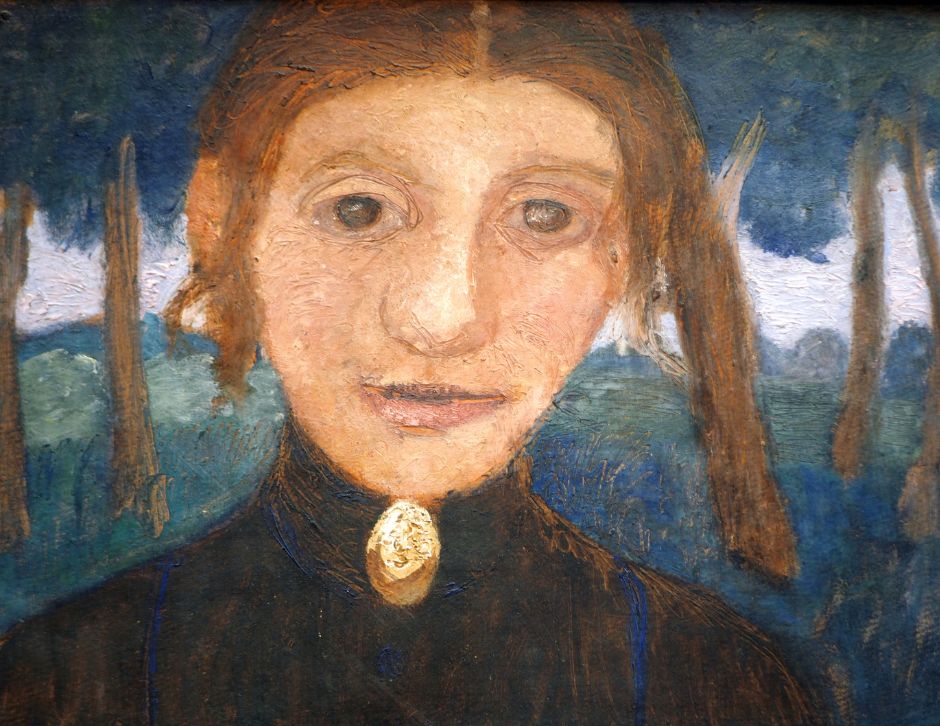
When Modernism was on the threshold, and a rising tide of feminine sensibility and feminism was underway, there were very few women artists who risked everything to become something. One of them falling into this category is Paula Modersohn-Becker, who put everything to become a daring innovator of gender imagery; the first woman artist to challenge the generations of traditional depiction of female bodies in the art world. She was the only artist who not only painted herself nude but also her mother and daughter. It must be known that before Modersohn-Becker, no other woman artist ever painted their nude. Further, while reconfiguring the nude, Paula resituated the still-life painting as well. The paintings of Paula Becker reflect the life she was living at the threshold of modernism as a woman and an artist, paving the way for future generations of female artists. Besides art, her life was majorly highlighted by her friendships with the poet Rainer Maria Rilke and sculptor Clara Rilke-Westhoff, as well as her personal anguish, including her marriage and irresolution about motherhood, and her professional struggles in France and Germany. Amidst the rise of her reputation, her death followed as she had complications following childbirth. Today, in this article, we will learn about her life and artworks, which greatly influenced the role of women artists in the evolution of modernism.
Paula Modersohn-Becker | Fast Knowledge
Paula Modersohn-Becker was the strongest German women artist of the early twentieth century who showed the issue of feminine imagery and its complexities. She portrayed herself and many of her subjects nude and also mastered painting landscapes and still lifes.
Artist’s Abstract: Paula Modersohn-Becker.
Paula Becker was born in Dresden on 8 February 1876 as the third of seven children. Her mother belonged to an aristocratic Bültzingslöwen family, and her father, of Russian heritage and the son of a lecturer in Odesa University, worked as an official at the German railways. Frequently inviting writers and artists to their homes, her parents provided a cultured and intellectual background to their children. Paula showed early interest in drawing which is why when her family moved to Bremen in 1888, her parents arranged for her to take lessons from a local painter, Wiegandt. In the same year, Paula went to stay with her relatives in London, where she attended art classes that involved drawing from copies of antique statues. Knowing that a career in art is unlikely and difficult, her parents encouraged her to study teacher training in Bremen in 1893, hoping that she would then become a governess after completing the course. However, they reluctantly agreed to support her studies at the Berlin School of Art for Women once she had acquired her teacher’s qualifications, ensuring her employment in the future. Though Paula had a short career, she produced over four hundred paintings and at least one hundred drawings and graphic works.

Sadly, Modersohn-Becker’s experiences at home mirror a darker suppression of the highest order. Adolf Hitler took a similar stance in 1937 when he included Modersohn-Becker’s work in his Degenerate Art exhibition, commenting on her later portraits,
“Her vision is so lacking in femininity and so vulgar…”
We will learn the entire life of the artist in the following sections.
| Artist | Paula Modersohn-Becker |
| Birth | February 8, 1876 – Dresden, Germany |
| Death | November 30, 1907 – Worpswede, Germany |
| Nationality | German |
| Genre | Self-Portraits, Landscapes, and Still-Lifes |
| Period | Post-Impressionism and Degenerate Art |
| Famous Paintings | Self-Portrait at 6th Wedding Anniversary, Lying Mother With Child II |
Looking at the Life of the Artist.
In the native land where Paula Modersohn-Becker worked, especially in the Bremen area, she was recognized as the pioneer of Modern art. She was also the first German painter to assimilate the Post-Impressionist current, which she discovered for herself in Paris.

Born in Dresden into a cultured home, her family moved to Bremen, where she took drawing lessons from a local painter, Bernhard Wiegandt, and then stayed in London with her relatives, as I told you earlier in the abstract. However, due to her difficult aunt, nostalgia developed for home, and the development of severe headaches, she returned to Bremen and continued to receive teachings from Bernhard.
“It would be the greatest joy to me if you could really accomplish something, something more than the little bit of dabbling which all the young girls can manage,”
Her mother wrote once in a letter to her. Though her mother and father wanted her to have a stable career, her mother always wanted Paula to pursue her art,
“with all the time at your disposal.”
Sometimes, she would even give blunt criticism to Paula’s artworks, which hurt her, but they were rendered out of respect for the seriousness of the profession.
On the other hand, Paula’s father was rarely indulgent to her but he always thought of art as a potential profession for Paula, which is why he voiced the unconventional opinion that
“every young woman must strive to make herself independent.”
However, he was a little doubtful for the fact whether Paula would ever
“accomplish something worthwhile or… at least manage to learn how to support herself by painting.”
Furthermore, his premature retirement in 1895 also exaggerated the concern for his daughter’s financial security and so he began to nudge her to obtain a position as a governess. And this was the reason he sent her to a two-year teacher’s training program so that Paula had a safe future. Hence, she joined a two-year teacher’s training program and then started learning art after it was over.
In 1896, she left her home and attended the Berlin School for Women Artists, where Käthe Kollwitz studied and taught. Her father again and again chose the word, “threat” of independence, a recurring theme, which many letters would have. However, one of the generous relatives gave a small inheritance and a three-year stipend to her. In the same summer vacation, she discovered the artists’ colony in nearby Worpswede, where she settled in 1898 and continued her studies and work on her own.

Greatly impressed by the artists’ work there, she convinced her family to move to study with the founder of the colony, Fritz Mackensen. It was here that she saw the real art and also here she would meet her future husband, colony artist, Otto Modersohn with a group of friends and fellow artists including Heinrich Vogeler and Clara Westhoff.

Despite her distaste for the sentimental doctored realism of the Worpswede painters, she had no problem with an idealized view of reality. She had a greater interest in portraiture, but she accepted nature’s concept of evoking mood through landscapes as a repository of spiritual values, which is why she painted more landscapes during this time. A further aspect of Paula Modersohn-Becker’s portrayal was that she represented the local peasants as personifications of the elemental grandeur that undergirds our most basic existence.
A child, in Paula’s opinion, embodied special qualities, as they possessed a clarity of sensation that adult artists should strive to achieve. Despite the advice she gave to her Worpswede comrade Heinrich Vogeler, her portraits of children reveal a strange ambivalence, for they show what we all have in common, such as children, birds, and flowers. A few of these paintings also depicted young girls with flowers in their hair walking through idyllic landscapes.
Paula left Worpswede in January 1900 in order to study in Paris, where she learned more formal artistic techniques. It was significant that this trip marked the beginning of a lifelong pattern of movement between Worpswede and Paris. This time around, after settling in Paris, she enrolled at the Académie Colarossi and the École des Beaux-Arts. In this environment, she focused on life drawing and developed her interest in nude figure studies, which had long been a passion of hers. According to her,
“Afternoons I draw from the nude at the academy.”
It is evident from her diaries and letters to home that she was even more inspired by the art exhibitions at Exposition Universelle and the museums she visited.
Paula’s father hoped that the trip to Paris would give a permanent break to Paula with the Worpswede painters, whom he thought of as too “modern.” But Paula always intended to return to the German village. Therefore, she convinced some of her Worpswede friends to join her at the 1900 World Exposition in Paris and made plans to go home with them in June. Sadly, what was supposed to have been a pleasant holiday interlude turned into sadness when Otto Modersohn’s wife passed away suddenly in Worpswede. As a result, they left Paris ahead of schedule without Paula, who departed several days later.
Paula had liked Modersohn from the moment they met and between them was a close friendship. Due to her naive nature, Paula assumed that Otto shared all her ideals which made them even closer. And so when Paula returned to the Worpswede after a few weeks from Paris, she sensed a deeper relationship with Otto. Hence, by the end of the summer, they were engaged. But shortly before she accepted Otto’s proposal, Paula made the acquaintance of poet Rainer Maria Rilke. Since the passing of Paula, Rilke has penned a moving Requiem, prompting much speculation concerning their relationship. However, no evidence has been found to prove anything other than platonic. Paula’s letters to Otto resound with an untainted love that is deep and unsullied. The poet may have entertained hopes of winning the fair painter, however, since her engagement Modersohn was initially kept secret due to his wife’s recent death. Whatever the case, the two developed a rapport that would deepen with time.

At the beginning of 1901, due to her parent’s insistence, Paula Modersohn-Becker joined Berlin’s cooking school so that she could learn to be a proper wife. She ironically remarked to Otto,
“For you, it will be beautiful pictures- for me, soups, dumplings, and stews.”
Paula’s concern that domesticity might conflict with her art is expressed obliquely in an allegorical prose poem that acknowledges the artist’s “masculine” ambitions and the mutual exclusivity between sexual love and creativity. They were married at the sickbed of Paula’s father, Waldemar Becker, who died in 1901. The year was a time of loss as there was an estrangement due to the death of her father and her closest friend-sculptor Clara Westhoff. Also, in the same year, she understood that,
“In marriage, one feels doubly misunderstood. I am probably just as lonely as I was when I was a child.”
In the first year of their marriage, Paula Modersohn-Becker had a disillusionment that this marriage would be a promising beginning. Though Otto never asked her to give up painting for household chores or something, instead, he perceived their marriage as an artistic and physical union, Paula came under her influence and started painting landscapes instead of portraiture, which was her true call. In evaluating his wife’s work, Otto displayed both condescension and respect, and with great pride, he called her paintings “progress.”

However, after a year of docility, she felt for her older ambitions. She wrote to her mother,
“The dawn has broken in me, and I can feel the day approaching.”
There was a single question revolving around her mind; love or art? Now, a career for Paula Modersohn-Becker was a self-fulfillment, but her family called it selfishness, an accusation she faced for a long period. Otto once wrote,
“Paula is very much infected by these modern notions, (such women) think that egotism, independence, conceit are the best things there are, and no happy marriage can come from that.”
Hence without dissolving her marriage, she returned to Paris in the spring of 1903 to study from Colarossi. Between February and April 1905, she studied at the Académie Julian, made contacts with the Nabis, and explored other contemporary trends. She said,
“If I want to learn something this time, it’s going to cost me more than it did the last time. The first time I didn’t have you, and I didn’t have a home.”
This way, Paris ultimately succeeded in separating the couple physically. For her first stay in Paris, she went to Académie Colarossi, where she became more open to the influences of Japanese and ancient Western art. Then, she became more absorbed in Rodin’s drawings and sculptures, discovering some small pieces by Degas, Daumier, and Miller. She once wrote,
“They don’t seem to care whether what they are making is a ‘picture’ or not, or whether the public always understands them. The important thing to them is that it be art.”
After her first trip to Paris after marriage, she returned to Worpswede in March 1903. The couple believed that their love deepened more due to separation. Paula Modersohn-Becker thought her husband’s work was too lame. Otto wrote for her artworks,
“Paula hates to be conventional and is now falling prey to the error of preferring to make everything angular, ugly, bizarre, wooden.”
Then, she went back to Paris at the beginning of 1905. This time, she continued her friendship with Rilkes and her sister, Herma. During this period, Otto’s mother died, and there was an emotional distance created between her and her husband, which didn’t let her enter into his grief. She writes to him,
“It seems so odd that we two… have such different lives now…. You are serious and depressed there with your dear and grieving father, and despite it all, here I am in this great city full of hope for the future.”
Since Paula Modersohn-Becker liked staying in Paris, Otto came to spend some days with her, but since there were discrepancies in their emotional states, the couple faced a predictable disaster. She writes to Herma,
“He was very jealous of Paris, French art… etc. He imagines that I only preferred to stay in Paris and thought nothing at all of Worpswede. He had completely submerged himself in such thoughts and wouldn’t say a word, and really ruined the last week for me.”
In the following years, Paula tried to extricate herself from her relationship with Otto, but she was financially dependent on him, whereas Otto did his best to appease her. However, he always had a displeasure with Paula’s art. He wrote,
“What Paula is doing… now does not please me nearly so much as it used to. She will not accept any advice- it is very foolish and a pity. A huge squandering of her powers. She had a great gift for color, but unpainterly and harsh. She admired primitive pictures, which is very bad for her- she should be looking at artistic paintings. She wants to unite colors and form- out of the question the way she does it. She doesn’t like to restrain form- a great mistake.”
In 1906, Paula turned thirty, and this was the most productive phase of her life. She left Worpswede and Otto Modersohn for her art. She was now free to immerse herself in the lessons offered by the despised “moderns.” On her last trip to Paris, she gave attention to mastery of color. She wrote,
“My paintings look so dark here. I must get much purer colors. I have to learn to modulate.”
She wanted to produce something, which is compelling and full of excitement- something that is really powerful.
She achieved Proto-Cubistic angularity in her forms and portraits. Alongside, her still-lifes, which she began painting after Cezanne’ work became bolder and less conventional. The aim of her use of colors and form was not purely aesthetic, but to convey the emotional center of a purely representational subject through the reductive use of color and form. And this strange combination of formalism and realism, as if it was a merging of French and German culture, was the basis of Modersohn’s achievement. Through a spiritual resonance of art, which she learned from her Worpswede experience, and through the use of a realistic subject, she was able to convey an emotional state rather than just visual optical experimentation.
Paula spent 1906-07 winters with Otto in Paris and returned to Worpswede in March. At this time, Paula was pregnant, but it was a difficult pregnancy. On November 2, 1907, she gave birth to a daughter, Mathilde. After a difficult labor, she remained in bed for several weeks. She was recuperating nicely but had pain in her legs. When she got up for the first time on November 20, her leg suddenly gave away, and she died of cardiac embolism. Her last words were,
“What a Pity!”

Paula Modersohn-Becker lived just 31 years, but her ambition to paint and be a painter was always reaching and never grasping.
A Brief Look at a Few of the Paula-Modersohn Becker Paintings.
1. Still Life With Blue-And-White Porcelain and Tea Kettle.
Paula Becker probably painted the painting in her Worpswede studio after returning from Paris in June of that year. There are elements that are traditional to the genre in this film. It features textures such as linen, porcelain, copper, and glass, as well as highlights and shadows, in addition to color registers. A conflation of picture planes here is also a hallmark of modernism. In the picture plane, the fleur-de-lis on the drape in her studio sits in the background and the front of the picture plane. Matisse’s famous Harmony in Red, 1908, is reminiscent of such oversized, renegade, hallucinatory decorative elements. Here, the German tea kettle contrasts with a decorative French tapestry with its more articulated utilitarian design. “A metaphor… for all manner of conflicts and confrontations” is how Picasso characterized the genre.

2. Old Peasant Woman With Arms Crossed on Her Chest.
The Old Peasant Woman With Arms Crossed on Her Chest is one of the last monumental Paula Modersohn-Becker paintings. Wearing a blue-dressed long-sleeved frock and white cap, the old woman in a poorish attire stares vacantly in front of her with her arms crossed upon her chest. Set against a green leafy background, there is a great color contrast flowing through the composition. Be it the blue dress or blue eyeballs, there are great and deliberate forms and color contrasts. There are three yellow flowers sitting on her lap further outbursting the color combination.
There are many similarities between the portrait and Vincent Van Gogh’s work. Van Gogh was always drawn to the humanity of the working classes and preferred to elevate their position by introducing illuminating light sources and by depicting large toiling hands in his works. There is even an argument that Paula Modersohn-Becker included yellow flowers in her painting to show that it is an homage to Van Gogh.
Paula turns the metaphor of a woman’s head into a flower in this last monumental painting. The painter’s deliberation and development are evident in this early painting, depicting the same model in roughly the same pose. Her first painting, Seated Old Peasant Woman, Half-length Profile, 1903 depicted the old woman as a typical nineteenth-century peasant, with an elegant profile and small hands. She wears a brownish-green dress and the background is gray, creating a somber atmosphere. She might have gone undetected in 1907 if not for the curve of her mouth and chin and the slant of her forehead.


3. Worpswede Peasant Child Sitting on a Chair, 1905.
As Amrita Sher-Gil, Berthe Morisot, and other artists took the family for her models, Paula also looked to her family for the models of her paintings, especially her younger sister Herma and her stepdaughter Elsbeth. One of the best Paula-Modersohn Becker paintings of a young child is Worpswede Peasant Child Sitting on a Chair. This portrait features a full-figure girl with a subdued brown palette, staring straight ahead, unblinking, hands folded on her lap. A poor room of meager furnishings surrounds her, with the chair on which she sits, the wall behind her, and the picture frames defining the shallow space of the room. This icon of immurement was painted by the artist during a year of paralyzing indecision. As the frontispiece to late editions of Modersohn-Becker’s letters and journals, it became identified with her in the 1930s.

4. Girl in a Red Dress, 1907.
The artwork, Girl in a Red Dress uses a bright palette, thick brushwork, and simplified shapes to portray a frontal, clothed, and three-quarter figure in landscape. A girl stands still in this painting with her hand cradled in her chest and eyes darted sharply right as if she heard something stealthy. To her wary glance, there is a high horizon line cutting the clear blue sky. Paula showed a pair of wildflowers blooming pink and red to the right and left of her cornflower blue eyes and ruby-red slit of a mouth. The composition shows no space behind her as she is right against the picture place. Further, two slim white birch trunks one at each side fill up the space to limit her physical boundaries. Paula posed her nine-year-old stepdaughter, Elsbeth for this painting. Though the choice of subject is opportunistic, it is also haunting at the same time.

5. Self-Portrait at 6th Wedding Anniversary.
Of all the self-portraits, one of the most controversial artworks, she painted is Self-Portrait at 6th Wedding Anniversary. Making reference to the artwork in the image as an artist in the inscription, Paula writes,
“I painted this at age 30/ on my 6th wedding day. / P.B.”
Despite her visceral pride at having created this major piece, her belly’s curved line unfortunately overshadows her expression. In Italian painting, such nude painting is often connected to allegorical artwork, signaling fecundity, spring, and renewal as Botticelli’s Primavera portrayed. Showcasing herself as nude with a white cloth draped over her waist and a bead necklace, she shows motherhood in this artwork alongside giving the shape of the woman artist who wants it all.
Despite the fact that she was not pregnant, the artist painted herself as if she was. In contrast to her previous works, the artist has not shown any interest in being a mother and introduces a topic that is full of questions and challenges. During this time, in her mind, her marriage was over and she told her husband,
“And I do not want to have a child with you now at all.”
Though the artist shows herself pregnant, the artwork exists as an allusive and open-ended statement for our consideration, whether it refers to her longing for a child or metaphorically, suggesting that she was pregnant with ideas. Also, the painting, Jan van Eych’s Arnolfini Wedding Portrait or Annie Leibovitz’s Vanity Fair cover of Demi Moore. Yet the images of pregnancy which were rare don’t represent “woman’s physical condition but an uncharted frontier of body imagery.”

Final Words.
“I know that I shall not live very long. But I wonder, is that sad? Is a celebration more beautiful because it lasts longer? And my life is a celebration, a short, intense celebration. My powers of perception are becoming finer as if I were supposed to absorb everything in the few years that are still to be offered to me, everything… And if I can paint three good pictures, then I shall go gladly, with flowers in my hands and in my hair.”
– Paula Modersohn-Becker
The quote itself describes the entire life of Paula Modersohn-Becker through her own words. Though she died early which no one suspected, she simply did a wondrous job of showing a pathway to the future women artists. Her artworks are bold and sentimental, but filled with such sensitivity which I have never seen in modern artworks.
Resources.
- Paula Modersohn-Becker: Her Life and Work by Gillian Perry.
- Paula Modersohn-Becker: The First Modern Woman Artist by Diane J. Radycki.
- Paula Modersohn-Becker by Jane Kallir.
- Paula Modersohn-Becker, The Letters and Journals by Paula Modersohn-Becker.
- Women Artists: 1550-1950 By Ann Sutherland Harris and Linda Nochlin.
- Featured Image: Self Portrait Infront of the Landscape by Paula Modersohn-Becker; Paula Modersohn-Becker, Public domain, via Wikimedia Commons.
Frequently Asked Questions.
Paula Modersohn-Becker painted four hundred paintings and at least one hundred drawings and graphic works. Majorly focussing on portraiture, she is known for her paintings of children, women, and self-portraits.
Paula Modernsohn showcased emotional and subtle color contrasting effects in her artworks with an opposed naturalism to express emotional intensity with a spiritualistic tendency. She merges French and German culture with the use of formalism and realism in her artworks.
Paula Modersohn Becker died due to a cardiac embolism. After her difficult pregnancy, she stayed in bed for several days but when she finally got up first time on November 20, her leg suddenly gave away and she died of the cardiac embolism, saying, “What A Pity!”
Related Reads.


