
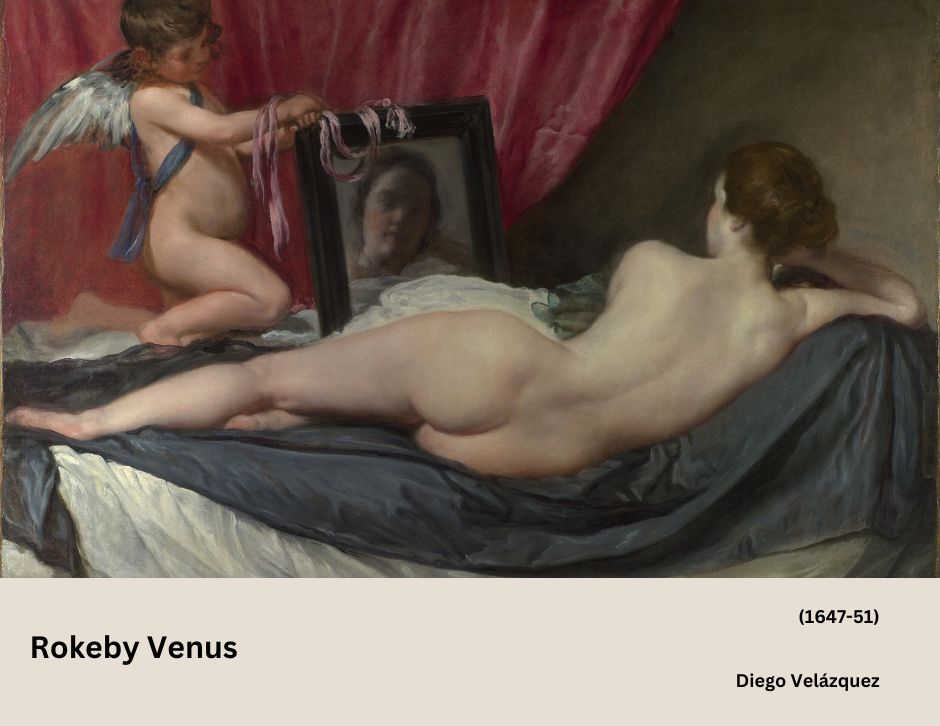
In entire art history, one of the most common subjects, which almost every allegorical artist depicted with utmost beauty and symbolism of feminine beauty is Venus. By now, many of you might know that Venus was the goddess of love and marriage, and she was the most beautiful among any other goddesses. Being a popular Olympian, the ancient worshipped her to find love. There are a lot of stories of Venus, which artists throughout history depicted in many emotions and forms. Like, in the painting, The Birth of Venus, Botticelli depicts the moment when Venus takes birth on the shore of the sea and is completely visible but with a momentous symbolism. Similarly, Titian painted Venus of Urbino, which remained controversial till now for its identification. Then, there were many other artists like Alexandre Cabanel, Artemisia Gentileschi, William-Adolphe Bouguereau, etc, who also portrayed Venus in several different ways. However, one of the more sophisticated depictions of Venus with a cupid in Spanish artistry is by Diego Velázquez, which we are here for. There is a possibility that Velázquez might have painted more than one painting of Venus and the others are not known. Hence, Rokeby Venus, also called The Toilet of Venus, becomes the only surviving Venus or even the female nude painted by the artist. But that is not the only reason to read about it. One of the other reasons, that makes the composition significant is that despite the rarity of the subject in seventeenth-century Spain due to the Catholic Church’s disapproval of the sensual images, the artwork was composed by the artist to be collected by the wealthy Spanish art collector. Let us now move to learning about the painting in more details, beginning with the brief information section.
Rokeby Venus | Fast Knowledge
The Rokeby Venus is a 1647-51 oil on canvas painting by Diego Velázquez, significant for its identity of the only surviving nude and the venus painted by the artist in his career. The painting showcases Venus reclining on a bed while facing backwards to the viewer and seeing cupid who is standing with a mirror facing her.
General Information About The Rokeby Venus Painting.
1. Artist’s Statement.
“I would rather be an ordinary painter working from life than be the greatest copyist on the earth.”
2. Subject Matter.
The painting shows Venus, the goddess of love, in a reclining posture, whose body curves are echoed in a sweep of sumptuous satin fabric under her, which originally was more purple in color than grey. Throughout the painting, pearly tones are used to emphasize her smooth skin, which contrasts nicely with the rich colors and lively brushstrokes used for the curtain and sheets. In front of her, Cupid, her son, holds a mirror, which has an intertwining of pink ribbons with a knotting at the top.

The reflection of Venus is blurred as if she can’t see herself right in the mirror. Perhaps, Velázquez wanted to give this a symbolic meaning- the personification of female beauty as if she can’t be identified, and we can complete her features in our imagination to see the incomprehensible beauty.
Several sixteenth-century Venetian painters, including Giorgione and Titian, painted naked Venus paintings. In this painting, Velázquez combines two traditional representations of Venus- one depicting the goddess reclining on a bed, looking into a mirror, and another showing her sitting upright, usually in a landscape. An image of astonishing originality results from this process. I will tell you more about the subject matter in the later sections of the article.
3. Artist.
Diego Velázquez, one of the most significant artists of the Spanish Golden Age, painted the composition The Toilet of Venus or Rokeby Venus. Having a primary position as one of the prestigious court painters for Spain’s King Philip IV, he is one of the most celebrated painters who added a psychological stir to his portraits and genre paintings. Naturalism was his individualistic style, coupled with an authenticity that distinguished him from others of his time who stayed within the traditional and historical methods of depicting their subjects. Being thoroughly personable and equally interested in the common man as the lauded, he created a fiercely individualistic and impressive body of work that showed his deep and abiding passion for human beings.
The art of Velázquez is rare, unfamiliar, and obscure. In a forty-year career, he left 120 paintings, which is why he is rightly credited with measuring out his genius in thimblefuls. Many of his paintings were painted for the Spanish King and court and remained in their original locations long after his death, immured in palaces. Back in 1819, Prado opened to the public with more than forty paintings of Velázquez, which was the first time everyone could see the artist’s work, unlike the time before when it was only accessible to well-heeled travelers. A Velázquez could only be remembered through the fantastic vagaries of memory since photography did not yet exist, prints were scarce, and could not accurately convey his mysterious and diaphanous style. Hence, it proved that his paintings were more than an impression.
4. Date.
The Rokeby Venus was probably painted between 1647-51.
5. Provenance.
As far as the painting’s provenance is concerned, we do not know when or where it was commissioned or painted. It might be during or after the artist took the second trip to Italy between 1649-51. In the household inventory of 1651 of Domingo Guerra Coronel (Spanish painter and art dealer), the painting isn’t listed but another painting is mentioned with a description of a nude woman, ‘una muger desnuda.’ Afterward, the painting was purchased by a renowned art collector, Gaspar de Haro, and was paired with a sixteenth-century Venetian picture of a naked nymph in a landscape. Thanks to Gaspar’s close relationship with Philip IV, the painting hung in a large room along with other mythological paintings and copies in the Spanish royal collection.
Shortly afterward, Gaspar’s daughter, Catalina Méndez de Haro, inherited the painting in 1687 and married Francisco Álvarez de Toledo, 10th Duke of Alba. His family held on to the painting until Charles IV of Spain ordered the Duchess of Alba to sell it to his favorite minister, Don Manuel Godoy, in the early nineteenth century. Godoy wanted to hang ‘The Rokeby Venus’ alongside Correggio’s ‘Venus and Mercury with Cupid’ and Goya’s ‘The Nude Maja’ and ‘The Clothed Maja’ (both at the Museo Nacional del Prado, Madrid) in a very private room (referred to by a contemporary as a ‘cavinete interior’) – one of Spain’s most remarkable cabinets of female nudes.


The original name of the painting is The Toilet of Venus, but it takes its nickname, The Rokeby Venus from the Rokeby Park, a country house where it was hung for most of the nineteenth century. I will tell you the entire historical provenance in upcoming sections of the article.
6. Location.
Rokeby Venus was acquired by the National Gallery of London, but it is currently not on the exhibition.
7. Technique and Medium.
The painting has a medium of oil on canvas. Velázquez used the speed and searching quality of brushstrokes to paint this artwork in the most modern and impressionist way.
| Artist | Diego Velázquez |
| Other Name | The Toilet of Venus |
| Year Painted | 1647-51 |
| Genre | Mythological Painting |
| Period | Baroque Period |
| Medium | Oil on canvas |
| Dimensions | 122.5 × 177 cm |
| Price | Not on sale |
| Where is it housed? | The National Gallery, London |
In-Depth Description of the Artwork.
About the Artist: Diego Velázquez.
Before we learn about the artist’s life, let me first tell you that Velázquez’s full name was Diego Rodriguez de Silva y Velázquez, and he always signed himself as Diego de Silva Velázquez. Earlier, in his Las Meninas painting, I have given a brief account of his earlier life, which you can refer to for more knowledge.

Velázquez’s father was a native of Seville, and his mother was Spanish. If his family lived in any other country other than Spain, they would have been considered upper-class; however, at the end of the artist’s life, he was made a Knight of Santiago by the King, giving a high position to him. Despite allowing the purity of his lineage for the courtship, an elaborate inquisition found fatal objections in the absence of a positive nobility. And in order to overcome this unfortunate obstacle, the Pope had to deliver a Brief.
From the earliest years of life, Velázquez was drawn towards painting, so at the age of thirteen, he was trained under a considerable painter in Spain, Francisco de Herrera. However, Francisco had an uncontrolled temper, which made the artist’s parents shift him to a more sympathetic instructor, Francisco Pacheco. Now, Pacheco had a charming character, which made his house a resort for the many literary and artistic people, who were found in Seville. In addition to this, he had a good influence on the artist, extending it beyond mere teaching as if he brought him up as one of his own family. Hence, Pacheco gave his daughter’s hand to Velázquez, saying,
“By the rectitude of his conduct, the purity of his morals and his great talents, and from the high expectation I entertained of his natural abilities and transcendent genius.”
Coming to the artistic life of the artist, Velázquez first struck out a path for himself- the path of realism. In “The Art of Painting,” published in 1649, Pacheco said that Diego’s first attempts were from studies to compose Old Woman Frying Eggs or the Christ at the House of Martha from the National Gallery. At that time, Velázquez intended on the simple imitation of natural objects or portraiture, where he developed his talents. Pacheco further says that he used to sketch a peasant lad continuously in all sorts of poses in charcoal heightened with white, a practice, which ultimately helped him to attain truth in painting portraits in his later life. Though these portrait studies are not known presently, but we know from history that these were painted before Velázquez left Seville in 1623. Besides, these portrait studies helped him to master his later artworks as he had greatly exercised realism, and they are proof of his individuality and exceptional determination, making him distinguished from any other painter in the world.


Now, that you know a brief on the genius artist, let us move towards the historical provenance of the artwork.
Historical Provenance of Rokeby Venus.
Velázquez majorly avoided painting subjects like Venus, and when he was obliged to do so, he would pose his model to offer a little offense, either to himself or the spectator. Due to the skepticism with which this picture (Rokeby Venus) was received by some of the authorities in whom the public should have absolute faith, I will quote Senor Beruete’s remarks regarding its authenticity.
“The painting is the only nude female figure in Velasquez’s entire work,”
he says, and
“it is still more surprising that such a piece exists, despite the reprobation it provoked in Spain, where not only moralists but also critics condemned it for its provocative style.”
However, since Titian and Rubens used to take this sort of subject, Velázquez executed a certain number of them, including Venus and Adonis (which has disappeared) and Venus at the Mirror or Rokeby Venus.


Randall Davies explains in his book,
“We have already said that this picture formed part of the decoration of the Salon des Glaces at the Alcazar before the fire in 1734. It escaped disaster, and Ponz saw it at the house of the Duke of Alba. Thence it passed to the favorite of Charles IV, Prince de la Paix, whose property was confiscated. It was sold in London in 1813, and acquired on the advice of Sir Thomas Lawrence by Mr. Morritt whose descendants have accorded it a place of honour in the gallery at Rokeby Park, near Barnard Castle.”
He further explains that
“The authenticity of the work has found numerous doubters in Spain, less on account of its subject than because so few people ever suspected its existence; but after it was exhibited at Manchester in 1857, and in London in 1890, it was recognized that its attribution to Velasquez was well founded. At the sight of the canvas, all doubt vanishes. There, indeed is the style, the inimitable technique of Velasquez.”
Velázquez may have painted The Rokeby Venus during his second trip to Italy when he was in his 50s. While the Italian Villas like of Medici were filled with gracious and beautiful paintings, Velázquez might wanted to show the Italian that besides landscapes and portraits, he could paint another genre, mythological or nude painting. Hence, he composed The Toilet of Venus, it may not have been the first nude that the artist painted, but it is the first known female nude in Spanish art history. Velázquez might have painted at least four other nudes, two of which were destroyed in the fire at the Alcazar in 1734. Also, during that time, nude art was not much composed in the art history of Spain, so Velázquez didn’t paint much of it. However, it might be possible that he painted The Toilet of Venus for an influential patron, which would not go for public display. Hence there is none of the distancing of the official picture as it was supposed to be seen in private and in close-up. The past records show that it might be possible that the artist may have painted similar works for the King Philip, but the Rokeby Venus was shipped back from Italy to Don Gaspar de Haro y Guzmán. Despite all these hidings, the artwork remained the only Spanish nude for another 150 years. After Guzmáns formed an alliance with the Albas, the artwork passed to the Albas. After the death of the dutchess of Albas, the painting was stolen by her lover, Don Manuel Godoy, the ineffable ‘Prince of the Peace.’ Six years later, Godoy’s house was burnt by the Spaniards but an enterprising Englishman took this picture and took it to England. Then this artwork spent ninety chilly years at the Rokeby in Yorkshire before finally reaching The National Gallery in 1906.
When this painting was cleaned by the Museum, the tonalities of the subject remained as radiant as he intended to give.
Describing Velazquez’s model for the Rokeby Venus, the subject possesses the body of a typical Spanish girl, who is just an attractive young woman. The painting’s moving and human qualities can be attributed to her flesh-and-blood appearance. In contrast to the erotic Venuses of Titian or Rubens’ Flemish brood-mares, she is sexually desirable, but not lascivious. In a pose that is completely natural and innocent, she turns chastely away from us, as though keeping the Inquisition in mind: a young girl admiring herself in the mirror, as she should.
Understand the Meaning of The Toilet of Venus.
Rokeby Venus painting is not about just beauty of femininity or Venus. It’s because when you see her face in the mirror, everyone will find something different in that distinct face; for some, it might be welcoming or forbidding. Velázquez has left the definition of beauty and emotions to the spectator through an illusion. The painting is open to all. Laura Cumming explains beautifully in her book, The Vanishing Man,
“Additionally, it connects the spectator to Velasquez’s acute and unprecedented sensitivity to us, to the presence and imagination of every single person who comes before the painting. It is that open-ended connection with the viewer that one sees all the way back to the sad-eyes servant in the House of Mary and Martha at the very beginning of Velazquez’s painting life.”
Subject Matter of the Artwork.
The painting is composed of a series of long curves whether sweeping from the right-hand corner to the curves of the spine, arm, hip, and leg of the nude lady lying sideways from the back. These body curves are well contrasted and sustained by the underlying curves of sheets and draperies in the background. With the compact head of the lady, in front of her sits a cupid with a mirror. The lady’s face in the mirror is Velázquez’s most artful and successful exercise in the illusion. He doesn’t portray the exact features of the lady, letting your mind make it on its own to enrich the beauty. And this is the mystery of the painting.


Though the nude body shows very much of the female body, Velázquez used an allusion to the equivocal nature of the human personality. Let me make it more clear to you. You see two faces of the girl; the face of the profil perdu with its innocent lines and a fuller face in the mirror with its flushed cheeks and sleepy smile. Yet, her face in this mirror is half-glimpsed through the smoky appearance of the glass surface. There is no exact focus of her eyes in the spectral mirror but still, Venus is no mirage but a real living woman.


Next, the body of the nude lady is more exaggerated with the sumptuous folds and color contrasts of the bedsheets or curtain draperies. At the same time, the cupid wears a gray feather with a baby tummy, holding the mirror which is full of pink ribbons. One must understand that Velázquez used draperies here to give a subtle drama to the painting as well as add a sublimity to the nudity of Venus. Besides the background and even standing cupid, the painting is only about Venus’s body as if it is virtually imperceptible.

If one checks the artwork according to the laws of light and optics, one might notice that Velázquez’s painting doesn’t follow them. Had he followed them, the mirror would have shown her waist rather than just her features. Velázquez used an infinite softness over her curves, giving an unidealised face which is the key point of the entire painting.

Formal Analysis of Rokeby Venus by Diego Velázquez.
1. Line.
The painting shows a profusion of lines to depict the sublime beauty of Venus in this artwork. For instance, the curves and postures of the leg are through diagonal lines with circular shapes for voluptuous body figures. You can see it more clearly in the picture. There is a use of motion through these diagonal lines, whether the grey feathers of the cupid, the posture of the mirror, or the backdrop (the pink curtain). Further, there is a use of folds and frills over the sheets to show more contrast to the Venus through different markings of line.

2. Light and Value.
The artist did not use any shadows in the entire combination hence there are rare instances, that show chiaroscuro patterns. However, through color combinations, Velázquez maintained to show light and value. For instance, the body of Venus is more contrasting and shinier than that of Cupid, which makes him barely noticeable at first to the spectator. Similar to this, the face of Venus is more blurred with a lower light and soft touch.

3. Color.
The spectator’s eye is shuttled back and forth from one line to one plane with an enormous zest throughout the painting but what gives more freedom to it is the use of colors. There is a combination of warm and cool hues in a daring and original juxtaposition. Because of the absence of shadows, there is the maximum impact of the slim white body of the naked lady with the tubby pink ribbons of the mirror and great slices of white, grey, crimson, and brown background. The soft face of Venus in the black framed mirror, held by Cupid with the blue of his sash, pinkish-red of the curtain and lavender pink ribbons on the mirror frame acts as a foil to the pale flesh tones of the lady.
Final Words.
Rokeby Venus is the most beautiful artwork by Diego Velázquez which shows sublime beauty instead of eroticness, which is usually shown for the subject. The use of soft contours, sharp color contrasting combinations, and a blurry face over the mirror to create an illusion all make it more enriched when it comes to the subject. Through a tougher history, the painting passed through generations and we are lucky to see it, unlike the rest of Velázquez’s works which are destroyed in different ways.
Before ending this article, I wanted to add one more line here. For all the art nerds, I am referring to one of the most beautiful books on Velázquez, which is written by Laura Cumming, and is a must-read.
Resources.
- Velasquez by Robert Alan Mowbray Stevenson.
- Velasquez by A.L. and Baldry.
- Velasquez by Randall Davies.
- Diego Velasquez: Painter and Courtier by Jon Manchip White.
- Velasquez: Painters of Painters Volume 1.
- The Vanishing Man: In Pursuit of Velazquez by Laura Cumming.
- Featured Image: Rokeby Venus by Diego Velázquez; Diego Velázquez, Public domain, via Wikimedia Commons
Frequently Asked Questions.
The Rokeby Venus is now owned by The National Gallery, London. It has been with the gallery since 1906.
The Rokeby Venus had a long history of damage as it was first damaged by the fire of Godoy’s house, but was prevented by an Englishman who took it to England with him. Next, the artwork was left damaged by Mary Richardson on 10 March 1914 by a meat cleaver, causing eight gashes in it for women’s suffrage.
Diego Velázquez, one of the finest artists of the Spanish Golden Age, painted The Toilet of Venus. He composed the artwork in his 50s. The Toilet of Venus is the last surviving nude painting by the artist.
No surviving documents convey information on whom commissioned Toilet of Venus. However, we know that Diego painted Toilet of Venus for an influential patron, which would not go for public display due to stereotypical Spanish society. Lastly, the artwork’s second owner was Don Gaspar de Haro y Guzman.
The primary meaning behind The Rokeby Venus is to portray beauty. However, Velázquez added a symbolic meaning through the use of illusion through the blurred face in the mirror. Furthermore, the painting connects with every spectator through their presence and imagination.
Related Reads.


