
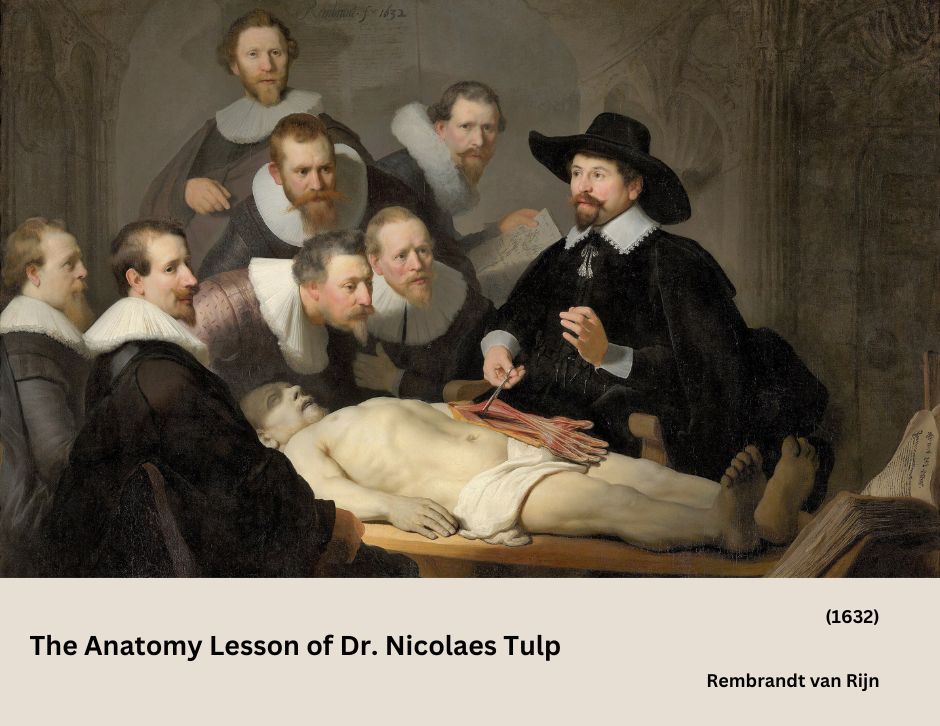
The nineteenth century remarked Rembrandt as an artistic genius, probably because of his demeanor of not giving a damn about the conventions of society and who under all circumstances wanted one thing in his life- to paint. However, the first half of this century left Rembrandt with the image of a misunderstood artist, a man who, after finishing The Night Watch, could only expect incomprehension from his audiences; he persevered indomitably on the path he believed was right. It was only after 1950 that the image of the artist evolved again, and he was marked with the title of ‘the painter of the people,’ because of his exceptional gifts of deeper penetration into the emotional psychology of his sitters. In addition to this; he profoundly portrayed the Biblical stories with such devotion and infinite understanding that no other artist could possibly compete with him. There is something nostalgic about Rembrandt’s art as it has the scent of nostalgic bibliomania. Regardless of what you read about him, time and century always change the way he is perceived. Certainly, Rembrandt existed, but there was a continuous reconstruction of his image over centuries. And, in an approach to build a more realistic picture of Rembrandt without any superlatives, I am leaning on one of his most essential and recognized artworks, The Anatomy Lesson of Dr. Nicolaes Tulp.
The Anatomy Lesson of Dr. Nicolaes Tulp | Fast Knowledge
The Anatomy of Dr. Nicolaes Tulp (1632) is a painting from the early life of Rembrandt where he used aerial perspective to provide subtle effects to the composition. The painting is a group portrait and was made in honor of the live anatomy lesson, which was uncommon those days, headed by Dr Tulp, with his fellow surgeons.
General Information About the Painting.
1. Artist’s Statement.
“A painting is complete when it has the shadows of a god.”
The Florentine Abbot and connoisseur, Filippo Baldinucci, after having conversations with Rembrandt’ pupil Eberhard Keil, wrote about his painting,
“that the strong impasto was due to Rembrandt’s slow way of painting and his habit of returning to the same passage over and over again, and that consequently the portrait commissions eventually stopped coming in.”
2. Subject Matter.
The painting portrays Professor Tulp demonstrating the physiology of the arm, showing the muscles that move the fingers. It is in fact, a group portrait that included only those surgeons who were prepared to pay for their portraits. The painting is much more complex than it looks. The significant focus of the image is Dr. Tulp, the doctor who shows the autopsy of the left arm of the corpse. A significant note of Rembrandt here is that he portrayed Dr. Tulp as the only person wearing a hat to depict his superiority among his seven colleagues. His colleagues have different kinds of facial expressions, which are deeply personal and psychological. I will explain them in later sections when we learn the detailed subject matter analysis of the painting. Approximately parallel to the picture plane is the body of Adriaen Adriaenszoon, a thief who was executed just recently. When you observe the illuminated body from head to foot, you will come across a book in the lower right corner, similar to Andreas Vesalius’ De humani corporis fabrica (Fabric of the Human Body, 1543). All told, Rembrandt shows nine distinct figures grouped together.

3. Artist.
Rembrandt painted The Anatomy Lesson of Dr. Nicolaes Tulp. With his distinctive work, he tends to speak through an extremely powerful voice. When considering the physical and spiritual aspects of man, Rembrandt was mainly centered on the spiritual side of the subject, a quality common from his Leyden days. However, during the first ten years of Amsterdam, his interest drifted to the physical side. Ultimately, in the following years, he focussed on the gradual integration of these two elements until he finally mastered the visual language to proclaim the spirituality in man with a power and intensity, that was never shown or portrayed in painting before. He often said that a painting is incomplete without the shadows of God in it, which is true in every sense.
The eloquence with which Rembrandt conveyed the expressive content of his theme is evident in almost all of his works. Rather than attempting to analyze the formal and technical devices he employed in these paintings, the best way to study his paintings is by seeing through the emotional response that he is trying to convey through them.
4. Date.
The painting The Anatomy of Dr. Nicolaes Tulp dates back to 1632.
5. Provenance.
Historically speaking, practical lessons in anatomy were rare at that time; the dissections of a cadaver were allowed only once a year, and that too with only the body of a victim of the death penalty. Please know that since live anatomy lessons weren’t allowed, the surgeons only acquired knowledge from books and preserved specimens or actual practice.
Now, a little provenance of the painting is that in 1628, for the first time, a chair of anatomy was created in Amsterdam, and the professor guiding it was Dr. Nicolaes Tulp. From 31 January to 2 February 1632, Dr. Tulp gave an open lecture to a select group of surgeons. Since these lectures were considerably an honor, Rembrandt, who was invited to this event, drew a painting out of one of the lessons, demonstrating the physiology of the arm.
The corpse on which the autopsy was performed is the body of a Leiden citizen, Adriaen’t Kint, executed on 31 January for the theft of a cloak. Besides, the artist copied this arm from a drawing or a preserved specimen, since the rendering is striking in all its detail. As I told you earlier in the section- the surgeons paid for the portraits to be included in this painting, so before he composed his group, Rembrandt would have made separate studies of the different heads. Though many artists before him confronted the problems of portraying a group, Rembrandt learned all and finally brought this group to life by making each person stare in different directions, yet without giving the impression that they were not paying attention.
This painting eventually hung in the Theatrum Anatomicum in the Weighhouse on the Nieuwmarkt.
6. Location.
The painting is on exhibition at The Hague, Mauritshuis.
7. Technique and Medium.
Rembrandt used the oil on canvas medium to execute this painting. The artist employed aerial perspective to create tonal differences even when the viewer was close to an object, separated only by shallow layers of air. With this use of aerial perspective, there is great subtlety in the depiction of the surgeon’s group in the painting. Furthermore, there is refined modulation of light and tone from one head and collar to the other, creating a striking atmosphere of the overall composition. Hoogstraten remarked,
“It appears that the air forms a body even over a short distance, and clothes itself in the color of the heaven.”
| Artist | Rembrandt Harmenszoon van Rijn |
| Year Painted | 1632 |
| Genre | Group Portrait |
| Period | Baroque Art |
| Medium | Oil on canvas |
| Dimensions | 169.5 x 216.5 cm |
| Price | Not on sale |
| Where is it housed? | The Hague, Mauritshuis |
In-Depth Description of The Anatomy of Dr. Nicolaes Tulp.
About the Artist: Rembrandt.
After the 1600s, when the element of tension vanished, Dutch paintings welcomed a certain lame and expansive classicism. When one compares the pictures of Cornelis Cornelisz van Haarlem, they will notice that the trend was invariably away from agitation and was more leaned on qualities like tranquility, relaxation, and clear lettering. Of course, there were mannerists like Joachim Wttewael who clung to their labored style, but others like Abraham Bloemaert passed the vital vision of classicism. Yet this generation was not the kind of generation that shaped the art of the new century. This changed after Rembrandt, whose teacher Pieter Lastman, belonging to Baroque, delved into the artistic world.

In my article on The Night Watch and The Storm on the Sea of Galilee, I already gave a little brief on the childhood of Rembrandt, which you can refer to. For this article, I am giving you a brief on the things that affected the early art of Rembrandt.
Starting from the artist’s earliest works, a few drawings dating from 1602 show mannerist features. His actual style took form in Italy in around 1605 under the influence of Adam Elsheimer as he didn’t very much like Caravaggio’s way of art. Elsheimer’s style was more like including minuscule figures with a dramatic form of classicism marked by sweeping, expressive, and harmonious movement. A fine sense of sinuous line, deep figures, rustle robes, and bold conceived landscape background are a few elements that express this impressive narrative style. There were other groupings which played a significant part in the Rembrandt’s youth. Among them was the movement modeled on Caravaggio, which took root in Utrecht, though its influence was felt in Haarlem and Amsterdam. The year 1620 was the earliest date which is assigned to any Dutch painting following this style. However, sooner after changes like the dying spasms of Mannerism, the fad for Caravaggio, growing impact of classicism, the styles changed, and Dutch painting reached the outset of the new century, at least for painting in the grand style.
Sooner, when Rembrandt formed his own style, which portrays a deep psychological and emotional stir in the sitter, these changes constituted the foundation of his artistic journey.
Historical Background of the Painting.
Two days before Rembrandt’s death in October 1669, the genealogist and antiquarian Pieter van Brederode visited him for his famous collection of “rarities and antiquities”. The greatest part, which included a prodigious assortment of busts, helmets, shells, coral, and weapons or porcelain cassowaries, were auctioned off in 1656 when Rembrandt declared bankruptcy. Among all these items, Brederode noticed that there were four flayed arms and legs anatomized by Vesalius in this collection. Among them, one “Vesalian” arm with floating pink-muscle, pickled in a glass jar, had been used by Rembrandt for the model of the forearm in the 1632 masterpiece, The Anatomy Lesson of Dr. Tulp. However, even if it had been the case, Nicolaes anyway used the dissection of the forearm and the demonstration of the flexor muscles as the exemplum of the God-given body. Before this painting, Rembrandt painted other masterpieces like The Supper at Emmaus and Repentant Judas, but this painting was the turning point of Rembrandt’s career. Since there was never a public airing of the anatomy on which the painting revolves, it plays a significant role in the career of both Rembrandt and Dr. Tulp.


To understand the entire provenance of the painting, let us first learn about the primary subject, Dr. Tulp on which the painting is based. Also, please understand that we don’t know much historical context from Rembrandt’s side, so we have to study from the perspective of the surroundings.
Who was Nicolaes Tulp?
Born as Claes Pieterszoon, the son of a linen merchant, he was raised in a house in the oldest section of Amsterdam. As Rembrandt had gone to the Latin school and Leiden University, Nicolaes at that time enrolled as a medical student in 1611. The faculties were though small but extremely distinguished. Nicolaes was a bright student, and in 1614, he successfully defended his dissertation on the disease of cholera humida and left Leideb after getting a licensed doctor medicinae. Consequently, he was entitled to practice in the top tier of a profession sharply divided into three interconnected but strictly separated levels. And sooner, Tulp became a consultant in nose ailments diagnosis, prescribing surgical or medical treatment. The range of procedures was confined for the most part to the removal of gallstones, cataracts, and some external tumors. When he returned to Amsterdam and set up his practice, the young doctor could expect throngs of the sick to gather on his steps each day. In 1617, he married Eva van der Voech. He was the disciple of the well-known anatomist Pieter Paauw, a follower of Andreas Vesalius.
Tulp became a serious weight and substance in Amsterdam when Rembrandt painted him and his colleagues in the surgeon’s guild. His wife died the year he was appointed preselector for anatomy to the guild, thereby being entrusted with the responsibility of conducting the Amsterdam Publishing Anatomy. When morality was so frequent a visitor in a plague culture, no one was ever single for very long if they could replace the deceased with a suitable replacement. And so he married Margaretha de Vlaming van Oudtshoorn in 1630. It was at this time that he decided to have his second public anatomy in January 1632, commemorated by a group portrait.
A Series of Anatomical Paintings.
This was not the first time when this kind of painting was made. Aert Pieterszoon painted a scene in 1603 in the artwork, The Anatomy Lesson of Doctor Sebastiaen Egbertsz, showing twenty-eight members and officers of the surgeons guild gathered around Dr. Sebastiaen Egbertszoon de Vrij as he stood poised, scalpel in hand, beside a faceless corpse of an English pirate. Then, Thomas de Keyser painted the same doctor in lesser crowded setting of an osteology or bone demonstration performed on a skeleton already dissected, as represented in his artwork, The Osteology Lesson of Dr. Sebastiaen Egbertsz. Finally, Nicolaes Eliasz Pickenoy painted an anatomy of Egbertsz’s successor, Johan Fonteijn, during the winter of 1625-26. After this anatomical series of paintings, Rembrandt made The Anatomy Lesson of Dr. Nicolaes Tulp, refashioning the art revolution of anatomy.


An infernally difficult genre, the artist had two hopelessly contradictory tasks- to provide a recognizable likeness or individuality of the sitters and yet provide a strong sense of the collective character of the group. Ideally, a painting depicts the plurality and a fellowship, but there were other requirements basic to the commission. All these groups must be differentiated by rank and function, especially in the case of militia officers, as in The Night Watch. These kinds of paintings were in enormous demand as by the 1620s, the stony formalism of portraiture began to decline, and they tended to interact with the viewer in a plausibly lifelike manner, preferably associated with the institutional character. Hence, there are many demands to make a group portrait. Within all these requirements, the artist must not forget to have some figures to address a meaningful gesture or glance to the beholder, reminding the importance of the institution and its leading figures in the life of the city.

Alois Riegl, analyst of the Dutch group portraits, in 1902, said that the “inner, closed unity” and “outer unity” in these paintings posed a challenge to group portraitists to which most of them signally failed. Like, in The Anatomy Lesson of Doctor Sebastiaen Egbertsz, the painting became enormously elongated, enough challenging to fit these 28 figures, who are lined up in the three rows along a single axis. In this painting, their most senior officials hold a basin with a list of the sitters, and only a slight variation in their angle of posture relieves the monotony of the relentlessly repetitive composition that was criticized even in its own day. In response to this criticism, Keyser and Pickenoy make a conscious effort to make the figures communicate with a greater dramatic coherence. Also, they used a far smaller number of surgeons so that they avoided the elongated form of the painting as in The Anatomy Lesson of Doctor Sebastiaen Egbertz. In Keyser’s version, he used a rendered skeleton to establish a physical center of the composition. Also, this modest concession added depth, giving an impression that the group is standing in a real space, rather than just stacked up on tiers. From all these paintings, Rembrandt learned to paint the best version of anatomy painting. However, it is shocking to know that despite being famous, oddly enough the painting is not singled in any of the Rembrandt biographies of the 17th and 18th centuries. Only Caspar Commelius in Beschrijiving der Stadt Amsterdam mentions that Rembrandt did two famous anatomical paintings.
We will discuss its elements in the later section.
Understanding the Meaning of the Artwork.
The painting though shows a historical event of a public airing of anatomy, its meaning revolves around interpersonal benefits and spirituality. In some sense, this painting let Rembrandt become famous, and the doctor established his reputation through this group portrait. However, in general, the meaning of The Anatomy Lesson of Dr. Nicolaes Tulp painting lies in the simple fact that God’s wisdom and providence are demonstrated in man’s body and that doctors are chosen to gain insight into this wisdom and heal the sick. Looking at the painting at first, one may simply think that the insolvent Rembrandt carefully did exactly what his patron expected- a group portraiture but it had an electrifying drama in it. The focus of the painting is about interior self-examination. Dr. Tulp is all about dexterity and divinity, indicating morality and Christian spirituality. A moment of truth is portrayed by Rembrandt, as another instance when the immediate and the eternal are stimulated simultaneously. Neither he nor Dr. Tulp would have missed the placard emblazoned on the back of the Leiden anatomy theater that read Nosce te ipsum– know thyself. In their respective ways, the painter and physician adopted this motto. In order to know, one must see both the husk and the kernel, the body and the soul. In this pose, Dr. Tulp holds his instrument with his right hand while his left hand is in the air. It is therefore Rembrandt who stands painting him, holding his palette with his left hand, gripping the brush with his right hand, making them both immortal.
There are a lot of chapters to understand the entire meaning of the painting, which you can read in Rembrandt’s Eyes by Simon Schama, who beautifully correlated many things and explained the entire painting in so much detail.
Besides, like all the cities of Holland, Amsterdam was a corporate town and a regular beehive of capitalism. Hence, it was natural for group portraits to flourish. Not only did the surgeons’ guild, but the militia guilds also preferred to have their group portraits. The Night Watch is another example of this kind of painting. In this painting, Rembrandt’s anatomy is more of a private affair as he painted it to honor a great anatomist.
Subject Matter and Dominant Elements.
The Anatomy Lesson of Dr. Tulp demonstrates Dr. Nicolaes as the primary subject, demonstrating the function of the left arm muscles through an anatomy lesson to the surgeon guild. Only two men in this painting were members of the physicians’ guild. It was a difficult task for Nicolaes to dissect the branchial musculature himself while demonstrating the delicate adduction mechanism of the extremity with his left hand demonstrating the movements. Furthermore, Tulp demonstrates two of the unique attributes of a man through this dissection- utterance and prehensile flexibility. With his right hand, he lifts and separates the flexor muscles, while with his left hand, he demonstrates the action enabled by the relevant muscles and tendons.

Now, second from the left in the front row of the painting is Adriaen Slabberaen, who looks out at the book (perhaps an anatomical text), which is propped at the end of the table. Next, Hartman Hartmanszoon holds a paper, which had some inscribed names of the surgeons (at a later stage, initially had the discernible outline of Vesalian man) with his body in profile, while head turned sharply towards the viewer.


The surgeon immediately to his right (our left), with a pallid brow, a fiery pointed mustache, and an ear that is puffed with excitement, is Jacob Block, his gaze wandering between his book and Tulp’s hand. Nearest to the action are the two remaining surgeons that are bent forward. The gray-haired Jacob de Witt is watching intently the motion of Tulp’s instrument on the muscles and tendons; Matthijs Calkoen is following its consequence, the doctor’s finger moving in and out of the light at the joints.


Lastly, there is a question about Tulp’s gaze and thoughts. You must know that the real subject of the painting is not Dr. Tulp but the ultimate Creator, who made the man’s body. Rembrandt portrayed this in his painting through Tulp’s expressions. He made sure that Nicolas looked at a long distance instead of watching or staring at his enthralled colleagues to rapt in the Christian meditation. This meditation is well explained in a poem by Barlaeus, which says,

“Dymb integuments teach. Cuts of flesh, though dead,
for that very reason forbid us to die.
here, while with artful hand he slits the pallid limbs,
speaks to us the eloquence of learned Tulp:
“Listener, learn yourself! and while you proceed through the parts,
believe that, even in the smallest, God lies hid.”
Formal Analysis of The Anatomy Lesson of Dr. Nicolaes Tulp.
1. Line.
The painting has a profusion of different lines, like horizontal, vertical, and even diagonal to create a sense of motion and space in the painting. These lines especially helped Rembrandt to avoid crowded compactness in the artwork, which was quite common in the Leyden period. The corpse, which lies on the table is in a diagonal posture to show a retardation but with perfection. The gaze of numerous figures in the painting passes in diagonal sight, making the painting more alive. This interesting array of gaze lines is called implied lines, which are basically lines that don’t exist physically but have suggested means. Dr. Tulp is the only one who is not looking firmly at the ongoing group, creating a powerful statement in the painting as if a pattern is broken, making the beholder give his full attention to the painting.

2. Light and Value.
The light in this artwork gives a realistic feeling of depth to the figures and the cadaver, as well. At the same time, this light multiplies the effects of gazes and postures. A delicate profuseness of the Leyden period is largely portrayed here, while there is lesser use of subtlety. For instance, Tulp’s hands despite having an eloquent posture look wooden in effect and not sensitively textured like Rembrandt portrayed in The Prophetess Hannah. Further, there is the use of light and shadows over the faces and cadavers to show an enhanced effect of chiaroscuro.
3. Color.
Rembrandt used a variety of soft colors in the painting contrasting well with the black and white uniforms of the figures. Reds and oranges are used most intensely on the corpse’s arm, which are soft pastel colors whereas the darks are expressed in grays and blacks. He uses even the minutest color shade like pink as seen from the ears and cheeks of the ongoing people.
Final Words.
What Rembrandt painted in this work is an act of direct witness or seeing oneself. But like everyone, we see the same body, which is a genius of god engineering, limited by its flesh housing. As an example of the correlation between art and science, Tulp shows the flexor mechanism of the arm physically but mentally, Rembrandt portrays the spiritual meaning of Christianity. Being one of the greatest early accomplishments of Rembrandt’s career, this painting is an innovation when it comes to Christian meaning. After The Anatomy Lesson of Dr. Nicolaes Tulp, he was no longer a partner in a van Uylenburgh concern but an independent artist who dedicated his life to the artwork and changed the entire artistic history.
Frequently Asked Questions.
The painting shows the live dissection of the left arm of the cadaver among the surgeon guilds, done by Dr. Nicolaes Tulp. However, the painting is much more than this first representation as Rembrandt connects Christian spirituality with this image.
In January 1632, following the second public anatomy class by Dr Tulp, Rembrandt received a commission. Though the commission was given by Dr. Tulp to increase his reputation in the capitalist society of Amsterdam back then, the figures in the painting also paid Rembrandt to get themselves included in the anatomy lesson of Dr. Nicolaes Tulp.
The painting gives the message that the human body is God’s genius engineering and that the doctor gains insight into it to treat the problem. Nevertheless, this painting is primarily concerned with self-examination on the inside. As Dr. Tulp shows morality and Christian spirituality, he is all about dexterity and divinity. Similarly, Rembrandt depicts a moment of truth as a time when the immediate and the eternal are stimulated at the same time.
Resources.
- Rembrandt by Annemarie Vels Heijn.
- Rembrandt Paintings by Horst Gerson.
- Rembrandt’s Eyes by Simon Schama.
- Rembrandt: The Painter at Work by Ernst van de Wetering.
- Featured Image: The Anatomy Lesson of Dr. Nicolaes Tulp by Rembrandt, Rembrandt, Public Domain, via Wikimedia Commons.
Related Reads.


