
Eugène Delacroix was a leading French history painter who led one of the finest modern movements toward freedom of expression, lively brushwork, and bold coloring, against a debilitated neoclassical tradition. His canvas, which was remarkably labeled as a ‘Romantic’ by his contemporaries, emulated the true qualities of classical art with a feeling of aliveness. Baudelaire summed up the essential qualities of Delacroix in a few words, “A volcanic crater artistically concealed beneath bouquets of flowers.” The rich canvases of the artist emphasize the themes of war, the tragedies of ancient heroes, and the fury of individual battles between men and beasts, which recurred frequently with the powerful imagination of the artist. In the composition The Death of Sardanapalus (in French: La Mort de Sardanapale), the subject was taken from Byron’s play whose conclusion was a paraphrase: the hero, not content to order the sacrifice of everything that has belonged to him, takes part in it. A disastrous painting reception that can be a shock to the viewer at first glance, the picture raised a hurricane of abuse through the exceptional imagination of the artist. Today, in this article, we are looking at the composition with a subject who, perhaps, is an “intoxicated broom.”
The Death of Sardanapalus | Fast Knowledge
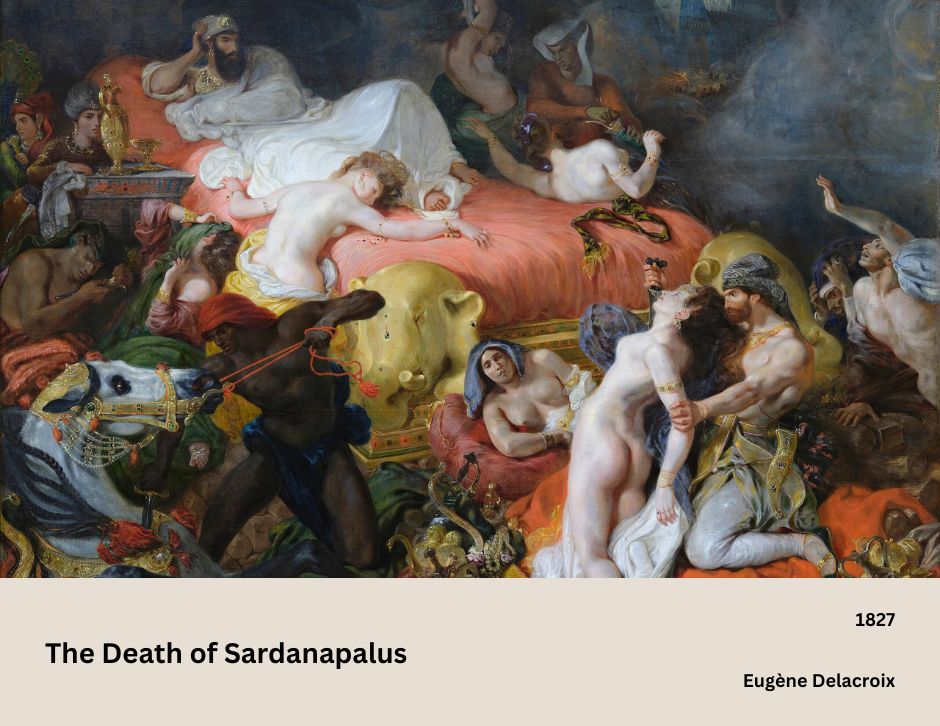
The Death of Sardanapalus is an oil on canvas painting by French artist Eugène Delacroix. It shows the King of Nineveh on the bed as he ordered the slaughter of his entire retinue, who are piled with the royal treasures on his funeral pyre. First exhibited in 1827, the composition is a controversial work of the artist due to its violent scenes.
General Information About The Death of Sardanapalus.
1. Artist Statement.
“Human beings are so strangely constructed that they often find consolation and even happiness in misfortune (for instance, when one is unjustly persecuted, the comfort of knowing that one deserves a better fate), but it far more happens that a man will be bored by prosperity and even think himself supremely miserable (19 July 1854).”
2. Subject Matter.
The composition shows Sardanapalus at the top of a vast pyre, lying on a superb bed with several figures slaughtered around him. He commanded his eunuchs and officers of the palace to slaughter his wife, his pages, and even his favorite horses and dogs, as he wanted none of the objects who gave him pleasure to survive him. The painting portrays the sick man, Sardanapalus, in delirium. When Delacroix first looked at the complete painting, he was severely shocked, and he wrote to a friend: ‘that people won’t look at it through my eyes.’

There is an exceptional dramatic moment in The Death of Sardanapalus painting. Nothing can be more impressive than the massing light on the empty marble staircase in the background, the grand figure of the executioners, and the silent action with strong emotional expressions of the figures. Besides the silent humiliation on the canvas, the artist keenly showed abuse that he might have witnessed at some point in his life.
3. Artist.
Eugène Delacroix was not only a great artist but a good man who is no less admirable as a person than for his work. An artist who created a world to carry the French painting from the shores of Neoclassicism to exemplary Impressionism, Delacroix had the most straightforward heart with an open mind and rare virtue. In his journal, he gave vast input to human conditions, which in turn tells that Delacroix was a highly self-aware person who gradually achieved self-conquest and self-possession.
If we talk about the nineteenth-century French art, then it was Delacroix who brought a revolution in aesthetics, leading to the formation of Modern art. He helped the romantic painters through his pictorial daring and invention to bring a revolution and combine classical art with dark medieval elements. There’s an absence of constraints in his style, but the pictures produced by him seem vivid, visionary, and moving at first. Born in Charenton-Saint-Maurice, Delacroix moved to Paris at an early age. By age ten, he became a frequent visitor to the Louvre. Apprenticed under Guerin, the former pupil of David, Delacroix began to sharpen his skills, and then in 1822, he experienced his first success with the mesmerizing The Barque of Dante.

4. Date.
The Death of Sardanapalus dates back to 1827.
5. Provenance.
Eugène Delacroix undertook a little journey to England in 1825, and he was highly impressed by the immensity of London. During this occasion, he developed an admiration for the great Kean in some of the Shakespearian impersonations and Terry as Mephistopheles in the adaptation of Faust. Further, he was very interested in the works of contemporary British artists, many of whom shared personal relations with him. He admired the works of Bonington, Constable, Turner, and Lawrence, and an influence of these artists can be seen in his later works.
After he returned from England a year later, he composed “Justinian Composing the Institutes” for the interiors of the Conseil d’Etat, which perished in a fire in 1871. A year later, when the Salon was reopened, he represented fewer than twelve paintings, including ‘The Death of Sardanapalus,’ ‘Marino Faliero,’ and ‘Christ in the Garden of Olives.’ Though the large Sardanapalus alienated from the entire collection, the reception of the composition was cruel as many critics were shocked to see the artwork. However, when it was exhibited in London in 1828, it was warmly eulogized.
6. Location.
La Mort de Sardanapale resides in the Musée du Louvre, Paris.
7. Technique and Medium.
The Death of Sardanapalus has oil on canvas medium. It is a provocative remark against Neoclassical constriction as it revolves around the principles of Romanticism. Showing an exuberance of color and movement, this composition is one of the most remarkable and major works of the artist from the Baroque period. Though it shows traces of Neoclassical influences, it is majorly based on the engraving of a pseudo-Etruscan relief that depicts a scene of slaughter, accounting for uncomfortable tension in it.
Delacroix used pastel techniques in the composition. For instance, he translated his pastel technique into oils at the foot of the male slave in the right foreground. First, he laid a general tone of the flesh evenly, corresponding to the buff paper in the pastel study. Then, without obscuring this preparation, he used opaque layers of impasto to create delicate and multicoloured hatchings. Depending on the color relationships and stroke directions, he created the illusion of solidity. This technique is usually used in sculptural modeling.
Delacroix further created an illusion of relief without any harsh chiaroscuro or linear perspective. In the slave’s foot, the artist used a synthesis of the thick impasto technique and excessive transparent coloring of a passage. In some compositions, broken and accented touch is used repeatedly. When looked closely, the object will show more reflections, and the farther away it is, the more matte it becomes. This effect was used by Peter Paul Rubens too.
| Artist | Eugène Delacroix |
| Year Painted | 1827 |
| Genre | History Painting |
| Period | Romanticism |
| Medium | Oil on canvas |
| Dimensions | 12′ 10″ x 16′ 3″ / 3.92 x 4.96 m |
| Price | Not on sale |
| Where is it housed? | Musée du Louvre, Paris |
In-Depth Description of the Painting.
About the Artist: Eugène Delacroix.
Eugène Delacroix is more than a name in Britain, as there was a time when the Press was flooded with his artworks. It is impossible to learn every one of Delaxroix’s works in a single article or even a book as there is no kind of painting that Delacroix didn’t make. From vast mural decorations treating religious, mythological, and allegorical subjects to the large canvases depicting historical scenes and battles or the works of great authors besides portraits, landscapes, interiors, animals, and still life, the artist laid everything on his canvases. In my previous article about Liberty Leading the People, one of the most significant works of the artist, I gave a brief introduction to the early life of the artist, which I do intend to repeat here.

Starting from the description, that Charles Baudelaire gave about the artist as he knew him,
“He was compact of energy, but of energy which sprang from the power of the nerves and the will, for physically he was frail and delicate. The eyes of the tiger watchful of its prey have less fiery a gleam, its muscles are less tense with quivering impatience than those of the great painter, as with his whole soul he flung himself on an idea or endeavored to grasp a dream.”
Ferdinand Victor Eugène Delacroix was the youngest of four children of whom the two eldest were more than twenty years older than him. His father, Charles Delacroix, died when he was just seven and his mother Victoire Oeben, was the daughter of the celebrated cabinet maker, Jean-François Oeben. The artistic bent of Delacroix appeared at an early age, initially towards music, a passion, which remained all his life. At the age of seven, he amazed his music teacher with his talent. After his father died, his mother settled in Paris, and young Eugène was taught under Louis le Grand. One of the journalists, Philarete Chasles, gave a small description of him,
“with his olive-hued brow and flashing eye, his mobile countenance, his cheeks early sunken, and delicately mocking mouth… At school, Eugene Delacroix covered his copy-books with drawings and heads. Real talent is so utterly innate and spontaneous that at the age of eight and nine, this marvelous artist reproduced attitudes, invented fore-shortenings, and drew and varied the outlines of everything…”
When the artist was sixteen, his mother died, leaving some small property to be divided between her three children; an unfortunate lawsuit, however, dissipated this. The only things that Delacroix got were two silver forks and spoons and a gilt china vase. Hence, he was entirely dependent on his own efforts, and in spite of his freedom claims from his family, it was not until the later years of his life that the question of money ceased to be a matter of continuous anxiety to him. At sixteen, he entered École des Beaux-Arts and worked in Guerin’s studio as an apprentice.
History and Background of the Painting.
The Idea Behind The Death of Sardanapalus.
The painting was strongly influenced by Byron’s play of the same name, which matches the description given by the ancient historian Diodorus of Sicily of the luxurious life and lurid death of an Assyrian king whose enemies were about to destroy him. Diodorus wrote,
“heaped upon it all his gold and silver as well as every article of the royal wardrobe, and then, shutting his concubines and eunuchs in the room which had been built in the middle of the pyre, he consigned both them and himself and his palace to the flames.”
This story was an appeal to the Romanticists as its visual trapping was exotic, and the violence was appalling. When Delacroix painted his version of the story, he showed Sardanapalus ordering his retinue to be slain before cremation so that the death of his accomplices becomes less painful. He showed the King on his royal bed in the midst of the carnage, oblivious to the massacre he commanded. Delacroix showed a state of total renunciation, perceiving the futility of trying to fight off his enemies.
The artist identified himself with the King, as he called him ‘My friend Sardanapalus,’ which remains a discussion among historians, as they connected it with Delacroix’s own spells of depression. Other writers on Sardanapalus commented on writhing nudes, as they submit their bodies to torment and death exhibiting the visual paraphrase of a sadistic orgy. There are several other meanings of this canvas, which I will tell you in the next section of the article.
A Little Background on Exhibition.
As large as the Massacre de Scio, The Death of Sardanapalus was exhibited at the Salon of 1827. According to Andrieu, the artist wished to reproduce a variety of hue and blond tonality of the composition.

At the salon, when Sardanapalus was hanging, the public shouted, “Scandal!” Delacroix was even compared to Iearus, who tried to fly too high and crashed to earth. For nearly a century, this composition was vanished. In 1921, the Louvre bought it from Baron Vitta, a Delacroix devotee who guarded his compositions for years in private collection.
One of the worth recalling episodes, after Delacroix presented his work at Salon, was his summon before the Superintendent of Fine Arts to be made to understand that unless he changed his manner, he could expect no further support from the Government. Hence, he saw a difficult career because of his choice to paint such a complex and violent subject.
Understanding the Meaning of La Mort de Sardanapale.
If you look at the composition carefully, in every single pose, there is an act of violence as Delacroix sought variety within an all-encompassing concept. It is based on the theme of violence, it encounters savagery and death. However, the faces, which are slightly tilted upwards, shows the only way to end of misery; the path of heaven. Hardly mentioned, this painting is also about the change of course of time. Since all life is a series of encounter, it shows that people and forces clashes headlong, and they change each other. Sometimes, it is through love or compassion, but more often it is through conflict or combat. Further, this painting is an autobiographical work, as to Delacroix, the creation of art was an encounter itself. He faced the raw energies in life, wrestled with them, and tamed them through transmitting them to the canvas.
Dominant Elements and Subject Matter.
King Sardanapalus, wearing a white mantle and golden crown with a large beard, sits on the bed throne in a posture of luminous diagonal thrusting from the lower right to the upper left. The exuberance of color and movement of this canvas is the most Baroque of Delacroix’s major paintings to date. I told you earlier that it has few traces of Neoclassical influence, but it is based on the engraving of a pseudo-Etruscan relief that depicts a scene of slaughter. However, the artist later resolved this tension between Baroque and Neoclassical methods of composition through another artwork, The Christ on the Sea of Galilee of the 1850s.

In every single pose of the composition, there is an act of violence. One of the figures with a full-length nude is bent backward and is going to receive the dagger in her breast and is complemented by the Ionian slave Myrrha, the king’s favorite, who is bent forward on the bed to receive another coup de grâce. The concubine who is about to be strangled with a green scarf is a close variation to the other cubine who is about to hang herself with a white scarf. The scene presents a striking contrast between chaos and beauty, highlighted by the magnificent horse with its braided, tasseled mane and golden harness. As the horse rears in panic, it evokes a sense of urgency as it faces the threat of being stabbed by a turbaned Moor, illustrating the indiscriminate nature of violence in this moment. Further, two orange reins, which draws the horse forward stand out against his slayer’s dark flesh. Two taut and straight lines in awelter of serpentine curves further enhance the look of this horse.


In the background, he showed a shape of a headdress, dimly visible, and then an elephant’s head, which is carved on the King’s bedpost. However, all this profusion of detail is never allowed to detract from the picture’s total impact. Furthermore, there are treasures all around the floor, depicting luxury.

Formal Analysis of The Death of Sardanapalus.
1. Line.
The painting consists of several curves through the nude figures. The curve of the golden lyre on the floor echoes the curves of the slave girl’s hips. Further, there are curves of falling drapery that is repeatedly used in the curve of a shoulder or breast. The posture of the king is diagonal that is threatening to the entire canvas. Each of the figures that are about to do massacre of King’s favorite has diagonal thrust, hence causing frightening appeal in the painting.

2. Color.
The color scheme of this composition is imaginative. Delacroix isn’t concerned with a naturalistic unifying atmosphere or easing the transition from one bright color to another by reproducing realistic exchanges of colored reflections. It is in fact so colorful that it is easily comparable to a Persian carpet or an amalgam of colors in a kaleidoscope. He used a florid coloring in the painting.
The artist used scientifically calculating complementary contrasts with a color circle instead of using them instinctively. What he did was that he drew a faint color circle and wrote the three primary colors with the complementaries on the circumference. Then, he connected each of the primary colors to its complementary with a diameter. In the final painting, he used three primary complementary contrasts: yellow and violet, blue and orange, and red and green.
For Delacroix, Sardanapalus was a supreme statement of the Romantic dilemma, hence he added a command of color here. He selected rich vermilion and gleaming gold, deftly transitioning into the muted depths of umberish minor keys, before soaring back into bold, bravura passages that shimmered with dazzling whites and delicate flesh tones.
Opinions and Conclusion.
The painting is like a massacre, but to me, there is an erasure of femininity from the canvas through unbearable cruelty. However, psychologically, The Death of Sardanapalus is a tough painting that takes you through a change of events for the worse. In one moment, you had everything you wanted but it took a steep end when the course of events in life changed. I understand that the work further shows two sides of life; the materialistic path through the luxurious objects, slaves, and horses and the ultimate death which is shown through nudity and several other objects. In brief, the artist has not shown insanity but reality which looked like madness to the people.
Resources.
- Featured Image: The Death of Sardanapalus by Eugène Delacroix; Eugène Delacroix, Public domain, via Wikimedia Commons.
- Delacroix, a Pictorial Biography by Yvonne Deslandres.
- Delacroix by Paul George Konody.
- Gramercy Great Masters: Delacroix by RH Value Publishing.
- Eugène Delacroix (French Edition) by Camille Mauclair.
- Eugene Delacroix by Dorothy Bussy.
- Delacroix (Newnes’ art library) by Henri Frantz.
- Delacroix and the Rise of Modern Art by Patrick Noon and Christopher Riopelle.
- Delacroix Pastels by Lee Johnson.
Related Reads.


