
One of the most significant figures in Western Art whose visionary work initiated a whole new revolution in landscape painting is J.M.W. Turner. Throughout his life, he painted many castles, abbeys, and other historic buildings that are now taken care of by the English’s leading conservation body. Often seen as a romantic painter, Turner created the universal images of the ideal landscapes, stormy seascapes, and almost abstract ‘Colour Beginnings.’ Somehow, his artworks were affected by the changing era of Britain, ravaged by the effects of the Napoleonic wars, revived by the Industrial Revolution, and an embarkment of the new age by the ascendancy of Queen Victoria. Born as the son of a barber, Turner studied at the prestigious Royal Academy of Art when the French Revolution was at its peak. At the time of the French Revolution, there was a climate of fear, which dominated Britain, further disabling him to travel abroad, which is why he reimagined the landscape to create the most iconic scenes of the country. Being the first artist to capture the beauty of the Alps and revive Venice as a subject, J.M.W. Turner was an industrious professional illustrator and a loyal servant of the Royal Academy who maintained a good income by selling his innovative oil paintings. Living in the great age of patriotic and picturesque Britain, Turner painted around 45 historic properties that belong to the care of English heritage now. What differed in his artworks is the use of profound humanity, which we also see in his most important artwork, The Fighting Temeraire. Furthermore, as a part of the patriotism and notions of nationality, Turner’s The Fighting Temeraire is one of the masterpieces that symbolically radiates the joy of serving the nation. Let’s discuss the artwork in detail.
The Fighting Temeraire | Fast Knowledge
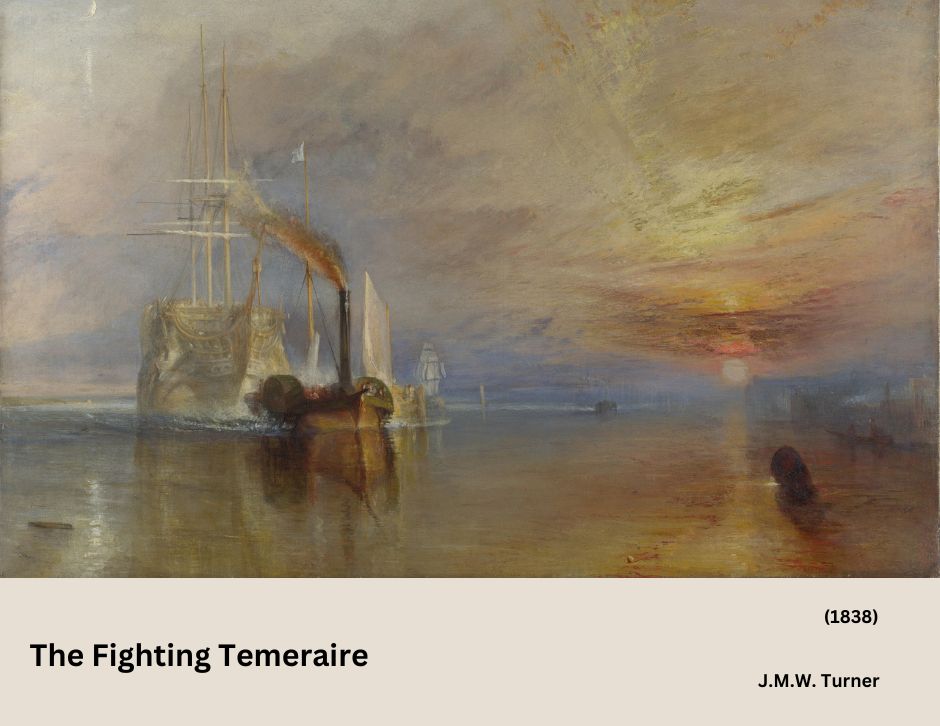
The Fighting Temeraire is an 1838 artwork by the British artist JMW Turner, which portrays a British warship Temeraire towed by paddle-wheel steam through the river to get it scrapped due to its long age and decayed material.
General Information About The Fighting Temeraire Painting.
1. Artist’s Statement.
“I hate married men; they never make any sacrifice to the Arts but are always thinking of their duty to their wives and families or some rubbish of that sort.”
2. Subject Matter.
The subject matter of the painting is the ship Temeraire, which is towed along the glass-smooth river in the golden light with a noble presence mediating the chasm between water and sky. The painting has strong and intense colors with tranquility in its atmosphere to bid an emotional farewell to the warship that took part in the battles against the Napoleonic wars. It has narrative echoes as the old Temeraire is finally dragged to her last home by a little, spiteful, diabolic steamer.

The mighty red sun in the flaring clouds rests on one side of the picture with an illuminating river, and the countless navy fades at an appropriate distance that was never painted before. A little demon of the steamer, which is lashing up the water and has a red-hot and malignant smoke coming from it, tows the ship, which is the most interesting part of the composition.
The Fighting Temeraire painting won the hearts of its audience when exhibited in 1839 but remained unsold simply because Turner refused to part with it. The artwork was closer to the artist as he knew that maybe the ship got dismantled in the old warehouse, but this painting was a glimpse of the great warships that are already priceless. Furthermore, it has an autobiographical hint, which I will tell you in the following sections of the article.
3. Artist.
Joseph Mallord William Turner painted The Fighting Temeraire. Born on 23 April 1775 in London, his father was a barber, and his mother came from a butcher family. When he turned 10, he was sent to stay with his uncle, a butcher in Brentford, due to his family’s illness. Turner’s only sibling, his younger sister, died the following year due to unknown reasons, and at that time, his mother’s illness became apparent. Being confined to the Bethlehem Hospital in 1800, she died after four years due to mental insanity. With the tragic deaths of his only sibling and mother, he was encouraged by a proud father who wanted his career to be beyond the barbershop. Initially, he worked as an architectural draughtsman and started his painting journey by coloring and copying prints, sketching churches, country houses, and landscaped parks in painstaking detail. He then had his first commission at ten or eleven to color the engravings in the copy of Henry Boswell’s Picturesque Views of the Antiquities of England and Wales. The artist had a troubled personal life but was successful in his career.
4. Date.
The painting, also known as The Fighting Temeraire, Tugged to Her Last Berth to Be Broken Up, dates back to 1838.
5. Provenance.
As informed in the earlier section, the artwork shows the final journey of the Temeraire towed by the paddle-wheel steam tug. The actual journey takes place from the Sheerness in Kent along the river Thames to Rotherhithe in south-east London, where it was to be scrapped. A little provenance of the ship is that it played its role in the Napoleonic Wars when it defended Nelson’s flagship Victory at the Battle of Trafalgar in 1805. However, in 1815, with the advent of peace, most of Britain’s great warships became redundant, which was why, in 1820, the Temeraire had been moored off at the Sheerness. Then, in June 1838, it was sold due to its decayed material and its age of 40 years. At this time, the artist painted The Fighting Temeraire.
One must understand that the painting combines numerous themes, sentiments, and responses as Turner explores the recent depictions of the British naval glory here. Hitting a note between sentimental melancholy and nationalistic pride, it strikes the hope, which makes it so special and closer to the artist’s heart. I will tell you the entire provenance of the artwork in later sections of the article.
6. Location.
The painting is on exhibition at The National Gallery, London on loan: National Treasures, Laing Art Gallery, Newcastle upon Tyne, UK.
7. Technique and Medium.
The painting has the medium of oil on canvas. Being the best-preserved pictures of The National Gallery, the artist used the technique called scumbling to create the atmospheric vision on the canvas. A scumble is a thinly applied paint layer that is lighter in tone than the underlying colors. It is translucent because of its thinness. Here, in this artwork, he first built up a background of the painting, the sky with thin glazes of paint, and then lightly brushed thick, opaque paint of yellow and orange shades over the top. He finished it by dragging his brush down from the top at irregular intervals, creating a dramatic effect of texture and intense colors.
| Artist | Joseph Mallord William Turner |
| Year Painted | 1838 |
| Genre | Landscape Painting |
| Period | Romanticism |
| Medium | Oil on canvas |
| Dimensions | 90.7 × 121.6 cm |
| Price | Priceless |
| Where is it housed? | The National Gallery, London |
In-Depth Description of The Fighting Temeraire.
About the Artist: J.M.W. Turner.
I have told you a little bit about the early life of the artist in the previous section. Continuing, in 1789, Turner entered the Royal Academy school; after he heard the first lecture by the president, Sir Joshua Reynolds, he instantly became inspired with the highest of artistic ambitions. The first works he exhibited at the Academy were watercolors of the historic buildings, reflecting his background and training from 1790. When he was fifteen, he sent View of the Archbishop’s Palace, Lambeth, for exhibition, and the following year, he showed King John’s Palace, Eltham. By 1798, he sufficiently exhibited ten works, four with quotations from James Thomson’s poem The Seasons and one with lines from Milton’s Paradise Lost. The paintings were landscapes of Cumberland and Yorkshire with antiquarian sites; Dunstanburgh Castle, Kirkstall Abbey, Norham Castle, Holy Island Cathedral, and Fountains Abbey. Similar to this, the following year, he exhibited eleven paintings again, which also led him to the position of Associate of the Royal Academy. Hence, Turner did all the hard work needed to be a famous landscape artist.


Turner explored every type of subject for his exhibition, whether the epic scenes of the storm-swept disasters from the Bible or Roman history or the serene sunsets over the classical and contemporary landscapes. After being elected as an associate of the Academy, he traveled abroad for the first time to explore Grenoble, Mont Blanc, the Val d’Aosta, the St. Gothard pass, and the Grande Chartreuse. After the final peace signed between Britain and France, Turner traveled abroad almost every summer from 1817 to 1844. Well, there is a lot to learn about the artist’s life, and I am pretty sure that I will cover them in parts whenever I discuss his other paintings; for now, let us move to the historical context of The Fighting Temeraire.
Historical Provenance of the Painting.
Turner was sixty-four years old when he painted ‘The Fighting Temeraire, Tugged to Her Last Berth to Be Broken Up, 1838.’ The picture was inspired by the fate of the ship Temeraire. I will tell you the entire history behind the painting briefly through different sections.
A Little Past of Temeraire.
A 98-gun fighting ship launched in 1798 and built by over 5000 oaks and manned by more than 750 men, Temeraire fought with conspicuous bravery beside Nelson’s flagship, the Victory, in the Battle of Trafalgar. After the Trafalgar battle, Temeraire spent over a year in the Portsmouth Dockyard to undergo repairs and refitting. However, by April 1807, she was pronounced fit for service and was directed to join the fleet stationed off Toulon, where Napolean was rebuilding its army. Hence, after the Trafalgar, the French offered no serious threats to the sea. There was a detailed Admiralty questionnaire, which concerned the ‘Sailing Qualities’ of all its ships, and it was supposed to be answered. As of Temeraire, her Captain, master, Boatswain, and Carpenter reported that she was, ‘A well built and strong ship but apparently much decayed,’ though its previous report showed no signs of weakness. Following this, on 19 March 1812, it was put out of commission; its career as a ship was over, and it was relieved of its duties.
On 16 August 1838, the ship was sold by an auction to a London ship-breaker, who arranged for two steam tugs to tow her upriver to his wharf at Rotherhithe. Then, on 5 and 6 September, one of the most famous veterans of Trafalgar and one of the only nine remaining ships that served the battle was to be towed to scrap its material. There is doubt whether Turner actually saw this event as there are several accounts that put him at different locations at the time. Certainly, Turner might have seen a ship towed, but on the canvas, he painted a sorrier state sufficient to revive the ship of her formal glory. Furthermore, he was well aware of how damaged Victory (when it returned from the Trafalgar) looked like when the ship reached Sheerness on 23 December 1805, for which he also painted sketches. It was only Turner who saw a subject in these battleships and painted it with such beauty and emotion that Thackeray likened it to,
“a magnificent national ode or piece of music.”
One of the poems that explained the Temeraire, written in 1866 by Herman Melville, writes,
“O Titan Temeraire,
Your stern-lights fade away;
Your bulwarks to the years must yield,
And heart-of-oak decay.
A pigmy steam-tug tows you,
Gigantic to the shore-
Dismantled of your guns and spars,
And sweeping wings of war…”
Please note that if you wish to know the entire narration of the battle, then you can refer to the classic The Battle of Trafalgar by Geoffrey Bennett.
Sea as a Continual Inspiration.
Though having varied subjects, Turner always had the sea as a continuous inspiration. In one of the purely imaginative passages, Ruskin suggests that in his London childhood, he might have tormented the watermen to hide in their boats and let him see the different parts of it. A more reliable source suggests that he spent some time at the Margate in or about 1786 when he was eleven and made some drawings there. Furthermore, the two popular Dutch masters, Van de Veldes and Jacob van Ruisdael engravings, helped him to develop the artworks of the sea more precisely. So what started with the craze or inspiration to paint the sea sooner became brooding abstractions on the nature of the sea in his later life.
Before the artist painted The Fighting Temeraire, he composed sea landscapes that chiefly reflected the activities of the human beings who engage with the sea, as fishermen, boat-builders, or passengers. The sea pictures by Turner reflect an interest in the aspects of human existence, but sometimes, they even show terrifying knowledge that nature can destroy men.
Starting from the Fishermen at Sea, exhibited in 1796, Turner produced a series of dramatic oil paintings of sea subjects in his lifetime, which put him at the forefront of modern painters. Then comes ‘Dutch Boats in a Gale; Fishermen Endeavoring to Put Their Fish on Board’ exhibited in 1801, which won high praise from many artists like Constable and Fuseli ‘spoke in the highest manner of Turner’s picture of “Dutch Boats in a Gale” in the exhibition as being the best picture there, quite Rembrandtish…’ A year later, Turner painted ‘Ships Bearing Up for Anchorage’ by which he translated a commonplace scene of the sailing ships off the English coast. He put the greatest beauty of design in this artwork, which is carefully worked and has heightened drama by the fall of light under a threatening sky. In 1804, he composed ‘Boats Carrying Out Anchors and Cables to Dutch Men of War in 1665’ for which The Sun provoked a review, ‘The Sea seems to have been painted with birch-broom and whitening.’


The series of sea paintings didn’t stop, as Turner composed them in many ways. ‘The Shipwreck’ exhibited in 1805 is the most hearty image of the early sea pictures by the artist as it conveys the message that hope has gone, and men are at the mercy of the raging sea. He composed it to highlight the issue of fishing, which is against nature. Then, in 1810, he painted ‘Avalanche’ for which he wrote these lines,
“The vast weight bursts through the rocky barrier;
Down at once, its pine-clad forests
And towering glaciers fall, the work of ages
Crashing through all! extinction follows,
And the toil, the hope of man- o’erwhelms.”


Turner expressed a lot in his paintings, and very few people know that he even expressed himself through a poem. It was in 1809 that he worked on his long, rambling, and unfinished poem to which he gave the title ‘The Fallacies of Hope.’ His works included the themes of this poem and all of the events from the decline of empires, destruction of armies, the deluge, and shipwreck to the Temeraire event of scrapping showed him the evidence of ‘the fallacies of hope’ or a simple fact that ‘extinction follows.’
There are other sea paintings by artists like Sheerness from 1824, Portsmouth (1824-5), etc, which you can take a look at and read in detail from Turner: The Fighting Temeraire by Judy Egerton.


The Fighting Temeraire and the Artist.
Coming back to the painting for which we are here, Margate provided Turner with the ideas for oils and watercolors throughout his life, whether you talk about his earliest drawings, the meditative and abstracted seascapes, or the later artworks, which have an emotional sentiment in them.
In 1837, Turner got the commission to produce twenty watercolor vignettes to illustrate sixteen poems from Edward Moxon’s edition of The Poetical Works of Thomas Campbell, Turner. One of the selected poems, ‘The Battle of the Baltic,’ which begins with the ‘Of Nelson and the North/Sing the glorious day’s renown’ originally entitled ‘The Battle of Copenhagen,’ celebrates Nelson’s victory over the Danish fleet on 2 April 1801. When Turner painted this poem in the form of composition, ‘The Battle of the Baltic,’ he showed the lurid plumes of gun smoke ascending into the bright morning sky that might have interested Turner and the inspiration for portraying the burning smoke in The Fighting Temeraire may have been taken from this poem.
Then, during 1835-6, Turner worked on his vignettes for Campbell. One of the best poems, ‘Ye Mariners of England’ subtitled, ‘A Naval Ode’ had this opening verse;
“ye Mariners of England!
That guard our native seas,
Whose flag has braved, a thousand years,
The battle and the breeze-
Your glorious standard launch again
To match another foe!”
Through this poem, Turner took the title of his composition, ‘The Fighting Temeraire.’ Furthermore, the third and fourth line of Campbell’s verse underlines the fact that once Temeraire had been sold out of the Navy, that flag no longer owned her.
The decision to make a painting on ‘The Fighting Temeraire’ might have been swift as he might have started painting it in the autumn of 1838. There are no preliminary sketches known of this painting. At the exhibition of 1839, Turner had four other paintings: the contrasting pair ‘Ancient Rome; Agrippina Landing With the Ashes of Germanicus’ and ‘Modern Rome- Campo Vaccino,’ ‘Pluto carrying off Proserpine’ and ‘Cicero at His Villa at Tusculum,’ each about 99×120 cm, exactly the size of the canvas of The Fighting Temeraire.


Lastly, one of the crucial aspects to know about this painting is that it belongs to the ‘third style’ of the artist’s life. Let me explain this period in a brief manner-
The period had less mechanical effort, less pride in new discoveries and less ambitious accumulation, more deep imaginative delight, and quiet love of nature. Sometimes, Turner would paint in defiance of critics as he painted only to astonish. Mr. Ruskin explains this period,
“Another notable characteristic of this third period is that, though his mind was in a state of comparative repose, and capable of play at idle moments, it was in its depth infinitely more serious than heretofore; nearly all the subjects on which it dwelt having now some pathetic meaning. Formerly, he painted the ‘Victory’ in her triumph, but now the ‘Old Temeraire’ in her decay; formerly Napoleon at Marengo, now Napolean at St. Helena.”
Understand the Meaning of The Fighting Temeraire.
The artwork has an autobiographical hint, as I previously informed you. After the arrival of new and young artists in Britain, Turner was somehow neglected or faded, which is why he painted the composition with such an emotional stir. One of the important things to notice here is the simultaneous portraying of the sun and moon; one rising in the sky and setting over the water, which is the great cycle of life that the artist sees. Franny Moyle explains in her Turner: The Extraordinary Life and Momentous Time of J.M.W Turner,
“Turner’s Temeraire is an expression of his own profound understanding that beyond the triumphs of empire, he had witnessed in his own time, more was to come in the endless revolution of time. Rise and fall. Night and da. Chaos and creation. Life and Death. Old Victories and Brave New Worlds.”
Furthermore, the painting bids a farewell to the old Temeraire as it is dragged to her last home. It is slow and sad, but at the same time Majestic during the final days of Temeraire, dragged by a steamer, and she has death written over it. Mr. Titmarsh brings one important point to our notice,
“I think… we ought not, in common gratitude, to sacrifice entirely these noble old champions of ours, but that we should have somewhere a museum of their skeletons, which our children might visit, and think of the brave deeds which were done in them.”
The display of a ship, a steamer, a river, and a sunset, all on the same canvas, surely displays the power of the artist.
Subject Matter of the Artwork.
The Life of J.M.W. Turner by Walter Thornbury describes the painting,
“a great puffing of the cream-colored sails, the red prows, the striped masts, the violet haze on the distant sea-rocks, the yellow glow of the expanding sunlight, the horizon’s bar of denser blinder blue, the great ripple of red and golden cloudlets, the gleams on the upper cliff of the Cyclopean land, are all deliciously woven together to form this imperial picture.”
What Does the Ship Look Like?
The ‘Temeraire’ is the result of a creation and a poem. It portrays the Temeraire as a doomed ship, unreal and already ghostly, with her own black and yellow colors invisible in the faded atmosphere. There are curves of her bows and catheads on either side behind, with her anchors stowed with a few dark and sketchy brushstrokes to display her emptiness. When you look closer at the Temeraire, you will find that there is a specific area of it that symbolizes the change that overtakes the entire ship. If you look at the area immediately above and below the bowsprit cap; it is visible that the perpendicular spar fixed below the bowsprit cap, called the dolphin striker (one which stays to carry the rigging forward), is loosely hanging as if its function is gone and its lower end remains broken. The broken part shows that the former version of the ship was complex, purposeful, and beautiful and that the older version has its functions gone. One more thing to know here is that the ship doesn’t have a flag, as Campbell wrote in his poem,
“The Flag which braved the battle and the breeze No longer owns her.”

A Look at the Steamer.
The black steamer has the angle at which the tug’s smoke is emitted, moving backward through the Temeraire’s masts. Turner didn’t use the contemporary design of the steamer and used his own first-hand observations of the steamers. He did so by placing the funnel foremost in the tug, in front of its mast, which you can compare with the model of the Monarch. A white flag with an indecipherable emblem rises higher from the Temeraire’s masts, which contrasts the absence of the Temeraire flag even more and makes it more pitiable.

Lastly, there is a magnificent sunset, which occupies half of the picture. As Art-Union’s reviewer described it,
“It is a glorious sunset, and we are to suppose that by the time that the glowing disk shall rest upon the horizon, the Temeraire shall have been towed into her last resting-place.”
He further added,
“On one side is the setting sun- emblem of the aged ship….; while on the other is the young moon- a type of the petty steamer- about to assume its station in the sky.”
In the background of the ship, the artist further conjures up a mysterious effect of the numerous sailing ships in a far distance to describe them as, ‘a countless navy that fades away.’ Lastly, there is a dark prosaic shape of the buoy in the right shallow, which is indispensable in tying the sunset down to finally give us the realization that life must go on.

Formal Analysis of The Fighting Temeraire.
1. Shape.
In the composition, The Fighting Temeraire, the Temeraire, sunset, and the black prosaic shape buoy in the right shallow create a subtle triangular arrangement when joined. This geometric shape gives a dynamic movement to the artwork, making it complete and interconnected with each other.

2. Color.
The painting consists of both warmer and cooler colors. For instance, to the bottom side of the artwork, there are soft blues, weak grays, and pale white reflections of the moon that hit the clouds and oceans. At the same time, the hues of the sunset are warmer, hence juxtaposing the two atmospheric events in the painting. The warmer shades of the painting consist of saturated oranges and yellows, which further create an illusion of naturalism.
The Temeraire is painted in light colors which gives it a mythical appearance in comparison to the black and dark steamer. The combustion of the steamer further has warmer colors with a blackish accent to fill up the space.
Conclusion & Opinions
The Fighting Temeraire is an excellent seascape painting that I have seen so far. The momentous attention on the black steamer along with the faded atmosphere and the minutest details of the seascape makes it more beautiful. But the most important aspect is the message behind it. It is worth noticing how the artist puts the message that everything extinguishes someday but he instantly compensates it with a hope to live the life. The title of the painting The Fighting Temeraire somehow still messes with my head as Temeraire is approaching its sweet death and there is nothing worth fighting now. All those days of glory and past have come to an end and the Temeraire, who is almost in tears just wants to hear one last time, “The Old Temeraire!”
Resources.
- Turner, The Fighting Temeraire by Judy Egerton.
- Featured Image: The Fighting Temeraire by J.M.W. Turner; J.M.W. Turner, Public Domain, via Wikimedia Commons.
- The Life of J.M.W. Turner, R.a.: Founded On Letters and Papers Furnished by His Friends and Fellow-Academicians by Walter Thornbury.
- Turner: Painting The Nation: English Heritage Properties As Seen by JMW Turner by Julius Bryant.
- Turner: The Extraordinary Life and Momentous Times of J.M.W. Turner by Franny Moyle. (Recommended)
Related Reads.


