
Our beloved Vincent is one of the few painters with an imagination and a flair for color, assisting him to produce clearly the richest collection of paintings in ten years under the most strenuous circumstances. Starting with naive art to attending a dramatically remarkable style in his mature years, Vincent was an artist who learned and experimented with art with his own efforts. Despite all the positive energy his compositions portray, he produced them with a weakened state of mind which very few people saw at the time and it made him unable to see the success he deserved. Painting over eleven hundred drawings and almost nine hundred paintings, Vincent was not only an artist who conquered the hearts of art lovers but also an inspiration to be fused with our souls. Our only way to honor his excellence is to study his paintings and bring them together to appreciate their beauty. Hence, previously with the analysis of Sunflowers, Cafe Terrace at Night, and Bedroom in Arles, I tried to transport you to his veracious oeuvre. As an example of his other work, I offer you an artistic read of Wheatfield With Crows, a painting that will live on and be remembered by posterity.
Wheatfield With Crows | Fast Knowledge
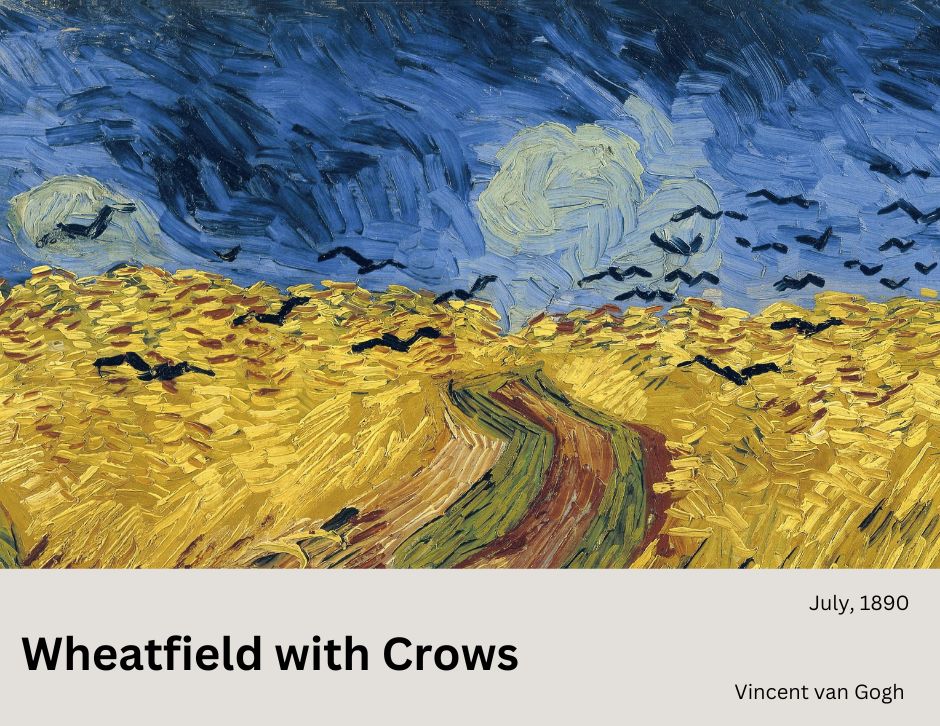
Wheatfield With Crows by Vincent van Gogh is a July 1890 artwork subjecting a wheat field crushed by a dark blue sky with crows flying in a flock above the landscape. The Post-Impressionist painting exhibits Van Gogh’s extreme sadness and loneliness, with paths reaching a dead-end.
General Information About Wheatfield With Crows Painting.
1. Artist’s Statement.
“Quite absorbed in the immense plain with wheat fields against the hills, boundless as a sea, delicates yellow, delicate soft green, the delicate violet of a dug-up and weeded piece of soil, checkered at regular intervals under a sky of delicate blue, white, pink, violet tones. I am in a mood of almost too much calmness, in the mood to pain this.”
Vincent wrote this in his letter to his mother and sister, explaining his two series of paintings, Wheatfield Under Thunderclouds and Wheatfield With Crows.
2. Subject Matter.
The painting Wheatfield With Crows showcases a dark blue sky crushed down, atopping a wheat field. An ochre-lined path separates the larger wheat field and reaches a dead end at the middle of the painting. Furthermore, above the landscape, crows fly in a flock.

3. Artist.
Vincent Van Gogh painted Wheatfield With Crows, a composition from the post-impressionist era. The artist believed that any painting has a hallmark of optimal use of color, perspective, and brushstrokes, which is more about expression. Vincent had a spontaneous painting technique in studies from nature and preferred the impasto Reaper.
The artist painted his first masterpiece in 1885, as he was long preoccupied with the idea of the canvas, which could launch his career artistically and commercially.

4. Date.
Vincent produced Wheatfield With Crows in mid-July of the year 1890.
5. Provenance.
A little history to this artwork is that during the closing weeks of Vincent’s life, which were absolute calm and utter despair, he produced this artwork along with one additional notable work. Many websites indicate this was his last work, but it is not, as he painted many more compositions after this. However, it fits into the category of the artworks he produced at the end of his life.
During mid-July, when the artist had two alternating states of mind, he produced two sets of paintings- Wheat Fields under a clouded sky, which is serene, and Crows over the Wheat Fields, which virtually shouts out the anguish the artist experienced.
6. Location.
The painting is on view in the Rijksmuseum Vincent Van Gogh, Amsterdam.
7. Technique and Medium.
Vincent painted the Wheatfield With Crows using medium oil on canvas with the post-impressionist style. In essence, he rotated his brush to create strokes that are short, feverish stabs filled with black slashes from crows. The swirling brushstrokes over the sky made the canvas look like a claustrophobic hell, which has no escape.
Now that we have general information about the composition: let us move towards the following section to understand the painting in-depth.
| Artist | Vincent Willem van Gogh |
| Date Painted | July 1890 |
| Medium | Oil on canvas |
| Period | Post-Impressionism |
| Genre | Landscape Design |
| Dimensions | 50.5 x 103 cm |
| Worth | Priceless, Not on sale |
| Where is it housed? | Rijksmuseum Vincent Van Gogh, Amsterdam |
In-Depth Description of Van Gogh’s Wheatfield With Crows.
About the Artist: Vincent van Gogh.
Vincent Van Gogh was the son of a parson who had faith in one fact- the only chance to achieve personal or social success is through becoming an artist. In the ten years, he developed a somewhat overwrought and awkward sketch to a master painting, whose style has never been copied or overpassed. Whether they be crucial artists like Monet, Degas, or Manet, they all produced their first masterpieces at a later age, but Vincent’s talent made sure to surpass this, making his first masterpiece in 1885.

His religious career ended abruptly in the summer of 1879, and when he was twenty-six, he neither had a degree, university qualification, or particular trade. During his solitude, he became motivated to become an artist, and once he made up his mind to do so, he continued making the best pictures regardless of financial insecurities and mental breakdowns. He once wrote,
“But I must continue on the path I have taken now; if I do nothing if I don’t study; if stop searching, then I am lost, in misery. That is how I see things, persevere; that is what I must do. But what is your final goal, you may ask? That goal is becoming more clear, it will take shape slowly but surely, as the scribble becomes a sketch and the sketch becomes a painting. As one works more seriously and embroiders on the initially vague idea, the thought at first volatile and transient-until it takes on a concrete form.”
To avoid repeating his birth and childhood details every time, I chose to give you a newer substance of information that I haven’t told you before in my previous articles about Vincent.
History and Background of the Artwork.
Let me take you to the period when Vincent moved to Auvers in May 1890. Now, one must understand that Auvers is a sleepy agricultural village with a slow-moving Oise river, with thatched roof houses sweeping the acres and acres of farm fields. And Vincent found it,
“profoundly beautiful… the real country, characteristic and picturesque.”
He lived in a local inn at a rent of three francs fifty per day with board. However, the room was dark and cramped with barely enough space for a bed, table, and chest of drawers. During this time, he used to see Dr. Paul Gachet, a 61-year-old widower. This stage of life brought him more work. He rose early in the morning and drank little, throwing himself completely on work. Vincent lived 70 days in Auvers, producing one painting a day.
At this time, Theo had a son with Johanna, and he named him Vincent, after his brother. And a similar time, he was penniless instead of all the hard work he did. When Vincent went to Paris to visit them, he knew that his financial welfare was a lethal blow, but his brother and Johanna always assured Vincent of the good. During the closing weeks of his life, around mid-July, he painted two compositions in a series, Wheatfield Under Thunderclouds and Wheatfield With Crows. Referring to his work, he wrote to Theo,
“vast fields of wheat under troubled skies, and I did not need to go out of my way to express sadness and extreme loneliness.”

Understanding Wheatfield With Crows’ Meaning.
The painting is a claustrophobic hell, expressing the sadness and extreme loneliness of the artist’s life. David Sweetman, a Van Gogh biographer, sees it as,
“the last cry of the haunted artist living out his anguish in pain. Here surely, Vincent, the angst-ridden father of the modern movement, of Fauvism, Expressionism, Abstract Expressionism, progenitor of any art in which the tortured personality of the artist is paramount of the work.”
Subject Matter Analysis of the Artwork.
The subject matter of the composition is a landscape of wheat fields with a stormy dark sky and crows flying over the horizon. There are three ways or roads, represented with brown colors, with one among them reaching a dead end at the middle of the painting.

The painting documents the darkest premonitions- pronouncing the conventional view of the artist’s life. Many critics have detected a sense of menace in the dark flying birds towards the foreground. If one looks closer, one might be able to see that the artwork represents three paths, out of which the dead end symbolizes Van Gogh’s feeling that he had nowhere to go and no way to escape the circumstances.
The composition is rich in darkness through its stormy sky, supplying a powerful contrast with a yellow wheat field. It is a re-creation of the memories of the artist of the north. In Letter 133, he compares himself with a bird in a cage and notes,
“But then the time comes when migratory birds fly away. A fit of melancholy- he’s got everything he needs, says the children who look after him- but the sky is brooding and stormy, and deep within, he is rebelling against his misfortune.”
Vincent adds,
“I am in a cage, I am in a cage, and I’ve got everything I need fools! I’ve got everything I could possibly want! Ah, dear God, freedom- to be a bird like the other birds.”
The crows in the form of black stack lines represent the personal symbol of danger. The composition articulates a sense of isolation and loneliness. In letter 133, Vincent writes,
“The bird that once longed to be released into the stormy skies is now having to struggle against the elements.”
One must understand that these arguments might be a myth, but the fact that Vincent showed a stormy sky with contrasts of yellow fields, braided with green borders to represent extreme sadness and loneliness, is indeed appropriate.
We have learned about painting quite well, but let me show the most crucial aspect of any composition, the formal analysis.
Learning Wheatfield With Crows Analysis.
1. Light and Value.
The painting is strongly darker. The landscape with wheat fields shows a higher contrast (yellow with brown) and value (light against shadow). The sky had a dark background with lighter accents through fields.
There is rich color saturation with lightness and darkness together.

2. Color.
The artwork features striking colors visually, showcasing the strong blues with yellow and browns with some green, a powerful combination. Vincent exaggerated the elements in the painting, which makes it seem unreal if one visits the actual site, but he always painted with his instincts and emotions, which are evident in this painting. Look at the stormy sky, which looks at his interpretation of the world in a different state of emotion. If you see The Starry Night’s sky, you will see an illuminance, but in this sky, a loop moves in a circular motion, which is claustrophobic. With black stack crows, the sky looks complete, and the contrast achieves an accomplished view.
3. Brushstrokes.
Van Gogh used blocky and linear brushwork with compulsive patterns and characters. In the sky, there are diagonal brushstrokes, which show instability and motion. On a similar end, the landscape, including fields and rails, shows diagonal dabs in different directions. And there are a few touches between the field and sky in brown color, showing horizontal brushwork.

Opinions and Conclusions.
The painting that Vincent produced had its own right. The art he portrayed with his state of mind consists of rich color, striking contrasts, and highly moving strokes as if the viewer is dabbed into the painting. The Wheatfield With Crows was one of his last compositions. Imaginative and imperishable, Vincent made something that will remain forever in our hearts.
Resources.
- Van Gogh. The Complete Paintings by Ingo F. Walther and Rainer Metzger.
- Van Gogh by Ingo F. Walther.
- Vincent Van Gogh, Paintings by Uitert Evert Van, Tilborgh Louis Van & Heugten Sjaar Van.
- Dear Theo: The Autobiography of Vincent Van Gogh by Irving Stone and Jean Stone.
- Featured Image: Wheatfield With Crows by Vincent van Gogh; Vincent van Gogh, Public domain, via Wikimedia Commons.
Frequently Asked Questions.
“Quite absorbed in the immense plain with wheat fields against the hills, boundless as a sea, delicates yellow, delicate soft green, the delicate violet of a dug-up and weeded piece of soil, checkered at regular intervals under a sky of delicate blue, white, pink, violet tones. I am in a mood of almost too much calmness, in the mood to paint this.”
Landscape design Post-Impressionist artwork.
Van Gogh’s Wheatfield with Crows measures 50.5 x 103 cm.
Vincent van Gogh painted Wheatfield with Crows a few hundred metres to the north of Notre-Dame-de-l’Assomption Catholic Church at Auvers-sur-Oise, by a small track known as Sente du Montier.
Vincent painted Wheatfield with Crows in the mid of July 1890.
Wheatfield with Crows currently resides in the collection of Rijksmuseum in Amsterdam and is not on sale, hence tagged priceless.
Wheatfield with Crows is a claustrophobic art piece representing the sadness and solitude of Vincent. David Sweetman, the biographer of Vincent van Gogh says, “the last cry of the haunted artist living out his anguish in pain. Here surely, Vincent, the angst-ridden father of the modern movement, of Fauvism, Expressionism, Abstract Expressionism, progenitor of any art in which the tortured personality of the artist is paramount of the work.”
Related Reads.


