
At first, it may seem like any ordinary but picturesque depiction of a cafe at night, only to allow the viewer to explore its depth and mirror the artist’s stance alongside his personal tremor that led him, or perhaps pushed him paint Cafe Terrace at Night. Vincent van Gogh was many things, a kind man, a linguist, a loving brother, a tricked-by-life artist who lost his sanity at one or more occasions but unlike others this didn’t paint an image of failure, instead, he became an artist whose work can never be copied or be fully understood as they carry such perfect imperfections, scenic landscapes, city views, or personally motivated portraits alongside an autobiographical origin that learning them through an article is never enough. However, contrary to my belief, I will detail today’s artwork, Café Terrace at Night through such a layout that it will only motivate you to visit Kröller-Müller Museum with information far more than other viewers and get absorbed by the mastery of Van Gogh.
Café Terrace at Night | Fast Knowledge
Café Terrace at Night is a Post-Impressionist artwork by Vincent Van Gogh, painted in 1888 and residing in the Rijksmuseum Kröller-Müller. The painting depicts a Cafe in Arles, now named after Van Gogh. It also exhibits Van Gogh’s exceptional color gradation and his exquisite selection of blue, violet, and green for the night.
General Information About the Artwork.
1. Artist Statement.
“I often think that the night is more alive and more richly coloured than the day.”
The painting is one of the first views Vincent painted after he went to Arles. He wrote about his composition,
“a view of the Cafe in the Place du Forum that we used to Go to, painted at Night.”
2. Subject Matter.
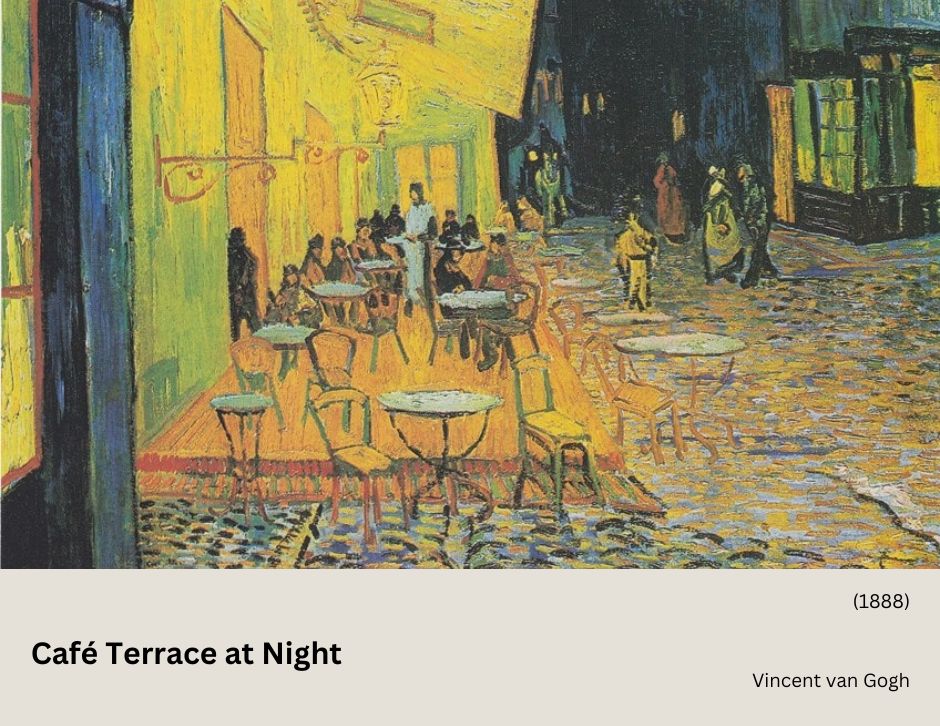
The subject matter of Café Terrace at Night is a yellow cafe with a bright sky strewn with stars, a few people sitting or strolling on the terrace in front of the cafe, and a cobbled street where the houses have yellow lights emitting from their windows. The motif that he wanted to achieve here was the gaslight that shone in the darkness from the outside wall of the cafe out over the square.
In fact, the composition is a meeting of familiar yellows and blues that has a vitality that was never achieved previously by Vincent. If you dissect the figures in general from this work, it is an embodiment of two colors with different light values. The loud yellow and subdued blue represent the areas of arresting brightness and a delicate semi-darkness, just as Vincent saw through his eyes.

3. Artist.
Vincent van Gogh painted Cafe Terrace at Night. In his words, he said,
“And my target for my life is to make as many and as many good paintings and drawings as I can and then when my life is over, I hope to depart looking back lovingly and wistfully and thinking: Oh, the pictures I might have made! Yet this surely does not prevent me from making what I possible.”
Surely, Vincent stood true to his words, making eleven hundred drawings and 900 paintings in just ten years. Vincent’s work as an artist remains ambivalent to a degree, knowing they are not yet fully recognised. The paintings of the artist are notable for their immediacy and sensual impact. There is no doubt that Vincent learned from his experiences, yet his life precluded him from taking a straight and simple course. He grew up in a century when people for the first time saw their existence as everything, with no transcendental support system- a century that produced many odd and even self-destructive characters.
4. Date.
Café Terrace at Night dates back to September 1888.
5. Provenance.
In February 1888, Vincent moved to the Arles, a town that made him remember the beautiful landscapes of Japan. Unlike in Paris, Vincent hardly ever sought company in Arles. He would prefer to paint the open country to the lanes and back streets of the old town. At best, he would stroll around the park by the Place Lamartine where he took rooms. Only once did he overcome his shyness and set up an easel right in the center of the town in the Place du Forum to paint The Cafe Terrace on the Place du Forum, Arles, at Night.
In the 1880s, gas was widely available to the provinces. Gaslight forfeited the atmosphere, but it lacked any romantic aspect that made the stars in the sky or candles in the windows. Since gaslight was artificial and representative of the glaring directness of the new. Since Vincent was aware of this fact, painting old and new meeting on the centre axis of the work. There is some kind of desolation in the way the uniform glare of the canopied area contests to the glittering area of the darkness. I will talk more points in the later sections of the article.
6. Location.
The painting resides in the Rijksmuseum Kroller-Muller, Otterlo.
7. Technique and Medium.
Cafe Terrace at Night is an oil on canvas painting from the Post-Impressionism period. Vincent painted swiftly, while establishing a likeness with a very few well-placed strokes, something that was ordinary for him. The paintings during this period didn’t have the traditional technique of virtuoso brushwork, or pointillism, or impressionism, which he used to use in his earlier artworks. In the summer 1888, (Letter 510), he states,
“My whole work is founded on the Japanese, so to speak… in its homeland Japanese art is in a state of decline, but it is putting down new roots in French Impressionism.”
However, he primarily thought of the Petit Boulevard painters like Bernard, Toulouse-Lautrec, and modesty himself.
Primitive and folk art are symbolic in the sense, as in the Japanese art. Here, Vincent used a strict distinction of line and color; lines express the constant, color the fleeting, with the total effect heavily relied upon the color to convey the impression. Hence, he used outlines to locate the motifs and regulate the flow of cover to keep it from becoming over-impetuous.
| Artist | Vincent Willem van Gogh |
| Date Painted | September 1888 |
| Catalog | F467, JH1580 |
| Medium | Oil on canvas |
| Period | Post-Impressionism |
| Genre | Cityscape |
| Dimensions | 81 x 65.5 cm |
| Worth | Not on sale |
| Where is it housed? | Rijksmuseum Kröller-Müller, Otterlo |
In-Depth Description of Cafe Terrace at Night.
About the Artist: Vincent van Gogh.
Vincent van Gogh was a Dutch Post-Impressionist painter who created 2100 artworks in his lifetime and became popular in Western art. The majority of his paintings consist of landscapes, still life, portraits, and self-portraits that had bold and dramatic color influence, a basis of modern art.
Born in a middle-class family in 1853, he was thoughtful and quiet during his childhood. His family lived a quiet life in the modest vicarage at the Zundert near Breda, in Dutch Brabant. Vincent’s father had been a pastor too. Though they were not strict Calvinists in belief, they were adherents of the Groninger party, a liberal branch of the Dutch Reformed Church. Vincent was deeply influenced by the hard-working and pious atmosphere of his parental home. He had five siblings- Anna Cornelia, Theo, Elisabetha Huberta, Willemina Jacoba, and Cornelis Vincent, of which he would keep his close relations with only two of them- Willemina and Theo.

He explained his days in his Zundert home,
“During my illness I saw every room in the Zundert house, every path, every plant in the garden, the surroundings, the fields, the neighbours, the graveyard, the church, out Kitche garden at the back- down to the magpie nest in a tall acacia in the graveyard.”
However, in the last years of his life, the longing for his childhood home never relaxed its grip on the artist’s mind.
The family had a respectable station in society, which was why Vincent felt constant pressure as he chose art as a career. In his due course, the resigned twenty-four-year-old wrote his brother Theo in Letter 98,
“When I consider the past- when I consider the future, all the well-nigh insuperable difficulties, the vast and arduous toil which I feel no taste for and which I, wicked I, would like to avoid, when I think of the eyes of so many people, gazing at me- people who will know what the reason was if I am unsuccessful, people who will not level the customary reproaches because, tried and tested in all things good and decent, in all that is refined gold, they will say by means of their expressions: We helped you, we were a light to you on your way- we did what we could for you; did you sincerely want it? What is our reward? Where is the fruit of our labour?”
History, Background, and the Meaning of Café Terrace at Night.
Van Gogh completed the Café Terrace at Night in 1888, and considering his brief introduction to a tragic life, one can see through his feelings in this artwork. I think learning about Van Gogh’s masterpieces shall remain incomplete without an introduction to his thoughts. And what’s better than being able to read his letter to his sister just before the painting was completed? The letter says,
“I was interrupted precisely by the work that a new painting of the outside of a café in the evening has been giving me these past few days. On the terrace, there are little figures of people drinking. A huge yellow lantern lights the terrace, the façade, and the pavement, and even projects light over the cobblestones of the street, which takes on a violet-pink tinge. The gables of the houses on a street that leads away under the blue sky studded with stars are dark blue or violet, with a green tree. Now there’s a painting of night without black. With nothing but beautiful blue, violet and green, and in these surroundings the lighted square is coloured pale sulphur and lemon green. I enormously enjoy painting on the spot at night. In the past, they used to draw and paint the picture from the drawing in the daytime. But I find that it suits me to paint the thing straightaway. It’s quite true that I may take a blue for a green in the dark, and a blue lilac for a pink lilac since you can’t make out the nature of the tone. But it’s the only way of getting away from the conventional black night with a poor, pallid and whitish light, while in fact, a mere candle by itself gives us the richest yellows and oranges.”
“You never told me if you had read Guy de Maupassant’s Bel-Ami, and what you now think of his talent in general. I say this because the beginning of Bel-Ami is precisely the description of a starry night in Paris, with the lighted cafés of the boulevard, and it’s something like the same subject that I’ve painted just now.”

Now that you have read his letter, it is appropriate that we head to the timeframe of the Cafe Terrace at Night. But before that, it is crucial to note that the time during which Van Gogh drew the painting was the period of Post-Impressionism. Notably, you must know that Paul Gauguin and Paul Cézanne belonged to the same era.
What Was Post-Impressionism?
Post-Impressionism was an art movement in France that developed roughly from 1886 to 1905. What do you need to know about its emergence? That it was a reaction to the Impressionist’s concern for the naturalistic depiction of colors. In simple words, it rejected the limitations of Impressionism, extending itself to vivid colors, using impasto (thick application of paint), inclined towards geometric shapes, and use of modified colors. But this is not everything the movement delivered since the Post-Impressionists were deeply dissatisfied with the extra emphasis on colors and loss of structure in the Impressionist paintings. Therefore, they used their methods to create better structures for their artworks. Vincent van Gogh often used vibrant colors and striking brushstrokes in his artworks.

When Did Van Gogh Paint Café Terrace at Night?
Moving forward, we will look at the timing of Cafe Terrace at Night to understand its provenance. It was the period when Vincent moved to Arles, a small city in France, in February 1888. He completed this masterpiece by the end of September of the same year, taking inspiration from a cafe, now renamed to Cafe Van Gogh. In Paris before Arles, Vincent dreamed of moving to the countryside, and now, since it reminded him of Japanese landscapes, he moved there. In September, when he rented a place, The Yellow House, the only way Vincent found to decorate was through his artworks. So, he received a small amount of money from his brother Theo to furnish it, and then he started painting on canvas for the sole purpose of decorating The Yellow House with his works. Besides Cafe Terrace at Night, he also painted Sunflowers for this aim.

It is vital to note that after he rented The Yellow House, he invited Paul Gauguin to be his roommate, but they eventually separated due to disputes after living together for a few months.
Subject Matter Analysis of the Artwork.
Being aware of the background, we are prepared to move on to the most awaited part, the subject matter analysis of the Van Gogh cafe.
As you see the painting, the first noticeable subject is the colorful outdoor view that calms the spectator, who enjoys self-company while looking at different people in the surroundings. From the perspective of the painting, it looks like Vincent was sitting at a distance witnessing this.
The yellow hues of the cafe contrast with the blue-black shades of the streets and the violent blue of the door in the foreground. Here, in the cafe, there are over ten tables and chairs arranged with several people with faded faces. It shows Vincent’s emotion of loneliness he felt during his stay. One can also see how few of these chairs are empty, emphasizing the emotional distance of Vincent from people during that time.

There is an effect of a heavy artificial yellow lantern with a soothing soft natural glow of stars, representing a juxtaposition. In addition to the yellow swirls of the stars, the color repeats itself with the cafe tables.


On either side, there are European buildings neglected by the green stems sprouting from their branches. At the center, a figure is standing, and another is walking into the building. Surrounding the buildings, there is a cobble-stoned street on which figures are walking in different directions. All of the windows of these structures emit yellow lights.

When you take a closer look at the composition, you will find that Vincent presents a classic example of his use of analogous forms. There are three parallel lines that leads from the left-hand side to the centre of the composition; the lowest is the lintel of the window frame at left, the reddish edge of the awning, and topmost is the gable of house, pointing into the blue infinity of the heaven. These lines are parallel, which means Vincent defied all the rules of perspective in this composition.
However, he deliberately sets out to flout the rules- only to establish new laws within the picture. Though the lines have function to display the edges, frames, or lintels, they convey a message. Further, they spin a self-referential graphic web over the canvas, attesting to the two-dimensionality of the painting.
Vincent deployed the components of his composition in an abstract and geometrical fashion, on a level which suggests the comparison with the impalpable indefinable realm of music. The motifs were there as themselves and he didn’t use them to showcase the reality.
Now that you have studied the subject matter and other elements thoroughly, let us move on to the next section.
Learning the Café Terrace at Night Analysis.
1. Line.
In the canvas, there are different forms of lines. For instance, for the boundaries of pillars, chairs, and windows, Vincent used strong darker lines to clearly distinguish the identity of each object. However, to represent the crowd sitting around the chair, the artist used indistinct contour lines in the form of fusing figures with their surrounding space. Upon closer examination, you will notice vertical lines that demonstrate Vincent’s perception of instability in the surroundings. These vertical lines are in the form of pillars, straight buildings, and window panels, which energize the composition.

2. Light and Value.
The effect of light shows the darker night to be merrier through the illuminance of windows, stars, and lanterns. Café Terrace at Night has a bright radiance that reflects light onto each figure and object. Further, the light has a comforting and natural view. There is a pronounced contrast and brightness in the painting.

3. Color Analysis.
In the painting, there is an expression of feelings and emotions, as if two lovers mix them with their distinct personalities in a marriage. Against a darker background, there are bright tones of colors, which makes the entire painting personal and expressive. If you look at a single glance, you will see that the colors are not realistic but they appear magical on the canvas because the artist had command of weaving different colors together without making it look overdone. It seems that he painted it through his emotions and how he saw the world. Few objects like stars are exaggerated with their appearances whereas distant people are recessed.
It essentially focuses on night effects. Even though the painting appears to be calming, it contains a hidden message that links loneliness and social distance. When you check the emptiness of the foreground space and the generalized facial expressions of people, it represents the tension and the observer’s perceived social distance.

Through the use of blue and yellow, Van Gogh expresses conflict and his detachment from other people. Furthermore, the artist portrays a positive and joyful mood through the well-lit yellow area of his artwork.
He explained his color usage on the Cafe Terrace at Night through these words,
“It’s quite true that I may take a blue for a green in the dark, a blue lilac for a pink lilac since you can’t make out the nature of the tone clearly.”
Now you must understand that there is a use of color gradation especially in the composition, which blends all the shades in a better form. Observe how the yellow light slowly turns green on the wall. At the top of the building, the green gradually turns blue. A weak blue leads to a rich sky blue. Hence, this way, Vincent gives a motion to our eyes to watch the painting through his color gradation.
4. Brushstrokes.
The brushwork of Vincent van Gogh is linear and blocky. It creates interesting patterns and characters on its own.

It is easy to notice how his brushwork follows the contours of his subjects. In the café ceiling, the artist used a diagonal brushwork pattern, the sky has a tile pattern, the walls have vertical lines, and the ground has horizontal dabs. The rest of his brushwork remains roughly the same regardless of the subject (he used linear brushwork for buildings and circular brushwork for skies).
Final Words.
For Vincent, painting was an aspiring condition of music, where he used rhythmic patterns of colors and shapes, constantly repeated, with subtle variations or syncopated breaks in the pattern to leave an impression. What he did in the Cafe Terrace at Night painting is that he deployed geometric motifs and used color zones to penetrate every essence of the subject. Of course, he added architecture, a time zone, and even the furniture to articulate the composition meticulously. I recommend you to read Van Gogh: The Complete Paintings by Ingo F. Walther and Rainer Metzger to delve into the artistry of the artist.
Resources.
- Van Gogh. The Complete Paintings by Ingo F. Walther and Rainer Metzger.
- Van Gogh by Ingo F. Walther.
- Vincent Van Gogh, Paintings by Uitert Evert Van, Tilborgh Louis Van & Heugten Sjaar Van.
- Dear Theo: The Autobiography of Vincent Van Gogh by Irving Stone and Jean Stone.
- Featured Image: Cafe Terrace at Night by Vincent van Gogh, Vincent van Gogh, Public Domain, via Wikimedia Commons.
Frequently Asked Questions.
The painting represents social isolation and loneliness despite its vivid colors. It is the juxtaposition of the two moods of Vincent- the left side represents his joy, whereas the right side represents his dark past and psychological disorders.
The artwork Cafe Terrace at Night is priceless. Vincent painted the artwork a year before he was admitted to a mental asylum in Saint-Rémy-de-Provence.
It displays post-impressionist art and cloisonne. Cloisonne is a post-impressionism art kind with a dark background and flat figures.
Post-impressionism style with a dark background with more emphasis on lines, shapes, and geometry are the elements of art used in the artwork. In some areas, Van Gogh uses thickened strokes of the brush.
Cafe Terrace at Night is kept at Kröller-Müller Museum in Otterlo, Netherlands.
Related Reads.


