
In 1874, a hostile critic went to the exhibition of some artists who didn’t have a name for their art movement. After he thrust upon them to choose their name, this group of artists formed a unified radical movement and named themselves The Impressionists. What they all had in common was that they all were in Paris in the 1860s, so they got to know each other, further meeting each other in cafes to connect. They then realized that they all shared a similar desire- to paint the landscape, cityscapes, and modern life in new ways. This is how Impressionism came to artistic life. The first Impressionist exhibition happened because no artist received great and regular success at the official Salon, whose juries were notoriously inconsistent and reactionary. Though this first exhibition did near to little challenge to the powerful Salon, it pushed their movement into the limelight. It became sensational after being supported by writers such as Baudelaire, and Zola, and hostile critics, resulting in some of the finest artists, such as Claude Monet, Edgar Degas, Pierre-Auguste Renoir, Alfred Sisley, and Édouard Manet, among others, dominating the new art movement. It is true that all of their paintings depicted reality with a stir of emotions and were important. However, one of the most famous paintings and the painting that gave the Impressionism movement its name is Monet’s Impression, Sunrise. Let’s learn more about the painting in this article!
Impression, Sunrise | Fast Knowledge
Impression, Sunrise is an 1872 oil on canvas painting by Claude Monet. The painting is crucial for suggesting the name of the French art movement Impressionism. Subjecting the industrial harbor of Le Havre, it is a spectacular capture of a moment with fog-hidden scenery and Monet’s tranquil work of colors. The painting now resides in Musée Marmottan Monet, Paris, France.
General Information About the Artwork.
1. Artist’s Statement.
“For me, the subject is of secondary importance: I want to convey what is alive between me and the subject.”
2. Subject Matter.
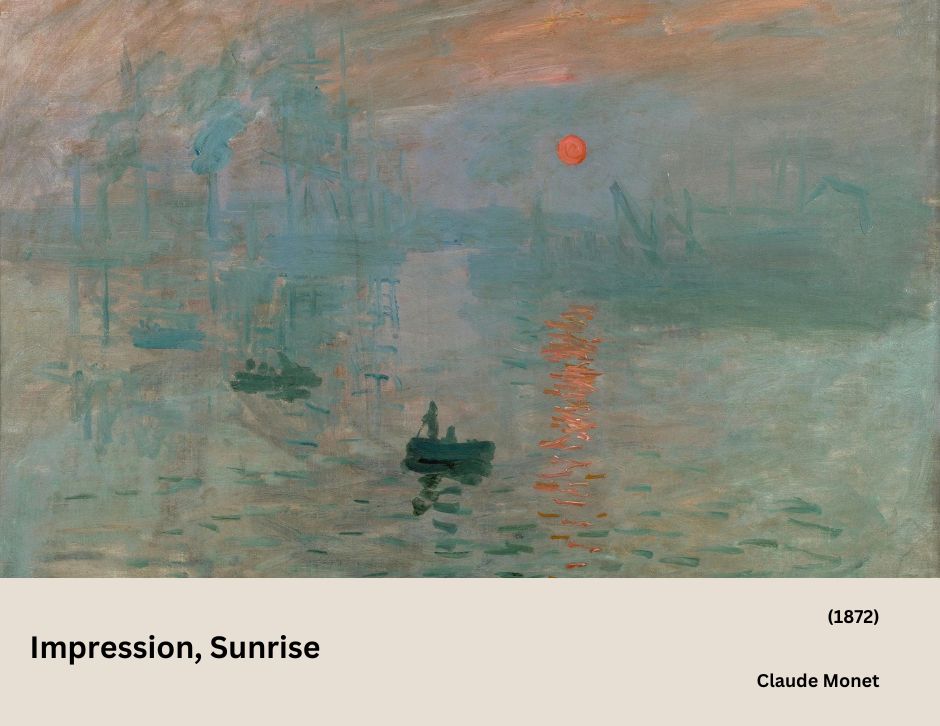
The painting Impression, Sunrise portrays a foggy atmospheric morning scene of the port of Le Havre. Showing a pure orange sun and distilled light reflection in water, the seascape painting doesn’t go with the rules of academic art. It shows the fusion of grey-bluish and orange colors to demonstrate the industrial harbor of Le Havre. One significant thing to understand is that this artwork is not typically Monet’s work though it does carry his usual style elements. It is because water, sky, and reflections merge into each other in this image where the horizon has disappeared. The orangish-red sun dominates the painting, and the buildings and ships in the background are only vague shapes. Monet expresses himself for Impression Sunrise,
“It really can’t pass as a view of Le Havre.”

3. Artist.
Claude Monet, one of the most significant artists of Impressionism, painted this artwork. In one of his letters from 1890, he wrote to Gustave Geffroy,
“… the more I go on, the more I see that a lot of work has to be done in order to render what I seek: ‘instantaneity,’ above all the envelope, the same light spreading everywhere and more than ever I am disgusted by easy things that come without effort.”

Studying painting mostly on his own through the efforts of nature, Monet began his formal training with the local landscapist Eugène Boudin on the emphasis of Gravier, the frame-maker for which Monet displayed his drawings. Monet thought Eugene’s landscapes to be
“horrible, used as I was to the false and arbitrary color and fantastic arrangements of the painters then in vogue.” However, Eugene eventually persuaded him to accompany him on a landscape expedition. To choose his career as an artist, Monet says, “I had seen what painting could be, simply by the example of this painter working with such independence at the art he loved. My destiny as a painter was decided.”
After a short training with Eugène, in the spring of 1859, by saving some money- income from the caricatures, Monet went to Paris in the spring of 1859, armed with letters of introduction from Boudin to several other artists like Troyon and Gautier. While learning and studying, Monet rejected the idea of training under many artists, and in this course of a long time, it was Johan Jongkind, who impressed him to the point that he considered him his master.
4. Date.
After a long controversial debate, it is finally known that Impression, Sunrise dates back to 1872.
5. Provenance.
A little provenance of the painting is that Impression, Sunrise was exhibited two years later than it was composed, on 15 April 1874, at the former studio of photographer Nadar. Surely, this artwork caused an outrage in the artistic world as one of the most vociferous critics, Louis Leroy, mocked this painting with its sketch-like style, flouting the rules of academic art. Then, on 25 April, one of the articles wrote,
“An impression, I’m sure. I thought to myself, this has made an impression on me, so there must be impressions somewhere in there […].”
It was in May 1874 when this artwork was purchased for 800 francs by Ernest Hoschede, and was resold four years later through a court auction of Ernest’s collection for the amount of 210 francs to Georges Bellio. Bequeathing this to his daughter, Victorine, and his son-in-law Eugène Donop de Monchy, the painting was finally gifted to the Musée Marmottan Monet in 1940. It is surprising to know that Impression, Sunrise, one of the most significant paintings of Claude Monet and Impressionism, would wait in shadows due to war, which is why art historians were uninformed of this masterpiece until the 1950s.
When it was loaned to Mulhouse Museum in 1959, this artwork was stolen but was miraculously rediscovered in an apartment in 1990. I will tell you its entire provenance in later sections of the article.
6. Location.
Impression, Sunrise is on exhibition at Musée Marmottan Monet, Paris, France.
7. Technique and Medium.
The artist used oil on canvas medium for the painting Impression, Sunrise. It is important to know that Monet restricted himself to show only the essentials, hence the image shows wonderful faded details as if it really appears foggy. It shows the momentarily visual impact to create an overall impression through the mere strokes of color with a smaller brushwork. Monet’s aim in this painting was to record an impression while one stares at a foggy atmospheric port and not to create an accurate landscape, which is why he give a blurry appearance through strokes and colors.
Typically, the technique used here is impressionist, which M. Louis Leroy explains well. In his view, impressionist art is entirely concerned with capturing the light and color of a fleeting moment, usually using brilliant colors in a series of strokes rather than blending them together. The painting proves the fact that optical impression and reality were indistinguishable from Monet’s artworks and that he claimed the same authenticity.
| Artist | Claude Monet |
| Year Painted | 1872 (Exhibited in 1874) |
| Genre | Landscape Painting |
| Period | Impressionism |
| Medium | Oil on canvas |
| Dimensions | 63 x 48 cm |
| Price | Not on sale |
| Where is it housed? | Musée Marmottan Monet, Paris, France |
Detailed Description of Claude Monet’s Impression, Sunrise.
About the Artist: Claude Monet.
For nearly seventy years, Monet executed many paintings, which tell his extensive oeuvre. These images weave a fabric as seamless as the late Water Lilies canvases. However, this continuity was always enriched with innovation and a stir of feeling, making Monet’s paintings look more alive. An objective analysis indicates that the early works of this precocious student of Boudin, which defined Impressionism in the 1860s, are distinct from the last paintings of the water garden in the 1920s that demonstrate his mastery of abstraction as a means of expressing themselves personally. I have given a brief of the beginning of the artist’s life in The Artist’s Garden at Giverny, which you can refer to for an extensive read.
For this section of the article, I am talking about Monet’s life in and after the 1860s. Before Monet moved to Giverny, he lived and worked at Le Havre, Sainte-Adresse, Argenteuil, Paris, Louveciennes, and Vétheuil, but no place impacted the artist as much as Giverny, where he settled in 1883 and died in 1926. When he lived in Giverny, he traveled extensively from Normandy to Riviera, to Rouen, London, and Venice in search of new and challenging subjects, yet his paintings like the Etretat canvases of the mid-eighties, Rouen cathedral facades of the nineties, and the Venetian scenes of 1911-12 often ended finished at his home. Plus the paintings from the artist that focus on the Garden at Giverny itself tell us that the artist found a home there.
Talking about the Salon and paintings of the artist, he enjoyed limited success by 1865 and gained some commissions to live a decent life. In the same year, he exhibited two of his landscapes at Salon and got a mixed reaction. For instance, one of the critics thought of him as “a young Realist who promised much” but another compared his images to the child’s scrawl. However, despite all the critics, Monet continuously used the engagement of light and color over the subject as if he was still under the influence of Boudin, Jongkind, Manet, and even Courbet. He showed no traces of realism in his artwork, instead used impressions, which held the painting together. His experience to include more people as a subject nearly died after the 1860s. For instance, his painting, Luncheon on the Grass, which was never completed showed a powerful integration of light effects and figures for which Forge says,
“monumentalize the language of a plein-air sketch.”

There is always too much to learn about artists but for now, let’s focus on the painting, Impression Sunrise for which we are here.
Historical Background of Impression, Sunrise.
As I previously told you in the introduction, the impressionists took forward an exhibition as they didn’t achieve success in their painting. In 1874, when they hoisted their exhibition, few critics gave their reaction. There was a universal outcry as the whole group of artists, including Renoir, Sisley, Edgar Degas, Gustave Caillebotte, and Monet, became the art world’s public enemies and their contemporaries found their art to be unfinished and sketchy. The art critic, Louis Leroy publicized the nouvelle peinture by presenting a sarcastic account of the show, labeling its participants “impressionists.” He wrote,
“They are Impressionists insofar as they reproduce, not a landscape, but the impression a landscape evokes.”
This term, Impressionists was because of the painting, Impression, Sunrise which Monet exhibited. Now, this first exhibition was not a very great success as it drew a mere 175 visitors first day and 57 on the last, most of them were present to poke fun at the art exhibition. However, in May of the same year, the painting was sold for 800 francs.
Talking about the years of the 1870s in which the Impression, Sunrise was composed, we saw that in January of 1874, the exhibition of Impressionism occurred for which Monet left for Le Hague. Towards the end of this exhibition, he again absented himself and went to Amsterdam. Now, many of the paintings that were in the course of the year 1872 were given the date of 1874, the likelier date as there is nothing that biographers could trace from Monet’s life during 1872. Hence we do not know under what conditions the artist painted Impression Sunrise.
Influence of the Painting.
The foremost question is what’s so special in Impression, Sunrise? I mean it can’t solely be important because it coined a new name to the art movement. Obviously, there’s more. It influenced greatly other artists when it came to landscape paintings.
The focus of the sketches of this image was to capture atmospheric effects and render an experience rather than just visualizing things through an eye. It is more about how we perceive certain things. Hence, Monet’s art was a recurrent point of reference. Emilie Mediz-Pelikan who gave an intensive study on French impressions and especially Monet was inspired by this, and occasionally she would come very close to the French master without even relinquishing her own signature style. One of the paintings, which shows a dramatic representation of color effects while dissolving water and sky into a tapestry through the use of broader brushstrokes is Sea in the Midday Heat. Another painting of her, Sunrise Over the Sea appears as a paraphrase of Monet’s painting. Of course, this image shows a clear inspiration from Impression, Sunrise. Many other artists sketched their sensations through an impression of colors, as Theodor von Hormann did. And it would not be possible if Impression, Sunrise didn’t exist.

Now that we know a little provenance of the painting, let us move to the subject matter of the painting.
Subject Matter and Dominant Elements.
In this famous picture, Monet used delicate strokes of thin paint to compose an impression of a foggy morning at the harbor of Le Havre. With a few succinct and audacious strokes, he used the orange reflections of sunlight to juxtapose with the greyish-blue surroundings. In this foreground, the artist painted ships’ masts and chimneys, hazed by the mist. These constitute simple shapes or look like a graphic fabric of verticals and diagonals, providing structure and vitality to the canvas. As he used loose brushstrokes to record perceptions of a single moment, his sketchy immediacy struck the public as scandalous and brutally coarse. The Impressionists were thereby at first ridiculed but the label stuck and within a few days of Le Charivari’s article, a disposed critic said,
“If their aims were to be described in a single word, we should need to coin the word Impressionists. they are Impressionists in that they do not reproduce a landscape but convey the impression it makes on the beholder.”

Understanding Impression, Sunrise Analysis.
1. Brushstrokes.
The artist used lighter but frequent strokes of color to paint this composition. However, he used impasto paint to highlight the bolder accents like the boats, sun, and its reflection. Monet used loose brushwork here in the composition but in a few places like the dark green boat at the center, he used larger and fewer brushstrokes but at the same time, he used a quicker and more aggressive brushstroke for sunrise reflection.
Lastly, for the sky, the artist used a downward curve as the brushstroke. So, the entire painting is a fusion of different kinds of brushwork to give an experience of the seascape.


2. Color, Light & Value.
Impression, Sunrise embodies the motif of reflections in water with a subdued coloration, conveying little luminosity here. The artist used a weak tone of colors notably grey, blue, and black with an exaggerated orangish-red color of sun, which dominates the seascape. Monet once explained his experiments of color in a few words after contemplating and studying the effects of colors and light,
“… One day, finding myself at the deathbed of the woman who had been and was still very dear to me, I caught myself, with my eyes focused on her tragic temples, in the act of automatically searching for the succession, the arrangement of colored gradations that death was imposing on her motionless face. Blue, yellow, grey tones, who knows what else? That was the point I had reached. Nothing is more natural than the urge to record one last image of a person departing this life. But even before I had the idea of recording those features to which I was so profoundly attached, my organism was already reacting to the color sensations, and, in spite of myself, I was being involved by my reflexes in an unconscious process in which I was resuming ‘the course of my daily life”
The painting shows darker hues but it is well dominated by the orangish red color. Only this contrasting color takes the artwork out of its dimmer theme. There is the exact same value, which means Monet didn’t use a contrast, saturation, or hue contrast.

Final Words.
The Impressionist movement is not perceived today as a revolution or an individual artist’s achievement, but rather as a further development of ideas, techniques, and observations that recurred throughout the first half of the 19th century, although Monet and his fellows applied it with radical rigor. Besides, the word Impressions makes sense as it just narrates a momentarily visual impact, which is made by any landscape or other motif of a millisecond. The painting, Impression Sunrise is that single impression for the first gaze of the morning of a port. Monet painted a visual freshness in the first fleeting moment of a seascape, which is free of any opinions or traditional percept. When Monet first opened his eyes, he might have seen a few color blocks, and in that instant nothing was crystal clear, it was just an impression.
Frequently Asked Questions.
The painting, Impression, Sunrise depicts a momentary impression of a seascape. Monet composed this image to portray a blend of water and sky reflection with no horizon and with a few shapes of ships and boats fading away in the foreground. There is a dominance of the orangish-red sun and its reflection in this painting.
The painting is priceless and is not for sale today. Currently, on the exhibition at Musée Marmottan Monet, Paris, France, the Impression Sunrise painting was first sold for 800 francs to Ernest Hoschede.
Claude Monet, one of the finest artists of French Impressionism, painted Impression, Sunrise. This painting coined the term Impressionism.
Resources.
- Monet. The Triumph of Impressionism by Daniel Wildenstein.
- The Impressionists Handbook: The Great Works and the World That Inspired Them by Robert Katz and Dars Celestine.
- Essential Monet by Vanessa Potts.
- Featured Image: Impression, Sunrise by Claude Monet, Claude Monet, Public domain, via Wikimedia Commons
Related Reads.


