
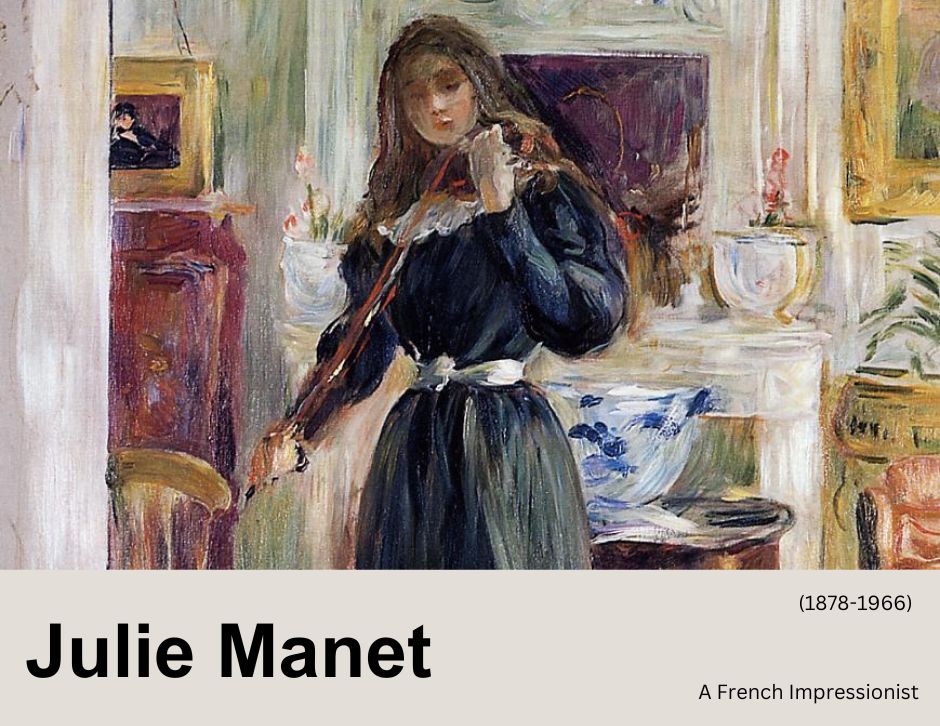
After a wrecking day of my screen-tired eyes, when I finally give my evening time to my flabergasting garden and walk towards the woods, my eyes vividly open up as they absorb the colors of the landscaping beauty. It is so mind-reviving to see how the green trees and the dark branches play different roles in contrasting the colors with the sky and earthly warm tones. Although it is not new for me to experience the disappearance of eye strain, tiredness, and drained brain energy every time I surround myself with nature, this time, I reflected upon how the only thing quite comparable with them is the exquisite choice of Post-Impressionist colors. And maybe this is the reason I love every single Impressionist artist. However, I am really disappointed with the fact that very few people know about these creative beings despite their spectacular command of color, their invention of a beautiful style, and their contribution to craftsmanship. Following the urgency to change this and introduce you to one such forgotten yet significant painter, I brought Julie Manet from the Galleries and Documents of France.
Julie Manet | Fast Knowledge
Julie Manet, the daughter of Eugène Manet and Berthe Morisot, was a French Impressionist who subjected figures in natural postures and modesty and depicted Renoir’s influence. Troubled by the early death of her parents, she is also crucial for her diary account narrating her mother’s life.
Artist Abstract: Who Was Julie Manet?
Julie Manet, born in Paris on 14 November 1878, was a famous Impressionist artist. Being a part of a wealthy and cultured milieu, she had a very conventional childhood and was loved and cherished by adoring and artistic parents and relatives. Whatever we know today about the artist is all because of her rough scribbled diary, where she recorded memoirs of her life. There is mention of countless summers spent exploring fascinating places and Parisian winters crammed with attending exhibitions and concerts.

| Name | Julie Manet |
| Birth | 14 November 1878, Paris |
| Died | 1966 |
| Nationality | French |
| Style | Impressionism |
| Genre | Portraiture |
Life of the Artist.
The only child of painter Berthe Morisot and Eugène Manet, Julie had an idyllic childhood, spending her summers in Bougival, where in 1881, she lived in the Villa at Four rue de la Princesse with her parents. She used to sit at the big table with adults and eminent grown-ups, which made her train to look into things from an early age. Her mother would take her on trips abroad and encourage her to visit museums and cultural places. When she was eight, she visited Italy, Belgium, and the Netherlands with her parents. In 1890, Eugène’s health started to decline, and by 1892, when he passed away, Julie was immensely affected by it.

As her father died, her mother went grief-stricken and never recovered fully from the loss. Naturally, Julie became close to her mother after her father’s death and became her constant companion. And she recorded a loving detail about her mother in her diary. However, after some time, Berthe’s health was diminishing and became fragile. Following this, she created Stéphane Mallarmé as Julie’s guardian if any misfortune fell upon her. In 1895, Berthe died, which made Julie an orphan and shook her from the inside.
After the troubling instances, her future appeared uncertain, and she lived with her cousins Paule and Jeannie Gobillard. Julie remained devoted to her art and painting, and her only desire was to become an artist just like her mother and most of her surrounding friends. Julie’s art was commercial and charming, depicting the influence of Renoir in her works.

Now, one must know that, unlike Berthe, Julie was not all consumed by artistic activity, as she was a spectacular wife, mother, and grandmother.

There is one of her diary entries from 30 August, which tells her painting activity during her teenage,
“We spent the morning painting in the forest near the place where we were yesterday. After lunch, we went by carriage to fetch Monsieur, Madame and Mademoiselle Mallarme. Mamar Monsieur and Madame Mallarme took the big carriage, and I went with Mademoiselle Genevieve in her trap. She has hired a quite good-tempered horse for a month as of yesterday.”

Throughout her life, from her diary, we know that she was the most cherished one with a great bond with her cousins and paintings. At the end of 1899, she stopped writing diary, probably because she engaged with Ernest Rouart.
Further, just after marriage, she and her husband made their way to Saint Valery en Caux in Normandy, a small fishing port and popular seaside resort. After their honeymoon, they returned to their professions of pursuing art. The couple lived in the fourth-floor apartment at the rue de Villejust. After a short period, they undertook a restoration and redecoration of Chateau du Mesnil and painted murals. During this time, Julie had three children- Julien, Clemnt, and Denis.

Julie Manet and her husband organized many crucial exhibitions, such as Manet at the Tuileries in 1932, Degas exhibition in 1937, and Berthe Morisot’s show of 1941.
If we go on learning about the nature of Julie, she was a kind, quiet, and serious woman who talked about art and literature, while spending her end days retrospecting herself on life as a fervent Catholic.
Looking at the Paintings of the Last Manet.
In one of the artworks, Jeune fille au chapeau, Julie portrayed a young lady with a cowboy hat using her warm colors and hatching. A closer look at the picture reveals a blurry face, but through her position and expressions, it appears that the subject is looking at the viewer. Although the starter’s eye is comforted by the warmer color choices, the color palette of this canvas does not include bright colors and the chiaroscuro technique.

Another painting, Portrait of Jeanne Gobillard, seated three-quarter length at a table with a cup and saucer, showcases a similar kind of color palette with the dominant colors red and blush pink. The lady gazes at the cup of coffee while stirring with a spoon. It seems that Julie painted her subjects with the utmost natural positions and modesty.

In the painting Jeanne Baudot in the Salon, Rue de Villejust, Paris, a young girl lies with her hand on the ottoman and another on her lap, giving a model pose with her eyes sideways. The usual color palette of the artist is the shade white with comparatively darker contrast through the sofa. Julie painted with shades while keeping them somewhat in similar harmony by differentiating the hues.

Some other artworks by Julie Manet are The Study of a Woman Sitting in the Garden and Two Studies of Heads, and Self Portrait With Larte The Dog.
Final Words.
The life of Julie Manet was awe-inspiring as she faced every personal loss, and painted without any restrictions on her canvas. With her ample notes, we know the culture of France through her eyes, her beloved famous mother Berthe, and her mesmerizing journey to be an artist.
Resources.
- Growing Up with the Impressionists: The Diary of Julie Manet by Rosalind Debolande Roberts and Jane Roberts.
- Featured Image: Julie Playing a Violin, 1893 by Berthe Morisot; Berthe Morisot, Public domain, via Wikimedia Commons.
Frequently Asked Questions.
Pierre-Auguste Renoir painted Julie Manet With Cat subjecting young Julie with a relaxed expression as she sits and gently holds the cat.
Julie Manet was the daughter of Berthe Morisot and Eugène Manet, both impressionists and crucial artists who enjoyed the circle of crucial artists like Claude Monet and Pierre-Auguste Renoir.
Julie Manet, daughter of Berthe Morisot and Eugène Manet, was a French Impressionist who took influences from Renoir and painted subjects with natural positions and modesty.
Related Reads.


