
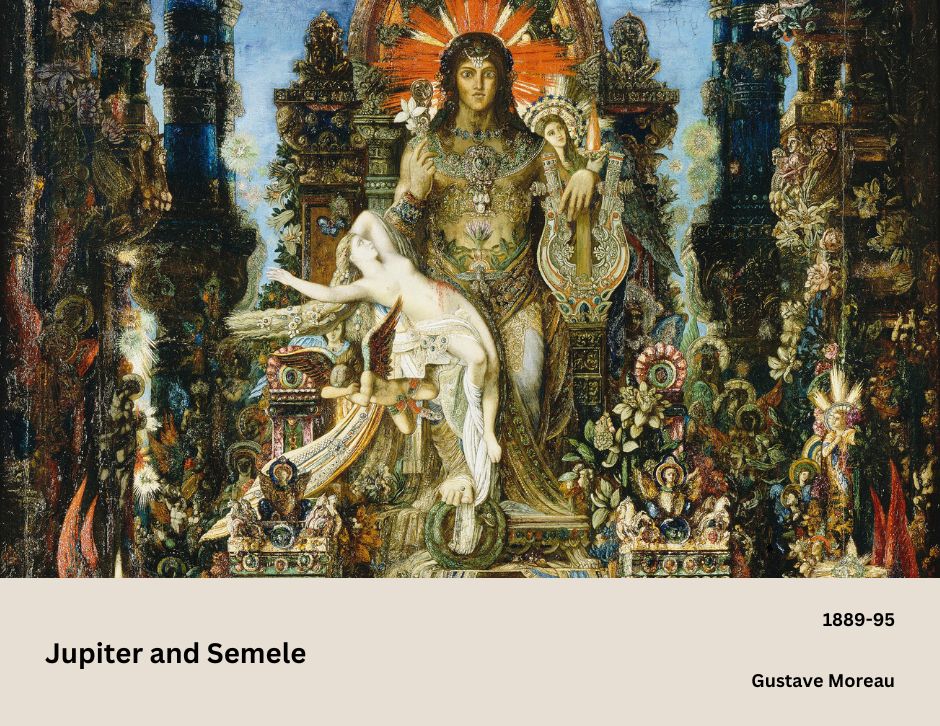
Anxious, uneasy, and sensitive, he was someone who changed the entire landscape of French art. Forced to confront the contradiction between his need to create art alone and his desire to communicate his unique vision to others, Moreau was truly, as Hysman puts it, “a hermit who locked up in the heart of Paris.” The artist’s paintings are somewhat in the middle of opposing the contemporary trends of academic naturalism and Impressionism while accepting innovative symbolism and surrealism. There are ample paintings and sketches which we can refer to know the artist’s method of research, one of which is that he was always motivated by a larger conceptual intention: to use color, drawing, and gestures in the service of dreams and ideals. To understand these facts more clearly, today, I am introducing you to one of his most impressive artworks, Jupiter and Semele.
The Beginnings.
Before I tell you anything about the artwork, let me first give you a brief about the artist himself. Beginning his journey as a gifted painter, Moreau ultimately co-opted the fierce colors of Romantic artists like Delacroix and Theodore. Through his paintings, he started a strange, late nineteenth-century movement whose symbolism offered an antidote to the harsh realities of the industrial world. In all his canvases, there are several creatures of fantasy, myth, and nightmare, heroes and villain queens, yet several of them show his fabulous world with the themes of the fin de siecle. He invented Fauvism and trained Matisse, Rouault, Marquet, and Manguin. At the same time, it should be noted that many Surrealists acknowledged his mastery.
One of the significant lines from his notebook says,
“No one could have less faith in the absolute and definitive importance of the work created by man, because I believe that this world is nothing but a dream; but living with the masterpieces of the dead, masterpieces that have been carefully selected, I live with what has resembled more closely the divine and immortal than anything else on earth.”
Moreau laid his soul over the respect and admiration for the old masters, especially Leonardo da Vinci. His basic inspiration always remained in the depiction of the highest spheres of human thought in an endeavor to communicate in his own way, which further made his compositions a work of genius.
Interesting Fact
The first-floor apartment of the house at 14, Rue de La Rochefoucauld, furnished by Moreau, made it possible to penetrate the artist’s private quarters. One of the highlights of the dining room of this space is Moreau’s late masterpiece, Jupiter and Semele.
A Little Background.
A few years before his death, when Moreau talked about this composition, he told his friend Rupp, ‘I think after all that I have made some progress.’ The remark was humble and modest as it came from a member and teacher at École des Beaux-Arts who was widely regarded as a leader of contemporary painting.
In 1889, Moreau began to paint his final magisterial painting, Jupiter and Semele, which was later sold to Leopold Goldsmith in 1895 after repeated corrections and reworkings. At first, the artist sketched the preparatory drawings, which made it possible to identify some of the medieval motifs that the artist obscured with the subsequent layers of paint. I will give a few examples of this in the later sections of the article.

If I talk about his private life at this time, his friend Henri Rupp, who was one of his students when he was young, went to live with Moreau so that he could look after his daily needs. Now, the artist was really fond of him, so he treated him with unreserved confidence. In fact, he discussed everything connected with the paintings with him. Furthermore, Rupp’s presence made it possible for the artist to turn his ideas into practical shapes. It was during this period that the artist painted this composition alongside others, like the Triumph of Alexander and Orestes and the Erinyes.


Moreau would work day and night in his parents’ home in the Rue de la Rouchefoucauld, which was full of memories. At the bedside table, he kept his sketch pad where he would note down a few words or strokes of ideas when he could not sleep. The next day, he would show Rupp a sketch, which he had done during the night, and tell him excitedly, ‘Go and prepare two large palettes for me. I can’t wait to make this into a painting.’ The artist would then work the entire day with the same energy, often stopping for a moment for his meals. One of his friends, Ary Renan, exclaimed after seeing his painting, ‘The supernatural aspect of the work makes it a unique example of plastic art.’ The painting was perfect for the artist as he had never rendered the promptings of his imagination with such richness and brilliance.
Did you know?
When Moreau died on April 18, 1898, he wrote in his will: ‘I bequeath my house, situated 14 Rue La Rochefoucauld, with all its contents: paintings, drawings, cartoons, etc., the work of fifty years, as well as everything contained in the rooms of the said house, which was formerly occupied by my father and mother, to the state, or in its default, to the Institut [Academie des Beaux-Arts], on one condition- this is my dearest wish- to keep this collection together, forever or as long as possible, as a perpetual record of the amount of work and effort accomplished by the artist in his life.’
What Does Jupiter and Semele Show?
Jupiter and Semele subjects the king of the gods and one of his mortal loves. The mythological scene depicts Jupiter’s jealous wife, Juna, who persuades Semele to ask the god to show himself in his full splendor. Jupiter knew that if he did it, the vision would destroy any mortal, but he was bound by an oath to grant Semele’s request. Despite Semele dying in this myth, Jupiter saved their unborn son, Bacchus, who was hiding in his thighs till the time of his birth. In the eyes of the artist, this was a union that was a sacred marriage between Semele and Jupiter. For him, the union was divinized physical love, and the radiance of this love consumed Semele while Jupiter appeared in his supreme beauty. He commented,
“It is an ascension towards the upper spheres, refined, purified beings rising towards the divine.”
When Moreau composed an oil sketch of this composition in 1889, he portrayed Jupiter enthroned, Semele on his lap, and Bacchus flying away from her. Then, he worked on this oil sketch, placing areas of color, light, and shade while exploring compositional possibilities and experimenting with each figure’s position. The entire picture has an amalgamation of energy, fluidity, and brilliant color, which the artist achieved through several sketches. It must be noted that in the early stages of the painting, Moreau elaborated the theme by adding figures, and with each addition, the composition consisted traditional meaning of the subject. For instance, in one sketch, he portrayed a figure to the left of the eagle at the bottom, and Bacchus is shown flying away. These changes were in fact, a personal statement, and the myth solely served as a starting point for the expression of the artist’s ideas on the canvas.
As the artist expanded this composition by increasing its width, he added more figures and components to give a valuable relationship with the subject. At the bottom, he added a group of figures to support sumptuous minutiae in the picture and make it more symbolic and synthetic in character. Ragnar von Holten described this painting as ‘an allegory of regeneration by death’ as Moreau himself wrote,
“Semele, penetrated by the divine effluence, regenerated and purified by this consecration, dies struck by lighting and with her dies the genius of terrestrial love, the genius with the goat hooves.”
The artist wrote the following explanation of the painting,
“The god, who has so often been invoked, is manifest in his still veiled glory surrounded by the colossal forms of ancient architecture, with neither bases nor roofs, covered with sacred plants, which quiver with life as they stand against the dark blue of the starry vault and the desert regions of the heavens. Semele, penetrated by the divine effluence, regenerated and purified by this consecration, dies struck by lightning, and with her dies the genius of terrestrial love, the genius with the goat hooves. Everything is transformed, purified, and idealized by the incantation and sacred exorcism. It is the beginning of immortality, the divine is diffused over everything, and all beings, still shapeless and embryonic, yearn for the true light. Satyrs, fauns, dryads, hamadryads, the dwellers of the waters and forests, are all affected, wild with joy, enthusiasm, and love; they free themselves from their terrestrial slime, ascend to the summits and, as they rise and rise, assume the forms of higher genii, sacred genii with outstretched wings. Two ephebes stand in the attitude of officiants on either side of the throne in adoration before the god. At the foot of the throne, death and sorrow from the tragic base of life and, not far from them, beneath the outspread wings of Jupiter’s eagle, is the great Pan, a symbol of the earth, bowing his head in sorrow at the thought of slavery and exile, while at his feet are heaped the somber phalanx of the monsters of Erebus and death, unformed beings who have not yet attained the life of light, beings of shadow and mystery, indecipherable enigmas of darkness. The silent, fateful moon, Hecate with her oblique, distraught glances, griffins, lemurs, blood hydras, monsters of hybrid form and fateful night divinities sleep in the depths of the gulf and in abysses of shadow. The great two sphinxes, which are past and the future, the guardians of this fearful herd from Erebus and the celestial solitudes, gaze at each other, smiling, in hieratic immobility. It is an ascension towards the upper spheres, refined, purified beings rising towards the divine… Death on earth and apotheosis in immortality. The great mystery is accomplished, all nature is penetrated by the ideal and the divine. It is a hymn to the divinity.”
He further added,
“Atoms and particles of Christianity appear in this composition. The death of the senses, the destruction of physical beings before the soul can enter immortal life, and the joyfulness of beings at the sight of the divine light and their encounter with the divine ideal- all this bears the stamp of Christianity. The essence of paganism is vitiated by the inversion and distortion of its symbolis.”
Inspiration Behind Jupiter and Semele.
Moreau took the inspiration from the 1660 edition of Ovid’s Metamorphoses; The Tale of Semele, who was the granddaughter of Agenor and daughter of Hermione and Cadmus, the founder of Thebes- is told in the third fable of the book entitled ‘De Semele brulee par le foudre, & de Bacchus enferme dans la cuisse de Jupiter’ (Of Semele burned by lightening, and of Bacchus enclosed within the thigh of Jupiter). The book originally insisted that it was only concerned with nature and the civilized role of the vine represented as Bacchus. However, Moreau transformed it into a picture of divinity without even bothering to actually depict Bacchus’s eventual birth.
Now, Moreau established a powerful contrast within the painting through the depiction of the fragile figure of Semele and the muscular and colossal god, whose figure is inspired by the Christ of Michelangelo’s Last Judgement. When we see the depiction of Jupiter, Moreau opted to portray her through the poetic idea of Poictevin, describing the spring of 1888. Then, he took inspiration from the Trinity panel of Jean Bellegambe’s Polytych of Anchin, a reproduction of which he sketched in the Second Empire. Here, Jupiter was portrayed enthroned, holding a scepter in his right hand: a small bronze that decorated the artist’s mantelpiece, an ancient fresco that he copied in Baples, Ingres’s Jupiter and Thetis, and an Apollo with his lyre in one of Flaxman’s engravings.

At the back of Jupiter’s shoulder, there is a face, which has ideal pensive beauty and superiority. The artist used the fixity of the Indian god to give a spiritual resonance to it. At the bottom, Moreau added several small drawings that extend the original subject. This includes evocations of the realm of Erebus (a kind of Greek mythological Purgatory that was described by Hesiod), a semi-circular design below Pan that was inspired by the Zodiac rendering in one of the Flaxman’s engravings and others.
Did you know?
Jupiter and Semele owe certain figural motifs to Michelangelo, with its principal organization similar to that of the Sistine Ceiling, where the figures are placed and activated on the basis of varying degrees of knowledge of divinity.
Symbolism and Iconography
If I talk about the iconography of the subject matter, a young poet, Francis Poictevin, left a remark on Jupiter in this composition. He said that it looked ‘brown like a rajah.’ Similar to this, Robert de Montesquiou remarked that ‘the appearance of this painting, harmonious in its flickerings, is that of a teeming kakemono.’ Hence, this way the composition shows a fusion of Indian and Japanese traditions in the figure alongside the Western motifs.
Having complex symbolism, the painting shows Jupiter as a large and youthful hero to give a universal idea that is similar to human intelligence, an attribute that permits a human to attain the ideal. Thereby, there is a unification of the diversity with the god. Two of the most important elements that give a unification of male and female are the lotus present on Jupiter’s chest, which is a traditional Indian symbol of the female principle in the universe, and a lingam accompanied by its attribute, the eagle, representing the Hindu male principle. Lastly, the Egyptian symbol of the godhead on Jupiter with his foot resting on a snake biting its own tail is a symbol of eternity.
Semele represents sensual temptation, and Moreau believed that a man must rise above his senses to achieve a divine state of spiritual understanding. Hence, the blood dripping from her side displays inevitable death. Bacchus, who is the child of Jupiter and Semele, is able to escape his mother’s fate because he combines her sensuality and humanity with Jupiter’s ideality. He represents a man’s condition: a constant conflict between idealistic and spiritual thoughts with the physical and sensual temptations.
In the composition, Jupiter occupies the upper portion of the picture, while the figure seated directly below the eagle is Pan, the famous divinity on the earth. The two figures beside the Pan are death and suffering. These three figures- Pan, Death, and Suffering stand for the reality of earth and human life, while the monsters below them represent evil.
Final Words.
Jupiter and Semele is profoundly tempting as it regards the artist’s pictorial and spiritual testament. Instead of just portraying a mythological scene, it represents divinity in terms of the traditional theological tripartite composition of father, son, and the holy spirit. The pictorial inspiration has a hierarchical scale, symmetry, balance, and precise decoration that has its lineage from the Early Renaissance. The composition represents a transformation, the transformation of Semele, who, by her vision of the eternal, died in ecstasy, the divine love that killed the earthly love. There is an evil, melancholy, and petrified world below, but a human has to rise above all, and only divine love can do so, as Moreau greatly displays in this composition.
Featured Image: Jupiter and Semele by Gustave Moreau; Gustave Moreau, Public domain, via Wikimedia Commons.
Related Reads.


