
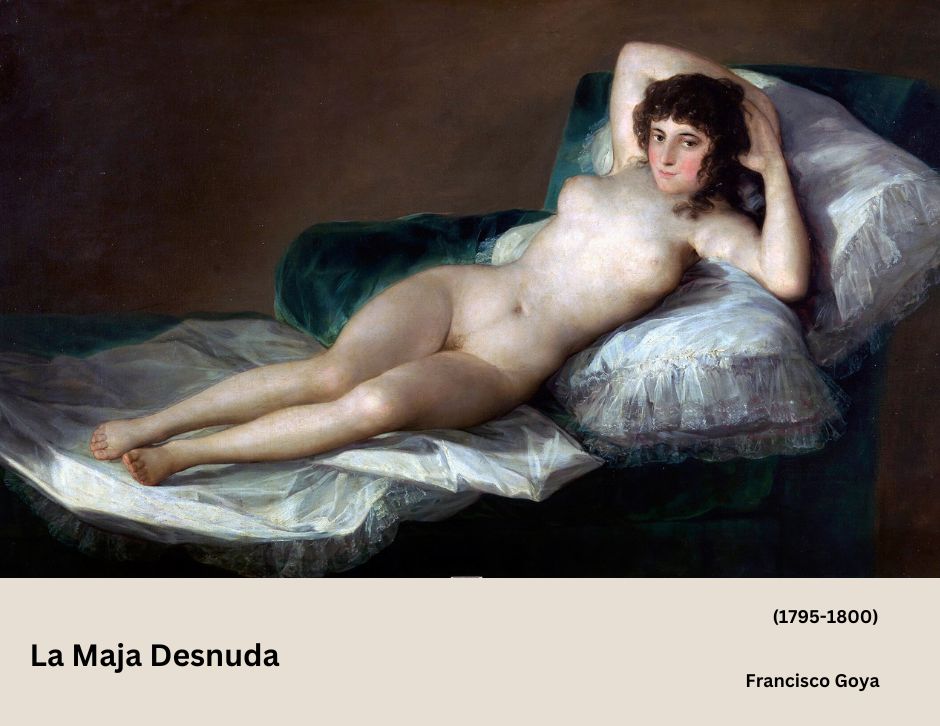
In the contemporary art of the Neoclassicists, one of the artists whose compositions stands in complete contrast to David, Blake, Fuseli, and Runge while originating in the late Baroque tradition is Francisco Jose de Goya y Lucientes. Many of us know the artist due to the demonic element he used in his dark paintings, not because he opposed morality or had a spectral vision but because of what he saw in men’s faces in the terrors of war. Taking the themes from Tiepolo and Velázquez, Goya added a supple freedom of the brushwork and vivid use of color in his paintings, which had dynamism and a dramatic portrayal of Baroque. Besides, the artist doesn’t always present this dark portrayal of the subject, as there was a period before 1800 when he created many plates to satirize society. These cast ridicule the indefensible prejudices that came from a vicious upbringing, the snobbery of caste, the frivolousness of the upper castes, society outlaws, the hostile atmosphere where men struggle for power, the trickery of charlatans, avarice, the ignorance of doctors, musicians, and painters, the repellent aspect of some people, the suffering of the ordinary people and most importantly the vices and ruses of the clergy. It is interesting to note how Goya was completely against the clergy as he literally criticized their self-indulgent life. A part of portraying this series was that Goya took inspiration from his obsession with the women in all their frivolity and responsibility to bear social evils. Hence, he showed every aspect of the role that eroticism plays in human society, from a pure animal instinct to a violent and passionate love, while including women as a temptress or a being of dalliance and lust. While he saw women as the cause of men’s downfall due to their arousing nature, Goya painted them with immodest full bosoms, narrow waists, and shapely legs to illustrate the conception of the ‘eternal feminine,’ but very differently. Among these depictions of women, one of the most outstanding compositions remains La Maja Desnuda or The Naked Maja from his gallery.
La Maja Desnuda | Fast Knowledge
The Naked Maja or La Maja Desnuda is an oil on canvas painting by the renowned Spanish artist Francisco Jose de Goya y Lucientes. Depicting a reclining naked lady on soft seating, the painting enthralls the viewer with the seductive gaze of the subject, hiding many secrets of the time.
General Information About The Naked Maja.
1. Artist Statement.
“Fantasy, abandoned by reason, produces impossible monsters; united with it, she is the mother of the arts and the origin of marvels.”
2. Subject Matter.
Francisco Goya portrayed a naked lady in the possible posture of Venus reclining as a generic attribute of female beauty. With curly hair, smoothly rounded thighs, and heavy and almost implausibly perky breasts, the lady looks to the viewer with her seductress gaze. One of the peculiar features of The Naked Maja is that the head of the subject doesn’t fit well on her body, causing an awkwardness in the drawing, though Goya had a superbly fluent hand. It might be someone else’s head, and there is a hypothesis behind it, which I will tell you in the later sections of the article.
The subject’s beauty is that she is not a sweet little thing; instead, she has a passive and receptive appeal to the male fantasy.
Licht describes the subject,
“Goya’s Maja’s is the perfect prototype of a peculiarly modern woman who, more than a century later, will be represented by the protagonist of The Blue Angel… Goya divorces sexuality from love.”

3. Artist.
Francisco Goya is truly a great artist who not only created a world of his own in his paintings through creative urge but also used his instincts, intuitions, and passions to move humanity. Depending on his talent, creative ability, fantasy, and imagination, he formed compositions, which interconnected with his soul and mind. Goya’s private world can be best seen in his etchings. From the beginning to the triumphs of his last and mature period, he added meaning and message in his works, which further measures his own genius.
What made his paintings richer was his reflection of his inner life, which combined with his acute observations of the outside world to give shape to his subjective impressions. Not only did his works mirror the social scene and events of the time, but there was a longing for a better world and the very nature of man in them. He shows men with all his failings and his vices and reveals his subjection to the formless world of dreams. His work declares his own moral and social reactions to the world around him with a daring exploration of the human mind recesses with its vision and its monsters.
4. Date.
Though not confirmed, La Maja Desnuda might have been composed by the artist between 1795 – 1800.
5. Provenance.
The first mention of the composition is from November 1800 in the Godoy’s palace description by the engraver Pedro González de Sepúlveda when he made a visit to it with Juan Agustín Ceán Bermúdez and the architect Pedro de Arnal. The Naked Maja was hung in an interior cabinet with other Venuses for which Pedro noted in his diary,
“A naked Venus by Goya but without drawing and dull in the coloring.”
The presence of this artwork in Godoy’s palace was also documented in one of the Ajipedobes in which this painting appeared as a decoration on the working cabinet door.
Then, on 27 May 1811, Gregorio González de Azaola, a Valencian scientist and scholar, referred to The Naked Maja and The Clothed Maja in an article on Goya´s Caprichos. He noted,
“All enthusiasts of the fine arts are no doubt aware of our renowned painter Francisco de Goya y Lucientes, and many will have admired his beautiful frescoed ceilings, his Venus and his portraits.”
However, every time this artwork was described, it was assumed that it depicted Venus. It was only in 1830 when Javier Goya, the artist´s son who alluded to ‘the Venuses he painted for the Prince of Peace’ reinstated it with the correct title. And so it was hung in the Godoy’s private cabinet with Velázquez’s Rokeby Venus and Titian’s paintings.
In the 19th century, this painting was then referred to as a portrait of the Duchess of Alba with whom the artist had an affair, but that is a long story, which I will tell you in later sections of the article. Besides, Pedro de Madrazo identified it with Pepita Tudó: Godoy´s mistress in the years when La Maja Desnuda was painted. Hence, the painting gained a lot of controversy for its subject identification. Only the recent X-radiograph showed that the entire body was painted in one go without any alteration, and the composition is reminiscent of the famous classic sculpture of Sleeping Ariadne from the Royal Collection.
6. Location.
La Maja Desnuda has been possessed by the Museo del Prado, Spain, since 1901.
7. Technique and Medium.
The painting has the medium of oil on canvas. Though the actual elements of the technique are not known for most of Goya’s paintings, including La Maja Desnuda, it is possible that here, the formal precision is replaced by an impressionism of vigorous daubs executed with a very fluid medium. The black tonalities somewhat juxtapose with the entire terrain of the artwork.
| Artist | Francisco Jose de Goya y Lucientes |
| Year Painted | Between 1795-1800 |
| Genre | Nude Painting |
| Period | Romanticism |
| Medium | Oil on canvas |
| Dimensions | Height: 97.3 cm; Width: 190.6 cm |
| Price | Not on sale |
| Where is it housed? | Museo del Prado, Spain |
Detailed Description of La Maja Desnuda.
About the Artist: Francisco Goya.
Born on March 30, 1746, Francisco was the son of Jose Goya, the master gilder of Basque descent, and Engracia Lucientes, belonging to the low Aragonese nobility. In my article on Saturn Devouring his Son, I already told you a brief on the early life of the artist, which you can refer to.
Moving to 1783, Goya’s career took a turn because of his portrait of Charles III’s chief minister, Conde de Floridablanca, with himself in the foreground. It was due to this portrait that his fame increased. A few months later, Goya came to the notice of Don Luis de Borbon, the brother of Charles III, and he was commissioned to paint a series of portraits of the family members. With this success behind him, the artist suddenly received a stream of portrait commissions from the aristocracy and professional and official circles. Sooner, in 1786, he was appointed the court painter of Charles III, and on the recommendation of the architect Francisco Sabatini, he received commissions of three altarpieces for the church of Santa Ana, Valladolid.

However, in 1788, Charles III died, but it rarely impacted his popularity as he was then appointed as the court painter of Charles IV, under whom Goya made several portraits of the new Monarch and his Queen, Maria Luisa. However, the repercussions of the French Revolution in 1789 were even felt in Spain, which is why many of Goya’s friends fell into favoring the French, which exiled them. That’s when the artist found it difficult to maintain his position at the Court, where his living was dependent.

Late in 1792, he started his journey to Andalusia and stayed in Cádiz with his friend Sebastian Martinez. But, there, he felt ill, which led him to be stone-deaf for the rest of his life. Due to this frightening illness, he lost his capability to communicate, which is why he communicated with other people in writing, sign language, or through his art. This event affected him so much that it was even visible in his paintings as he portrayed a taste for subjects of human misfortune or suffering in the first series of works in 1794, which included Shipwreck, Fire at Night, and Yard With Lunatics. He further took an interest in painting witchcraft, violence, and atrocity that revealed his inner compulsion with new visionary subjects.


Now, I am taking you to the part of his life when he composed La Maja Desnuda, eventually narrating the entire historical context of the artwork.
Historical Background of the Artwork.
Who is the Subject Anyway?
Goya had intimate friendships with many ladies, but among all of them, the one with the Duchess of Alba remained in slight doubt. Brunet, one of the earliest biographers of the artist, wrote,
“When Goya’s compositions reveal a slim figure elegantly dressed, with burning eyes, and arched eyebrows, connoisseurs will recognize this patrician.”
At least dozens of times, we see her portraits, and throughout his etchings and drawings, we find a reminiscence of her striking personality, which is why the Duchess of Alba remained Goya’s ideal.

Dona Maria Theresa Cayetana de Silva y Alvarez de Toledo was the thirteenth Duchess of Alba and a fashion leader at the court of Charles IV and Maria Luisa. Her life was short and intense. Born in Madrid in June 1762, she died of a wasting illness, breakbone fever complicated by tuberculosis at just forty. Goya probably met her in the mid-1780s when she was in her flowering youth and beauty. Not to neglect the fact that Dona Maria Theresa was more than pretty, and Goya was fascinated by her oval features, keen tongue, and active spirit. She reminds us of the brilliant women who directed the Fronde War. The audacious unconventionality and the bold manner in which she put her opinion of society were worth praising.
One of the most celebrated portraits of the Duchess of Alba by the artist hangs in the Liria Palace. Against an indicated landscape, Dona Maria Theresa stands in a stiff attitude with her right arm stretched forward with an air of authority. She wore a white robe, which indicated plain fashion, finished up with the white red sas and a similar bow crossed upon her breast. The portrait was painted in 1795, but it is not one of the finest Goya works as it is both stiff and affected compared with the easy grace of Marquesa de la Solana (1794) or the bold insouciance of The Bookseller of the Calle de las Carretas. It is said that Goya was so invested and impressed by the absorption of his model’s personality that he wasn’t able to fully grasp the grip of his brush.


Goya and the Duchess of Alba had a special kind of friendship, which was clear by his many paintings of her, but this changed after he was deaf due to some illness. Having great things in life and he, who was delighted in music, in the brish conversation of the studio, the merry wit of the popular clubs, the repartee of the salon was now completely deaf. This event changed even the friendship between the Duchess of Alba and Goya as the artist soon found himself to be old, exhausted, and bitter in his 40s. As their friendship remained for a year after this event, Dona Maria Theresa appeared in more than one of the first volumes of the etchings and three extraordinary compositions, which the artist didn’t publish abroad, so not all of them refer to her. These three unpublished etchings were etched much later than the series, los Caprichos. In the first series, Goya wrote under the figure of the Dutchess,
“Sueno de la mentira y inconstancia (A dream of lies and inconstancy).”
This series further marks the ending of the friendship between them, but before leaving this story, one of the most popular references must be made to the two crucial canvases, The Naked Maja and Clothed Maja. We don’t know for sure whether the subject of both the paintings shows The Duchess of Alba, but there is a very popular story narrated from Madama Dieulafoy’s book on Aragon.
It says,
“The Duke of Alba, learning that his wife often went to Goya’s studio, became suspicious. He bribed the artist’s servants and soon discovered that she posed before him in a paradisiacal costume, which marvelously became her. Friends warned both artist and sitter that the Duke was openly swearing to interrupt the next sitting in a starling manner. The next day, the Duke presented himself at the door of the studio, accompanied by alguazils and police. The door was broken open, and the Dutchess was discovered correctly clothed, whilst the painted was busily engaged on the Maja Vestilda (The Clothed Maja). During the night, Goya had made an exact copy of the Maja Desnuda to ensure that if the Duke had been given correct information concerning the pose, he had deceived concerning the costume.”
Whether this tale is true or not, we don’t know for sure, but it is the most significant evidence in support of the assertion that the Duchess was the model of the two Majas as they followed the similarity of facial features.


Having an Overview of Both The Majas by Francisco Goya.
The Clothed Maja and The Naked Maja both have a lot of resemblance, and the chief difference between them is the expression. Both the portraits are inclined to melancholy. Both the Majas have a frankly self-conscious, looking at the spectator with the slightest suspicion of a graceless twinkle. The question of the dates behind these artworks is a question and is the most awkward bar to the story. Though the Naked Maja is credited to 1795-1800; hence it is possible that Goya’s friendship with the Duchess might have ceased between these years itself. Questioning the identity of the Maja, it is possible that she might have been a model known in the Madrid studios at the period, but historians refused to admit that Duchess sat for Goya for a nude painting.
Coming to the inspiration, Goya became an absorbed disciple of Titian. In the Royal Palace, the Bacchanal, which came from the Pamfili Gallery of Rome, was hung, and then the same collection had the Venus Listening to Music brought by Philip IV. Hence, these artworks might have inspired Goya to paint La Maja Desnuda. Commissioned by Godoy, he painted La Maja Desnuda before the 1800s, and nearly eight years later, he composed The Clothed Maja.


Understanding the Meaning of La Maja Desnuda.
As I explained earlier,
“Goya sees women as a temptress and seductress, a being full of coquetry and lust, and the cause of Man’s downfall, leading him to eventual ruin and death through the passions she arouses.”
Necessarily, Goya illustrated the conception of ‘eternal feminine’ by languid girls who sell their favors. The artist uses immodest full bosoms, narrow waists, and shapely legs to convey. One of the most important aspects of the painting is that Goya attacked even the marriages of convenience, which are contracted without love, purely for ulterior motives for money or those unhappy alliances that can’t be dissolved.
Subject Matter.
The rarity of the nude in Spanish paintings is well known, which I have even narrated in Rokeby Venus. In Goya’s painting, a woman indolently casts upon the large pillows covering a couch. The forms of these pillows provide a rhythm to the figure’s beautiful body curves, contributing decisively to the deeply coherent feeling of this masterful work.
Maja reclining over the diwan has a sensuous and pearly flesh tone and an almost ornamental boldness of outlines. Furthermore, her luxurious and serene attitude with her flank glance directed towards the viewer expresses a total indifference to her nudity. Her face has a delineation because of the suggestive use of the sfumato technique. One of the most significant things in the painting is that Goya displayed the pubes of maja which was unacceptable in Spanish society and these weren’t added previously in any portraits.

In La Maja Desnuda, Goya presents an intriguing beauty of the subject through the mass of dark hair, darker eyes, and eyebrows with a frankly self-conscious look towards the spectator with the slightest suspicion of a graceless twinkle. There is grace in the pose, excellent touches of color, and a more summary workmanship in this painting. Hugh Stokes explains in his book,
“The painting is a solitary experiment, ‘the dear fleshly perfection of the human shape, rose from top to tow in the flush of youth,’ one of the few nude paintings in a school that did not encourage the study of the undraped figure. Yet Goya was strong enough to challenge any of the gifted men who had been working a few years earlier in Paris. He had that subtle feeling for the flowing curves of flesh, which distinguishes Boucher. His brush carries a vivid carnation, reminding the English visitor of Etty.”
Formal Analysis of La Maja Desnuda.
1. Line.
Having feminine curves through the sumptuous body parts, the subject enriches a pleasing, sensual quality and a softening effect on the composition. There is a presence of diagonal lines, through Maja’s legs and her crossed hands above her head, which indicates excitement, action, and drama in the painting. Further, the body itself is in a reclining position, representing feminity.
The contour of the bodyline figure is pretty visible, however, her chin almost blends in with her body, sensing a blurred contour due to the use of the sfumato technique here.

2. Light and Value.
Unlike any other paintings from Baroque, Goya utilizes light and shadows in such a way that it suffices to render firm and compact modeling.
The light over the body of the subject is neither intense nor weak, giving a complete illuminance. It loses its strength beyond Maja’s body in the sheets, pillows, and background wall. The source of light is seemingly in the spectator’s plane as if this light is cast from slightly below. The painting has a synthesis of naturalism and impressionistic intuition with the strongest effect of luminosity.

3. Color.
The artist used minimal colors of green and white for the diwan with a pale yellowish-black background. The pale whiteish skin tone illuminates the light with the subtle contrasts of brown hair and pink blush.
Though there is dullness in the painting through its background, the subject with an illuminance and the diwan color gives a subtle contrast to the artwork. That’s not it as even this choice of colors adds excitement and drama to the artwork.
Final Words.
La Maja Desnuda, or The Naked Maja is one of the most symbolic artworks by Goya, which not only fills the spectator with excitement but also sends a provocative message on feminine beauty and sexuality. What I felt was that the Duchess of Alba has a resemblance with Maja’s body, but Goya changed the body of the figure, probably with his mistress, so that there is not an obvious indication of the subject’s identity. Though sexually appealing, Maja doesn’t fill the viewer with a seductive thought, instead, it explores the mysteriousness through her gaze and self-consciousness through her posture. Though there are many messages inside this painting; one of the most controversial elements which I probably saw as a shock but pride is the artist’s addition of pube which was never added before in any paintings. Besides, the drama, choice of colors, environment, and expressions are worth noticing.
Resources.
- Featured Image: La Maja Desnuda by Francisco Goya; Francisco Goya, Public Domain, via Wikimedia Commons.
- Goya by Robert Hughes.
- Francisco Goya: A Study of the Work and Personality of the Eighteenth Century Spanish Painter and Satirist by Hugh Stokes.
- Goya 1746-1828 Two Volumes by Jose Gudiol.
- Francisco Goya- His Complete Etchings, Aquatints, and Lithographs by Francisco Goya and Enrique Lafuente Ferrari.
Related Reads.


