
Among all the major movements, I found Neoclassicism to be the most fascinating. Dominating the art world from the second half of the eighteenth century to the beginning of the nineteenth century, this movement swept across Europe in short order. Neoclassical paintings show an inclination towards morality, admire philosophical attitudes, embody enlightenment, and harmonize classical values while being rooted in the traditions of the modern age. Not only this, but it combines the artistic splendor with a turbulent social upheaval. Hence, the paintings of Neoclassicism even show political rebels. This new age was more of an effort to get rid of the weight of the past, further walking in the light of logic and reason. When you examine these works, you will find them favoring a rationalist and scientific vision of the world, rather than the blind faith displayed through the art of past movements. In this article, I will explain various Neoclassical artworks to understand the core of the movement. However, before we continue, here’s a quick word from the sponsor of this article.

This article was made possible thanks to the generous support of Michigan Betting Hub, a one stop information channel to learn about betting in the state of Michigan. Play legally, safely, and smartly.
Caution: This game involves an element of financial risk and may be addictive. Please play responsibly and at your own risk.
A Brief History of Neoclassicism.
A Little Background.
Starting from a little historical background, Louis XVI became king of France in 1774 after his grandfather died. Four years prior to his ceremony, he married Marie Antoinette, daughter of the emperor Francis I and of Maria Teresa of Austria. Louis promised during this time that he would encourage the arts in France, and he showed a preference for the paintings, which had classical forms. In response to Madame Vigee-Lebrun’s portrait of Marie Antoinette in 1788, he replied,
“I know little about painting, but you make me love it.”
Numerous historical and archaeological records showed that these paintings had the purity and balance of the works of antiquity. The first artist who offered a repertoire of these classical subjects was Joseph-Marie Vien, who returned to Paris from Rome. And that’s when artists were inspired to return to classical values in French paintings.

What is Neoclassicism?
Neoclassicism is the style of the eighteenth century, which is also known as the Enlightenment. There is a reflection of the moral earnestness, urgent seriousness, and high-minded idealism of the free thinkers and philosophes in the movement. The most significant part of this period is the political and social revolution, which was greater than any other period. Deeply marked by the underlying and suppressed contradictions, Neoclassicism further has an increasingly uncompromised stance, which was derived from the pressure of the inner tensions.
In the words of Sir Isaiah Berlin, Neoclassicism was dedicated
“to the creation or restoration of a static and harmonious society, founded on the unaltering principles, a dream of classic perfection, or at least the closest approximation to it feasible on earth. It preached a peaceful universalism and a rational humanitarianism.”
Neoclassicism is not a youthful, fiery, and rebellious movement, and this name was not given to this period in the 18th century. Rather, critics, theorists, and the artists called it simply ‘true style’, further remembering it as a revival of the arts. Neoclassicism arrived as a decorative style in the interiors by Robert Adam and James Wyatt, furniture by Riesener and Weisweiler, and silver by Auguste and Paul Storr, late Sevres porcelain, and early Wedgwood pottery. Furthermore, it has masterpieces including the paintings of David, the sculpture of Canova, the architecture of Ledoux, Soane, and Latrobe jacket.


10 Neoclassical Paintings You Must Know About.
1. The Intervention of the Sabine Women by Jacques-Louis David.
Jacques-Louis David was one of the most celebrated and controversial artists of his time. Being the foremost adherent of the revolution, he has a distinctively epic and solemn style on his canvases. The Neoclassical paintings that the artist composed in the 1780s were the heroic decade of The Oath of the Horatii and Brutus, alongside those that had staggering success, like The Death of Marat and Sabines, offering a new perspective.
When Jacques chose this historical theme for his canvas, he characteristically aimed to outdo his rival, Vincent, at the Salon of 1781, further offering a famous scene by Pussin. However, he revealed the subject more explicitly in The Intervention of Sabine. Critic Pierre Chaussard explained this painting as Romulus holding the javelin in the air, who is ready to throw it against Tatius. The cavalry general who sits on a horse on the right of the canvas puts his sword back into his sheath. The soldiers raise their helmets high in the sign of peace. The canvas shows the feelings of peace and fraternal love among the ranks of both armies—Romans and Sabines. The relief-like composition, a group of several figures, and sharp lighting give a metallic effect to this canvas. The painting is a high-minded project by the artist, who even rendered the diaphanous gowns in an antique style that women wore at that time. Exhibiting this in December 1799, David’s Sabines attempted to reactivate an open vision of the historical narrative, but the notion of history changed. Further, the painting brought a stir because of the nudity of the male figures and David’s capacity and willingness to step out of line with the dominant opinion.


2. Helen Brought Before Paris by Benjamin West.
Benjamin West, the Father of American Art, was the first American painter to study in Italy. Settling in London, he further moved to the highest circles of celebrity and power, becoming an intimate of George III. From copying the old masters to studying the Baroque art, Benjamin produced works in Rome in perfect accordance with Neoclassicism. He composed paintings with the events in the life of Hannibal and celebrated Roman military heroes.

Illustrating the lines from Book III of the Iliad, Helen Brought Before Paris shows a female figure who is reluctant, Helen, averting her eyes as she is urged by Aphrodite into the arms of Paris. Now, Paris was just saved from death at the hands of Menelaus, Helen’s rightful husband. The union of Helen and Paris led to the Trojan War, and then there is a noteworthy symbolic shadow falling over Cupid’s face at the center of this painting, which reflects the West’s fear of war between the monarch and his subject. The soft brushstrokes, elegant and masterful gestures, sharp lighting, and dramatic expressions all make this Neoclassicist painting a masterpiece.

3. The Apotheosis of Homer by Ingres.
The fame of Jean-Auguste-Dominique Ingres chiefly rests today on the naked women, although he composed some of the exceptional history paintings. The portraits of the artist show a different aspect. The photographic accuracy of these portraits is deceptive, as the pictorial space is distorted, with the limbs rendering no lessons of anatomy. Despite the fact that Ingres knew the anatomy, he painted them in an orthodox and unconventional way because he wanted to portray how he saw the world and his personal outlook. In the course of his life, he experienced three different revolutions with three different political systems, which impacted his artworks as well.
The Apotheosis of Homer portrays a gathering of men of genius who are positioned according to one of the ideals of classical antiquity. Commissioned in 1826 as a ceiling painting for the Louvre, this composition represents a new form of portraiture through the deification of the woman. Here, the Virgin who holds the crown in the center of the painting shows the divine icon of feminine power and majesty. Her perfectly oval, rose-crowned face, with compelling force and arms rendered in paleness and tenderness, makes her more divine. Around Homer, who is yet to have his crown, there are Apelles, Phidias, Raphael, Michelangelo, and Poussin, alongside some of the greatest poets, philosophers, and musicians from Neoclassicism. In the center of the composition, the poet is enthroned in front of the temple with a golden laurel wreath by an allegorical figure. The masterful colors, symmetrical composition, and allegorical figures celebrate Neoclassicism in the Apotheosis of Homer.

4. The Portrait of Madame Récamier by François Gérard.
Among all the Jacques-Louis David students, François Gérard was the closest to his master, but he modified the technique of his master through tempered sensitivity in his artworks. The artist has an intimate style, which is best showcased in his portrait paintings.
In the portrait of Madame Recamier, Gerard showed a friendlier and more intimate side of the subject with a reflection of charm. With its more sumptuous and outward-looking portrait, the painting possesses a certain decorativeness. At first, the artist planned to show her as a standing nude, but that seemed too daring, so he painted her in the fashionable Greek-style dress with a brightly colored shawl that accentuated her overall look. The way the work is composed shows the delicate features and charms of Juliette Recamier.

5. The Cupid Seller by Joseph-Marie Vien.
Joseph-Marie Vien was baptized in the church of Saint Anne into a family of locksmiths. Being the student of Charles-Joseph Natoire in Paris, Joseph Marie-Vien won the Grand Prix de Rome in 1743. Best known for teaching Jacques-Louis David, Vien was the one artist who actually wanted to revive the classicism of the previous century’s masters. He, in fact, achieved it through a severe and archaically informed style in a robust, Baroque manner. In the 1750s, he used classical motifs and simple linear composition while promoting the le goût grec. The most famous work of his that reflects this style was The Seller of Love.
The painting, The Seller of Love or Cupid Seller, has an elaborate and prettified background with the elegant Louis XVI-style furniture. The investing figures in the composition with a simpering sentiment and giving the cupid in an obscene manner turn it interesting. The contrasting colors with classical poses, as if the figures were taken from antique poses, make it the first Neoclassical painting.

6. Achilles and the Centaur Chiron by Pompeo Girolamo Batoni.
Batoni learned draftsmanship from his goldsmith father, and while he was in Rome in 1727, he executed drawings of ancient statues and studied Raphael and other classical painters of the seventeenth century. From his studies, he developed naturalism. Working as a landscape painter first, he later moved to figures. With a sensual irony and elegance, his paintings further give a keen observation to his model with a mild nostalgia of the myth behind them.
The work, Achilles and the Centaur Chiron, shows a close reading and understanding of the sixteenth century’s grand mythological tradition. In the composition, the artist used a Veronese-style bust, leafy oaks, fair skin, and an intense expression. There is utmost sensitivity in the composition, with an engagement of the great classical Renaissance tradition, further showing the delicacy of an archaeologist and restorer. The painting further displays the knack of pink faces of the figures and languid bodies, a signature style of the artist in his compositions.

7. Heroic Landscape with Rainbow by Joseph Anton Koch.
The paintings of Koch capture both the ideal beauty of landscape and the simplicity of the Arcadian pastoral life. Marking the crowning point in the German Neoclassical landscape paintings, Koch’s paintings show an affinity with the moral and descriptive Swiss landscape poetry of Albrecht von Haller and Salomon Gessner. In all the artist’s compositions, the fundamental idea is the relationship between the human form and landscapes. There is a unity in the formation and execution in all the Neoclassical paintings of the artist, with a poetic idea in the landscapes.
In the composition, Heroic Landscape with Rainbow, the artist showed an idealized landscape with a shepherd playing music with his flock and two female listeners admiring the rainbow. The rainbow in this painting suggests a complete circle on the right edge, making it a symbol of the biblical convenant between God and humankind. Further in the background, three people are traveling across a wide river with their costumes based on Greek mythology. According to Greek mythology, the ferryman Charon transports the souls of the dead across the River Styx to reach Hades, and in this analogy, Christianity promises life after death, so on the opposite bank of this river, there is an afterlife where an imposing city skyline rises. Lastly, the classical articulation in this painting betrays the influence of Poussin; the basic elements of his art were Arcadian figures, motifs of classical architecture, and a clear perceptible depth of spatial perspective.

8. Portrait of Wilhelmine Cotta by Christian Gottlieb Schick.
Being one of the most significant painters of Swabian Neoclassicism, Schick occupied important artistic achievements in the history of German paintings around 1800. He studied in Jacques-Louis David’s studio from 1798 to 1802, but before this, he already knew French Neoclassicism through his teacher, Hetsch. Some of his portraits were classic examples of German Neoclassical paintings.
Wilhelmine von Cotta painting portrays the wife of the famous German writer Johann Friedrich von Cotta, which gives it an important historical and cultural value. Showing an elegance and sophistication through the subject’s slightly incline pose and soft gaze towards the viewer, this painting has usage of pastel tones which highlights the subtle beauty of the subject. A little provenance of this painting is that when Gottlied Schick returned to Germany from Paris, he witnessed the Jacques-Louis David’s portrait of Madame Récamier being created. Hence, Frau von Cotta, the subject immediately commissioned a portrait of herself in the latest fashion, which made artist to compose this masterpiece.


9. La Grande Odalisque by Ingres.
Ingres was one of the rarest artists, often regarded as ‘classicist par excellence’ and ‘the high-priest of pure form and outline.’ Being one of the pupils of Jacques Louis David, Ingres’s subjects usually ranged from costume paintings to religious paintings to female nudes to allegories and even portraits. In all of his Neoclassical paintings, he portrayed truth and beauty as a jealous lover with his strong opinions.
This Neoclassical masterpiece shows a high point in Ingres’s career, as it shows free linear reduction of the physical form in it. The picture is, in general, part of the tradition of the reclining nude, which goes back to Titian’s Venus of Urbino and compares with the work of David’s Mars Disarmed by Venus and the Graces of 1824 and even with Edouard Manet’s Olympia of 1863. One of the significant points to note here is that throughout the 19th century, the painting was known for its anatomical inaccuracy, as the woman was said to have three lumbar vertebrae. The deformation was, however, a part of the symbolism that Ingres’s paintings had. Further, the woman’s head looks away from her pelvis, which the artist marked for her resigned look and her social role (through her lengthened pelvis).

10. Self Portrait Hesitating Between the Arts of Music and Painting by Angelica Kauffman.
Angelica Kauffman was an established artist in Europe and a prominent cultural figure in Rome. Born in Switzerland and trained by her father, Kauffman was an excellent history painter with meticulous skills. At the age of twenty-five, she established herself as a portrait painter in England. In her portraits, she majorly questioned her selfhood as the economic and social orders changed.
In the Self Portrait Hesitating between the Arts of Music and Paintings, the artist conveys the dilemma she faced during her young age of whether to choose music or painting as her profession. On the left, as music departs, there is mourning of loss, which is rightly conveyed through the left figure’s expressions. And as the middle figure chooses art, there is a long way for her to cross the Apollonian heights and path of victory. The painting is known to have two replicas, one of which is now in the Pushkin Museum in Moscow and the other one at Nostel Priory, West Yorkshire. Being a painting that represents academic ambition, it might also be an allegorical self-portrait that is merely an “argument.”

Final Words.
Neoclassicism was not just a period to bring reforms in the art or share the vital expressions through the canvases, but a purgative return of the primitive simplicity and purity, with a better world governed by the laws of reason and equity. However, this period witnessed the highest revolutions of political and social order, higher than any other period since the fall of the Roman Empire. Hence, what was meant to start as an exploration of the beauty and logical part of the world passed through increasing pressure from the inner tensions of the time. When the French Revolution started, Sir Isaiah Berlin described it as “the creation or restoration of a static and harmonious society, founded on unaltering principles…” If the society in the French Revolution is substituted with the term “art,” then it will be a whole Neoclassical revolution. It changed the dynamics of art, and it still inspires the world through its deep insights.
Resources.
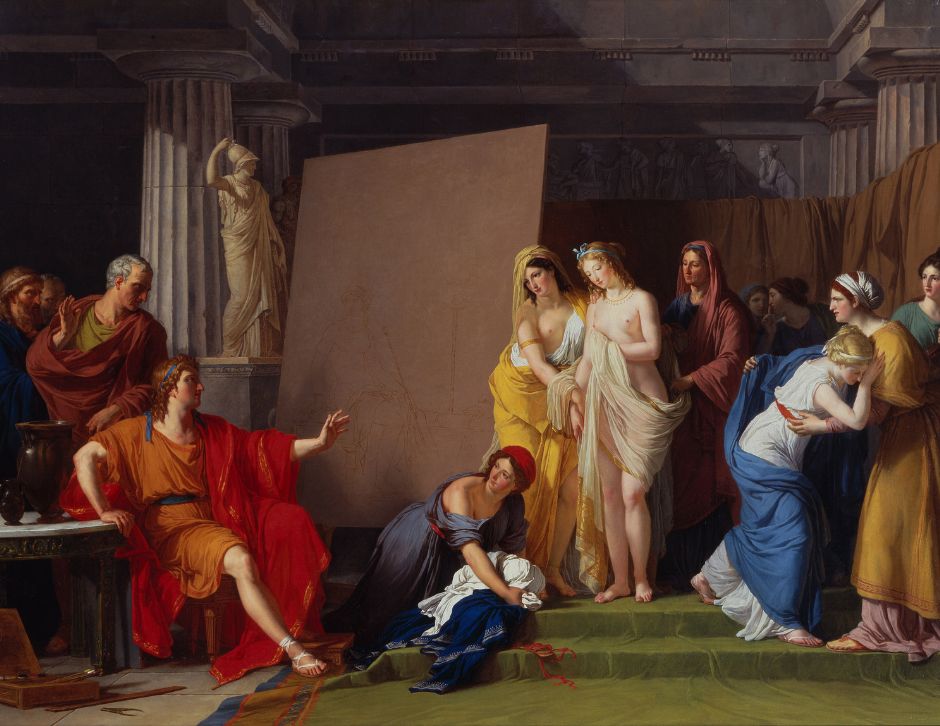
- Featured Image: Zeuxis Choosing His Models for the Image of Helen from Among the Girls of Croton by François-André Vincent; François-André Vincent, Public domain, via Wikimedia Commons.
- Jacques-Louis David: Empire to Exile by Philippe Bordes.
- The Paintings of Benjamin West by Helmut von Erffa.
- Jean-Auguste-Dominique Ingres by Karine H Grimme.
- Jean-Auguste-Dominique Ingres: 1780-1867 by Ullman.
- Master Paintings Evening Sale (2018), Sotheby’s.
- The Epic and the Intimate.
- Neo-Classicism (Style and Civilization) by Honour Hugh.
- Baroque & Rococo by Marco Bussagli and Mattia Reiche.
Related Reads.


