
Paintings in India have always been a form of patronage to the motherland and god. It was once believed that artists who had seen, felt, and experienced God’s miraculous power created such paintings in India. Truly, in several of the areas, the form of painting is still rooted in devotion to the deity, combined with music and customs. One such art form from Mewar, Rajasthan, is Phad painting, which has a captivating story to narrate and depict. The rulers of Mewar traced their descent from Rama’s son, a form of Vishnu. However, their patron deity was lord Shiva in the form of Eklingji. Krishna in the form of Shree Nathiji at Nathdwara also rose to become an important site in the late seventeenth century, as a priestly Brahmin family sought refuge from the Mughals. This is significant to know, as the music and paintings revolve around this, and several courts maintained painting workshops and court artists.
In this article, I will be talking about Phad paintings, an art form that arose from the Bhilwara region of Rajasthan.
A Brief Text on Phad Painting.
The Phad paintings are executed as a scroll, scattered with episodes and not painted in sequence. However, they narrate a story through several images. Because they are complex, with several images on large-scale cloth, they follow an organizing principle that arranges these images. This principle is none other than the monoscenic method, in which a single moment from a narrative is depicted within a pictorial frame. The continuous narration is a pre-modern narrative strategy, where the whole sequence is enclosed within a single frame. This was the basis of the Phad painting. Even the changing of location, like depicting a building, river, or tree setting, acts as a location marker in the painting, most often undergoing visible transformation.

Before we understand Phad art, let us understand the structure of the painting, where a brief sketch of the epic is given to make sense of the character and the place name. The story behind this painting is the life and ventures of Pabuji, a Rajput chieftain from the fourteenth century, whose elder brother, Buro, ruled Kolu. Pabu set up his own court with his loyal followers, who included three Rajputs and one raika. The brothers were in frequent conflict with the Khichi rulers of Jayal. In an alliance with the rulers of Jayal, they married their sister Perna to the ruler Jindrav Khichi, which proved of no use.
Stories Behind Phad Paintings.
There were several stories behind this canvas, including Pabuji traveling across the sea to Lanka or Pabuji promising to steal the special red-brown camels of Lanka to give them to his niece as a wedding gift. These tales were portrayed in the Phad painting. Pabuji also had dealings with a woman from whom he acquired a magical black mare. This mare was promised to Jindrav, but Pabuji was gifted this mare. Hence, Jindrav became infuriated, and in retaliation he punished this woman, Deval, by stealing her cattle. Pabuji becomes a hero here in rescuing Deval’s cattle, but because of this action, he abandons his own wedding ceremony. In this battle to save the cattle, Pabuji spares Jindrav’s life out of consideration for his sister. However, Jindrav returns with his allies, and in the second battle, Pabu, his brother Buro, and his followers are killed. It was much later that Pabu’s nephew and Buro’s son avenged their deaths in this battle.

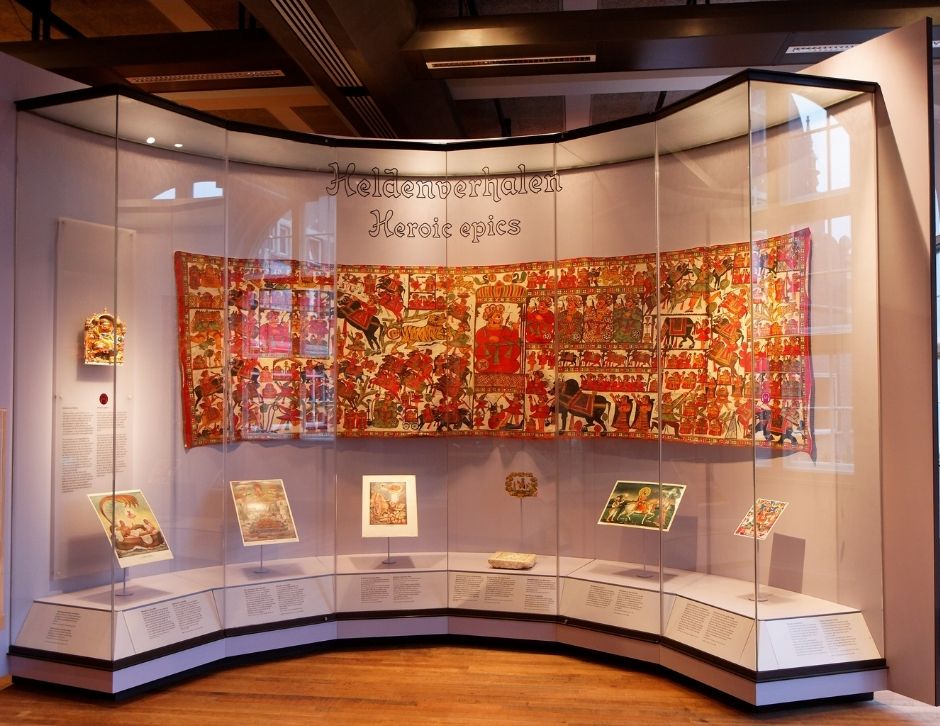
In the Phad painting, a central figure first catches our attention, as it is a comparatively large figure. Pabuji is the prominent central figure of this painting. He sits on a carpet with a cushion behind him. In one hand, he holds a flower as he prepares to sniff it, while his other hand holds a bow or dagger. Facing him, there is a row of figures depicting his four loyal followers in his court at the village of Kolu. We know that the place depicted in this composition is Kolu because the characters hold sway there, and thus the central court comes to signify Kolu, the place. On the left side of the composition, there are several victorious images of Pabuji battling a tiger and other various adventures. On the right side of the painting, the court sitting is depicted, and the arrival of the Black mare is shown with Pabuji.

The Phad painting is organized around a set of locales, so it is tempting to understand it in a cartographic sense. These paintings are not arranged according to geographical relations, as there is no map, direction, or proximity. However, there is a moral mapping, a cosmogram of sorts. This composition is divided into six parts: left, right, center, periphery, top, and bottom. The highest registers of this composition have the highest spiritual values. The topmost figures from the top left-hand corner consist of images of Hindu gods and goddesses, including Ganesh, Saraswati, and the sun god, followed by the reincarnations of Vishnu. Pabuji is believed to be an incarnation of Lord Laxman from the Ramayana. In Phad art too, Pabuji’s image starts from this highest register and drops down, as it is a moral realm.
Spiritual Values Behind the Phad Painting.
While the Phad is being painted, the eye of the central Pabuji is always left blank, and it is filled in the ritual act. Immediately after completing this painting, the painter, at an astrologically auspicious moment, in the presence of the Bhopa, pierces the icon’s eye with a golden needle so that the blank eye sees its devotees. In a well-used Phad, one finds several informal inscriptions in the part of the scroll recording impressive gifts to the Bhopa during his performances.
Once this painting is infused with life, this scroll must be treated with respect and dignity because it holds a living god. Ideally, the Bhopa should not open it for casual viewing but only for proper worship reasons or recitals. Only after years of use, when this Phad fades or tears, must the Bhopa offer a final worship and then immerse it into a water body such as a well or lake. The Pushkar Lake, which is sacred, is best for these immersions. However, there are several rituals before this.
The Phad also consists of some frontal figures—demigods or demons, including folk forms of Shiva or the blue-skinned demon that lies just below the central icon of Pabuji. These figures might depict the supernatural entities, and Pabuji even comes in conflict with a few Muslim characters. The Phad painting does not have room for frontal figures, including the gods, and Pabuji was not intended as God but as the hero of the narrative. The ritual is to bring life into the central image and make the god meet the eyes of devotees.
Who Are Bhopas?
Bhopas are a group of people who particularly recite the verses called “gav” while playing their ravanhattha to worship the Lord. As painting and music are connected in Indian religions, this singing includes instrumental music with a few dance steps too. This recital is a description of the relevant figures on the scroll. They further carry a lamp with them to focus on a small section of the painted field. This nightlong performance of Bhopa allows telling two to three episodes from the dozens that compose this entire epic.
The Artists of Phad Painting.
Phad paintings are painted by professional artists living in the Shahpura and Bhilwara towns, Raypur and Chittau of the Chittaurgarh district. Known as Joshis—a Brahmin surname—these painters belong to the Chhipa community, a caste that is also engaged in block printing on fabric. The clan of painters also paints decorative murals on the front walls of clients’ houses at the time of weddings; most popular motifs include horses and elephants with the female attendants bearing vessels of water. Furthermore, the Kalamkari prints on the cloth are also done by them to honor Mother Goddesses, seeking blessings for the clients of Bawari caste.
Final Words.
The Phad painting typically frontviews the society, culture, and life of Indian society from an enlarged lens. The hundreds of stories are kept alive, narrating the rich history and society treasures. One of the most significant points of Phad art is that it remained untouched by Sultanate and Mughal art and remained pure for centuries. The selfless devotion, moral sequence of characters, and respect towards the Rajput hero are a few words that describe the Phad painting. It further served as a relationship between several castes, including the Bhopa, who were considered the custodian of the words of the epic, and the Joshis, painting the narrative.
Resources.
- Featured Image: Phad painting scroll depicted at Wereldmuseum Amsterdam; Marc Chang Sing Pang, CC BY-SA 2.0, via Wikimedia Commons (Image was cropped for publishing reasons).
- Kingdom of the Sun: Indian Court and Village Art from the Princely State of Mewar by Joanna Gottfried Williams.
- Phad Paintings: A Window into cultural Heritage of Rajasthan.
- Files of Epic of Pabu from Internet Archive.
Related Reads.


