
Agnostics, loudmouths, poets, philosophers, eccentrics, assassins, thieves, and several other undesirables were part of the life of the Spaniards besides the royalty of the aristocrats. At this time, when the French Republicans punished these people and their enemies with the merciful device, the guillotine; Americans experimented with the noose, firing squad, electric chair, gas chamber, and lethal injections; the Spaniards of Goya’s day employed the fearful ceremony of garrotting. There were several other methods for the fearful punishments like tumbril, or shackling the condemned to an upright post with an iron collar, etc. Goya witnessed these merciless events and made ink drawings of the garotte at work. Hence, the subjects and the figures in the background of Goya’s paintings which include blind beggars, cripples, cutthroats, lunatics, swaggering majos, flirtatious majas, carnivals, inquisitors seeking the devil or massacres, were much of what Goya saw through his eyes. One such remarkable painting, which shows lunatics battling with each other in an intense realism and emotionally expressive, is Yard With Lunatics, which we are going to talk about in this article.
Yard With Lunatics | Fast Knowledge
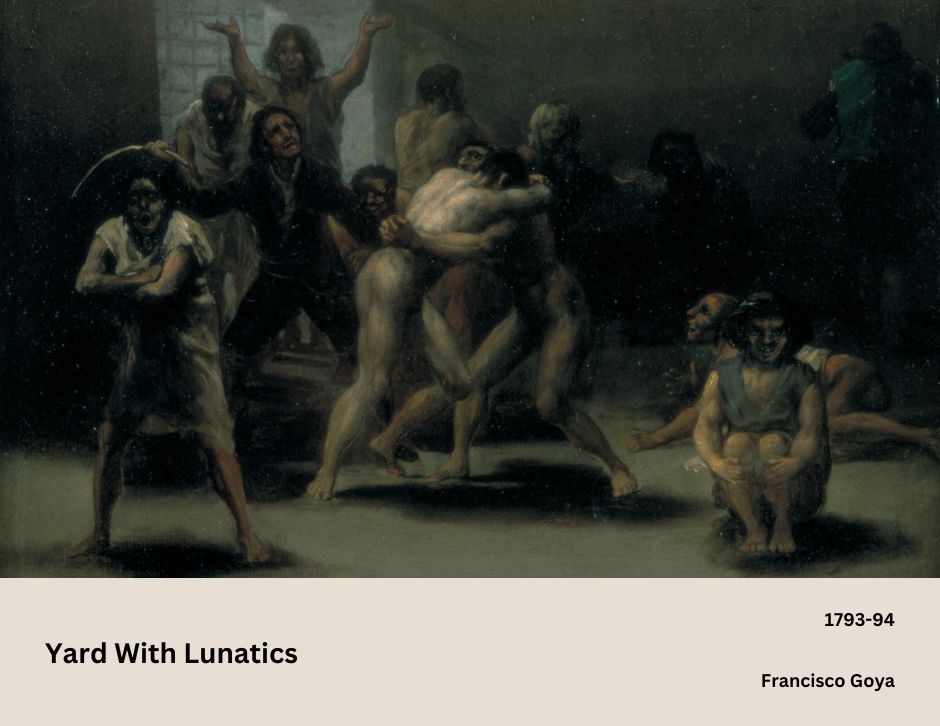
The Yard With Lunatics is one of the terrifying canvases from the late career of Francisco Goya. Being a ‘cabinet painting,’ it shows a group of madmen whipped by a warden, twisting and turning in the raking light of an asylum courtyard.
A Little Background of the Painting.
Yard With Lunatics or Courtyard With Lunatics is not only about what Goya saw around him but also an exploration of the inner world he witnessed during his second stroke of illness.
In the 1790s, Goya was particularly chafed at his ongoing obligation to produce cartoons for tapestries. Though at one point, he resisted doing the work, he had to continue doing so as the factor director raised a complaint with the King. Goya’s friend Francisco Bayeu had to intercede on which Goya wrote an apology letter, further continuing the work. In his book, Goya: Man Among Kings, Anthony Hull suggested that this forced work stifled the creative power and talent of the artist.
The first time Goya faced serious health concerns was in 1777 when he complained to his friend, Zapater, that he had “only just escaped alive.” This series of illnesses changed the artist’s life completely, but the far worse came in the second series of illnesses, which came in the 1790s. In 1792, he spent many months at his friend Sebastian Martinez in Cadiz to recover. Goya suffered from noises in his head, loss of balance, loss of vision, delirium, and paralysis, and he was close to death on a number of occasions. However, when he recovered, he was left permanently deaf, which he portrayed through an unprecedented alienation in his portrait sitters.
When he recovered from this illness, he painted a group of 11 small ‘cabinet’ paintings, which he called Diversiones Nacionales. Upon completion, he sent them to Bernardo de Iriate, a writer who was then vice-protector of the Royal Academy of San Fernando. Goya wrote a letter to Iriarte in which he said,
“In order to use my imagination, which has been painfully preoccupied with my illness and my misfortunes, and to offset the expenditure I have inevitably incurred, I set out to paint a group of small pictures, in which I have managed to include observations of subjects which would not normally fall within the scope of commissioned work, in which there is no room for the inventive powers and inspiration of the imagination.”
Eighteenth-Century Prison and Madhouses.
The late eighteenth century had the concept of prison as an isolator and not a reformatory institution. The concept was simple; bury them and lock down the lid; it was a prevalent idea before. However, as bad as prisons were, the madhouses were even worse because practically no one had any idea of how to deal with a mad. Madness was an absolute and it was laid beyond the reformer’s reach. Madhouses, therefore were simply holes in the social surface and small dumps into which the psychotic could be thrown without the smallest attempts to discover or treat the nature of their illness. To beat them up or do their exorcism was like the God’s work because madness wasn’t much explored in medical terms.
Goya visited the madhouse in Zaragoza to jot material for the paintings of lunatics and then he visited madhouse in Bordeaux which showed some of the most terrifying images of lunacy. When Goya saw the disorienting and frightening illness in Andalucia, he was particularly worried by the thought of what could happen to him if he did indeed go mad. Hence, he connected his deafness with madness, something he feared most.
Looking at the Subject of Yard With Lunatics.
Being the most powerful of the small paintings, Yard With Lunatics states the artist’s mind in the wake of his illness. Composed in 1793-94, this painting shows a madhouse scene with a dark and crude background. Essentially, this was a hospital in Zaragoza. An architectural fantasy, invented by Goya partly out of his memories of Piranesi’s prisons, the background of the composition has a huge, rudimentary, and oppressive architecture with a dominating bid shadow arch. The walls may be at least six feet thick, with an open roof that allows light to fall. However, the walls are so high that even the light causes dark shadows below. This light is not from the outer world but from a foggy cold light filter.

Thirteen figures are depicted on the canvas, each engaged in various activities that collectively provide a profound insight into madness. Two of the central figures are fighting with each other. Both of them are nude and their warden beats them and others with a sack. Moreover, this image shows confinement- harsh isolation without an appeal for reprieve. Probably, Goya connected it with his deep deafness where there are no strong visual metaphors.
The face of the warden has an inconsolable despair because of the miserable inmates. Even the expression of the fighting nude figure is painful as if he is fighting with his own fears. All of the figures are in fact imprisoned by each other as if they are miserable loonies of Zaragoza. They are fighting, struggling, snarling and glaring, crouched and crawling like animals on the gray stone. The two flanking figures, on the left and right, one hugging his arms around his chest and the other clutching his legs, seem to be disturbing to the viewer. On the extreme right, two blackened figures exist, but they are doomed in the darkness as if evil lurks upon them.
There is a trauma in this composition and it is mind-worrying about what else might be in store. What the artist faced in his illness was not a fantasy but a mystery, which he portrayed through this composition. For Goya, deafness was isolation and it acted as a silent prison of the self. This loathing of deafness is like a torturer and jailer who have always done their best to simulate it in creating punishment.
The canvas shows a passion in the tortured contortion of limbs in the dramatic play of light. As a view of a depraved world, humans are often treated no better than wild beasts. The darkness is the painting portrays that the world is dark and evil lurks in every shadow. Lastly, it also depicts the great cruelty of the mentally ill people during the 19th century (even when it was painted in the previous century).
Inspiring Romanticists.
The imagination of Goya in the cabinet paintings showed deep emotional content with acute realism. This became the basis of the 19th-century Romantic movement. The French artists, like Théodore Géricault and Eugène Delacroix, saw themselves as spiritual heir to the mysterious world, which was once witnessed by Goya. Hence, the Romantics set themselves against the principles of Neo-Classicism to prevail the content and expression in their canvases.
Yard With Lunatics was a direct and passionate response to life, a love for the wild and exotic, and a realistic depiction of the darker side of the world.
Final Words.
When I first saw Yard With Lunatics, it brought hell out of my life but seeing it again and again gave me multiple illusions. At first, the figures appeared despairing and in need, but other times, it felt as if they wanted me to believe in their madness to approach them. If I do so, the possibility is that I will be lurked by the evils that the darkness and shadows hide. I believe the canvas represents a transcendental journey of a person who is caught in the madness of the world. Spirituality always hovers over them like a guiding light, but it remains unattainable until they rise above their circumstances. To me, this composition is filled with frightening details of madness.
Resources.
- Featured Image: Yard With Lunatics by Francisco Goya; Francisco Goya, Public domain, via Wikimedia Commons.
- Francisco Goya: Life and Times by Evan S. Connell.
- Francisco Goya by Martha Richardson.
- Francisco Goya, 1746-1828 by Rose-Marie Hagen and Rainer Hagen.
- Goya (The Colour library of art) by Bernard L Myers.
- Goya by Robert Hughes.
Related Reads.


