
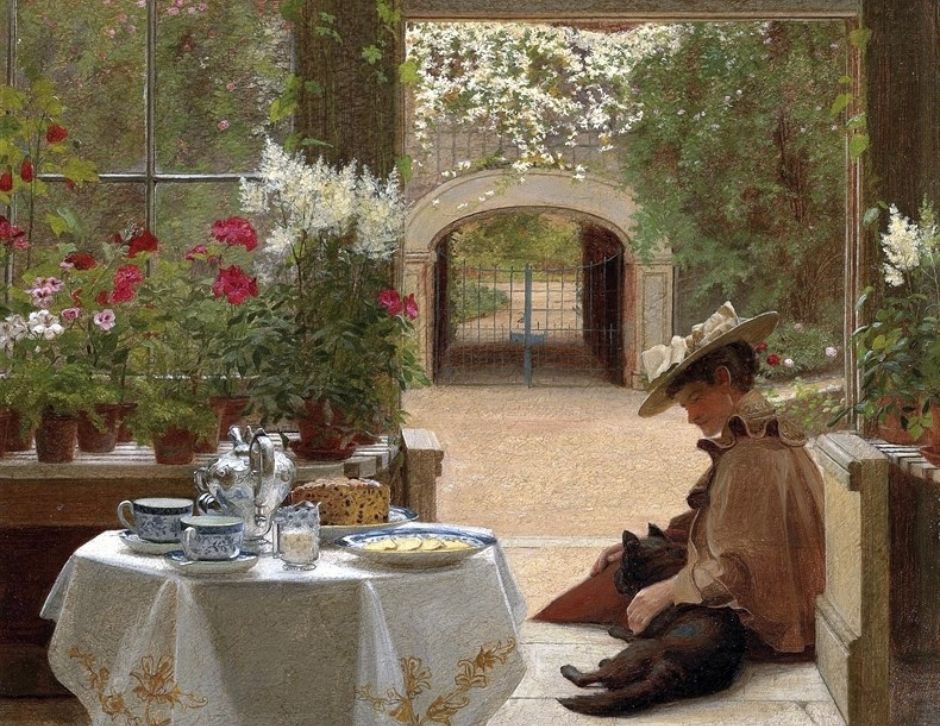
The nineteenth-century attitudes towards women majorly spoke of their natural emotional and responsive sensitivities towards their surroundings so that they play a central and defining role within the family and home. Female accomplishments focussed on providing nourishment and a comfortable environment for the benefit of her husband and children while responding to the emotional, physical, and material needs of the family. Hence, the pivotal role of women became increasingly restricted to the domestic and interior setting. As in the 18th century, painting and sketching became increasingly common social activities; it was undertaken in the company of other women like sisters, mothers, daughters, or a close personal friend. Hence, numerous women artists practiced art during childhood or adolescence, but they eventually gave up this art when they married and had children. Even those who received excellent and advanced education in the arts and attempted to paint on professional standing, such as Edma Pontillon (sister of Berthe Morisot), would practice this art only on the amateur level after marriage. For a few women painters who associated themselves with this artistic society and manifested as professional artists, their artworks revolved around their experience in domestic settings. For instance, one of the fine English artists, Mary Ellen Best, recorded the rooms she lived in and their occupants and activities, making her artworks more personal, intimate, and particularised in response to the individualistic situation of everyday life. As in the 19th century, these domestic settings further expanded to local landscapes, domestic animals, garden plants, and even flowers, which were easily accessible and popular choices of subjects. These domestic subject matters were also singularly appropriate for women artists besides being most readily available for study. Sooner, these formed into a genre painting, which included the rituals of women’s life from household work and courtships to motherhood and Family life, or cautionary tales warming against the transgression of these norms. One of the significant artists from this period who reiterated the “natural” sphere of femininity was Edith Hayllar. Belonging to the artist’s family, she, along with her sister, Jessica, in particular, produced and exhibited these serene and highly domesticity images in public, like The Royal Academy. Today, in this article, we will discuss the life and artworks of the inspiring Victorian artist Edith Hayllar.
Edith Hayllar | Fast Knowledge
Edith Hayllar was a Victorian artist who painted domestic setting genre art. One of her most famous artworks is A Summer Shower, which is often contrasted with The Nameless and Friends by Emily Mary Osborn.
About the Artist: Edith Hayllar.
Edith, Jessica, Kate, and Mary were the daughters of painter James Hayllar. Edith, though the most talented of the four, received thorough academic training along with her three sisters from James. Determined to concentrate her subject matter on the domestic genre scenes, she majorly portrayed scenes from her daily life in their home at Castle Priory, sports subjects or more precisely, the relaxation following the athletic exertion rather than the sporting event itself. She exhibited around twelve works at the Royal Academy from 1882 to 1897 and showed them at the Society of British Artists, the Institute of Oil Painters, and the Dudley Gallery; the latter was more popular among women artists. She even sold a painting to the Walker Art Gallery in Liverpool.

Despite receiving success as a professional artist, Edith completely abandoned painting after her marriage to Rev. Bruce MacKay in 1900. So deeply did she hide the evidence of her artistic abilities that even her own granddaughter didn’t realize her excellent craftsmanship until after her death.
| Artist | Edith Hayllar |
| Birth | 1860 |
| Death | 1948 |
| Nationality | British |
| Genre | Domestic Genre Art |
| Period | Victorian Era |
| Famous Painting | A Summer Shower |
About the Artist’s Life and Works.
The Hayllar sisters were born in the middle of the century and achieved great success in the 1880s due to their father’s devotion to painting and skilling them. Though Edith had eight more siblings, it was only her three sisters, who coordinated into art under her father’s name in the Academy as he passed away at the peak of his career. Christopher Wood suggests that James Hayllar’s sons were much less malleable than his daughters, which is why
“he moulded to the production of a streamlined and unified product oil scenes of middle-class idylls, usually domestic.”
Coming to the artist’s education, though the Royal Academy schools were open in the 1870s and early 1880s for women, Edith, with her sisters, was trained by their father, who preferred to tutor them at home. She mastered the art of domestic setting, but her career nearly ended after her mother’s death. In 1899, after the artist’s mother died and the tenancy of the Hayller’s home, Castle Priory, was relinquished, only Jessica continued painting as Kate turned to nursing, and Edith, like Mary, gave up her career after marriage.

It is important to understand that by the closing decades of the nineteenth century, women had a decisive and strong presence as artists in the art world, so there was a good chance to exhibit their paintings. Precisely, this was also the time when the public exhibition of women’s paintings dramatically increased, and there was a visual presence of these artists in illustrated magazines, art journals, and women’s papers. Hence, Edith and Jessica were among many artists who specialized in domestic pictures at this time.
Coming to the paintings composed by Edith, she generally portrayed women or children taking tea, conversing, playing music, studying, arranging flowers, and garden temple or boathouse. These scenes were intimate and significant to see the Victorian period through the eyes of female painters. Being a highly prolific artist, Edith produced more than two works, which were accepted for the Royal Academy exhibition. In her small and highly finished pictures, she persistently repeated the motifs, poses, figures, and accessories. Deborah Cherry explains in her book, Painting Women: Victorian Women Artists,
“It was in this process of continual reiteration and variation that a regime of representation was constructed to define the social spaces and rituals of femininity within the sexually differentiated terrain of the bourgeois residence.”

Edith’s works have been crucial in witnessing the process of domestic femininity that was maintained as a predominant form against the pressure of the economic and social transformation with the challenges of feminism. One of the most famous artworks, Feeding the Swans from 1889 sets out the formation of femininity in middle-class families where the women were always positioned as wives, mothers, sisters, aunts, or different positions of kinship. Edith Hayllar painted the work on the setting of the riverside steps of a garden pavilion, which has a graduated stage of femininity marked from youth to old age through dress and activity. The painting arranges a progression of life stages from girlhood to courtship, motherhood, and even widowhood.

Another painting from the artist’s gallery is A Summer Shower from 1883 which was exhibited at the Royal Academy in the same year. The artwork conveys an abiding satisfaction, spiritual and visual, and tranquil atmosphere to the viewer through its exceptional and realistic colors. It portrays a scene of the interrupted tennis party due to the sudden shower. Depicting the players waiting for the rain to stop, the artist combines the indoors and outdoors effectively with a view through an arched entrance to the wood-paneled refreshment room. The composition is an engaging reminder of the tennis game, which was becoming popular in England in the eighties. The foreground seems casual and loose in an informal setting with light and fresh colors. Christopher Wood calls it,
“One of the most charming genre scenes of the nineteenth century… wonderfully redolent of an English summer afternoon, with sets of inconsequential tennis, showers, lemonade, and tea doubtless to follow.”

There are other paintings by Edith Hayllar like Housemaid Polishing a Chair, which portrays the 1880s women servants in severe uniforms as a sign of an efficient household. The artwork shows a maid-woman engaged in domestic work with a tiring expression while she cleans the chair. One of the significant points to notice here is the distance that the artist portrays in her composition to showcase boundaries between the distinct spaces of the house.

Another artwork, Blackberry Tart from 1885 shows a low-ceiling kitchen with shelves of sparkling pots and a sturdy table where the cook rolls pastry. The paintings of Edith romanticize the domestic setting with a carefree intention.

Final Words.
The late nineteenth century witnessed femininity with highly elaborated specific dress codes and deportment, which the artist portrayed in her artworks. Whether it is a tea party or a formal ceremony, the artist’s painting shows a closeness to the contained world of the Victorian era. What I felt in her paintings is what women of the Victorian era actually felt through their surroundings. There is a carefree attitude of the domestic setting as if nothing is perfect but there is a greater connectivity to the subject of the artworks. The only complaint I had with Edith Hayllar was that she left the artistic world despite her excellence in the ability to capture the images of her surroundings.
Resources.
- Featured Image: Five O’clock Tea by Edith Hayllar; Edith Hayllar (1860 – 1948), Public domain, via Wikimedia Commons.
- Painting Women: Victorian Women Artists by Deborah Cherry.
- Victorian Painting by Christopher Wood.
- Victorian Women Artists by Pamela Gerrish Nunn.
- Dictionary of Women Artists by Delia Gaze.
- Women Artists: 1550-1950 by Ann Sutherland and Linda Nochlin Harris.
Related Reads.


