
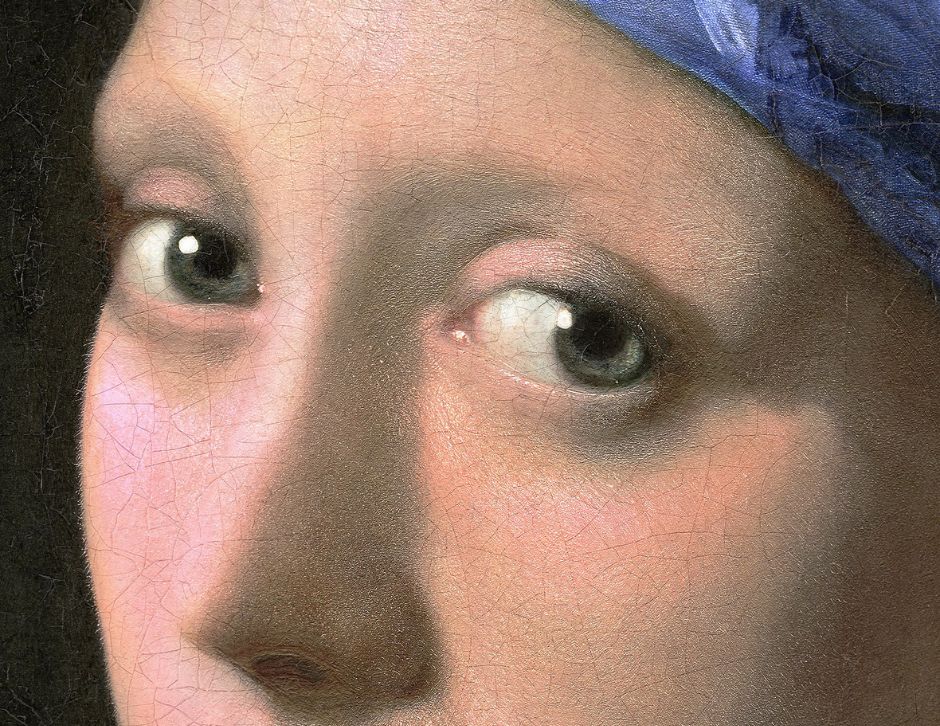
The evolving landscape of art presents us with the vividness of the past and the possibilities of the future, sometimes economical but fruitful (mostly). There is no doubt that since World War II, this field has changed immensely and sometimes shook the population with the gravity of the stolen Mona Lisa to the discovery of artists like Artemisia Gentileschi. However, with the growing popularity of every market, there are criminal brains who accept no stillness to exploit it in their favor. Similarly, there are criminals of art, varying from art thieves to forgers to culprits making a fake for increased value. These culprits are entertained widely, and a few of them even make their way into success, ruining the bridges of the art market along the way. To outpass their intelligence, history, science, and law departments play a significant role- researching old information, developing new technologies, and uncovering crime. In this article, I am going to explain one of the master techniques these agencies use to understand the authenticity of objects that connect us to our history and hold immense value in society- FING-ART-PRINT.
The Art of Forgery and Art Heist.
When I searched the internet to understand the topics of Art Heist, Art Forgery, and Fake Art, the definitions I read were not even closer to what I collected from the descriptions provided by Noah Charney, Jehane Ragai, and Thierry Lenain. But before we refer to their exact meanings, you should know that all three differ widely, and while art heist can contribute to organized crimes and terrorism (yes, terrorism), art forgery and art fakes are merely profitable crimes, probably the only crimes that pay, but disrupts art markets, fooling even auction houses in the process.
An art Heist is a well-planned crime if executed in its completeness, often involving the internal authorities or security lag to help a criminal perform the theft and sell the precious art forms to an unsuspected buyer internationally. Art forgery, on the other hand, is an entirely new work of art drawn from scratch to imitate something valuable (such as a Johannes Vermeer’s frame or a Leonardo’s). Lastly, an art fake is a fraudulent modification to an existing artwork to increase its value. To understand the difference between Art Forgery and Art Faker better, Hans van Meegeren, the famous 20th-century art forger, made forgeries of Vermeer and made only the scenes that Historians may consider relevant. Further, an 18th-century faker, William Sykes, bought an authentic 15th-century Flemish painting with no possessor or artist background, and added an inscription to its back suggesting that it was made by Jan van Eyck as a gift for King Henry V, and portrayed Thomas Becket – everything that was false.


However, to identify and track a historically relevant item (for various reasons including transport for loans or sales), scientists, as well as art connoisseurs, take into account the slightest possibility that it can be verified or found, and among the set of techniques they employ, FING-ART-PRINT learns the micrometers of surface details and helps the responsible authorities store this data for later evaluation, acting as a unique fingerprint of the artwork.
An Informative Account of FING-ART-PRINT.
The regulatory action on objects of cultural heritage and importance has been taking place for the past few centuries, ranging from raking light procedure to reveal crucial details to Morellian analysis; FING-ART-PRINT (Fingerprinting Art and Cultural Heritage – In Situ 3D Non-Contact Microscale Documentation and Identification of Paintings and Polychrome Objects) differs with a rather too concise and irrefutable claim on the identity of any object with historical context. Developed as a project in Europe in 2008, it needs a user-friendly apparatus for taking an art fingerprint, and with the help of museums and cultural heritage sites, this detail is continuously optimized. This apparatus includes a white light confocal profilometer for measuring surface roughness and a multi-spectral camera for obtaining spectral information. Further, these details are measured without coming in contact with the surface, as opposed to the previous profilometer that used a stylus to learn topography and presented risks of rupturing the surface of the objects, especially paintings of medieval times.


The details captured by FING-ART-PRINT are the topography and reflectance of spectra, i.e., roughness and color in simple words. The specificity of this technology and the way it competes significantly with a criminal brain or any damage during the loans or transport of an object is by measuring details in the closest variable, sometimes selecting only a few micrometers of surface area for documentation. These details, therefore, cannot be copied by the human eye and hand. To toughen the regulation, the details are kept known to only the owner, the institute authorized to take the measurement, and law enforcement. As purposefully aimed by the project workers, the details should be attached to the passport of the object, making it difficult for the thefts or forgery to exit the national borders.
To understand this equipment in a sophisticated manner, I will be now taking you through the steps it follows each time for a detection.
The Procedure of Getting an Art Fingerprint.
As the paper of FING-ART-PRINT by William Wei, Josef Frohn, Sophia Sotiropolou, and Mark Weber states, the fingerprint of any object is a digital file (ASCII file for roughness and .jpg for topographic maps) that stores the following information:
1. Roughness Fingerprint: 3D roughness or texture information on a sub-micron scale.
2. Spectral Fingerprint: High-resolution spectral information on the spatial scale of microns.
3. High-resolution 3D accurate color digital image of the selected area.
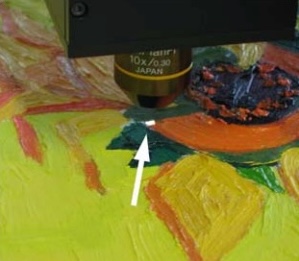


To obtain these details, this technique employs a NanoFocus µSurf ® confocal white light profilometer (alongside a digital imaging component) and measures depth by an upward-downward movement of the microscopic lens. During this, the device analyses a selected area, and scanning through all the depth levels produces a set of height/depth contours. These contours are combined and can be presented as false color topographic maps of the surface. At the same time, individual line scans, or the above-mentioned roughness parameters, can also be calculated from the raw contour data and displayed. Ensuring the safety of the object and accuracy, the process is semi-automatic (keeping the lens at a safe distance and keeping the movement automatic) and uses a convenient software developed by project partner University of Southampton, UK.
Now, the technology in itself can be mounted in two positions- horizontal and vertical. The former position, i.e., horizontal, uses a standard tabletop configuration where an object of relatively small size is mounted, either two-dimensional or three-dimensional, and the readings are taken by the profilometer (aligned perpendicular to the table). The limitation of the tabletop variant or the horizontal configuration is that it can only work when an object can fit on the table and not for a larger object whose surface cannot fit or be read without issues in relocating or moving. Next, the vertical configuration of FING-ART-PRINT gives more flexibility to the profilometer as the system is installed on a robotic hand, and an object, installed vertically, of any size can be detailed. If the reader feels a need to scrutinize a larger surface area of the object, the system can take multiple readings that can be stitched together by the software to present a single topographic map and standard roughness data.
I am taking an instance to explain the complete process in even easier terms. Suppose a painting is restored, and as the surface has changed compared to its original state, it needs to reappear for FING-ART-PRINT. Note that the process has to be repeated timely with the change of the surface with time (due to age or chemical reasons) or restoration, as I just mentioned.
Following the procedure, the painting will be scrutinized by a profilometer and a digital imaging system to present the topographic map and roughness data. This process can take about 15 minutes (given the area that needs to be read) and is controlled by software on the computer that requires no technical expertise. The webcam in the FING-ART-PRINT will further note the location of the scanned region of this painting. The details are now shared with the law enforcement database, verified art historians, museum, and owner. In case the painting has to be reverified, the software, with the help of data stored by the webcam, will identify the location (where it was scanned before) and scan it again to compare it with the existing data and confirm if it resembles the new one.
It should be noted that this system can work on a variety of surfaces, including metals, plastics, printed paper, paintings, wood, and ceramics. The system is so precise that it can differentiate metals from the same mold and papers from the same book. At the same time, it does not work on textiles, unprinted paper, and mechanically unstable objects such as heavily corroded metal objects.
Final Words.
FING-ART-PRINT is undoubtedly one of the most advanced systems to enhance the database of valuable objects, and the standard roughness as well as false color topographic map it generates is of great value to help international networks control the illegal trafficking, sale, and purchase of these objects. The studies further confirm that this unique fingerprint has long-term stability. However, among these one of the demerits that it follows is the time it takes to learn a single object, which can be between 10 to 15 minutes (including the time the webcam takes to locate the fingerprint location). The longer interval of time limits it to scan a vast number of objects, essentially in a museum. Additionally, the system presents difficulty in being transported, as it requires two people to carry it from one place to another, making it not portable enough for the purpose. The study can still take place if the object is moved to the premises possessing this system and as there is already a profilometer of a significantly compact form by NanoFocus, it does present the future much better. There is also an enhancement in technology, enabling the lens to focus even more, though not needed. Lastly, art fingerprint is an exceptional project and a step to protect the cultural heritage that the government should standardize alongside a passport for objects of historical context but we must also know that science is only a way to support claims, and a connoisseur’s knowledge is always required to trust them and fully verify.
Resources.
- Experience with a New Non-Contact Fingerprinting Method for the Identification and Protection of Objects of Cultural Heritage Against Theft and Illegal Trafficking by William Wei.
- A Semi-automatic System for the Non-contact ‘Fingerprinting’ of Objects of Art and Cultural Heritage by William Wei.
- Art Forgery: The History of a Modern Obsession by Thierry Lenain.
- Art Crime: Terrorists, Tomb Raiders, Forgers and Thieves by Noah Charney.
- Scientist and The Forger: Insights Into the Scientific Detection of Forgery in Paintings by Jehane Ragai.
- Featured Image: Girl With a Pearl Earring by Johannes Vermeer, Koorosh Orooj, CC BY-SA 4.0, via Wikimedia Commons
Related Reads.


